The Arrest of Arsène Lupin
What a strange trip! (And yet, it had begun so well!) Personally, I had never taken a trip that promised such an auspicious start.
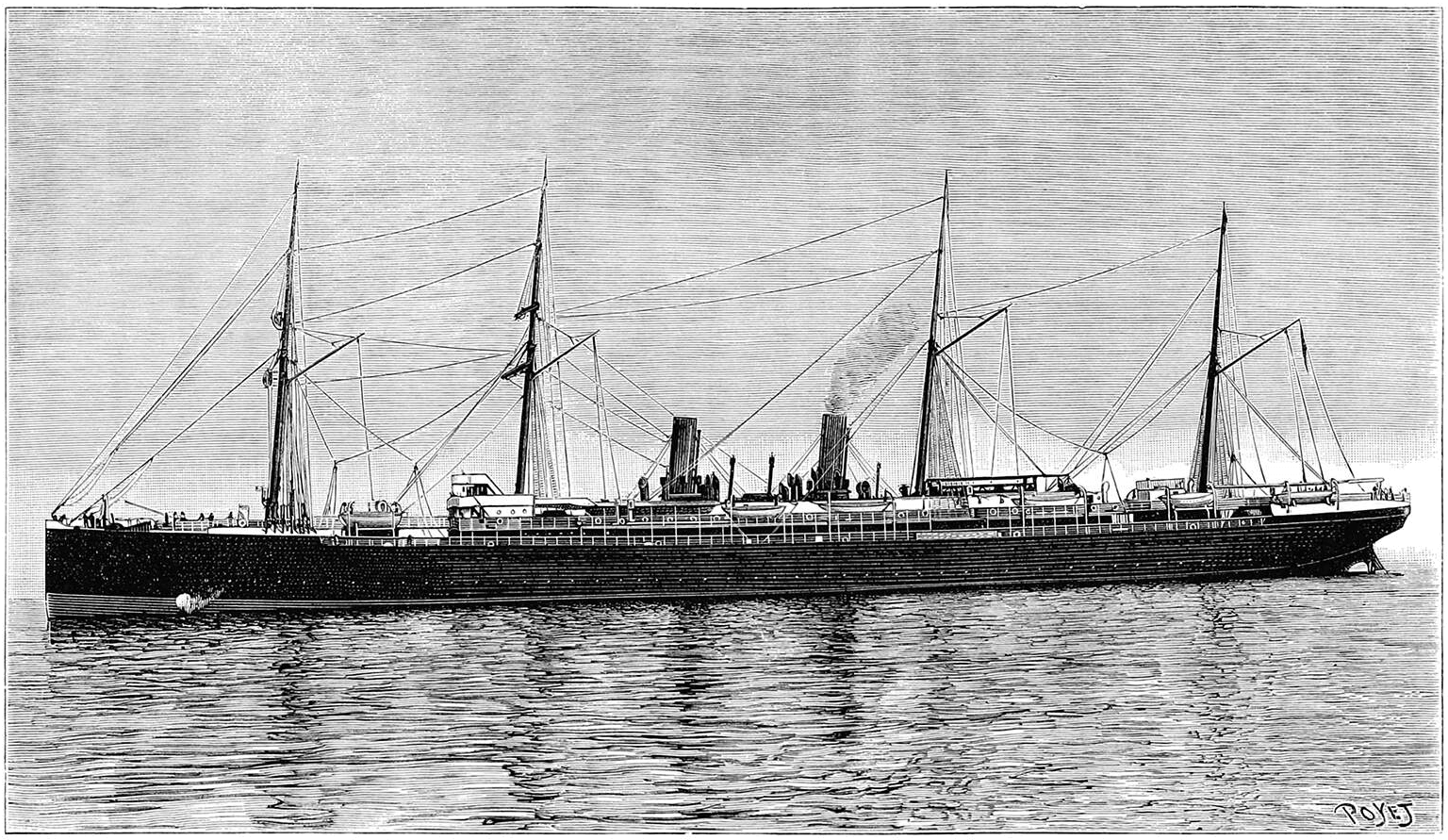
The Providence was a premiere transatlantic steamship—fast, comfortable, and captained by the friendliest of men. Only the cream of the crop of society was found there. Acquaintances formed; amusements sprang up. We had the charming feeling of being completely isolated from the world, confined to only our own company (as if on a deserted island), and thus forced to become closer with one another.
And become closer we did indeed...
Have you ever thought of what unique and unexpected things happen within such a group of people? People who, just the night before, did not know each other at all, and yet who, for the next several days, caught between the infinite sky and the vast sea, would live the most intimate of lives, together defy the raging tantrums of the ocean, the terrifying assault of the waves, the malicious spite of the squalls, and the deceptive calm of the sleeping waters?
Life itself, fundamentally, is a sort of abridged journey tragically cut short, with its obstacles and its triumphs, its repetition and its variety; and this, perhaps, explains why we enjoy this short trip—whose end is foreseen even from the moment it starts—with feverish excitement and an especially exquisite delight.
Now, a number of years after steamship travel first started, something singular happened that dramatically added to the excitement of the transoceanic journey. The small floating island still depended on the world from which it thought itself cut off. One link remained, which only unraveled little by little as we approached the middle of the ocean, and likewise, little by little was renewed as we approached the other side of the ocean.
The wireless telegraph! Siren song from another world, from which we received news in the most mysterious way! The mind could no longer call on wires for the invisible message to glide across. No, the mystery of the wireless telegraph was even more unfathomable, not to mention more poetic, and to explain this new marvel, we were forced to invoke the wings of the wind.
And so, for the first few hours of our trip, we felt ourselves followed, escorted, preceded even by that far-off voice, which, from time to time, whispered some words from the vanishing coast to one of us. Two friends spoke to me. Ten, twenty more addressed their joyful or melancholy farewells across space to us all.
Now, on the second day, five hundred miles off the French coast, on a stormy afternoon, the wireless telegraph sent us a dispatch with the following message:
"ARSÈNE LUPIN ON YOUR SHIP—FIRST CLASS—BLOND—WOUNDED RIGHT FOREARM—TRAVELS ALONE—UNDER NAME OF R..."
At that exact moment, a violent thunderclap broke out in the dark sky. The electric waves were suddenly cut off. The rest of the dispatch never reached us. We knew nothing of the name under which Arsène Lupin was hiding himself, except for the last initial.
If it had been any other piece of news, I don't have the slightest doubt that the secret would have been jealously guarded by the telegraph operators, as well as by the ship's officers. But it was one of those things that seems to break through even the strictest secrecy. That very day, without anyone being able to say how the news spread, we all knew that the famous Arsène Lupin was hiding among us.
Arsène Lupin among us! The elusive thief whose exploits the newspapers had been recounting for months! The mysterious figure with whom old Mr. Ganimard, our best police officer, had started a fierce contest, whose twists and turns unfolded in such flamboyant fashion! Arsène Lupin, the whimsical gentleman who operated solely in fine country houses and salons, and who, one night, after entering the manor of Baron Schormann, had left empty-handed, leaving behind his calling card, embellished with this catchphrase: "Arsène Lupin, gentleman thief, will return when the furniture is authentic." Arsène Lupin, the man with a thousand disguises: turn by turn a chauffeur, a tenor singer, a gambler, the son of a well-to-do family, a young man, an old man, a traveling salesman from Marseilles, a Russian doctor, and even a Spanish toreador!
Now this was the situation we found ourselves in: Arsène Lupin was freely roaming the relatively constrained environment of this transatlantic steamship, nay, in the tiny corner restricted to first class passengers, where one might come across him at any moment, in that dining room, this salon, that smoking room..! Arsène Lupin, perhaps he was this gentleman...or that one...my dining partner...or my cabin-mate...
"And this will last an entire five more days!" cried Miss Nelly Underdown the next day. "How unbearable! I do so hope someone arrests him."
And addressing me, she said:
"You, sir, Mr. Andrézy, you already have a close rapport with the captain—have you found anything out?"
Ah, how I would have liked to know something with which to please Miss Nelly! She was one of those magnificent creatures who immediately occupy the spotlight wherever they go. Their beauty dazzles just as much as their wealth. They have a court, a ring of fans, a group of enthusiasts that follow in their wakes.
Raised in Paris by her French mother, she was now reuniting with her father, the fabulously rich Mr. Underdown of Chicago. One of her friends, Lady Jerland, was accompanying her.
From the moment I saw her, I had engaged in some light flirtation. However, given the rapidly-developing intimacy of our trip, her charms suddenly flustered me, and I felt myself too stirred with emotion for a mere flirtation when her shining dark eyes met mine. For her part, she received my attentions with a certain favor. She deigned to laugh at my jokes and to take interest in my stories. A vague sympathy seemed to respond in her to the eagerness I showed when I pursued her.
Only one rival could possibly have given me cause for concern: a rather handsome young man, elegant, reserved, whose taciturn humor she sometimes seemed to prefer to my own, being more "un-Parisian".
As it so happened, he was part of the group of admirers surrounding Miss Nelly when she questioned me. We were comfortably seated on the deck. The storm of the day before had cleared the sky. It was a beautiful day.
"I do not know anything in particular, miss," I responded to her, "but why can we not conduct our own investigation, just as well as old Ganimard, the arch-nemesis of Arsène Lupin, could?"
"Oh my, you're getting rather ahead of yourself!"
"How so? Is the problem that complicated?"
"Very."
"That is because you are forgetting what things we have at our disposal to resolve it."
"What things?"
"One: Lupin is going by the name of Mr. R..."
"That's rather vague."
"Two: he is traveling alone."
"If that detail is enough for you—!"
"Three: he is blond."
"So?"
"And so, we have only to consult the list of passengers and proceed by process of elimination."
I just so happened to have that very list in my pocket, so I took it out and read through it.
"First of all, I note that there are only thirteen people whose last initial should attract our attention."
"Only thirteen?"
"In first class, yes. Now, of those thirteen Mr. R's, as you can see, nine are accompanied by women, children, or servants. Thus, four lone travelers remain: the marquis of Raverdan..."
"The embassy secretary," Miss Nelly interrupted. "I know him."
"Major Rawson..."
"My uncle," someone else said.
"Mr. Rivolta..."
"Present!" one of us cried out, an Italian whose face disappeared under a beard that was the most beautiful shade of black.
Miss Nelly burst out laughing.
"He is not exactly blond."
"And so," I continued, "we must conclude that the culprit is the last one on the list. Q.E.D."
"And that is?"
"That is to say, Mr. Rozaine. Does anyone know Mr. Rozaine?"
Everyone fell silent. But Miss Nelly, calling out to the taciturn young man whose constant presence by her side bothered me, said:
"Come now, Mr. Rozaine, why didn't you answer?"
We turned our eyes towards him. He was blond.
I swear, I felt a frisson of shock run through me. And the resulting awkward silence that weighed on all of us afterwards showed that the others present also suffered that same suffocating feeling of shock. And yet, it seemed absurd as well, since nothing whatsoever in this gentleman's manner lent itself to suspicion.
"Why didn't I answer?" he said, "why, because, taking into account my name, the fact that I am traveling alone, and the color of my hair, I have already done a similar investigation, and arrived at the same result. I am therefore of the opinion that I should be arrested."
He had a strange demeanor, as he said those words. His lips, already as thin as two unbending lines, paled and became thinner still. His eyes were bloodshot.
Of course, he was joking. However, his appearance and attitude considerably impressed us. Naively, Miss Nelly asked:
"But you don't have the wound?"
"Indeed," he said, "I have no wound."
Jerkily, he lifted his sleeve cuff and uncovered his arm. But suddenly, a thought struck me. My gaze met Miss Nelly's: he had shown his left arm.
And by faith, I was just about to point that out, when another incident grabbed our attention. Lady Jerland, Miss Nelly's friend, was running towards us.
She was overwhelmed and distraught. We gathered around her, and it was only with great difficulty that she managed to stammer:
"My jewels, my pearls...! They took everything...!"
Actually, as we learned later on, they didn't take everything—instead, something much more curious happened: they had chosen from among them!
From the diamond star, the uncut ruby pendant, and the broken necklaces and bracelets, what had they taken? The largest jewels? Not at all! Rather, they had taken the finest, the most precious jewels, those, one could say, which were the most valuable while simultaneously taking up the least amount of space. The settings lay there, on the table. I saw them, we all saw them, stripped of their jewels like flowers whose beautiful, sparkling, bright-colored petals had been torn off.
And to pull off this heist, they would have had to, while Lady Jerland was having tea—in broad daylight, mind you!—and in a busy corridor, no less!—break down the cabin door, find the small bag purposely hidden at the bottom of a box of hats, open it, and choose the finest jewels from among them!
There was only one cry among us. There was only one opinion shared among all the passengers, once the theft was known: it was Arsène Lupin! And truth be told, it was indeed his M.O.: complicated, mysterious, inconceivable... and yet logical as well, for if it would have been difficult to conceal the cumbersome mass that the whole ensemble of jewels would have formed, how much less difficult would it have been with the clutter of little things, each independent of one another, of sapphires, emeralds, and pearls!
Now, at dinner, this is what happened: to the right and to the left of Rozaine, those two seats remained empty. And in the evening, we knew that he had been summoned by the captain.
His arrest, which no one questioned, led to a considerable amount of relief. We could finally rest easy. And indeed, we amused ourselves that evening. We danced. Miss Nelly, above all, exuded a dizzying gaiety that proved to me that, although Rozaine's attentions had pleased her at first, she hardly remembered them now. Her charms completely overcame me. Around midnight, under the serene light of the moon, I expressed my devotion to her with a level of ardor that did not seem to displease her.
But the very next day, to the general stupefaction of everyone on board, we learned that, the charges brought against him being insufficient, Rozaine was free.
The son of a prominent shopkeeper in Bordeaux, he had produced papers that were perfectly in order. What's more, his arms did not show the slightest trace of a wound.
"Ha! Papers! Birth certificates!" cried Rozaine's enemies. "Arsène Lupin will show you as many of those as you like! As for the wound, that's because he never got one...or that he erased all traces of one!"
Others objected that at the time of the theft, Rozaine—it was confirmed—was walking on the deck. To which was retorted:
"Does a man of Arsène Lupin's caliber need to be present at the site of his own crime?"
And then, ignoring any extraneous factors, there was one point on which even the most skeptical could not expound: Who, except for Rozaine, was traveling alone, blond, and had a last name starting with R? Who was the telegram indicating, if not Rozaine?
And so, when Rozaine, a few minutes before lunch, boldly headed towards our group, Miss Nelly and Lady Jerland rose up and quickly distanced themselves from him.
It was well and truly out of fear.
One hour later, a handwritten note was passed from hand to hand among the officers on board, the sailors, the travelers from all classes: "Mr. Louis Rozaine promises a sum of ten thousand francs to whoever unmasks Arsène Lupin or finds the possessor of the stolen jewels."
"And if no one comes to my aid against this scoundrel," Rozaine announced to the captain, "then I'll do it myself."
Rozaine versus Arsène Lupin, or rather, according to the word going around, Arsène Lupin versus Arsène Lupin himself: the fight would certainly be interesting!
It lasted two days. We saw Rozaine wandering from right to left, mingling with the staff, questioning, rummaging. His shadow prowled about at night.
For his part, the captain displayed a most incredible amount of energy. The Providence was searched from top to bottom, in every nook and cranny. They searched in all the cabins, without exception, under the very just pretext that the objects could be hidden anywhere—except in the cabin of the one responsible.
"We will end up discovering something, won't we?" Miss Nelly asked me. "However much a magician he might be, even he can't make diamonds and pearls turn invisible."
"But of course," I responded to her, "or else they would have to search the linings of our hats, of our jackets, and everything we are carrying."
And showing her my Kodak camera, a four-by-five with which I never tired of taking photos of her in all sorts of situations, I said:
"In a device no larger than this, there would be room enough for all the precious jewels of Lady Jerland, don't you think? They could pretend to be taking pictures, and that's all there would be to it."
"But I have heard tell that every thief leaves some clue behind."
"There is one exception: Arsène Lupin."
"Why?"
"Why? Because he does not only think through the theft he is committing, but also through all potential circumstances that could reveal him."
"You were more confident before."
"But now I have seen him at his work."
"And so, in your opinion?"
"In my opinion, they're wasting time."
And in fact, the investigations did not turn up any results, or at least, those they turned up did not correspond to the amount of effort: the captain's watch was stolen from him.
Furious, he redoubled his efforts and kept an even closer watch on Rozaine, with whom he had had several interviews. The next day, charmingly ironically, the watch was found among the first officer's spare uniforms.
All of this was quite astounding, and showed well the humorous manner of Arsène Lupin, a thief, yes, but an artist as well. His work combined business and pleasure, certainly, but also amusement. He gave the impression of a playwright greatly entertained by his own performances, and who, backstage, laughs heartily at the witticisms and situations of his own design.
He was certainly a master of his craft, and when I observed Rozaine, gloomy and stubborn, and thought of the double role that this curious character doubtless played, I could not speak of him without a certain level of admiration.
Then, on the penultimate night of our trip, the officer of the deck heard groans coming from the darkest part of the deck. He drew closer. A man was lying there, head wrapped in a very thick gray scarf, wrists tied with thin rope.
He was freed from his bonds. He was assisted to his feet, and he was taken care of.
That man? It was Rozaine.
It was Rozaine, assailed during one of his expeditions, knocked down, and robbed blind. A calling card pinned to his clothes bore the following words: "Arsène Lupin gratefully accepts Mr. Rozaine's ten thousand francs."
Actually, the stolen wallet contained twenty thousand francs.
Of course, the poor fellow was accused of having set up this attack against himself. Yet, apart from the fact that it would have been impossible to tie himself up like that, it was clearly established that the handwriting on the card was completely different from Rozaine's, and on the contrary unmistakably resembled that of Arsène Lupin, as reproduced in an old newspaper found on board.
So then, Rozaine was no longer Arsène Lupin. Rozaine was Rozaine, son of a shopkeeper in Bordeaux! Thus the presence of Arsène Lupin reasserted itself among us, and in what a formidable way!
Now this was sheer terror. No one dared stay in their cabins by themselves anymore, let alone venture alone into places that were too remote. Prudently, everyone grouped up with people who were sure of each other. Yet still, an instinctive mistrust divided even those who were most intimate. That was because the menace no longer came from someone who was isolated, observed, and therefore less dangerous. Arsène Lupin, now, was...was everyone. Our overactive imaginations attributed to him a miraculous, omnipotence. We supposed him capable of taking on the most unexpected disguises, of being in turn the respectable Major Rawson, or the noble marquis of Raverdan, or even—because we no longer stopped at the accused initial—even this or that person known to all, with a wife, children, servants.
The first wireless dispatches from America brought no news. Or at least the captain never shared a word of them, and such silence on his part did not reassure us at all.
And so, the last day seemed like it would never end. We lived in anxious expectation of a calamity. This time, it would no longer be a theft, or a simple assault—it would be true crime, murder. We did not accept that Arsène Lupin would be satisfied with those two insignificant thefts. The absolute master of the ship, having reduced the authorities to impotence, he had only to want something, anything, and it would have been permitted him; he was the manager of all our assets and indeed of our very lives.
These were delectable hours for me, I admit, because they gained me the confidence of Miss Nelly. Rather intimidated by recent events, and of an already anxious nature, she spontaneously sought protection by my side, a security which I was only too happy to provide.
Deep down inside me, I blessed Arsène Lupin. Was it not him who had brought us closer together? Was it not thanks to him that I was able to surrender myself to the most beautiful dreams? Dreams of love and less fanciful ones as well, why not share them? The Andrézys are of good stock from Poitiers, but their reputation is a bit tarnished, and it did not seem ungentlemanly to me to think of restoring the lost sheen of my family name.
And these dreams, I sensed, did not offend Nelly in the slightest. Her smiling eyes encouraged me to make them come true. The gentleness of her voice told me to have hope.
And up until the last moment, leaning on the rails, we remained side by side, close to each other, while the American coastline drifted towards us.
The searches were suspended. We all held our breath in anticipation. From the first-class to the steerage where the emigrants swarmed around, we waited for the supreme moment when the unsolvable enigma would finally be resolved. Who was Arsène Lupin? Under which name, under what mask was the famous Arsène Lupin hiding?
And that supreme moment finally arrived. Even if I live a hundred years, I will never forget the most infinitesimal detail of what happened next.
"Goodness, you've gone quite pale, Miss Nelly," I said to my companion, who was leaning on my arm, feeling quite unsteady.
"And you!" she replied, "Ah! You've changed so much as well!"
"Just think on it! This is such a thrilling moment, and I am so happy to get to experience it with you, Miss Nelly. I suspect that your memory will linger on this moment for quite some time..."
She was not listening, breathless and feverish with excitement. The gangway fell. But before we were free to disembark, more people came on board, customs officers, men in uniform, postal workers.
Miss Nelly stammered:
"If they found that Arsène Lupin escaped during the journey, I would not be at all surprised."
"Mmm. Perhaps he preferred death to dishonor, and to plunge into the ocean rather than be arrested."
"Don't laugh," she snapped, annoyed.
Suddenly I shuddered, and since she asked why, I said:
"Do you see that little old man, standing at the end of the gangway?"
"With the umbrella and olive-green frock coat?"
"That's Ganimard."
"Ganimard?"
"Yes, the famous police officer, the one who swore that Arsène Lupin would be arrested by his own hand. Ah! I see why we have had no news from this side of the ocean. Ganimard was there! And he rather prefers that no one else interferes with his business."
"So Arsène Lupin is sure to be taken?"
"Who can say? Ganimard, it seems, has never seen him, except with makeup on and disguised. Unless he knows his current alias..."
"Ah!" she said, with that somewhat cruel curiosity of a woman. "If only I could see the arrest!"
"Let's be patient. Arsène Lupin has certainly already noticed his enemy's presence. He will prefer to leave among the last passengers, when the old man's eye is weary."
People began disembarking. Leaning on his umbrella with a casual air, Ganimard did not seem to pay attention to the crowd that was pressing between the two balustrades. I noticed that one of the ship's officers, posted behind him, filled him in from time to time.
The marquis of Raverdan, Major Rawson, the Italian Mr. Rivolta passed by, and others, many others... And then I saw Mr. Rozaine approaching.
Poor Rozaine! He did not seem to have recovered from all his misadventures!
"It might have been him after all..." Miss Nelly said. "What do you think?"
"I think it would be very interesting to have both Ganimard and Rozaine in the same photograph. Here, take my camera, I'm quite weighed down."
I gave it to her, but too late for her to use it. Rozaine walked by. The officer whispered in Ganimard's ear, the other shrugged his shoulders slightly, and Rozaine went on his way.
Really now, my God, who was Arsène Lupin?
"Yes," Miss Nelly said aloud, "who is he?"
There were only about twenty people left. She stared at each of them, one after another, with the confused fear that he, he himself, was not among those twenty people.
I said to her:
"We cannot wait any longer."
She moved forward. I followed her. But we had not taken ten steps when Ganimard blocked our way forward.
"Hey, what's going on?" I cried.
"One moment, sir. What's your hurry?"
"I am accompanying the young lady."
"One moment," he repeated, more imperiously.
He stared fixedly at me, then he said, looking me right in the eye:
"Arsène Lupin, are you not?"
I started laughing.
"No, Bernard Andrézy, actually."
"Bernard Andrézy died three years ago in Macedonia."
"If Bernard Andrézy were dead, I would no longer be of this world. And that is clearly not the case. Here, my papers."
"Those are his. How you got a hold of them, that is what I have the pleasure of explaining to you."
"You're crazy! Arsène Lupin boarded under the last name of R."
"Yes, another trick of yours, a red herring you contrived to throw off the scent for those on the other side of the ocean. Ah! You are quite formidable, my boy! But this time, luck is on my side. Come now, Lupin, let's do this quietly."
I hesitated a moment. With a sharp blow, he struck me on the right forearm. I let out a cry of pain. He had struck precisely the still-healing wound indicated by the telegram.
And so, it was time to give in. I turned towards Miss Nelly. She was listening, deathly-pale, trembling.
Her gaze met mine, then lowered to the Kodak that I had given her. She jerked violently, and I had the impression, nay, the certainty that she suddenly understood all at once. Yes, it was there, between the narrow black leather walls, deep within the cavities of the small object which I had taken the precaution of placing in her hands before Ganimard could arrest me, it was indeed there that I had hidden Rozaine's twenty thousand francs, and Lady Jerland's diamonds and pearls.
Ah! I swear, at that solemn moment, while Ganimard and two of his associates surrounded me, nothing mattered to me, my arrest, people's hostility, nothing, except this: what Miss Nelly would decide regarding what I had entrusted to her.
Whether they might have this material and decisive proof against me, I did not care in the slightest. No, what I cared about was: would Miss Nelly decide to give it up?
Would I be betrayed by her? Would she be my undoing? Would she act like an enemy who would never forgive, or rather like a woman who remembers, whose disdain is softened by a bit of indulgence, by a bit of involuntary sympathy?
She passed by in front of me; I bowed quite low before her, wordlessly. Mixing in with the other travelers, she headed toward the gangway, my Kodak in hand.
Of course, I thought, she would not dare, not in public. In an hour, in an instant, she'll give it up.
But, having arrived at the middle of the gangway, in a movement of feigned clumsiness, she dropped it into the water, between the quay wall and the side of the ship.
Then, I watched her walk away.
Her pretty silhouette got lost in the crowd, briefly reappeared, and then disappeared for good. It was over, over forever.
For a moment, I stayed transfixed, somehow sad and yet filled with a sweet tenderness at the same time, then I sighed, to the great astonishment of Ganimard:
"It really is too bad that I am not an honest man..."
That was how, one winter evening, Arsène Lupin told me the story of his arrest. The happenstance of these incidents, whose story I would one day set to paper, had grown between us certain bonds of... dare I say friendship? Yes, I dare say that Arsène Lupin honors me with some level of friendship, and that it is out of friendship that he sometimes arrives unexpectedly at my place, bringing into the silence of my office his youthful playfulness, the radiance of his fervent life, and the good humor of a man on whom Destiny cannot help but shower favors and smiles.
His image? How could I describe it? Twenty times I have seen Arsène Lupin, and twenty times a different being has appeared to me... or rather, the same being, of whom twenty mirrors would have returned the same amount of distorted reflections, each with its particular eyes, its unique face, its own gestures, profile, and character.
"I myself," he said to me, "even I no longer really know who I am. In the mirror, I no longer recognize my own reflection."
A joke, clearly, and a paradox as well, and yet true concerning those who meet him and are unaware of his infinite resources, his patience, his art of makeup and disguise, his prodigious capability of transforming even the proportions of his face and of changing the very relationships of his features to one another.
"Why on earth," he continued, "should I have one definite appearance? Why would I not avoid the danger of always having the same personality? My actions identify me well enough."
And he clarified, with a hint of pride:
"So much the better if no one can ever say for certain: 'There is Arsène Lupin!' What is essential is that they say instead, with no fear of error: 'Arsène Lupin is the one who did that!'"
