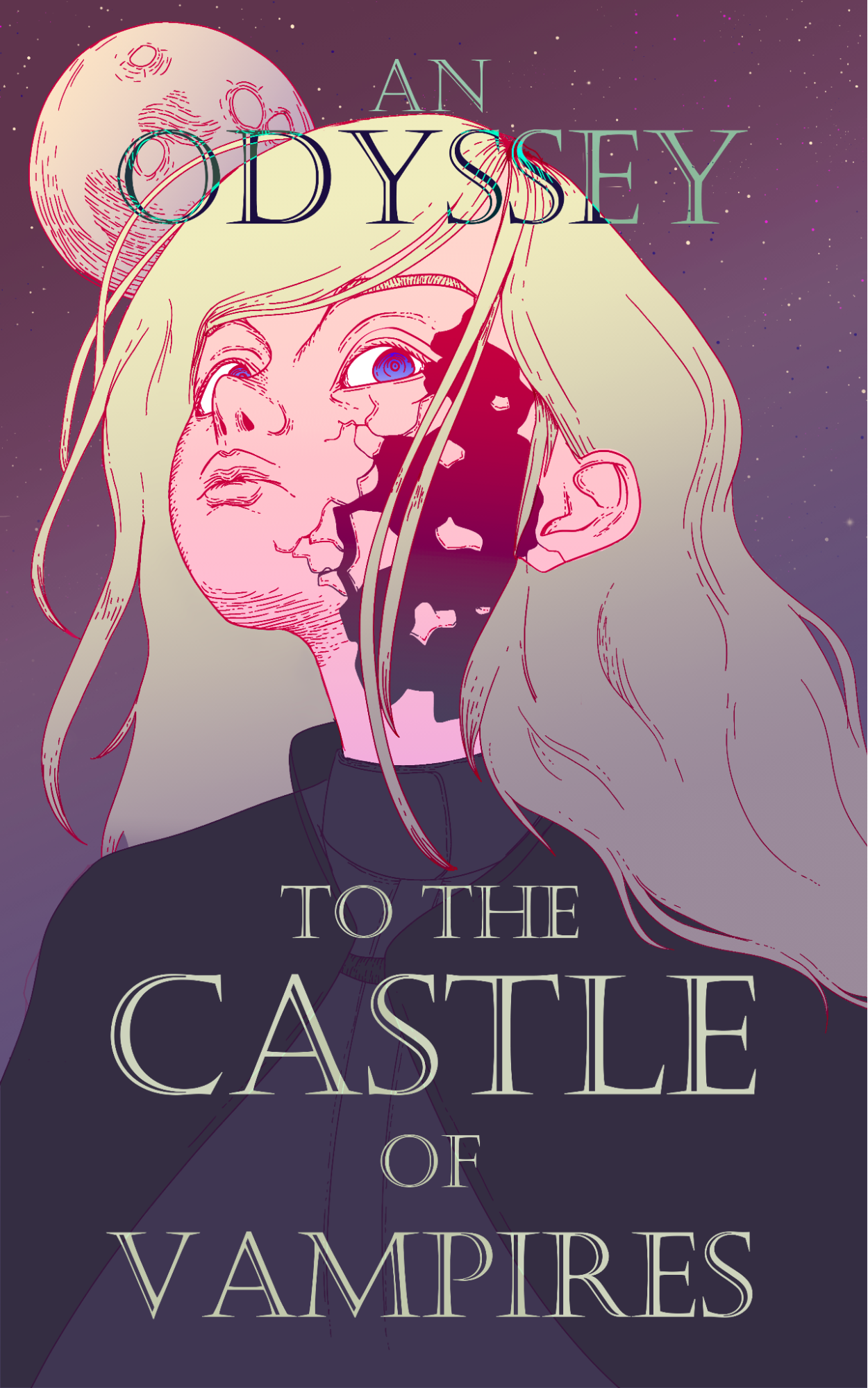
An Odyssey to the Castle of Vampires
by DWaM
TABLE OF CONTENTS
The Strange Tale of Dagon Hill
If there is such a thing as a god, and he creates with purpose, then Bruce Lowell’s purpose was to correct the grave oversight woven into the tapestry of human history: namely, humans themselves.
“Your intentions,” the Shaman continued, “may be good. But the outcome of all this will be anything but.”
The light between them flickered. That deep into the cave, the angry mountain howl had turned into a faint whistle: the song at the edge of the world. The two men – staring at each other, cross-legged – both knew how their encounter would end. Bruce knew he was too determined to turn back empty-handed. The Shaman knew Bruce was mistaking his greed for determination.
“This’ll be my last visit.” Bruce said, seemingly ignoring the other man’s indignation. “I just need one more case, and then I’ll leave you be. If you’re a fraud, you’ve done a hell of a job.”
Of course, by that point, Bruce had been entirely convinced:
This man is immortal.
Reaching into his bag, he pulled out a syringe and four empty vials.
“Four? That is more than we had agreed.” The Shaman noted.
The scientist grinned. “You don’t want me coming back, do you?”
The Shaman extended his arm. The scars from all of the experiments done in the previous week had disappeared, as expected.
“If there is a god,” Bruce mused, “and he creates with purpose, then the only true purpose is to eventually die.”
“Is that so? Very well.” The Shaman watched his blood fill one of the vials. “What, then, happens when you take that purpose away?”
“Then,” the scientist said simply, “I realize that playing god is just as fun as I always thought it’d be.”
Descending from the hermit’s cave back to the base camp, Bruce found Cynthia waiting for him in his tent. He’d never understood why she’d always given herself the special treatment. They were supposed to work as a group – yet, time and time again, she sought to discuss things with him personally. Did she think he valued her over the others? Did she value him over the others?
“I got him to give me four.” he said before she had a chance to ask.
“That won’t be anywhere near enough.” she told him.
“Am I supposed to be bleeding the man dry around the clock?” He placed the vial case onto his desk. “The blood itself is referential material at this point. It is not the serum.” This, he felt, should have been clear to her already.
Injecting the Shaman’s blood into one’s bloodstream resulted in improved healing effects of up to a few hours. It was nowhere near the level observed in the subject himself, however. The Shaman’s cells regenerated near-instantaneously. You could not cut him, not really: the bonds between his cells would reform at such a speed to where you would doubt you had cut him at all. You could not break his bones for the same reasons: an infinitely small breaking point would fix itself infinitely quickly.
They speculated that dismembering the man, if performed in such a way that the blade left no possible point of contact between the limbs, could theoretically kill him. But this was not a hypothesis they were prepared to test.
Regardless, to the research team, it was blindingly obvious that was not something one could simply pass over to another human through blood alone. At best, the team speculated, ingesting the blood would slow the effects of aging in the long-term. To what extent, they simply could not test.
Cynthia scoffed. “You’re drawing the line at taking his blood, but are perfectly fine with what Darian proposed?”
“Experimenting on the immortal risks ruining him.” Bruce sighed. “That’s all it comes down to.”
“I’m not sure everyone sees it like that.”
”As I said – we have enough referential material to proceed. Darian thinks he knows how we can best take it from here. And–”
“Thinks. That’s the key word. Thinks.” she pointed out.
“And I happen to agree with his thinking. So what’s your point here, really?”
“My point is that it’s insane! You’ll never get anyone to sign off on this! Bruce–”
“It’s done.” he said.
She blinked. “What?”
“It’s already been signed off.” He smiled, not with malice, for he appreciated her naivety. “We have the location. And the go-ahead to use the people there.”
She had to sit herself on his bed. “Oh, God.”
“Cynthia,” he told her, “we’re not monsters. I won’t let anything happen to them.”
The woman had finally stopped convulsing. The disgusting gagging sounds had stopped along with her. The vomit still slid from her mouth onto the basement’s steel floor. At least, Bruce thought, she had not pissed herself, like the other one.
“I was wrong.” Darian murmured. “I’m sorry.”
Cynthia threw her lab coat at him. This had become almost ceremonial: every failure an apology, every apology causing an act of disdain and shouting, every word of venom causing the basement lab to feel more and more confined.
They had been down there for two years by that point. The woman on the floor had been the eleventh subject.
“You were wrong.” Bruce noted. “But this wasn’t for nothing. We have the right structure. We just need to figure out why the body rejects it.”
Cynthia clutched her knees in the corner of the room. “They’re going to hang us. They’re going to hang all of us.”
“Maybe it doesn’t work on women?” Darian suggested. “I feel like the men on average last much longer.”
“The men still die.” Jacob pointed out, spreading a tarp onto the floor. “I’m telling you – we can’t cause this kind of mutation in adults. We should turn to artificial insemination.”
“So you can start wrapping fetuses in those tarps?” Cynthia asked.
“Jesus, Cynthia!” Darian groaned.
Jacob had no rebuttal. “All I’m saying is–”
“We’ll continue working with adults.” Bruce declared. “End of story.”
“How much longer,” Cynthia clutched her head, “is this going to last? Just admit it’s over, Bruce.”
“We have to keep going.” he said.
She jumped to her feet. “For who?! Berlin has all but fallen, the Fuhrer is hiding somewhere in some bunker waiting for his execution, we are stranded in the American midwest with all our contacts radio silent! Want to know why? Because they know. It’s over. It’s not happening. Not in this country. Not anywhere. And the moment anyone gets an inkling on what we’ve been doing – and you better believe they’ll get way more than that – we’re done. Done! They’ll hang us before they even find the grave site!”
The eyes of the three researchers turned to their leader.
“Jacob, Darian,” Bruce said, “get rid of the body. Go to town. Get someone new. We’re close.”
Cynthia grabbed him by the shoulder. “Bruce!”
“You don’t believe me? Fine. Tonight, then.” he told her, calmly. “We’ll try again tonight. No – we’ll succeed. I know what to do now.”
As he had eleven times before then. But who could question him now? They’d gone too far. They carried the same weight. It was not the weight of guilt, but of uncertainty. Had they truly been wrong? No. No, they couldn’t have been. Bruce had said as much. He had promised them. Bruce had the answers. Mad as they were, they were answers. They made sense. Maddening, maddening sense.
The immortal man existed. What other limits of this world could yet be found?
The answer, Bruce had realized long ago, would not be found by trying to breach the limits himself. Humans were never made for such a thing. A human could not have decided to be immortal. A god would not have allowed it, either.
That meant–
Lifting the shaking hand off him, he walked to the other side of the room, to the black book still lying on the blood-covered surgical table.
That meant–
“Start preparing for the ritual, Cynthia.” he told her. “This time – it will work. The stars are all perfect. We won’t get another chance like this. It was the specimen that was bad. That was our mistake. We won’t let it happen again.”
He turned to the two men.
“Will we?”
Two shadows crept through the forest surrounding the town of Dagon Hill. Having buried the body in their usual spot, they prepared themselves for the far more difficult task ahead of them. In the years that they have been doing this, the townspeople grew far more weary and distant. Not of each other – but of the darkness of the streets. They had understood that the evil that had descended upon their little town was not one originating in their midst. Whether human or otherwise, a threat lurked at night – one that would drag them into the fog, never to return.
At first, it was the drunks. Yet, the drunks, while hardly missed, proved poor candidates for experimentation. Getting them through withdrawal proved just as taxing as the actual genetic tinkering. Besides, the few drunks remaining sobered up after they understood the enemy’s criteria.
A small portion of the townspeople had left. The only contact with the outside world was via a rare, monthly train, set to deliver mail and supplies. Those who were brave enough to hop on went on to live with distant relatives, never looking back. Those who stayed had done so with nowhere better to go. And even if they had – they were not so foolish to believe the radio could prepare them for what lied beyond.
Indeed, the world frightened them more than any beast could. With over half the town being made up of German and Austrian immigrants, they had come to accept exile as part of their existence. No war was truly too great. No hatred finite. It was them against everyone else.
It was them against the shadows now creeping through their streets.
“She had such pretty eyes, that last one.” one of the shadows lamented. “She never complained, either.”
“You should leave while you can.” the other shadow murmured.
“Oh? I’m to run away?” The first shadow was shorter than the other. “And you?”
“I have nowhere better to be.” the taller shrugged. “You know that.”
“We’re close, Jacob.”
“No. No, I don’t think we are.”
“That last time should’ve worked. Her blood tests were almost the exact same as–”
“You don’t get to immortality by drawing magic circles and chanting.”
“We did more than that. You know that.”
“But tonight,” the taller shadow sighed, “we won’t. He’s got that look in his eyes, Darian. He’ll go too far. And we’ll have another body to bury.”
The folks had wisened up. They’d locked themselves in their houses. Locked their windows. Told their children to hide in their closets. Men slept leaning against the door, shotgun in-hand. The women peered through the windows, kitchen knives in-hand. Yet, they never saw them. Not once.
The snakes slithering through the garden of Eden.
“Do you think it’s true?” The shorter snake hissed. “That Germany will fall?”
“I thought you were smart enough to see the writing on the wall.” The other rattled. “No matter. Not for Bruce, at least. I think he’d found a better client a long while ago. Not even he’s stupid enough to put all his eggs in one basket.”
“You think he’ll stab us in the back?”
“I think I’m telling you to leave with good reason.”
Even so, neither of them would. It was precisely because there had been no such thing as ‘far enough’ for them that they had been recruited. Research could never go far enough. Success could never go far enough. Failure could never go far enough.
Your legs could never run far enough.
They looked up.
“He’s right. About the stars.” one of the men mused. “I can see the Constellation of Pyrrhus.”
Robin Palmer turned in his bed, troubled by the same thought that had followed him for the last three weeks since she’d disappeared.
I have to get out of here.
The romantic side of him told him she must have still been alive. The rational side took that as evidence could not possibly be. A child of the Great Depression, he had learned to trust the latter. Yet, in this case, the thought of getting on that train was just as nauseating as helplessly lying in his bed.
Would it always be like this from now on? Probably not, the rational side of him said. But perhaps it should, argued the emotional one.
They should have left when they had the chance.
Yes, he was a disgraced physicist. Yes, she had no knowledge of the outside world. But he wanted to start again. And she was willing to learn. Why then – why had they been so afraid to abandon this place?
Dagon Hill was supposed to be a temporary stop on a journey to nowhere.
Why had he fallen in love?
And why was he forced to now be alone?
Weren’t they supposed to build a life together?
“Please don’t forget me.”
He could still hear her voice. Had she actually ever said that? Yes – it must have been one of the more difficult nights. The ones where she sat curled up at the edge of the bed, with him stroking her hair. Every sob broke his heart a little bit more. Now, he felt, there was nothing left to break.
Her scent was beginning to fade from the sheets.
Soon, all of her would be gone.
The more he turned over in his bed, the faster she disappeared.
He got up, stumbling over to the window. It was pitch-black outside. In the first week, he roamed the streets, screaming her name, like the others who’d been left behind. And just like them, he soon lost the energy. To search. To cry. To eat. To dream.
The only comfort he could give himself was entirely esoteric in nature – and required him to relinquish the idea he was human at all.
He stared at his hand. A mass of skin, flesh, bone and nerves. Each of them formed by cells. Cells formed by molecules. Molecules formed by atoms. The same atoms that formed the air around them. Reality was a grand sea, where a chain reaction of a chain reaction gave way to an illusion of consciousness. Atoms simply moved. As they always would have. Masses of electricity had tricked themselves into believing they had commanded it.
In reality, atoms simply abided by laws of physics. For every action, there was an appropriate reaction – hidden deep within the microscopic world, far beyond human understanding. The underlying equation of the universe simply acted upon its invisible parameters. He was always going to end up in Dagon Hill. It had been decided since the Big Bang. And she was always going to disappear. Since the moment she was born, she was always destined to be kidnapped, tortured, raped, and–
He clutched his head.
He wanted to scream.
Did she cry? Did she call his name? Did the savage who took her laugh in her face, reveling in her misery? Would her last moments be sad, pathetic whimpers, as she begged to be let go?
“Please don’t forget me.”
But how couldn’t he, if this is what he would always remember?
The phone rang.
At that time?
Could it have been her…?!
He rushed to the receiver.
“H… Hello?” he whispered, listening to the trembling voice on the other end.
“Robin… I… I do not… I… I am afraid I…”
It was a woman. But not his.
“Gretel?” It was the daughter of the town priest. “Gretel, is that you?”
“Father… They… Someone came and… I do not know… I heard noise and… They… They took… I do not know.” The voice sighed. “I do not know.”
“Okay.” he said. “Okay. I’m coming.”
He hung up, guilty for the odd relief that he had something to occupy him.
Gretel Bauchmann had always been a little odd. Odd – but not weird. Odd – but not strange. Odd – but not unbecoming.
Simply a little odd.
It wasn’t the fact that her father was a priest – as far as anyone knew, she wasn’t particularly religious. It wasn’t that she said anything that would raise anyone’s eyebrow – to most, she offered little more than a polite greeting. She didn’t dress unusual – while her black dress certainly stuck out, it was anything but distasteful. She was beautiful – but put little effort into her appearance. She certainly had many who were interested in her – but she seemed to have no interest in finding a lover, let alone a partner.
That was, in short, what made Gretel Bauchmann just a little odd:
She didn’t really try to be a person.
That was how Robin had seen it, anyway. And to him, it wasn’t just a little odd. For reasons unknown to even him – it was downright repulsive. The way she would look at people with the most genuine lack of intention. She was a window through which someone was peering into the world. A doll never fully wound up.
He hated that. She, on the other hand, didn’t mind him.
So they got along.
“Ah. Hello.” Gretel murmured, as he stepped in through the broken-down front door of her home.
She was sitting on the couch of the living room, a half-empty cup of tea in her hand. The blonde strands of hair were messily strewn across the backrest. She was still in her nightgown.
As she brought the cup to her lips, she observed – as did Robin – the complete and utter destruction of the rest of the living room. The coffee table was broken. The lamp in the corner had been knocked over. There were scratch marks on the floor. And just a little bit of blood leading out into the hallway.
“Wh-What happened?” Robin asked.
She placed the cup in her lap. “I woke up. I am not sure, but I think I heard screaming. It was probably Father. Then came the noises and the crashing and everything. By the time I got down, it was like this. It has been quiet since.”
“Have you called the Sheriff?” he asked.
“I have been led to believe the Sheriff no longer picks up the phone.”
“Even he can-can’t turn a blind eye to your dad going missing.” Even if he undoubtedly would. Especially now that the enemy showed he could simply break through the door.
A long-running theory in the community was that a group of zealots had secretly festered within the town and decided to initiate a campaign of terror. Given the nature of Dagon Hill’s peculiar church, Robin could see this being the case. Just as he could see what would come of the priest’s disappearance.
“Father did not make it easy for them.” Gretel noted.
His captor would have expected nothing less.
Although in his early sixties, the cleric had been in remarkable health. Masculine and lean, the decades had not withered him – they had shaped him. His height always left him above eye-level, giving an air of importance and control. It was this strength that had united the community through sermons and ensured resilience in the face of evil. With each disappearance, the louder they chanted.
The priest’s disappearance would not lead to despair, Robin knew, but a rebellion. They would take to the streets, rummage through every basement, dig up every grave, burn the entire forest to the ground if that’s what it would’ve taken to exorcize the demon.
“I don’t think,” he concluded, “your dad has made it any easier for us, either.”
Gretel could see what he saw. The final end to Dagon Hill. A smoldering patch in the middle of nowhere. It is what Robin had seen since he first got to understand the beliefs of this place.
“You have no faith.” she told him.
“I never said I did.” he pointed out.
She brought her cup to her lips once more. “In us. You have no faith in us.”
Tip-toeing through the wreckage, Ribub found himself staring at the books scattered across the ground. Someone must have been slammed against the bookcase.
He crouched, picking up a black book. The black book. The one on which the church of Dagon Hill rested on.
The Path of the Final Throne.
The true myth of creation began earnestly not at the inception, but at the very end of everything. In the great void, in the Kingdom of Eternity, beneath the broken skies, beneath the ravaged stars, beneath the gaping mouth through which the corpses chanted and the living escaped. They had stacked their treasures, their books – the generous, even themselves – to build a ladder to have a chance at being gnawed.
Those without spirit remained at the banquet. The songs were still going. The limp body of God hung from the rafters – someone had stripped him. Long were the mockeries of the muses and the ghastly whines of their poets. The arisen saints drank each other’s blood, desperately trying to keep their holiness in them.
Below, in the hanging castle, two figures watched the spectacle.
The First King arrived to pay his respects to The Last King. The Last King recognized him, for the other man carried his face.
“Where am I?” asked the terrified Last King.
“Where I had sent you.” said the First. “You do not remember. I had not, either. Who can remember a mistake until it is too late? No matter. You will fade, as all ghosts do. I was here at the start. You may as well, however, remain with me at the end.”
The Last King touched the First. His hand seeped into the other man’s chest.
“You are empty.” the Last King murmured.
“Or you,” the First mused, “are simply incapable of feeling?”
The Kings looked to the spectacle beyond them.
“Where are they going?” the Last asked.
“To the beginning.” the First told him. “To cross the threshold of time and try again. For they did not remember the clay that made them in time. They feared death. Now they regret. And choose to start anew. Hoping. Praying.”
“And you?”
“And I? What of me?” The First cocked his head. “I sit on the Throne. A king without any people. A court filled with jesters. A queen made of many faces. I need no swords. I need no masks. I need no good. And I need no evil. Behold, my kingdom. Behold, my victory.”
“Who have you bested?”
The First King stared.
Not at his old self. Not at the crumbling walls of his castle. Not at the gnawing mouth of eternity.
He stares through me.
I, in turn, stare at Bruce Lowell. Dagger in one hand. His black book in the other. I cannot move. I am naked. He hums. His underlings hum. My blood hums. The liquid they release into me hums. The words they had written across my limbs hum.
They are all telling me one thing:
Remember.
I must remember before it’s too late.
I must see as the First King.
“Who have you bested?” asks the woman, sitting cross-legged. The other two surround me, forming a triangle – no doubt also drawn in my blood.
“Time.” Bruce answers. “And all its thieves of memory.”
“Remember.” orders one of the other two men.
I dare not answer. I simply must remember.
“Remember that you are made of clay.” says the third man.
Bruce Lowell raises the dagger.
“Tear the sky asunder!” he orders.
I close my eyes.
“Burn the night anew!” they all chant.
I see as the First King sees.
The Last King burns. The illusion reaches its expiration. It fades as a final reminder of the truth.
“Burn the night anew.” he whispers.
I look at my kingdom.
The blood flows from the gnawing mouth. From the stars. From the saints. From the broken sky. From God. From me.
Blood.
Blood.
Burn the night anew.
The blade shines in the dark.
And I–
“–See the Final Throne!” They scream, as do I – not because I believe, but because I hope!
I–
I–
I get up on my feet. The ground beneath me is wet. I am covered in mud. The trees are quiet. The faint shiver of leaves barely reaches my ears. The night is dark – but the stars shine, nevertheless.
I look at my hands. The leaves continue to shiver. No doubt, I realize, in disgust.
In the distance, I see a grand building of stone. I’ve never seen it for myself, but I know what it is. The dilapidated fort. Nobody has talked about it in decades. Some don’t even know it exists, with how deep in the forest it is. I’ve only had the misfortune of reading stories of it in the town records. The description of its skull-like shape was no exaggeration, then.
My stomach churns as I look at it.
It disgusts me, as I am disgusted with myself. How fitting, this being the place where I had abandoned myself?
I touch my face.
Disgusting.
Who can I love like this? My flesh, my blood – they are not mine any more than they are any else’s. I have lost my own kin. Who, then, could love me?
Indeed, my hope had been in vain. I see no throne here. I see no future. I see no eternity. Yet, the vainness turns into vanity. And the hope persists. For I do see many kingdoms. All of them, mine to take. All of them, mine to rule. All of them, mine to burn.
For I am the First. And I will be the Last.
I will find my way to the Throne.
But first–
First–
I will march against the thread of time. Against the thieves of memory.
I will burn this night anew.
Robin peered into the darkness. It seemed that the neighbors had caught wind of the commotion in the priest’s home and spread the word.
Four Pontiffs – the Church’s most devoted – marched down the street. Their plain white robes hiding their malnourished bodies; their blank, featureless masks hiding all but their eyes. Those had usually been reserved for ceremonies. Was this to be a ceremony? Or did a mask give comfort in a sea of distress? Either way, their steps could not hide that they were practically drowning in it.
Just as the broad shoulders of the woman leading the group could not hide the fact that Robin was about to face Lucile Gerrick: Bauchmann’s favorite.
They were still a little ways’ off when Gretel rested her head on Robin’s shoulder.
“Now that we are both alone,” she whispered, “can I sleep in your bed?”
“No.” he said, gently.
“Who will love me, then?” she asked.
Not Lucile Gerrick, Gretel decided. The woman and her entourage had walked past them as if they hadn’t even been at the doorway. They walked around the living room much the same way as Robin had a few minutes prior. Lucile looked through the books. One of the other Pontiffs went further into the house, no doubt to check the bedrooms. Another went into the kitchen, looking through the fridge and cupboards. The last one, seemingly at a loss for what to do with himself, headed back through the front door and scanned the house itself.
It did not take long for them to reconvene.
“Where is he? What happened here?” Lucile demanded.
Robin sighed. “C-Could’ve opened with that.”
She raised her index finger. “Not tonight, Mr. Palmer.”
Robin passed his hand through his black hair, relenting. “I don’t know. Gretel c-called me. I got here. There was a struggle. Obviously. S-Someone took him. Obviously.”
Lucile crossed her arms. “Obviously.” If all her years with the High Priest could be condensed into two teachings, they would be this: to never lose her head and to never harm another human being. These were the true principles of the Church. Their enemy had no qualms about breaking the second tenant. The priest, it was starting to look like, would soon be forced to break the first.
If it wasn’t too late already.
And she felt it was not. She had faith in the old man. As did she in her town. From the first, it was inconceivable to her that any member of the Church would stoop to such inexcusable crimes.
Therefore, she had always reasoned, the culprit had not worked within the town, but rather from somewhere in the surrounding forest. The revelation that it was likely more than one person – as suggested by the state of the living room – was troubling, but not unexpected. This group’s motives were still unfathomable, but their methods, at least, were clear. They would creep in during the night and act.
Tonight, however, they had not acted – they had acted out. This had been too loud. Too messy. Too visibly violent. The priest was gone, but in his place would come the people.
She could already hear them gathering outside.
A church was not built upon Dagon Hill. Dagon Hill was built upon a church.
Lucile walked through the front door and met her congregation. The hundreds of men and women, finally unafraid – no, unafraid as they had always been – gathered around the house. They wore the robes. They hid behind the masks. They carried no weapons. They were not bad people.
“They chose not to help us.” Lucile addressed them. “So we will help ourselves.”
She raised her hands in the air. “Spread out. Find them. They couldn’t have gotten far. Enough is enough! This ends tonight!”
I got my hands on the other one.
I hold him by the throat, watching his feet dangle in the air. We drift further from the ground. He’s trying to kick. To scratch my hand. But it won’t work. I’m too strong. They didn’t think I would be. Neither did I.
I’m trying to remember his name. It’s on the tip of my tongue. I’ve said it countless times. Yet now that I stare in his scared, pathetic eyes, the words simply escape me. Perhaps, after all this, he’s finally become unworthy of one?
I continue trying to remember, regardless.
He gurgles something at me.
All I end up remembering is that I don’t care.
All I really am – is hungry. And tired. And angry.
I think of the two tenets of my Church. In spite of who I am – what I am now – they have followed me my entire life. I will not give up on them, in spite of everything.
The first – reminding us that one should never lose their head. Very well, then. I’ll let him keep his.
The second – that we must never harm another human being.
Thankfully, I hold in my hand a monster.
Robin turned around, realizing that Gretel had stopped in her tracks, staring up at the sky. Instinctively, he did the same. He saw the stars – the Constellation of Pyrrhus, if memory served him right – and very little else.
“It moved.” she said simply.
“What did?” he asked.
“I do not know.” The tip of her finger touched her chin. “But something was moving. It must have flown over us.”
“Planes don’t fly around here.” Robin reminded her.
“Then, it was not a plane.” she decided.
He sighed. “Okay. W-Well. We should keep moving.” The group of townspeople they had been tagging along with was nowhere to be seen. The last thing he wanted was to be left alone when the chaos – which he felt more confident than ever was inevitable – began.
The sky may have been quiet, but the night was not. Footsteps echoed through the stone streets of Dagon Hill. Flickers of flashlights slipped through the gaps between houses. A yell here. A curse there. Some would say there may have even been a giggle. It was tough to say – beneath all the masks.
What, precisely, Robin wondered, would these self-proclaimed pacifists do when they caught the culprits? Give them a stern talking to? Drag them to one of their sermons?
He felt all the more guilty for not leaving when he had the chance.
“The First King is coming.” Gretel declared. “He may already be here.”
Robin blinked. “What?”
“That must be why Father is gone. His leadership is no longer needed. The King is here.”
“G-Gretel–”
“He is watching us. From somewhere above. He is circling the town, preparing to burn the night anew.”
He groaned. “Stop.”
Yet, as her eyes met his, the one stopping was him.
There was something on her cheek. A bright red stain, dripping all the way down to her chin.
He flinched. Had she hurt herself?
As if to answer, she ran her finger across the stain. No wounds hid beneath. Curious as to the nature of the substance herself, she licked the stain off the finger.
“This is blood:” she declared.
Just as she was about to lick it again, Robin closed the distance, taking her hand in his.
“No.” He ordered, now studying the stain up close. Dark as it was, he had to admit it certainly looked like blood.
“How did that happen?” he asked, looking the woman over. With the exception of her cheek, she was unblemished.
She smiled. “Why do you think I looked up?”
Minutes before midnight, Dagon Hill fell into silence once more. The priest had still not been found. Their fervor in finding him had not subsided. The hatred against their tormentor was no less righteous.
Yet, within those same crucial minutes, one of the girls had found something. Little by little, whisper by whisper, the bravest of the good folk left the confines of the streets to see it for themselves. Even Robin and Gretel, against the former’s better judgment, clung to the back of the curious party.
For years, they had been preparing for something like this.
In the outskirts of town, at the forest’s border, a man lay dead.
He stared upwards – his eyes frozen open, his jaw merely left hanging. The back half of him had seeped into the fresh mud. If he could see himself now, it would have been easy to imagine him embarrassed. Given the clothes, the shoes, the blonde hair so carefully slicked back, this had been someone who took great pride in his appearance. In himself.
Whatever had killed him had struck at the neck – that much was obvious by the drying blood covering his collar. The doctor among the group of faithful now gathered around him claimed that the man had to have been dead for at least an hour.
They’d kept their distance since finding him. Whatever misconceptions one might have had of this community, one could have never made the mistake of believing them foolish. The man had clearly been murdered. They had stumbled onto a crime scene. Someone had already gone off to warn the Sheriff.
“He won’t come.” someone said.
“He has to. This is not just about the disappearances anymore.” another of the masks pointed out.
“He won’t come. I’m telling you.”
In truth – and much to their own surprise – they were not terribly worried about the Sheriff. They were even more surprised to find, staring at the body, that what they felt was not shock, nor grief, nor anger.
It was relief.
If discomfort was felt among the crowd, that fact was, perhaps, the only real cause of it. And the more they came to terms with that, the guiltier they felt. They stared at the body, trying to grapple with that fact – reminding themselves that they were dealing with a human being.
But the harder they stared, the more relieved they became.
After all–
This man was a total stranger.
Neither the old nor the young could recall ever seeing such a face around the town. And in a place where everyone knew everyone, that was no easy feat.
It was not difficult, then, to imagine the faint trace of hope that arose among a certain few – that this man, this stranger, had been the one responsible for the disappearances. That the nightmare had reached its end without them having to compromise their tenets.
The thought had certainly crossed Lucile Gerrick’s mind. But she had no time to dwell on it properly. It was not just the fact that – tormentor or not – the man had clearly been murdered by someone.
As she turned her attention from the man’s face to the rest of her surroundings, she realized how fresh the mud was – and how easily the body had sunk into it. She had also noticed, for instance, that her feet and the feet of the others, had sunken in just as easily, leaving a trail of clear, intertwined footprints leading from the town.
Why then – she wondered – were there no footprints around the body itself? How had the body ended up there?
Robin, unable to keep his curiosity, had squeezed his way through the crowd. Finally gaining a better vantage point, he had reached the same question – and quickly found a potential answer.
“He must’ve come from the forest.”
He pointed to somewhere in the distance.
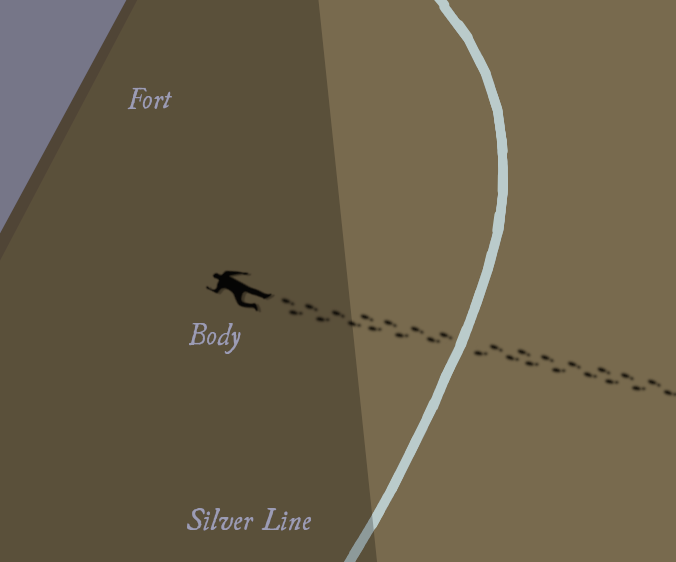
The footprints he’d spotted – a single, lone set of them – appeared to indeed come from the forest. They passed into the clear field, before abruptly stopping, facing the direction of the body. A cursory comparison with the shoes seemed to confirm they were indeed made by the man.
This, however, brought to light two more problems.
The first was that the point where the footprints had stopped and the body itself were over fifteen feet apart: a distance not even Olympic athletes could make.
The second was equally bizarre, yet far more troubling – the lack of any other footprints.
Where had his killer stood? The man hadn’t been shot – someone would have undoubtedly heard a gunshot. The killer couldn’t have simply used a range weapon, either – not only because no weapon was found, but because it was unlikely they could have made a throw from a distance they wouldn’t have left any footprints in.
“Doctor,” Lucile asked, “please look at the wound. Sheriff be damned.”
The old doctor did not need to be asked twice. Lucile and he approached the body. The Pontiff watched as the old man carefully pulled down the bloodied collar, revealing the wound.
As suspected, the cause of death had been a fatal wound to the jugular. The man, by the doctor’s estimation, would have had less than a few seconds – if that – before expiring. He was also certain that the spot the man had been found in was where he had died. The body was in very early stages of rigor mortis, meaning he had died no more than a couple of hours prior.
What none of them could have foreseen was the shape of the wound – and what had caused it.
As the doctor cleaned the area around the wound, two distinct holes came into view. For the briefest moment, one could be forgiven for thinking some kind of fork had pierced the man’s neck.
Lucile was just about to suggest as much when she stopped herself. “Is that–?”
The more she looked, the clearer she saw the other marks – they were nowhere near as pronounced as the two holes, but undeniably familiar.
Horrifyingly so.
“Yes.” The doctor admitted. “I suppose they must be.”
Lodged in the surface of the dead man’s skin were clear, distinct bite marks.
Human.
Having tasked the most trusted believers with guiding the body, Lucile led the group into the forest, following along the dead man’s footprints.
Robin caught himself shaking. Whatever was happening must have been connected to the disappearances. Wherever these footprints were leading must have been the heart of the matter. Would they find everyone?
He almost wished they wouldn’t.
He knew she wouldn’t be there.
Trying to distract himself from the inevitable horror, he shone his light across the footprints. They appeared to have been completely undisturbed. Nobody had tried re-treading the path by walking over them backwards.
“What are you doing?” Gretel whispered.
“I’m looking.” he told her.
“Why?”
He straightened his back. “Don’t you mean ‘where’?”
“No.”
He didn’t answer.
The forest trees eventually gave way to another clearing. The footsteps continued well past it, further into the forest. However, now–
“There’s something over there.” one of the masks pointed out.
From the same general direction as the dead man, another set of prints emerged. This one diverted from his path halfway into the clearing – whereas the dead man had continued on in the direction of the town, this other person had chosen to turn right, heading towards a section of the forest few dared to venture into.
Here, the believers also noticed a striking difference between the two footprints. The dead man’s footprints were deeper, with the distance between the feet much longer compared to this new set. To Robin, it seemed that he had been in distress, running to – or from – something. The second set, on the other hand, seemed to have kept an almost leisurely pace.
Whatever confidence this other person had, it was unearned.
Deciding to follow the end of this second set of prints on a whim, the group slipped through a patch of trees and found itself at another clearing. In its center lay a shadow. The followers leading the convoy rushed towards it.
“Another one!” one of them exclaimed.
Thus, the second body was found.
This man, too, was not one the townspeople were familiar with. Short in stature and with several days’ worth of stubble, the man still exhibited the same elegance as the first one. Their times of death also seemed to be relatively close.
Unlike the first man, however, there was no mystery as to what killed him. Given the unnatural position of his head and lack of blood, it was safe to conclude that his neck had been broken.
There was still a distance between where his body lay and the actual end of footprints, but a far less significant one than in the first instance – only a couple of feet at most, by Lucile’s estimation.
The only thing entirely identical in both cases had nothing to do with the men themselves, but rather the person that killed them – where had they stood? As before, there were no other footprints to speak of. The mud – if mud could ever be called that – was pristine, same as in the first case.
While this clearing was relatively small, the distance between the body and the surrounding trees was still too great for anyone to get to the man without leaving a single trace – much less break his neck.
A fall of some kind, then? While plausible to some at that point in time, later examination of the body would find no other fractures or bruises that would suggest it – the same findings as in the first murder.
Like in the first murder, a hasty search of the man’s pockets would turn up no clues as to his identity. Either the culprit had stolen everything they had on them, or they had no intention of carrying anything that could identify them.
If the latter was true, it strengthened the men’s involvement in whatever scheme had been used against the town over the past two years.
His anxiety now increasing, Robin turned back to looking. He eventually settled on staring at the man’s mud-covered shoes.
“They’re not the same.” he concluded.
Gretel leaned closer. “What?”
“The footprints leading h-here and his sh-shoes. They’re different. He didn’t walk here.” he told her.
Whoever had walked here must have carried the body and placed it here, then. But where had they gone next? As in the first case, the footprints were undisturbed.
“Stop that.” Gretel lowered her voice.
“Looking?”
“You look – but why? You do not see, Robin. You never could. Why, then, bother looking?” She crossed her arms. “I told you. Father is gone because he had served his purpose. The First King is here.”
The group, trying as they might have to ignore her, exchanged nervous glances.
“The First King killed him and flew away.” Gretel explained. “Is this not obvious to you?”
The residents of Dagon Hill were not able to attest as to who, or why, had built Mishra’s Fort. Or who, for that matter, Mishra was.
It was believed that it had been built sometime during the War of 1812 and seemingly abandoned shortly afterwards. The group of disillusioned American and German intellectuals who would go on to found Dagon Hill in 1816 gave it little thought. It was, at best, a reminder of the world they had so desperately tried to escape. Few ventured into it and even fewer found anything of worth hiding within.
It was, at least, not difficult to see why the fort had been abandoned. The patch of forest Dagon Hill had nestled itself within was small compared to the rest of the region, with hills populating most of the terrain. Passage to the town was treacherous, and numerous lives had been lost during the construction of the railway that would serve as the town’s only connection with the outside world. For a group of scholars wishing to rid themselves of society, it was the perfect choice. For a general, it was a strategic blunder. For the general’s enemies, it was hardly a fort at all.
Its stone walls resembled that of a skull. Its large eroding wooden gate formed the shape of the mouth. Over time, bored townsfolk had rid it of some of its stones, creating two rectangular holes just above it – the eyes. The vines twisting around the entire complex gave the illusion of wrinkled skin. It made the ‘face’ appear to resemble a scream, in horror of its own decay.
Beyond the walls was an oddity – at least, for what one would expect of forts: a large, abandoned two-story house. Its complicated structure did not mesh with the hasty building procedures of forts. It seemed to suggest that the house had existed there before the fort had been built, as evidenced by its shoddy addition of a watchtower, which stood high above the fort walls – a crude addition likely made by whoever had decided to build the fort around the house.
As to who the house’s previous residents were – misguided generals or otherwise – they had simply left no evidence behind.
In the early days, during the construction of Dagon Hill, the settlers had used the house as a temporary shelter. Their early records document signs of unease and discomfort emanating from the house’s halls. It smelled of an old age – precisely the one they wish to have no further part in.
Nowadays, it was doubtful if anything was even left of it.
Why then, Lucile wondered, had the two sets of footprints led to Mishra’s Fort? Had this been the base of operations for these people? How had that not occurred to anyone?
“Burn the night anew.”
What then, Robin wondered, was the purpose of the kidnappings? Was it just the work of a few sick individuals getting a kick out of torturing people? Was she rotting alongside the house now?
“Burn the night anew.”
Who then, the townspeople wondered, had killed the two strangers? Were they the ones behind everything? Was what Gretel had said true? Was it really the First King? Why, after all these years, did they feel the impulse to seek out the man who would always give them the answers? Why was he still nowhere to be found?
“Burn the night anew.”
Where then, Gretel wondered, will it happen?
“Burn the night anew.” she chanted, seeking the answer.
The group, finally realizing what she was doing, turned their attention to her.
“Father,” she explained to them, “is not coming back. I see that now.”
“Why are you acting l-like this?” Robin asked.
“Because,” she said simply, “it is what Father would have expected of me.”
He took a step towards her. “Gretel–”
“Look.”
She pointed to the sky.
They followed the direction of her index finger.
The stars had been covered by that point. They could see nothing.
Robin placed his hand on her shoulder. “Okay. I’m here for you. I-I know this is a shock and all, b-but–”
The sky lit up.
It was difficult to spot the few initial sparks – if any had existed to begin with. To the onlookers, it seemed as if a fireball had formed out of nowhere. The ‘ball’ quickly morphed, however, squeezing and bending as it descended above the fort, finally landing behind its walls.
Somewhere, a woman was screaming.
The light of the flame shone through the eyes of the fort, growing in rage and condemnation. The scream grew almost ear-piercing – as if the fort itself was in pain.
Frantic, the group rushed to the closed gate.
“There’s someone up there!” Robin screamed, pointing to one of the fort’s eyes.
They stopped.
In the walls of the fort, engulfed in light, the silhouette of a person appeared. They raised their right hand, summoning the wind that now carried their long hair. They raised their left, ordering the flames to grow in violence.
“The King.” one of the believers murmured. “The King!”
Whether it was euphoria or horror, this man ran to the entrance.
The figure lowered their left hand in his direction.
With only three steps, the man’s body burst into flames and exploded – near-instantly. His blood splattered the group, now frozen in awe. The ground shook. The figure raised its left arm higher. A chain of explosions soon followed, as a set of eruptions from the ground. The explosions formed a line around the fort.
“It is his now.” Gretel stated, grateful that they were being shown mercy by being left on the outside.
Finally, the figure met the eyes of the townspeople.
All – even Robin – fell to their knees.
They understood.
The King had arrived.
In the six months since the First King’s arrival, Gretel had not once tried to paint her father’s face. This was also, to some extent, the reason she had chosen to paint the series of the night of the arrival in reverse: her father would make an appearance in the very last painting.
The first painting she had done was of the very end – the fiery scene where the King had made Mishra’s Fort his own. She and the other witnesses were nowhere to be found in this depiction. Instead, the silhouette of the King himself took front and center, with the raging flame rising behind him, bending to his will.
The second painting was of the murder of one of the Kingmakers. It depicted the King’s silhouette, levitating in the air, biting into a man’s neck. With this act, the King had created the tether between his past cycle and this one, mixing the blood of the guilty with the innocent and turning into a partial observer in this new world. The face of the man, captured in eternal terror, was captured as accurately as her skill had allowed her. The doctor, at the very least, did not seem to mind her spending a few nights in the morgue to copy the likeness.
The third painting was the King snapping the neck of the second Kingmaker. The painting showed the air escaping from the Kingmaker’s mouth, being sucked into the King’s. With this, the King had established his foothold in this new world, remembering his past and his present, allowing him to remember his body and, subsequently, forget his mortality.
The fourth and final painting – which she was close to completing – showed the very beginning. The two Kingmakers, standing in the dark, above a naked man praying in the middle of the summoning circle. The man’s body was old and frail. The only thing he was missing was the face – her father’s. The body in which the King would be formed, and the soul which would remember its immortality fully.
She had, of course, wanted to see the King. To see her father’s face one last time. To see how much he had changed since becoming the King. She was, no doubt, not the only one.
Yet, she understood that she couldn’t. The King had duly warned them – the fort was his. They were not allowed to cross the line on the ground. He, in turn, would not cross into the outside world. The fort was enough for him to build his kingdom.
This arrangement suited the townspeople. The ones they held the most animosity for – the two Kingmakers – had ultimately proven to be devoted in the search of the Final Throne and had likely been aware of the fate that awaited them. The King, while a being that could not be called good or evil, understood that the Kingmakers had to be punished for their indiscretions against their kin. They had proven as worthy sacrifices to allow him to fully establish his reign.
In some respects, the majority of the people looked at the two Kingmakers with a sense of respect. They had summoned the King, validating their own search for the Final Throne. The fact that they were strangers, in their mind, had been a sign in itself – and the great mystery which their self-loathing creator was acting out.
Gretel stepped into the church. The pews had already been filled – the faithful grateful to have an opportunity to watch her paint.
The easel with the unfinished painting had already been set on the stage where her father had held his sermons. Over the hours to come, the people would move their heads to see the finer details over her shoulder. Some would approach the stage for a chance to touch her blonde hair. She never rebuffed them. With her father gone, it was now her duty to carry his mission and guide the people.
Her own search for the Final Throne had begun.
And with the King’s arrival, she understood – better than her predecessors – how she was going to lead the town to it.
Doctor Gottlieb had never been a fan of masks – figurative or literal. It was the literal ones that annoyed him more, however. They were always a hassle to put on and an even bigger hassle to keep on; the main reason being his wild, gray beard.
While some had advised that he simply shave it, he pointed out the practicality of being able to always pick the town doctor out in a crowd of masked worshippers, thanks to the awkward patches of hair always sticking out. The far more important practicality was that he simply didn’t feel like shaving: especially not for the purposes of ceremonies he didn’t much care for.
In spite of living in Dagon Hill all his life, he had never been particularly religious. Those things happened sometimes – the non-believers usually choosing to leave of their own accord. Yet, the good doctor, while not sympathetic to the customs, was sympathetic to the people. With the title of doctor being kept in the Gottlieb family, he could not, in good conscience, leave the people on their own.
The others, in turn, never minded his lack of devotion. Especially since he had always made the effort of doing the bare minimum – such as, for instance – wearing the mask.
He had been troubled by the arrival of the King. He worried about the boiling fervor among the townspeople. Their beliefs had been validated, certainly: but the doctor’s inner skeptic questioned through what means: divine or – perhaps – human?
Gottlieb was glad his morning guest had shared his skepticism. He was, in equal measure, surprised that she, of all people, would have a crisis of faith.
“Not participating in the painting ceremonies?” he asked, grinning.
“As far as I know,” Lucile said, cautiously, “that’s not a part of any customs.”
He nodded, glancing at his empty tea cup. “Well, you’d certainly know better than me.”
“That’s the thing. I’m not sure I do.” she sighed. “The High Priest turning into the First King… feels fitting, I suppose. But… I don’t know. Everything about that night still unnerves me. I’m not sure if it’s because I don’t want to accept the man I knew is gone or…”
“...Or because you don’t want to accept any of it?” the doctor offered.
“If that’s the case,” she shifted in her seat, “then isn’t that as good as doubting everything? The High Priest, myself, everyone else? There’s been so many sermons about the First King’s arrival. We – I – should’ve been ready for it. Why does it feel so wrong, then?”
“The suddenness of it all, maybe?”
“Maybe.”
“Of course, I can think of a few reasons of my own when it comes to this ‘wrongness’. I’m a little concerned that nobody is questioning who these two men – these ‘Kingmakers’ – were and how they happened to find their way to this place without anyone noticing. And I’m not even talking about why they came here or how they knew of this place – I am specifically talking about how they physically got through town without anyone spotting them.
“There are no roads, so they would’ve been forced to use the train. But I spoke to the station master and he swore up and down that we’ve had no visitors. He, perhaps more than anyone, was surprised when he learned about the strangers.
“The only thing that comes to mind is that they had always – somehow – been at the fort. Years, decades, even more – I don’t know. What they were doing, I also don’t know. How they evaded us generationally, I can’t even imagine. But it’s the only thing I can think of.
“But that creates another problem, doesn’t it? If there was an entire group hiding in the town, and they sought the Final Throne, why had they only started acting recently? Conversely, if they weren’t religious, what had caused them to be?”
“Maybe,” Lucile cleared her throat, “they weren’t acting out of religious reasons at all. Maybe, the disappearances had nothing to do with that.”
“But then,” the doctor spread his hands, “how did we end up with the King being here? You can’t tell me they just accidentally summoned him.”
“...What if it’s not the King at all?”
“Meaning?”
She dared not suggest it.
The good doctor, along with the majority of the townspeople, had given up trying to understand if there was ever any deeper meaning in Lucile’s words. She was the only one who wore her robes and mask at all times. It was impossible to tell what she was thinking.
“Not the King.” she said. “Not anything. Not real.”
“Ah.” On this point, the doctor decided to be the hesitant one. “I’m not sure. I was there for all of it, and I’m having a hard time explaining the things I saw. I am doubtful, but I am not close-minded. What I’ve seen may have been supernatural. Even if,” he searched for the words, “the King’s actions may not have strictly been part of the, uh, ‘canon’, yes?”
What the King did when he appeared wasn’t something known. “Miss Bauchmann certainly wasted no time interpreting it all for us.” Lucile remarked.
“I detect a hint of resentment?”
“I–” behind the mask, Lucile bit her lip. “No. Of course not. She is the High Priestess now.”
“And you, the most trusted Pontiff.”
Trust, Lucile thought, had to be mutual to mean anything.
King Pyrrhus was trapped.
He had infiltrated the city of Argos in the cover of the night – he, his troops, his elephants. The darkness of the city streets, however, had made the element of surprise go to waste – as it happened, his troops had eventually gotten just as surprised as the enemy, with confusion as to who was fighting whom overtaking both sides, forcing them into a stalemate until dawn.
And with the light of dawn revealing the odds, King Pyrrhus knew he was outnumbered.
His attempt to escape was thwarted by a simple twist of fate – his troops inside the city were blocked by the troops that had been waiting on the outside, as they mistakenly believed it was their time to act. His entire army soon found itself skirmishing within the city walls. By the time everyone had realized how dire the situation was, the body of the largest of his elephants had blocked off their only means of escape.
The streets ran red with the blood of his men.
Stumbling through the alleys, on the bodies of his troops, frantic and desperate, lost between his shame and pride, he spotted Tumault, the Great Betrayer. Tumault told the desperate king that he was destined to die – his only escape, he said, was through the stars. Tumault would arrange this passage for him, but require, in return, to relinquish his corpus and all his future cycles to him.
Pyrrhus accepted.
When the battle had turned to silence, Halcyoneus presented Pyrrhus’ head to Antigonus, the Macedonian king. Although it is said that the body of Pyrrhus had been returned to his son for burial, his head had, in fact, not been. It had, instead, found its way to a Carthaginian merchant, who was fascinated by the fresh blood still trickling out of the head whenever he happened to nip at its forehead. He collected the blood in a series of vials and hid them away, deciding it had mystical properties.
These had been the machinations of Tumault. For over a millennia following the Epirote king’s death, the vials would be lost to time, exchanging hands and ancient vaults, awaiting to fulfill the plan written in the stars – to end up in the hands of Angelo Banelli.
Angelo was a painter of small renown within the city of Florence. He had acquired the vials while looking for a substitute for red paint – trying to paint the Christian Devil, he believed the pigment he had at his disposal was not sufficient to portray the full nature of evil and damnation. Using blood, sacrilegious as it might have been, was fitting for what he was trying to do.
The moment the old king’s blood touched the canvas, however – it remembered. It remembered the battle and the pain of death – and it reached out to the stars, seeking itself. Pyrrhus, now among the stars, heard the cry of his past. It had been a beacon left over for him to find the Earth once more – such is the will of the Great Betrayer.
Having seen the abyss of the universe and understanding the hopeless curse placed upon humanity, he joined forces with Tumault. He twisted his now-celestial mass of stars and dust to point to his own blood, to serve as a guide and gateway – to let into the world of humans the bearer of knowledge.
Almost without thinking, Angelo was no longer painting the Devil. The strokes of this brush formulated the body of a woman. Her eyes and skin colorless, his hair infinitely tangled, her mouth filled with black.
This was Elysia, the Woman of Winter. Now reborn in blood, she spoke to Angelo through the canvas. She told him of the universe. Of its pain. The scourge of humanity.
She told him of Shuld, the Loathing Creator. The one who decides to end it all when he cannot justify his own existence anymore. His deaths are always joyous – the celebrations beyond imagining.
She told him of Tumault, the Great Betrayer. The ally of humanity – too impotent to intervene himself, but always whispering to those willing to listen. Without him, the cycles would have never changed.
She told him of Daluk-Uhm, the Iridescent Devourer. He sleeps in the darkness of the universe, waiting to fulfill his role. At the end of time, those seeking to save themselves from Shuld’s death and try again will be consumed by him, waiting for the universe to be reformed in his womb.
She told him of Forago, the First King. The eternal witness. The one who remembers the secret of human immortality: the one cursed as the only one capable of truly doing so. Originally human, and comparatively powerless, he builds his quiet kingdom and observes the cycles. He refuses to interact with humanity, choosing to act neither in or against its interests. This lasts until he reunites with the Last King, when everything comes to an end. When and how he is brought into a new cycle is always different. Neither he, nor the Woman of Winter, nor Shuld himself, can explain it, as he is never consumed by Daluk-Uhm and thus, should not exist in the following cycle.
She told him of Vulk, the Enemy of Reason. A monster Shuld had carelessly unleashed in one of his weaker moments, now forever moving between cycles. It breaks the rules of the universe, goes beyond the passive torture of humanity to an active one, preying on their weaknesses and obsessions. In spite of the defenses Tumault tries to build, it always breaks through.
To escape their horrible curse of death and reincarnation, the Woman of Winter told Angelo, humanity must seek the Final Throne: unite itself, ally with Tumault, gain the trust of the First King, and prevent Shuld from annihilating all.
There had been many cycles, she warned Angelo, and humanity had always failed.
This cycle was still young. Perhaps this time would be different?
Angelo wrote what the messenger had told him into a book: The Path of the Final Throne.
Now, centuries later, Lucile held his book in her hand, quietly observing the work of Otto Weiss, another high-ranking Pontiff and the town sculptor.
Seeing the First King’s behavior and her own doubts, she wanted to demonstrate the town’s intentions to him. She had asked Otto to produce silver plates engraved with the symbol of Tumault. They would place them on top of the line the King had drawn on the night of his arrival, showing the town’s intent to respect his boundary and their knowledge of the Final Throne through their allegiance with Tumault.
Otto had just finished circling the entirety of the fort, putting the last of the plates down, completing the silver barrier. He looked worn out. As he had decided to place the plates into the line in the ground instead of covering it, to ensure the ground was leveled out, the plates ended up being quite thick. A decision he was no doubt regretting, judging how heavy it must have made the plates.
“All done, Madam.” he declared, having finally caught his breath.
Otto, in spite of being a widower a decade older than her, never hid the fact that he would do anything for Lucile – with or without the religion. She worried that a request as daunting as the one she’d made would break the spell she held over him, but Otto was a man of endless patience. Devoted to the Church and to her in equal measure, he was excited to be a part of the King’s arrival.
He turned to the fort. “He hasn’t shown himself since then, has he?”
“No. Not that he’s had any reason to meet us.”
“Would you like to?” he asked.
“I don’t know.” she admitted. “I’m not sure it’d matter much. It isn’t him.”
“How do you know?”
She closed her eyes. “He would’ve stuck to the tenets, until the very end.”
Lucile thought about that night. The brutality. The bodies. Could the High Priest really have done that? Could those two ‘Kingmakers’ have really made him into the King?
“Otto, I have another favor to ask.” she admitted.
“Oh, boy.” he chuckled.
“I just want you to ask around. I mean – talk to the High Priest’s neighbors. If they heard or saw anything on the night it happened. Just anything of note. I can’t really say why, but…”
“Sure.” he said. “Okay.”
“Thank you, Otto.”
“Ah,” he cleared his throat, “but if I could ask a favo–”
“Oh, I’m sorry.” she said. “I have to go see if the High Priestess has finished her painting. Sermon should be starting soon.”
She turned her back to the fort and Otto, her mind clouded with ancient Greek kings and distant deities.
Robin was trapped.
While the disappearances had stopped, he was no closer to any form of closure. No matter how many times Gretel had tried to explain it to him, he simply was not listening. Where was her body? In the fort? They were forbidding him from going in there, so it may as well have been on the moon. The fact that the entire Church seemed to vindicate the two degenerates who had done so much damage to their community angered him even more.
Leaving now felt like admitting defeat. It was as if they were provoking him with all these non-answers and half-baked scripture. Testing him until he cracked and left.
He’d lost so much. He wasn’t willing to lose anymore.
That was how Robin had ended up trapping himself. With Gretel taking her position as the High Priestess, she no longer had time for their odd conversations. He was now in the position of the ‘odd’ one: without Gretel, he was horrified to realize that he had nothing resembling a friend.
As a result, he spent his days shut inside. The initial plan had been to return to his physics studies, but that quickly fell flat: with no way to infer the current status of the academia, and with no money to finance any research whatsoever, his only option was to read old books in the library. If he was to do that, he figured, he may as well have read something a little less dry.
His lover had been a fan of mystery novels. Not so much for the ingenuity of criminal plots, but their ridiculousness.
“You’d like them, though. Unironically, I mean.” she would tell him.
On the nightstand, she had left behind a copy of The Tainted Lotus by Oberon Brahms. Thumbing through it, he found the story of a Great War veteran returning to his village after the dust had settled, only to find that his family and his fiance no longer recognized him. In fact – they outright denied a person with his name had ever even existed.
Renting out a room in the local inn, he sets out to interrogate the people from his past, who seem just as baffled by his claims. This investigation eventually culminates in the man’s own murder – on a bright winter day, in the middle of a clear patch of snow, with the only traces being the man’s own footprints, going directly to where his body lay.
This was where Robin chose to abandon the novel.
Regardless, the damage had been done. With thought re-implanted in his head, he found himself thinking back to the Kingmakers, as they called them.
He went to his desk and sketched out the two scenes.
Of the two, Robin was convinced he could explain the latter man’s death.
The patch of trees separating the smaller clearing from the bigger clearing had been key. The culprit, carrying the body, stopped beneath the patch of trees and climbed up one. This resulted in a set of footprints that led all the way under the trees, but did not step into the clearing itself.
Still carrying the body, they navigated through the treetops, finding the point closest to the center of the smaller clearing.
They then threw the body into the smaller clearing.
Following that, they jumped right after, landing at the point where the footprints leading to the body had ended, and walked backwards, stopping again under the tree passage, at the point where their first set of footprints had ended.
Once again, they climbed the tree, and made their getaway.
This was, at least, what Robin thought six months ago. Reviewing it now, he found a few issues with the idea. The first – how easily a single person could carry a body up a tree without any difficulty. The second – if it was even possible, regardless of how close they might’ve gotten – to throw the body to land directly in the center of the smaller clearing.
There was also the fact that he had no explanation for the first man’s death. Or the sky burning up. Or someone exploding, seemingly by command.
The more he thought about it, the more the feeling of hopelessness he had felt when first seeing the King began to overtake him.
He truly was trapped – in the Kingdom of Eternity.
Now defeated more than ever, he hoped fresh air would do him some good.
The streets grew emptier by the day. It was only around noon, yet all the shops were closed. Why would they have closed that early? Had they not opened at all? Of course, Robin could guess – they were all still obsessed with Gretel’s paintings.
It was in those moments of eerie silence that Robin reminded himself of an inevitability:
Someday, Dagon Hill will burn itself to the ground.
Walking aimlessly, he eventually found himself standing at the train station. Not even the station master – who strangely cherished his job more than the Church – was present anymore.
There was, however, a woman sitting at one of the benches, staring at the tracks.
“Hello.” he offered.
As she turned to look at him, he just barely managed to stop himself from flinching. Half of the woman’s face had been horribly scarred – the result of some kind of burn injury. Although he tried to maintain his composure, something on his face must’ve given him away, as the woman quickly turned the other cheek.
“Hello.” she murmured.
“There’s no train coming today.” he told her.
“Ah. There isn’t? I was told as much, but…” She sighed. “Okay. I understand.”
He approached her. “I don’t believe we’ve met.”
She shrugged. “I don’t believe I’ve met myself either.”
“What?”
“I don’t know who I am.” she said simply.
“Oh. You’re not… from around here?”
“Not according to your High Priestess. Or whatever her name is.” She crossed her arms. “Sorry. I don’t mean to sound so awful. I guess I was really holding out on that train coming.”
“It’ll come eventually.”
“I know.” she said. “I know. But today’s the day I had the courage to try and get on it. I don’t think it’ll last.”
It sounded all too familiar. “What do you remember? Where are you staying?”
She bit her lip. “Your fellow townspeople have been gracious enough to give me a cottage on the outskirts of here. Honestly, if I were you, I’d be more suspicious.”
“I can be suspicious of you, depending on what you remember.”
“Nothing. That’s the problem. If I could at least remember my name, it’d be one thing, but… I just woke up in the forest around here a couple of months ago. According to the radio, Hitler’s dead, so that’s something.”
“You remember Hitler?”
She laughed. “Sad, isn’t it?”
“Fate does tend to be cruel like that.” he remarked.
She wore a man’s tweed jacket – likely a sign of goodwill from the townspeople. In spite of it being too light for this weather, she didn’t seem to mind.
Occasionally, she touched the scarred side of her face. She would then readjust the bangs of her short black hair to cover up as much as she could of it.
“Are you the type of person to believe in fate, sir?” she asked.
“In a sense.” he didn’t feel like it was the time or place to tell her about Laplace’s Demon.
“Then,” the woman said, “I don’t think I’ll share your opinion. If fate is cruel, then if I don’t believe in it, there’s one less cruel thing in the world, isn’t there?”
“S-Something doesn’t stop existing just because you s-stop believing in it.”
She turned to face him, now smiling. “Are you certain?”
Lucile was trapped.
Gretel walked across the stage, facing the once-favored Pontiff, alongside the rest of the masked congregation. The High Priestess herself, however, wore no masks. No robes. She was as she’d always been – the odd Gretel Bauchmann. She had never addressed it up to that point, nor had the others fussed about it.
For the first time in a long while – perhaps ever – there was excitement in the air. The four paintings of the King’s arrival excreted it. It doused their songs and filled the lungs of the faithful. It crept into the people’s most private whispers. They feared more than ever. They laughed louder than ever. The ground hummed beneath them. They watched into the sky, awaiting for it to burn once more. It never did. They were thankful.
Lucile had chosen to spend her life being thankful – but not for this.
There was something in the High Priestess’ eye that was just too odd for her.
“I will not deign to call you my brothers or sisters.” Gretel now took the center of the podium. “My father never had. Neither of us had ever understood the purpose of emphasizing such an artificial connection. I do not share blood with you. You are not my brother. And you are not my sister. Yet, this idea of brotherhood and sisterhood entices us. We want to believe there is something higher than blood – higher than nature itself – that connects us. That gives our relationships a kind of meaning that goes beyond just natural law.
“I, unfortunately, cannot agree. Blood is blood. Nature is nature. What draws us together never goes beyond either. Genetics define the type of people we will connect with. Our genes are written in our blood. In that sense, we are indeed connected by blood. You may then ask why I do not see you as family. My argument is simple: because the concept of ‘family’ is cruel in itself – and by design.
“To those born in a loving home, it is a comfort like no other – and an immeasurable disappointment: to know you could never feel as loved as your family makes you feel. To those born in a miserable home, it is a curse like no other – to be hated by those who they were taught were supposed to love them the most. I look into the world to find love, and all I see is coldness. I see the coldness in my heart, and I see love all around me.
“If a father hates his child, should he be blamed? The child shares his genes, but not all of them – and even if it did, how many of you could truly say you love yourselves? What is this obligation of a mother’s love? If she is entitled to dislike a person, why not her offspring? It is only through the obligation of ‘family’ that both the parents and the child are stuck in a deadlock.
“It is a trick. It is the reason we have failed time and time again. It is the lesson Tumault had always wished to impart on us: we are in this together. We are already bound by blood – with someone. Someone who may not be close, but who is undeniably out there. We need only to surrender to the blood to find them. But this notion of ‘family’ has divided us from the moment we were born: ‘my’ family, ‘his’ family, ‘her’ family. It is the building block on which monarchies were built – a merchant’s family grows rich and continues to grow; the other families lie in poverty. The merchant becomes a king, the others become peasants. The king stays the king. The peasants stay peasants.
“Us. Them.
“You. Me.
“But we are not individuals. We are an amalgam. The blood shows us that we are missing a piece. Maybe more. And to truly unite, we must seek out the pieces that fit into the slots. Piece by piece, until we are whole. The idea of ‘family’ prevents us from chasing this notion in earnest.
“Humanity should not be blamed for the invention of ‘family’, however. Because the missing pieces – the people who will make us whole – are unlikely to exist in our lifetime; and even if they did, we would need to have more than one to find them. That was Shuld’s cruel design: try as we might have, we cannot form the amalgam. We do not have the time. Our bodies are too frail.”
She stopped, scanning the pews.
“These masks,” the High Priestess spoke slowly now, “were a failed rebellion. It was a childish idea created to ‘unite’ us by shedding away who we were. A way to suppress our natural bonds.”
She raised her hand. “Take them off.”
The crowd did not move.
“Now.”
The crowd complied.
Lucile did not.
She could not.
The walls grew closer. She would almost be crushed. But she could not move. She was trapped.
The mask was her only means of escape.
She would not take it off.
Gretel did not mind. “Now, then.” In fact, Gretel had forgotten about Lucile altogether. Just as she had forgotten the names of her devoted followers years ago. She was building the amalgam. Names were not required for that. A lesson she would impart on them later.
For now, she had a much more important message to deliver.
“Father came to me last night.” she declared. “Not the King. The former High Priest Bauchmann – what little lives on in the ether since the arrival. He did not come to me in a dream. His faint presence manifested in my bedroom. I could barely make him out. He could not touch or feel. He was an echo.
“In the moment before his complete annihilation, the echo told me of what he had felt as the King took over. The secret now running through his blood. The path Tumault had planned for us for so long:
“Humanity is set to ally with the King. Such is the belief Tumault has instilled into us. Very well. But how? In every cycle, the King withdraws into his corner of the world and awaits the end. Even if he were to do anything else – what could he? His power cannot tear the universe.
“Yet, he keeps returning. He is the one constant. Why? What is his purpose? It cannot be to simply watch. There has to be more. This was what we had always believed. Now that he is finally here, we have a chance to understand.
“The King has already allied with humanity. He comes and remains in his little kingdom, because he wants us to know where he is – he wants to share something with us.
“Listen well. This is what my father told me.
“It is his blood. The King’s immortality lies in his blood.
“Those who drink it will come to share it.”
“Without the curse of age, humanity will be given a chance to truly unite – not only across space, but time, as well.
“So that, when the end comes, we stand truly united – and tear the belly of the beast wide open.”
The gates of Mishra’s Fort creaked open.
Gretel looked up, her hands still in the air, her knees still on the iron line. Her chants had gotten through to the King. The rest of the congregation – those brave enough to understand the depth of the High Priestess’ knowledge – had kept their distance. Lucile was there, too; she believed she had understood the Priestess’ teachings, but it could not be said it gave her courage.
The King’s long feet stepped into the mud. The tattered cloak covering him showed little else of his body – so it seemed to those who did not feel worthy to meet his cold gaze. Instead, they stared at the metal box he carried in his hands. The rest of the courageous lot quickly found themselves losing their footing.
The face of the High Priest Bauchmann looked straight ahead. Gone was the strength and warmth the faithful had once searched in his eyes. He was still strong – of that, they had no doubt. And he was certainly warm – boiling, even – with an unspoken rage of the pact being formed between himself and the townspeople. The King’s cool gaze showed an indifference – even a disgust – with humanity; an irritation of the role Tumault had forced upon him; and the discontent in the elderly body he had found himself in.
Even so, he brought the metal box over to the edge of the border and placed the box into Gretel’s extended arms.
Two thousand years ago, having sent Pyrrhus to the stars, Tumault cradled the Epirote’s head in his arms. He met its empty eyes. In them, he saw Bruce Lowell sitting in a cave. He saw the blonde priestess making a pact. He saw the hanging man. The magician. The flight. The bullet. The ladder. He saw the banquet of death. He saw the insurrection of life. He saw the fire.
He saw how the cycle would come to an end.
Gretel brought the metal box to her chest.
With that, and without a single word, the King retreated back into his kingdom, closing the gates behind him.
Carefully, stepping away from the iron divide, she placed the metal box in the clearing and opened it. The King was generous. They had not needed a lot of blood – few that they were. Yet, they had gotten vials upon vials.
Gretel smiled.
Tumault had, as well.
They would fail. As they had so many times before.
But they would get far.
Very far, indeed.
“How did you feel after that?”
Lucile no longer felt trapped. But she hardly felt much of anything by that point. After the spectacle, she had dragged herself to bed, still wearing the robes and mask, the knot in her stomach turning, and quietly shattered. There were no tears or sobs or whines – she had simply given up, as was the only choice she had been given.
“What was it about the mask?”
It wasn’t about the mask. Or the blood. Or even the High Priest. It wasn’t about any of those things. Yet it was all those things, together, now gone, that had made it all feel pointless. It hadn’t been fair. She had been forced to make a bet and lost everything.
“Tell me about Otto.”
There was nothing to tell. That was the thing. He was the last thing on her mind.
“But he called?”
He did. In the middle of the night, the phone rang and Lucile readily answered. It was Otto, saying that he had heard something from one of Gretel’s neighbors. He had a bad feeling about it. No, he couldn’t discuss it over the phone – he wanted to come over. Lucile couldn’t understand why. It was pitch-black outside. She told him that they could discuss it in the morning. But he insisted it had to be that night. He sounded scared.
“Did you go?”
Lucile went. The night was cold and empty. She hardly had the habit of walking in the middle of the night – little of her routine and caution had changed by the disappearances or their resolution. She felt uneasy. The mask helped – but made an already disorienting darkness even more disorienting. She was thankful Otto’s house wasn’t far.
“What happened when you got there?”
The front door had been left half-open. This immediately raised Lucile’s suspicions. In a sense, it could be said that she had instinctively understood what was about to happen. Yet, she did not run – even though her brain had commanded her body to do so. If we are all built of atoms forming the illusion of a coherent existence, this may have been one of the times the illusion broke. The illusion of consciousness acted one way. The illusion of the body, another. Regardless – their actions were ones always foretold by the unwritten law of the universe. She was always going to flinch at the sight of that half-open door. She was always going to pass through it.
“Is it fair to say the darkness would’ve made you miss things?”
One tends to miss things one does not look for. She could not have known that, in the house across the street, Robin Palmer happened to glance out of his window and spotted her entering Otto’s house. Neither could she have known that Doctor Gottlieb, Otto’s other neighbor, was curling up with a book next to the window overlooking the southern side of Otto’s house.
“What did you see?”
Almost nothing. The hallway was shrouded in darkness. There were two doors – both on its right-hand side. The one closer to the entrance was Otto’s studio, where he spent most of his time. Further down was the door to his bedroom. Light crept beneath its doorframe.
“What did you do?”
She first called out Otto’s name. There was no response. She then went to the bedroom door and tried knocking. No response. She then tried pushing it open. No luck. Notably, the door itself did not appear to be locked – something on the other side was jamming it. She tried calling out again. And again, she was only met with silence.
“What did you feel?”
Uneasy, but not undeterred. The house was in the shape of a ‘U’, with a gap between the studio and the bedroom. One of the studio windows happened to see into the bedroom’s. Thankfully, its door happened to open.
The studio itself was a mess – but that was nothing unusual. After the death of his wife, Otto demolished sections of the house, reducing it to the two rooms. Of the two, the studio held all his necessities – a fridge, a toilet bowl, a sink, a tub and, of course: the art. In the center of the room, surrounded by dust and marble and paint, sat an unfinished sculpture of a woman. She was missing her head.
Lucile peered out the window and saw it: the limp body of a man dangling from the ceiling. She could not see the man’s face, but she did not need to guess who it was.
“What did you think?”
There was no time to think. She chose to act. Rushing back into the hallway she began throwing the weight of her body against the door. She had always made a point to be in shape. On this occasion, whatever had been blocking the door proved to be no match for her shoulders.
“Was it too late?”
Of course it was. Otto’s corpse hung from the ceiling lamp, the rope wound tightly around his neck. His mouth was half-open, his expression frozen in a mixture of terror and sadness. The sadness was unexpected, but the terror inexplicable – judging by the chair directly beneath his feet, he had done this to himself.
“Was he dead for long?”
No. He must’ve been killed almost right after he’d called Lucile.
“What did the rest of the bedroom look like?”
Otto’s body was in the center of the room. The bedroom itself had three windows, one on each wall. The ones to the left and opposite of the door had their curtains drawn. The one to the right looked into the studio.
The bed was below the window opposite of the door. It was perfectly made. Instinctively, Lucile checked under it. There was nobody hiding.
To the left was a work desk. On it was a rotary phone. It was left off the hook. Next to the desk was a waste bin. She had almost missed it, but hidden among the crumpled up papers of stray designs and unattainable ideas were bits and pieces of clear glass. There was some blood on them.
Beneath the right-hand window was a chest. With the exception of dirty aprons, the Church robes and his general clothes, there was nothing in the chest – especially not a person.
“What was jamming the door?”
On this, Lucile was genuinely unsure. The bedroom door had a chain lock, which had indeed been set from the inside. But there had to have been something else jamming the door, otherwise she would’ve been able to at least partially open it. But there was nothing else in the room that fit the bill.
“You mentioned you searched the room and didn’t find anyone hiding. Why were you so confident you would find someone at all, though?”
Because it was odd – too odd. Why would he have called her only to kill himself moments after?
It must have been murder. It was only a question of where the killer had escaped to. The only option left were the windows. The one on the right-hand side was locked. She then checked the one on the left. Locked as well.
Pulling the curtains of the last window open, Lucile froze. Doctor Gottlieb now stared at her from the house next-door, with a look of complete and utter bafflement. She likely looked no better. The only question was what had surprised the doctor more: the most trusted Pontiff being in Otto’s house, or the corpse dangling behind her?
She sighed, ensured that the window was locked, and waited for the next link in the series of inevitabilities.
“Which was?”
Gretel glanced around the room. Doctor Gottlieb and Robin had just finished bringing the body down, with the doctor confirming the time of death to have been within the previous hour. Lucile sat on the bed, motionless. Gretel had called for two Pontiffs to stand guard at the front door of the house.
Finally, the High Priestess’ eyes rested on Lucile.
“What,” she spoke slowly, “do you believe happened?”
Lucile grimaced beneath her mask. “I already told you.”
“I am not asking you to describe what you experienced. I am asking for your opinion. What do you believe happened?”
“I don’t know.”
“I do not think that is true.”
“I don’t know what happened.” Lucile repeated. “But I don’t think he killed himself. It just doesn’t make sense.”
“Good. Then, we are in agreement.” Gretel declared. “In which case, allow me to ask: why did you kill him, Lucile?”
All eyes turned to the High Priestess. While a part of Lucile had been prepared for this outcome, actually hearing the words welled something inside her she hadn’t felt in a long while – if ever.
It was fury.
“I didn’t kill anyone.” she said.
“Miss Gerrick.” Gretel began counting on her fingers. “You claim that the door was barricaded from the inside, yet, if you believe Mister Weiss did not commit suicide, you cannot explain how the perpetrator left the room. All of the windows were locked from the inside. You–”
“Why would I kill him? Why would I intentionally come up with something that would throw so much suspicion on me? Why wouldn’t I just call it a suicide?”
“I cannot speak of your motives. I can only speak of the evidence.”
“That’s how it’s going to be, is it?” Lucile rose from the bed. “Fine. Sure. Yes. They couldn’t have left through the window. Fine. They left after I broke the door down. When I got in, I was too focused on the body. I even went to check under the bed. If they were hiding behind the door, they could’ve slipped out right after. There’s no big mystery here.
“I am afraid,” Gretel continued counting, “that this is where we reach the second point. Mister Palmer here was watching the front entrance of the house ever since he saw you walking in. According to his testimony, nobody had gone in or out since, until he spotted Doctor Gottlieb arriving.”
Gretel turned to Robin. “Is this correct?”
Robin nodded. “Yeah. Sorry.”
Lucile shrugged. “Okay. He did it, then. He’s lying and you’re choosing to take his word over mine.”
Gretel smiled ever so slightly. “I am afraid that is not possible.”
“Why not?” Lucile demanded.
The High Priestess sprung her trap. “Because Mister Palmer was not alone. I was in the middle of visiting him. I can assure you neither of us had left the house.” She paused. “Or, do you intend to suggest we are both lying? That I am lying?”
The accused woman bit her lip. She had found it odd how quickly Gretel had arrived at the scene. She must’ve been in too much shock to notice she and Robin had arrived together. “Fine. Then the culprit’s still hiding in the house. They must be in the studio.”
Gretel raised her brow. “Shall we go and prove that, then?”
All four moved to the studio. Of course, Lucile had known it was unlikely: for the simple fact that there had been nowhere to actually hide.
And indeed – there was nobody hidden.
“Nobody then? What now, Miss Gerrick?” Gretel examined the windows of the studio, which had the same layout as the bedroom’s. “These are also locked.”
“Then what about the ones in the hallway?” Lucile insisted.
“What about them indeed?” The High Priestess looked on indifferently. “Shall we take a look?”
The windows in the hallway, as it happened, simply did not open.
The group returned to the bedroom.
“You were saying, Miss Gerrick?” Gretel offered.
Lucile took. “The culprit must’ve used some kind of trick to leave through a window and lock it behind him.”
“This, unfortunately,” Gretel counted once more, “brings us to the testimony of Doctor Gottlieb. Doctor – do you stand by what you said earlier? That you had seen and heard nothing in your watch of the house until you spotted Miss Gerrick standing in the bedroom?”
The old doctor sighed reluctantly. “I’m afraid so. It’s been a pretty quiet night and I kept my window open. I would’ve heard someone trying to go out through one of those windows. But there was nothing.”
“Could you see into the bedroom?” Lucile asked him.
The doctor shook his head. “No. An hour or two ago, the curtains were actually pulled, but the last thing I saw was Otto pulling them himself. He waved. I figured he was expecting company.”
“Yes. Miss Gerrick.” Gretel mused.
“Or his killer.” Lucile suggested.
“I believe that is what I said.” It was time to bring up the fourth issue. “On the point of your claim that something was blocking the door to begin with, I believe you give yourself away. You yourself admit there was nothing in the room that could have been blocking the door. No doubt to make us believe that the thing blocking it had been a human being’s own weight.”
“A-A-Actually,” Robin chimed in, “I think – I mean, assuming she’s telling the truth – I think I know what was probably blocking the door: it must’ve been the chair, right? Someone could’ve forced it under the doorknob. When she broke the door down, she must’ve sent it flying back, right under the body.”
“Actually,” Doctor Gottlieb had decided to throw his own hat in the ring now, “I’m afraid I’ll need to disagree with all of you. My dear Lucile, I believe your own imagination is now working against you. You are too accepting of the idea of murder.
“Look here. I see nothing suggesting that this was anything other than a suicide. Trying to hang someone is a lot more difficult than you’d think. They’d put up a fight. You’d need to actually lift their body up and position it to get the scene right.”
“Miss Gerrick does not lack in strength.” Gretel argued.
“Maybe not. But what you lack is proof. How did she subdue him? I see no injuries or bruises on the body pointing to it. His pupils show no signs that he was affected by a sedative of any kind. Obviously, I’ll need to perform an autopsy to be sure, but I’m beyond doubtful.
“What I do see is the telltale signs of scratching around the rope, suggesting that he was entirely conscious as he was asphyxiating.
“High Priestess,” he said carefully, “this must be a suicide.”
“Thank you for your opinion, Doctor.” Her counting had reached her pinky now. “Particularly for pointing out the inherent contradiction in the very idea. If Mister Weiss had hung himself, then the chair is exactly where it needs to be. If it is exactly where it needs to be, then it could not have been moved to jam the door after. If the chair could not jam the door, then we must question Miss Gerrick’s claims once again: what was jamming the door?
“I propose – nothing. And that the entire story is entirely fictional. And if it is fictional, we can only assume the reason for its existence is to cover up your own actions. Namely, that of murder.”
“I didn’t kill anyone.” Her eyes scanned the group’s faces. “I didn’t!”
How could she appeal to this woman’s reason? Did she even have any of it left?
There had to have been something. Something that would give Gretel pause. Something that she would open her mind to. She did not trust humans. Who did she trust? What did she trust?
“What if,” Lucile clutched her head, “what if it was the King?”
Gretel’s eyelids dropped. “The King?”
“You said it yourself, didn’t you? Your father appeared to you. He manifested himself into your room, didn’t he? Who’s to say the King couldn’t do that? Who’s to say he – or someone with his powers – couldn’t have manifested in this very room and killed Otto? Wh–”
“Ah. I see.” Gretel widened her eyes. “That was why, then. That was why you came up with this story. That was why this impossibility had to take place. You wish to cast doubt on the King.”
“What?” Lucile blinked. “No. No, I’m just–”
“You wish to cast doubt on the King and, by extension, me. If the King is a murderer, then he is not impartial. Worse yet, he is not an ally. And if he is not an ally, I am wrong. Is that not it? Am I not your true target tonight, Miss Gerrick?”
“No!”
“No? You harbor no animosity against me, then? You deny that you had asked Mister Weiss to question my neighbors about the night Father disappeared?”
Lucile took a step back. “How do you know about that?”
“Because Mister Weiss told me of your request. Just as he told me he would not follow through with it. Is that why you had chosen him, specifically, as your victim? Because he had defied your whims?”
“No. No! I didn’t do anything!” Lucile’s fists trembled.
“You tried to use the apparition of my father against me.” Gretel murmured.
“There’s no King, is there?” Lucile chuckled. “I’m not the one trying to get rid of you. You’re trying to get rid of me, aren’t you?”
The High Priestess shook her head. “This will not do, Miss Gerrick. This will not do at all.”
“Yeah?” The accused took her mask off. “Then how about this, then?”
Robin raised his arm. “Stop–!”
She would not.
Lucile threw herself at the priestess.
Gretel poured the red liquid into the glass and set it in front of Robin.
“Drink.” she told him.
He stared at the glass. “It’s disgusting.”
“Is that your only reason?” she clicked her tongue. “You are still trapped in the thinking instilled in you by the outside world. You always have been. What, precisely, is disgusting about this? A blood transfusion is not disgusting. Why would this be?”
“Then inject me with it.”
“No. You have to drink it.” she sat on the other end of Robin’s kitchen table. “It will not work otherwise.”
“How do you know?” he frowned.
“Father told me. And I would say Father has been correct about most of what he told me. Would you not agree?”
In the two months since Otto’s death, the townspeople had begun to regularly take portions of the King’s blood. Things had noticeably changed. The people felt more energetic. More capable. Their wounds and cuts healed faster, ever so slightly. Their hair stopped falling out. Some among the elderly had even begun to suspect that, given enough time, the blood could make them young again.
Robin would not know. He had rejected the blood.
Gretel would not have it anymore.
“If you wish to stay here,” she told him, “you have to drink.”
“And if I don’t?” he asked.
“Then you may as well have never even been here.” Gretel placed her hands on the table. “You have always been an outsider, Robin. I apologize if certain members could not see you as anything but. We have tried. But at every turn, you had resisted. You have shown complete indifference to our customs. You have avoided us. You have forced people to avoid you.”
“I had her.”
“And now you do not. But you do not have to be alone. You do not need to spend your days rotting away in here. We are ready to accept you with open arms. But you have to take the blood. You have to stay with us. We do not want to accept you and then be forced to watch you wither away. Similarly, we do not want to force you to do something you do not wish to do.
“And if this is an impasse, then I will have to ask you to leave. A train passes through tonight.”
Robin crossed his arms. “She’s leaving tonight, too, isn’t she?”
Gretel blinked. “Yes. Miss Gerrick is parting ways with us.”
Robin knew, of course, that her leave was far less amicable than his would be.
All the years of Lucile’s service to the Final Throne had disappeared overnight. She was labeled a heretic. A traitor. A schemer. While nobody would take any action against her – it would go against the principles – they had no issue shunning her. The few people who had initially respected tradition and continued to wear the masks and robes had now thrown the garments away. They were a symbol of Lucile Gerrick and the blood she spilled.
Lucile, for her part, had taken the isolation stoically. She still had an ally in Doctor Gottlieb. He had tried his best to act as a mediator between her and the townsfolk, still insisting that Otto had killed himself. It did little to assuage the people’s concerns; if anything, it caused them to instead become concerned for the good doctor. Whether it was his wellbeing or allegiance – it varied from person to person. Some feared that the doctor’s health would eventually start failing if he didn’t take the blood – but his association with Lucile had made it difficult for the High Priestess to give him any. If he were to die – what would happen if they needed a doctor?
Gretel assured them they would no longer need to rely on one. Doctor Gottlieb did not argue – simply because he felt the statement was so ludicrous it didn’t deserve a response.
In the end, it was Lucile who raised the white flag and chose to leave.
“Are you joining her?” Gretel asked.
“I have nowhere to go.” Robin said honestly.
“And nothing to lose.” she reminded him.
He chuckled. “It feels like I’m losing to you, somehow.”
“We are not fighting.”
“Of course not. We’re playing a game. I just haven’t figured out what it is.”
Gretel cocked her head. “Do you think so little of me?”
“I don’t know what to make of you.” His honesty continued. “Did you kill him? Otto? Did you get rid of her?”
“I had no reason to. She had no power.”
“But that’s what it’s about, then? Power?”
“No.”
“It is about something, though. All this?”
“Of course.” said. “Everything has meaning. This is about love.”
“Your love for the people or their love for you?”
She smiled. “Can it not be both?”
He couldn’t take his eyes off the glass. “I had this thought, the other day. About inevitability. About the idea that everything that happens happens because of some unknown equation. Some law of physics that we’ll never figure out. O-O-Our thoughts, our actions, everything – being predetermined by that law. That everything we do and we’re going to do is set, and time itself is like this – this reel. And we’re not actually ‘living’; we’re just experiencing m-moments on that reel.
“B-But now I’m thinking – what if it’s the other way around? What if there is no underlying law? The only reason to think that is because we look around and see all these laws – but what if they don’t actually exist?
“If I pick up a coin and let it fall to the ground, I know gravity is real. I can take it, I can plug it into an equation and I can tell you exactly how fast and when that coin will hit the ground. But what am I basing the equation on? Observation. Measurements. C-Consistency. If something happens frequently enough, then it must be because it’s just how things work. If something behaves fifty million times the exact same way under a given set of conditions, then that’s how it is. That’s physics. That’s science.
“But what if that’s the trick? What if we’re wrong? W-What if we take these observations, decide they’re laws, apply them to the universe and find – find that the universe is too big, and we’re too small? What if an observation is just that? What if fifty million times isn’t consistent enough? What if fifty m-m-million and f-first is the time where the calculations are off by a decimal?
“What if there are no laws? Just occurrences that we mistakenly interpret as laws, and just haven’t hit the barrier that proves all those ‘laws’ contradict each other somehow? What if the universe is far more changing and inexplicable than we ever could’ve thought?
“If that’s the case, physics doesn’t exist. B-But free will does.”
Gretel leaned back in her chair.
“I sense,” she said, “that there is a question for me somewhere in there?”
“Hm? Sure.” he smiled. “Here’s a question. If the universe is d-deterministic, that means no matter what we d-do, we’ll always end up exactly where we’re supposed to. If we had all these – ‘cycles’ – then when we failed, we did so because the universe demanded that. On the other hand, if it’s not – if it’s all random – how do you even know what rules you’re trying to overcome? Are your gods even gods?”
Gretel said nothing.
Robin drank the red liquid and made his way to the bedroom.
Gretel followed.
She slept in his bed. He slept on the mattress he got from her house. There was nothing physical between them. They did not love each other. They hardly even liked each other. They most certainly did not touch each other.
There were times when he would wake up to the sound of her sobbing. There were times when she would wake up to him staring out the window. But having someone else in the room helped.
“I just want to help you.” she whispered.
“I believe you.”
“I will guide you to something wonderful.”
“I believe you.”
But he didn’t. He didn’t believe in any of it. Not in her, not in the King, not in the people of Dagon Hill.
He dreamt of his beloved.
He dreamt of the fire that would consume them all.
With the last full stop, Isaac Dove breathed a sigh of relief. He put the pen away. His hand was killing him. He’d never imagined he’d get that much material.
Lucile Osborne – formerly Lucile Gerrick – was just as surprised by how much she’d ended up saying. It had been ten years since she’d left Dagon Hill. She’d sworn that she would never breathe a word of it to anyone. She became more resolute with each year, as she grew more and more accustomed to her new life. She had a husband and two children now. She had a nice house. She had nice hair. She had nice dresses.
Gretel had taken away her mask. Now she had made herself a beautiful new one. Memories of that cursed place would have only ruined it.
Talking to this man, she knew, may very well have done just that – ruined everything. But he had seemed earnest about his intentions. He’d promised to keep her name out of it, which was all she really wanted. Well, that, and the money he’d offered for their interview.
Isaac watched as she lit another cigarette. He was fascinated by the woman.
He was fascinated by a great many things, in fact. Since an early age, he had been fascinated by mathematics. So he got himself a position as a professor of it. When he got bored of that, he dove into the nature of numbers themselves, which made him fascinated by the occult. As he scraped through the depths of rationality, he came across the Order of the Final Throne. Specifically – he came across a young man who had left the only place that actually practiced its beliefs: the small town of Dagon Hill. The town became Isaac’s newest fascination.
The young man would not disclose the town’s location and quickly became tight-lipped on the finer details when he realized Isaac’s interest would not be a passing one. Isaac tried to find the location on his own, with little luck – the town did not exist on any maps.
He then tried searching for other former residents. A friend of a friend in city hall happened to stumble across the documents of a woman who had written Dagon Hill as her birth place.
Her name was Lucile Osborne.
Having read the writings of Angelo Banelli, Isaac had a certain expectation of what a seeker of the Final Throne should look like. Lucile checked none of the boxes. She was calm, composed, and – most importantly – critical.
In other words, she was no longer a seeker at all.
This had disappointed him immeasurably, but he had come this far, and he figured he should get as much out of her as he could.
“Can you tell me more about Otto?” he prodded.
Lucile raised her brow. “Why?”
“This is more just curiosity on my part.” he said. “You’ve presented an enticing mystery. Can you blame a guy for wanting to know more?”
“Sure I can.” she smiled. “But I won’t. If only because there’s not much to tell. I told you he was a sculptor, I told you he had a dead wife, and I told you he had a thing for me. He didn’t really have any enemies, if that’s what you’re asking, but I can’t really recall any friends, either.
“Actually – he was real unfriendly with Doctor Gottlieb. But I don’t know why and it was one-sided, anyway.”
“You sure? I would’ve been a bit more suspicious than that.” Isaac leaned in. “I mean, it sounded to me like you had the right idea. If the killer locked the window from the outside, then it’s as good as solved. The only thing stopping you was his testimony, but if he’d been lying…”
She shrugged. “Not my problem anymore.”
He took a sip of his whiskey. “No thoughts for poor Otto?”
Lucile scoffed. “Sure I had thoughts. When I was leaving, I thought he shouldn’t have died on me. When I got married, I thought him dying might’ve actually been the best thing to ever happen to me. Now I’m thinking that him dying wasn’t actually too big of a loss, anyway. He was always a bit of a brute. You just didn’t see that part of him after his wife died and he got all faithful. Before then? Sheesh. I could hear him screaming all the way down the street some nights. How he thought I’d fall for him knowing what I know is beyond me.
“To be honest, I’ve always had this thought that his wife hadn’t died at all. Might be awful to say, but there it is. One morning he just dragged a wooden casket through town and told us to bury her. He told us she’d died in her sleep. We didn’t question it, we didn’t open the casket, we just did as he wanted.
“Thing is, the night she died, the train was passing through town. I’m thinking she packed her bags and left, and he was so embarrassed he figured he might as well call her dead.”
She put the cigarette out. “I was right. That was awful to say.”
“Curious how you say he had no enemies if that’s how he behaved.” Isaac pointed out.
“He was only nasty to her. And even then, he never beat her. Religious or not, it’s not how we did things.”
“Some people might’ve taken offense to the yelling, though.”
She smiled. “I took offense. Do you think I killed him?”
He chuckled, scanning his notes. “You kept mentioning this ‘Robin’ character, but he hasn’t really stuck out to me.”
“It’s all he knew how to do. Not stick out. He wasn’t much of a believer and he wasn’t much of a worker. He was just a thinker. And that was fine while Alice was around, but–”
“Alice?”
“His woman. Alice Neumann. She latched onto him the moment she saw him. He was only supposed to be passing through town, the guy, but she locked him up in that house of hers and he realized he liked it. Days turned to years real easy. After she disappeared, though, he didn’t know what to do with himself anymore.
“She was a piece of work, I’ll tell ya. Her daddy had remodeled the church – the building, I mean – and her entire family was basically set for life. High class in a place where we were all supposed to be equal. Pft. I don’t think she worked a day in her life.
“But she sure looked down on anyone. She didn’t yell or anything. She didn’t pick fights. She just needled. She always knew how to take whatever you did and poke just enough holes to deflate ya. She liked doing it, too. Almost as much as she didn’t like people.
“Except Robin. She did like Robin. The only times I ever saw her smile was when Robin was around. For all the nothing he was, I guess he did have enough in him to make her happy. If you ask me, though, the part she loved most about him was how he wasn’t born in Dagon Hill. With him around, she could keep all her prestige and snobbery and still feel like she’s got that link to the outside world.”
She glanced at her empty glass. “Gosh. I really am awful today, aren’t I?”
Another cigarette came to her lips. “The one thing I liked about Alice – more in retrospect than anything – was that she really didn’t like Gretel. The others she at least tolerated. But Gretel? She couldn’t stand Gretel. She must’ve felt the kind of menace that girl could become if unchecked. Just the fact that Robin managed to be friends with her of all people must’ve made her blood boil.”
“And Gretel?” Isaac asked.
“What about Gretel?”
“What do you think of her?”
“Do you really need me to spell it out?”
Isaac smiled. “No. No, I guess not. B–”
“Gretel is what Dagon Hill deserves. Does that answer your question?”
“In a sense.” he admitted, glancing at his watch. “But may I ask another?”
“I’ve been answering for a while now, haven’t I?”
“So you have. This one is a bit different in nature, though: I was wondering if you’d like to join me for a social event.”
“I’m flattered. But also married, Mr. Dove.”
He blinked. “Oh. Oh, no. Nothing like that. I have an appointment with a good friend of mine who would be interested in meeting you. He’s also fascinated with Dagon Hill.”
She clicked her tongue. “I’m sure he is.”
Isaac reached into his pocket. “Just as I’m sure that he’d probably pay over double what I have for a chance to speak with you.”
He brought a lighter to her cigarette’s tip. The smoke mixed with the cloud covering the murmurs and clatters of the busy restaurant.
She eyed him carefully. “Would he, now?”
Isaac still remembered the first conversation he had with Ronald Dallinger – namely because it hadn’t been in person. They had started a correspondence by letter after a fellow researcher put Isaac’s name in Dallinger’s ear.
What precisely Dallinger hoped to gain with the friendship was beyond Isaac. The man had come out of the first World War with the highest distinctions and returned to a successful business in New York. Dallinger’s father had left his son a modest province in the world of clothes manufacturing – the son, in turn, decided to turn it into an empire. Was this the typical type of person to dabble in mysticism? This question would turn the old man into another, albeit minor, fascination of Isaac’s. He simply had to figure him out.
The mathematician believed that, while unpredictable, certain factors made people easy to understand. In Dallinger’s case, it was the handwriting.
The first few letters contained calm, sophisticated penmanship; not something one would associate with a decorated officer, but not unexpected, either. These were obviously ‘feelers’. Dallinger had to first make sure he wasn’t talking to an amateur. More than that – he wanted someone he could trust. Their topics, while esoteric in nature, never got to the heart of anything. Dallinger spoke of distant tribes and the midwestern loonies – but what was he interested in? Was it purely academic? Isaac didn’t think so.
He was right not to. Over time, as Dallinger’s handwriting became progressively uglier and cursive, his wording more profane and filled with spelling mistakes, his passions bubbled to the surface. Dallinger was obsessed with immortality. Not of the soul – but of the body. He had started by trying to read between the lines of Jesus Christ’s miracles. This eventually led to him getting involved with Satanists, who he quickly grouped into either petty atheists or attention-seeking heathens.
Dallinger was seeking something that was not meant to be reached. He turned to the epic of Gilgamesh. Gilgamesh is ultimately unable to find immortality, but rather uncovers the means to rejuvenate his youth. This idea of rejuvenation greatly appealed to Dallinger, no doubt because of his own age. Who would want to live in the body of a sixty-year-old forever, after all?
Where Dallinger surprised the most was in his thoughts of the Nazi regime. In one particularly bizarre exchange, Dallinger wrote:
“They ultimately were morons, all of them, but they had the right idea. To advance humanity in the long-term search of immortality, one must be willing to push the human body to its limits. To do that, human experimentation is required. Obviously, few would be willing to simply hand their bodies over in the name of progress, so they must be forced into it. Hitler had picked himself a nice group he could’ve done whatever he wanted to. His mistake was in antagonizing them. He should’ve treated them as HEROES. THEY should have been the chosen people. Fuel will run a motor. Yet, the more RIGHTEOUSLY the fuel burns, the better the motor runs. If someone is to die for the progress of humanity, they should do so with a smile on their face. If the whole world is clapping and cheering for you to die, would you really have it in you to run away? If I took everything away from you and showed you the hundreds who your wealth would be divided to, would you not feel a sense of pride? He could’ve had the exact same result, but avoided all the fuss. Do you think I’m talking nonsense? I bet you do. But take all that aside and look at how many men lie buried in the battlefields. Look how many women we’d pulled out of their kitchens and had sweating away in factories. All in the name of heroism. All in the name of an idea. Our idea would be immortality. The final stage of human evolution. It just needs a few good heroes.”
Of course, if you had met him in person, you could never tell Dallinger had such thoughts festering in his head. He was cold, stern, respectable and no-nonsense. The few times Isaac had ended up visiting Dallinger in person, the encounter was always the same and equally uncomfortable – Isaac would do most of the talking, with Dallinger nodding along, seemingly equally uncomfortable. The awkwardness made their first meeting in person just as unremarkable as any other.
…With the exception of their very last encounter, which would prove to be anything but.
Upon hearing that Isaac was going to be meeting a former follower of the Final Throne, Dallinger insisted he be introduced to her. Given that the researcher had done quite a number of interviews with cultists, both former and current, and that only this one had invoked any kind of reaction in the old man, he had felt practically obligated to accept.
The cab drove Isaac and Lucile out into the outskirts of town. Way out past the suburbs, Dallinger had secured himself a large estate, and built something resembling a manor.
“It’s not a manor, though.” Isaac told Lucile as they stepped out of the car.
Lucile looked at the two-story house. “But it clearly is a manor.”
“Just don’t call it that. Not in front of him, anyway.”
“Why?”
“It’ll make him feel like you’re calling him rich.”
She raised a brow. “But he is rich.”
He grinned. “He doesn’t like people stating the obvious.”
The duo were greeted at the door by a young woman wearing round sunglasses. Judging by her uniform, she was part of the house staff. Something about them must’ve struck her as odd, as she took some time studying them before uttering a single word.
Isaac decided to make the first move. “Hello, Theresa.”
The maid – evidently named Theresa – jumped. “Oh. Is that you, Isaac? That must be the cult lady, is it? I’m sorry.” She played with her shoulder-length hair. “Come inside. I can’t see you out there in the sun. My eyes have been sensitive ever since the doctor gave me these new eye drops.”
She ushered them in. “Come to see the old man, then?”
“Depends.” Isaac said. “Is he in?”
Theresa shrugged. “Where else would he be?” She turned to Lucile. “Hello.”
“Hello.” Lucile waved. “Pleasure to meet you. I’m the cult lady.”
“Hm.” The maid smiled, turning on her heel. “Follow me, please. I’ll have you know we have some other guests today, but Mr. Dallinger should be able to see you.”
Passing through a hallway, the trio stepped into a dining room. The aforementioned guests were seated around its table discussing Konrad Adenauer’s public push for the reinstatement of commercial zeppelins and the announced construction of the Odyssee. The three men promptly stopped upon noticing the new arrivals.
Lucile couldn’t shake the feeling one of them looked oddly familiar.
They hastily introduced themselves. Although different in age and from various backgrounds, all were decidedly academics.
The oldest among them, Edvard Koch, was a German immigrant with a doctorate in psychology.
Although a biologist by trade, the middle-aged Carmicheal ‘Carr’ Palmer always took care to introduce himself as a collector, having amassed a small fortune in buying and selling rarities and oddities.
Finally, there was Victor Dallinger, the army man’s only son and the recent owner of an economics degree.
At the danger of her purpose already being known, Lucile tactfully avoided mentioning her name as they took her hand.
Theresa gathered the men’s empty glasses and excused herself.
“I don’t know if you should play along with him today, Isaac.” Victor said cautiously. “I think he’s been going too far recently.”
“It’s these maids.” Koch huffed, wiping his brow. “They just indulge him. Too afraid to say no.”
“It’s their job.” Carr pointed out. “Besides, Victor, if you’re that worried, there’s nothing stopping you from moving in, is there?”
“Sure there is.” Victor scoffed. “My dignity and the man himself.”
“And if you wanna toss around blame,” Carr mused, “I’d argue Isaac here carries the most of it, no?”
“Always a pleasure, Carr.” Isaac sighed, leaning against the doorway. “But as I’ve always told you, everything I do is purely on a research basis. I’ve never pushed–”
“Sit down, sit down.” Victor waved his hand. “We know.” He turned to Lucile. “Look, my Dad is no creep, but he’s not who he used to be. I don’t know what you’re here for, but if he starts doing anything strange, just leave. That’s my advice. Don’t matter how much he’s paying you – I’m guessing he’s paying you? – just know when to leave. I’ll cover for your trouble if I have to.”
“With what money?” Carr poked.
“You’re scaring the poor girl.” Koch groaned. “For crying out loud, the man isn’t a lion and this house isn’t a den.” He looked over to Isaac. “I’m assuming this is part of the, er, research?”
“Something like that.” Isaac said. “She’s a–”
Catching Lucile’s scathing look, he scratched his beard.
“Well. Anyhow. I’m sure it’ll be fine.”
“Mhm. But she’s a believer, is she?” Carr yawned, leaning back in his chair. “Let me ask her, then. Does she have a leader figure? You know, like an old guy in robes saying he can fly or cure people or something? I just want to check – is it true that all those guys have like fifty wives?”
Isaac shook his head. “Carr–”
“Okay, okay. They don’t have to be wives. It can be little girls, too.”
“I’m sorry for his behavior, dear.” Koch stepped in. “I do believe he’s had too much to drink.”
Carr raised his hands defensively. “I do believe I’m perfectly sober.”
“And I believe in nothing.” Lucile said. “Not in God, not in the man in the white robes, not in the generosity of old men and not in the idea that you will ever apologize for your last few remarks.”
Carr sniffed, crossing his arms. “I–Hm. I apologize.”
She shook her head. “Hallelujah.”
Theresa walked back in, carrying a tray with two pitchers of water. Trailing behind her was the other maid of the house, Beth, carrying another tray of empty glasses. Unlike her partner, she was noticeably more restrained when it came to unnecessary comments. Lucile found her refreshing – and became all the more aware how unpleasant of a situation she had dragged herself in.
Theresa set one of the pitchers onto the table. Beth distributed four glasses in front of the men, placing the final one onto Theresa’s tray.
“Shall we go see Mr. Dallinger?” the maid asked Lucile.
“Oh.” Isaac coughed. “Uh, sure, I guess we could–?”
“Just her.” Theresa said, not hiding her boredom.
Feeling that the sooner she got it over with the better, she followed after the young woman – from the dining room, through the living room, into a large library and, finally, to the ominous door of Dallinger’s personal study.
The three guests skimmed through Isaac’s notes. Carr had either finished – or given up – fairly quickly, visibly distressed. While everyone had understood why, nobody had the patience to prod him on it.
Isaac was well-acquainted with this particular trio.
He had been friends with Koch and Carr long before meeting Dallinger – the former having met through his PhD supervisor, and the latter being the very man who had introduced him to Dallinger. Victor was the glue that held them all together, being the one his father would occasionally ping to seek out the opinions of experts on all sorts of matters.
Victor had not initially minded, believing the interest to be that of a bored old man. By the time he had realized the extent of research Dallinger Sr. had been undertaking, it was too late to turn back the clock. As penance, he chose to drop in on his father every once in a while. He’d bring along a friend or two to make it more tolerable.
“What do you think?” Isaac asked them.
“Poor girl.” Koch observed. “To be raised in such a system since the day she was born… The level of brainwashing is frightening.”
Carr rolled his eyes. “Yeah. Definitely not something you see in our great and modern society.”
“Your sarcasm is noted.” the old man coughed. “Obviously, though, the murders are the most interesting part. The entirety of the King’s arrival is baffling.”
“Really?” Victor pursed his lips. “I’d say it’s pretty obvious.”
Isaac brought out his pack of smokes. “Is it?”
“Sure. Just put yourself in the Bauchmanns’ shoes. You’ve got a town that’s been around for a few generations now and people are starting to get a little bored. If they start leaving, that’s less followers, and less followers means less power. You have to get everyone back on the same page, so you do what sects have always done.
“First, you put the fear of God into them. You start making people disappear. This helps weed out people who are completely out of your reach. Those on the fence realize they don’t have anywhere better to be and turn their focus back on the community. Fear gets people talking again. As long as you convince them the culprit isn’t in their midst, they start seeing themselves as a collective. There is no ‘I’ – there is only ‘us’. Get it?
“Now, fear doesn’t last forever – there’s diminishing returns. The longer it lasts, the more brave people start getting. You don’t want that. So you need to find the right moment to capitalize on it. Put simply, you need a spectacle, right? You need the moment of re-affirmation.
“So, you stage a miracle. You invite two strangers into town. You make sure nobody knows about them: you’re the High Priest, and the station master’s loyal enough to keep his mouth shut. You get your guests out in the woods and kill them. You then have a pair of your faithful carry the bodies to two clearings, place the bodies on the ground and wait. This is before rainfall, before the ground is muddy.
“And then you have them wait. After the rain, with the ground soft, you have them walk backwards to the fort, to give the illusion that the dead bodies were the ones walking to the clearing. If the doctor’s also in on it, he can make sure nobody asks too many questions about the time of death or anything on the body that might give it away.
“For the first body, the conspirator ensures that they’re wearing the same kind of shoes as the victim, then intentionally steps away from the body to give the impression the man had been picked up from the ground and dropped. For the second, they ensure the exact opposite – to give the impression the culprit had placed the body and flown away.”
“And the spectacle at the fort?” Koch asked.
“The sky burning up sounds like an exaggeration. Those were probably just some kind of fireworks. The spontaneous combustion and the ground explosions are just that – explosions. Explosions are caused by explosives. In this case, probably crude and home-made. The devotee could’ve doused himself with something flammable ahead of time to make sure he goes out with a proper, er, bang.”
Isaac was so impressed he’d forgotten to actually grab himself a cigarette. It was the chance he needed to remind himself he was meant to be quitting.
He crossed his arms. “Well… it makes sense.”
“Does it?” Koch shifted in his seat. “I’m not sure I agree at all. For one, I can’t wrap my head around the suggested motivations. There’s nothing to suggest that the Bauchmanns were somehow losing their grip on the people before the disappearances. And the idea that they would stop people from leaving is contradictory. If people had started to go missing left and right, going away would be the first thing on my mind – no matter how devoted I was.
“You said that the period of fear should not take too long – but conveniently forgot that it did: for two whole years. There was no need to drag it on for that long, was there? If anything, the sheer length would’ve made me doubtful if the whole thing was some kind of punishment from the true God, who was furious about me worshiping the wrong entity.
“Then there are the strangers. I can understand why the two dead men had to be strangers – they serve as effective patsies for the disappearances. But where do you get them? How did this little isolated town find the two people they would sacrifice, and how were they not afraid nobody would come looking for them?”
“Okay. Let me change that, then.” Victor nodded. “Let’s say both of them were secretly living in the fort.”
“Squatters.” Carr suggested. “For all we know, those two might’ve actually been behind the disappearances and the leadership just decided to take advantage. You never know.”
“But it’s still the leadership behind it, yes? That’s another point I find odd.” Koch sighed. “What about Ms. Osborne? She was one of the high-ranking members. Wouldn’t she have known? Wouldn’t she have been ‘in’ on it?”
“Maybe she was.” Carr yawned. “Now she’s just playing dumb.”
The psychologist shook his head. “To what purpose? Why discuss it? We’re talking about two murders in the middle of nowhere that were never properly investigated. She risks getting the authorities involved and – worse yet – ideas like these getting thrown around.”
The collector nursed his glass of water. “Maybe she wasn’t as big as she thought?”
“No, she was.” Isaac looked up. “The guy who used to live there mentioned her. She would’ve been on top of this thing – maybe even the one executing it.”
“There you have it.” Koch clapped his hands. “Are you saying you’ve invited a murderess in your home?”
“It’s not impossible, but I hope not.” Victor chuckled. “But, have it your way, old man. How about this, then? Let’s say, instead of the townspeople, the people behind everything were a mysterious Group X. For whatever reason, they infiltrated the town, hid in the fort and started making people vanish – yes, without anyone noticing. For the same weird reasons, they killed two strangers – maybe two of their own, maybe some other random kidnapping victims they happened to have. The point is, they killed them and staged the King’s arrival. How about that?”
“The issues still remain, I feel.” Koch pondered out loud. “Short of it being some kind of a strange social experiment, I can’t imagine what they’d have to gain from it. The believers were in control before – they were in control after. Leadership might’ve been put to a different person, but other than that…”
“The blood.” Carr snapped his fingers. “They wanted the town to drink the blood.”
Koch waved at him dismissively. “If they had the manpower to steal people away and have explosives, they would’ve had the power to poison the water supply if they wanted the town to ingest something.”
“Fine.” the collector snorted. “Then I guess they just did it for laughs.”
“Ah, well.” Victor sighed. “At least I got the method.”
“Oh, you definitely didn’t.” Carr leaned in his seat. “At least, if the doctor isn’t in on it.”
“What do you mean?”
“I mean, according to your girl there,” the collector stretched his neck, “the doctor said the two of them were dead for a couple of hours before they were found – at most. So, there you go. There’s your problem. They had less than two hours to kill them, to carry them to the right spot, to wait for rain or fog or whatever to make the ground wet and go all the way back to the fort to prepare for the spectacle. All without being seen by anyone.”
“I don’t even think,” Isaac checked his notes, “that she mentioned anything about it raining that day… I’m not sure we even know how foggy it was.”
“Oberon Brahms would disinherit you for cluing as poor as that!” Carr laughed.
“Fine, fine. I yield.” Victor sighed. “I retire from my position as armchair detective.”
“What about Otto Weiss’ murder, though?” Isaac prodded.
“Hid in the statue!” Carr declared.
Koch lowered his eyelids ever so slightly. “What?”
“I mean, I think she had the right idea, our cult lady. The killer hid behind the door, snuck out of the bedroom, went into the studio and, uh, you know, hid in the statue. There was a statue, right?”
“Sculpture.” Isaac jumped to the latter sections of his notebook. “An unfinished sculpture of a woman missing her head.”
“Right. There you go.”
“How exactly does one hide in a sculpture?” Koch asked, raising his brow.
Carr lowered his voice. “Very carefully.”
Isaac crept away from the laughter that soon filled the dining room and made his way to the kitchen. Beth, the other maid, was in the middle of lunch preparation, making no effort to hide the annoyance in having to accommodate five extra people.
“Havin’ fun?” She didn’t even need to turn around. It wasn’t that she had exceptionally good hearing; it was that the mathematician had an exceptionally sheepish step.
He smiled at the very sight of her. “I wouldn’t be here if I were.”
“Ooh. That how ya play it? Pay ol’ Betsy a visit whenever ya get bored, do ya?”
He playfully reached for her waist. “Now, now…”
Her palm reached for his cheek – far less playfully. “Not while I’m on the clock, ya hear?”
“Mh.”
Her attention shifted back to the stew in front of her. “Quite a looker, ain’t she, that lil’ heathen of yers.”
“I wouldn’t have noticed.”
“Liar.” she giggled. “S’ppose that’s how they like ‘em, tho. Poor things.”
“I wouldn’t say it’s quite that traditional.”
She shrugged. “Mm. If ya say so, I’ll believe ya. Just don’t call any of it ‘traditional’. Makes me feel like it’ll stick around.”
“What? Religion?”
She tapped his chest. “Ya knoo what I mean.”
He took her hand and kissed it. “I knoo.”
She gave him another slap. “Restrain yerself, honestly!” she laughed.
Now satisfied, he began pacing around the kitchen. “So, what’s the old man up to today?”
She covered her mouth. “Oh. Ooh. They didn’t tell ya?”
For a moment, it seemed like blood. In another, she convinced herself it was blood. In the third, she reasoned it couldn’t be, despite its unnatural shine and the unusual smell permeating the room. In the fourth, she decided not to think about it.
In all four of those moments, however, not once did Lucile doubt what the shape formed with this mysterious red liquid was:
The mark of Tumault.
It took up almost a third of the floor of Ronald Dallinger’s study. It stared at you the moment you walked in. Or, rather, you stared at it. For its grasp was inescapable. Lucile now knew this for a fact, for she had been trying to escape it for an entire decade.
Who was mocking her more? Dallinger or fate? Realistically, she should’ve blamed her own greed and hubris. She should’ve said no to Isaac. If not when he first called her up then when he suggested they come to the estate. She was given every chance, and she threw them all away. In the end, it was the past mocking the future.
It was just a symbol, though. So said the rational part of Lucile’s brain. It could not hurt her.
She thought about Otto. She started to feel woozy.
It was the cough from Theresa that snapped her back to reality.
The pair had let them into the study. At some point, the maid had moved further into the room, now standing in front of the desk. In spite of the sunglasses, her look was obviously that of impatience.
Having gotten Lucile’s attention, she wordlessly nudged her head towards the man behind it.
It was Ronald Dallinger, in the flesh – what little had been left of it. Lanky and hunched over, the old man looked sternly in Lucile’s direction. There was no anger in his eyes – rather, the kind of disappointment only a father could have for his child.
“Miss Osborne. Welcome.” He sounded tired, yet his voice still boomed against the study’s four walls. He was a wolf without teeth.
Theresa placed the glass she’d been carrying onto the desk, filled it with water from the pitcher and placed the tray with the pitcher onto a large metal safe across the room. There was a moment where she appeared to be confused by something. She then went to the other side, to the fireplace in the upper left corner of the room. She considered it, glanced at Dallinger and decided against lighting it.
Finally, she stepped behind Dallinger’s chair and motioned to the two leather chairs in front of the desk.
“My apologies for Mr. Palmer.” Dallinger said. “He has his moments. So I’ve heard.”
Lucile considered offering him a handshake. Then thought better of it and took a seat. “You have a lovely house.”
“And you have lovely eyes.” He stared at her. “You see, I too am fond of half-truths. Just as my house would only be lovely without me in it, so would your eyes be if they didn’t have all that discomfort.”
His eyes moved in the direction of the symbol. “You’ve caught me at an inconvenient time. Or a perfect one. Depends on who you ask. And the person I’d like to ask,” his eyes darted back to her, “is a Pontiff of Dagon Hill.”
“Former.” she noted.
“I beg your pardon?”
“Former Pontiff.”
“And what do you suppose,” he sucked his teeth, “you believe in now?”
“Nothing.”
“Nothing?” he smiled. “Come now. When in crisis, human beings reset to their most inner beliefs and hopes – the ones instilled in them as children. Someone who thought the faith of Dagon Hill was utter nonsense would not have flinched the way you did when you saw that symbol.”
“I had my reasons.” she said.
“I’m sure you did. Yet, none of them are what you think.”
She pointed to the symbol. “The only thing I’m thinking is that whatever you’re trying to do won’t end well.”
“Ah. And why would you think that? Someone who doesn’t believe would only see a drawing, wouldn’t they?”
“I think so,” she said calmly, “because unlike mine, your eyes simply aren’t lovely under any circumstances.”
He grinned. “I’m an evil old man, am I?”
“Severely misguided, at the very least.” She sighed. “Just what are you trying to do?”
He lifted his gloved hand in the air ever so slowly, practically reaching for the dramatic effect. “I am going to invite the King to project his consciousness into me.”
Lucile blinked. “What?”
Amused – with himself, no doubt – he lowered his hand again. “Tell me. As a Pontiff. Why do you think that the King always keeps coming back with every cycle? Why does he always simply ‘watch’?”
“I have no idea.” she admitted.
“You never wondered?”
“No.”
“You prove me right yet again. The true non-believers question their roots the most. The fact that you haven’t shows that they’re still lodged firmly in you.”
Laughter could be heard somewhere in the house.
“Okay.” She leaned back in the chair. “You were saying?”
“The King returns for the same reason as the rest of the universe’s components do – the sun, the grass, the trees, the animals. He is not a ‘being’, he is a ‘law’. A phenomena. A phenomena that manifests itself by overtaking a human body, altering its thought patterns and – most importantly – the aging of its cells. As such, there is no single ‘King’. There isn’t even an entity known as the ‘King’ – it is the same person, changed by the phenomena.
“The proof of this lies in the text itself. The existence of the ‘First’ and ‘Last’ King points to there being more than one all by itself. More interestingly, however, it seems to suggest the First and Last King are the same entity: but how? Because it’s not an entity.
“Think of a heap of sand. Your brain understands this as a singular object in space, yes? If you were to take that heap and divide it into two heaps, you would end up with two objects – in spite of the fact that moments ago, you could and did acknowledge it as one.
“Furthermore, although seemingly smaller in size, the heaps are fundamentally identical. No grain of sand is better than the other. You then put the two heaps into jars – in our analogy, a jar would be a human body: once empty, now full. The King still exists in space, and is part of the same original whole. The jar is no longer an empty jar and, as a result, its function and meaning change. A jar in the kitchen would be used and reused for all sorts of things, until eventually breaking or being thrown away. A jar filled with sand is so pointless to destroy and so repulsive to clean that it would simply be left alone, growing more undesirable as the years go by – outliving the other jars.
“What I want to do is prove that phenomena can be summoned into a human body. And Tumault stands at the gate.”
“Nonsense.” Lucile blurted out.
“Why?”
“The reason why there is a First and Last King and having them be the same entity in the text is to show the exact opposite – that there is only one King – he was the First and he will be the Last. The Last King is just as unwise and disoriented as a newborn baby, because the youth and wisdom he had as a First had abandoned him.”
Dallinger blinked. “You mean to say you hadn’t taken the text literally?”
Lucile laughed.
The old man was not amused. “In any case – you are wrong not to. I have seen living proof of the phenomena.”
Her laughter stopped. “I know. So have I. And let me tell you, whatever ‘phenomena’ you’re trying to summon will end with it dragging your body into the air and drinking your blood.”
Dallinger grimaced. “Now you’re the one talking nonsense. For the only real followers of the Final Throne, I expected–”
“I saw him lift his finger and make a person explode!”
He scoffed. “Flying? Drinking blood? Exploding? The King grants the human a cure against aging and death – and that is it. He – it – cannot make you break the laws of reality. Again: I have seen the phenomena. It does not do that.”
“Mr. Dallinger, you may be older than me, but if I may give you a piece of advice: there is a point where you have the right to decide you’ve seen enough and stop looking altogether.”
“I don’t follow.”
“It means that there are better things to do than,” she gestured to the symbol on the floor, “this. Or–”
She had wanted to look around the room for other examples of the man’s fruitless devotion, but was stopped almost immediately in her tracks. During their entire conversation, behind her, in the corner of the room, was a sculpture. It was a sculpture of a woman in a dress, with one of her hands stretched out to the side. Instead of a head – for she appeared to be missing a proper one – she had a bizarre metal monolith of some kind: several stretched out blocks of varying lengths pressed tightly against each other, forming a long, stretched out whole. It was as if, instead of a head, she had a crack in reality.
She herself must have been a crack in reality. Because Lucile had recognized the woman’s body:
It had been the same unfinished sculpture she had seen in Otto’s studio on the night he’d died.
“Where did you get this?” she asked suddenly.
Dallinger was mildly intrigued. “Why?”
“Just answer the question.”
“No.” He cocked his head. “Thank you for your time, Miss Osborne, but I’m afraid I’ve wasted it. I had hoped you could advise me on my next steps.”
“I did.” Her eyes couldn’t leave the statue.
“Yes. That has been duly noted.” He didn’t bother hiding his mirth. “However, I want you to understand that I will proceed with my intentions.”
“Then you’re entirely correct. I did waste your time.” She turned back to him. “Just one last question, though. A general one.”
“Go ahead.”
“What exactly do you believe in, Mr. Dallinger? Are you really following the Path, or just fishing around for whatever seems interesting?”
“Miss Osborne,” the old man grinned, “I think it should be obvious that I believe in nothing but myself.”
Isaac had just stepped into the library when the study door opened. There was no hiding the fact that the conversation had shaken Lucile. As she marched over to him, he was prepared to get hit – and he was entirely prepared to find out he’d somehow earned it.
Even so, he asked: “How’d it go?”
“Better than I expected, worse than I would’ve liked.” she said.
“Meaning?”
“I don’t know.” She sighed, waving a hand in the air. “I don’t even know what I just said.”
Theresa shut the door of the study, gave a light nod to the pair and shuffled out of the library.
“I’m sorry.” Isaac scratched the back of his head. “I should’ve warned you. He can sometimes be like that.”
“Like what?”
“Like… I don’t know.” he chuckled to himself. “Like however he was in there, I suppose.”
“That almost sounds like there’s a whole slew of ways he could’ve been awful to me. But I think that just shows you as a poor judge of character, Mr. Dove. He wears his heart on his sleeve – and it’s fairly uncomplicated. He’s old and boring and angry. Those kinds of people can only be awful in one way.”
He extended her his pack of cigarettes. “What way would that be?”
She graciously accepted. “By tricking you into talking with them.”
“He’s not all bad.” He gave her a light.
“He doesn’t need to be.” She blew smoke. “He just needs to be bad enough.”
Isaac looked to his feet. “I suppose you didn’t let go, did you?”
“Of what?”
“Dagon Hill.”
Lucile rolled her eyes. “If I ever even implied that, you should’ve been smart enough to know I was full of it. Nobody lets go of anything. I knew that when I lived there, I knew that when I left, I knew that when I saw the world and I know that now, standing here. It’s just that it gets easier to say when you meet pretentious creeps like–” She caught her tongue. “Anyway. I certainly hope you got what you wanted out of all this.”
“I’m sorry.”
“You all keep apologizing for each other. It’s funny.”
“Yeah.”
She bit down on the filter. “He has a giant sigil painted on his floor.”
“I know. I mean, I didn’t know when we got here.”
“That’s good. I think.”
“Say,” Isaac looked around the library, “did he mention anything about another guest?”
“No.” Lucile said simply. “Why?”
“Oh, nothing, someone just mentioned th–” He froze. “Do you smell that?”
She looked at her cigarette. “Yeah. Smoke.”
“Yes, smoke, but I don’t think it’s…”
That was when she smelled it as well.
Then a hollow thud came from somewhere on the other side of it. The ground shook ever so softly.
Isaac blinked. “Did that come from…?”
They turned to the study door.
“Everything okay in there?” Lucile asked.
They waited. A minute passed.
“Ronald?” Isaac knocked.
“Look!” Lucile shouted.
A faint black mist seeped from the cracks of the door.
They rushed inside.
Smoke had engulfed the room. Through narrowed eyes, Lucile spotted the source – the unlit fireplace was now booming – the fire had escaped its containment and spread onto the wooden floor. A trail of burning paper led away from it and overlapped a trail of blood – one that ended at the now knocked-over statue of the woman. Her massive metal head was lying in a pool of blood.
Ronald Dallinger was nowhere to be found. The chair he had so masterfully brooded in now had a hole in its backrest – large enough to stick your hand through; fire had caught onto some of the exposed stuffing.
“The windows!” Lucile shouted.
Of the three at his disposal, Isaac chose the one on the right-hand side of the wall, which had tucked itself between two large bookshelves covering the rest of the wall.
“It doesn’t open!” he soon discovered, failing to find any kind of latch in the window’s steel frame. He tried throwing one of the chairs in front of the desk at it – it simply bounced against the glass.
He decided to try the two on the northern side of the room. One was closer to the right-hand wall, while the other lay sandwiched between the burning fireplace and the pierced chair. Upon confirming the former was not yielding and that the latter was unreachable due to the fire, he backed his way to the door.
“Ronald!” he shouted. By now, smoke had covered the room black. The pair could barely see anything. Through the crackling of the fire and their own troubled breathing, Lucile could’ve sworn she heard a faint cough.
Even so – Ronald Dallinger did not respond.
The others began pouring into the library.
First came Carr and Koch. The two had been in the living room when they heard the commotion in the library. Next came Beth. She had just finished lunch and wanted to gather everyone. After that came Victor, who had gone off upstairs to look for a book he wanted to give to Dr. Koch. Finally came Theresa, who had gone straight to the servant’s room to lie down for a moment. A moment was all she had been given, since a cursory glance out the window of the servant’s room – the one looking directly into the study – had shown her the chaos unraveling on the other side of the house.
“What’re ya all standin’ there for?! Get a blanket or somethin’!” Beth commanded.
In spite of their collective wisdom, it still took them well over twenty minutes to subdue the fire. The smoke had been so thick that they had to periodically step out of the room just to combat the dizziness. Even after the fire died, they wasted another twenty minutes just lounging around the library, waiting for the smoke to fully clear.
“Thanks for recommending those ‘impenetrable’ windows of yours to him.” Carr said bitterly to Koch, still trying to catch his breath.
Koch sat at the far end of the library, soaked in sweat. “He said he wanted extra security. I merely offered a suggestion.” Frustratingly, the old man had taken the suggestion to heart and made all of the windows in the house identical – and unopenable, much to everyone’s chagrin. “They’re good windows.” Koch insisted. “I’ve had the same for years and… and…”
Victor sat on the floor, his back against Isaac’s. “What on Earth happened?”
“I don’t know.” Isaac said simply. “Ms. Osborne and I were chatting after she had her talk with him. Couldn’t have been more than a couple of minutes – and all of a sudden, we smell smoke.”
“Where’s Mr. Dallinger?” Theresa asked.
“I don’t know.” Isaac coughed.
“That was blood there, weren’t it?” Beth asked.
Nobody answered.
She followed her ominous question with a bizarre one: “Theresa. Did Mr. Scratch ever leave?”
“Who?” Carr heaved.
“Mr. Scratch,” Theresa explained, seeing her colleague still struggling for breath, “is a friend of Mr. Dallinger. He came by today, a little bit before you did.”
“Did he ever leave?” Beth asked again. “He showed up this mornin’ lookin’ mighty odd.”
“He always looks odd.” Theresa pointed out.
“True. Keeps his face hidden an’ all. But today was really unusual, weren’t it? Mr. Dallinger usually told us when he was comin’ over, but this time he looked pretty well surprised when I showed Mr. Scratch into the study, he did.”
“He looked a bit upset, too.” Theresa recalled. “Mr. Scratch, I mean.”
“Mr. Dallinger looked a bit miffed ‘imself.” Beth tapped her chin. “Victor, ya met ‘im, didn’t ya?”
Victor blinked. “I have no idea who you’re talking about.”
“Realleh? That’s odd. He was ‘ere the last time ya visited.”
“Well – where is he now?” Carr demanded.
“That’s what I’m askin’.” Beth coughed. “I dunno if he ever left!”
“I didn’t see him in the study when I let the cult lady in.” Theresa adjusted her glasses. “I wasn’t sure where he’d gone off to.”
“Some servants you are.” the collector murmured.
The room fell into silence.
“That there was definitely blood.” Beth clutched her forehead.
There had truly been no place for anyone to hide.
There was no space behind the door – it swung inwards, to the right, and was blocked by one of the bookshelves. There was no space under the desk, for there was no legroom. Opposite it, on the southern wall, had been the large metallic safe the pitcher of water had been left on, and next to it a collection of file cabinets that Dallinger had referred to as his ‘archive’. Someone may have, theoretically, fit inside the safe – but its door had been blocked by the fallen statue. Nobody, on the other hand, could have possibly fit themselves into a file cabinet.
On the left-hand wall, next to where the statue had originally stood, was a side table. With the exception of a few documents, nothing was on it. And there was no chance of hiding under it without being noticed.
“Guess the old man hid in one of the chairs.” Carr grinned weakly.
Of course, there was no chance – the leather chairs would not have been able to accommodate an entire body. Or even half of one.
Chances of escape had not looked much better. The windows, as established, were unopenable.
“Maybe you can pull the entire frame out of the wall.” Victor suggested.
Koch snorted. “Be my guest.”
Victor tried. So did Lucile. As did Isaac. No luck.
“I don’t suppose he could’ve snuck out when you found the fire?” Theresa offered. “The smoke was pretty thick…”
But Lucile would not let herself be taken in twice. “No. I was at the door the entire time. And after that, we were all in the library. Nobody could’ve gotten out.”
“That leaves,” Koch concluded, “the chimney, I suppose.”
Beth shook her head. “Not a chance. I’ve seen fellas cleaning that thing. Mr. Dallinger’s all skin ‘n’ bone and let me tell ya, not even he’d fit through there.”
Finally, their eyes were forced to meet on the statue. And the pool of blood.
“Alright.” Victor said cautiously. “Let’s lift it up.”
With some difficulty, he and Isaac managed to get the statue up – even if just peeking at what was beneath it had almost made them set it back down.
To call the thing underneath a human head would be a disservice to the living. On the other hand, refusing to call it that would be a disservice to Ronald Dallinger. In spite of the fact that his face and skull had been completely crushed, the bits of brain matter, the crushed eyes and the teeth had all been undoubtedly his. To deny him that fact would’ve been to deny the fact that he had lived at all.
Then again, with this kind of an end – that may have been the better option.
Carr screamed.
“Where’s…” Victor could hardly find the words. “Where’s the rest of him, for God’s sake?!”
“Th… The statue…” Theresa wasn’t doing much better. “The statue must’ve… fallen on his head and… and dislodged it from the rest of him.”
“But where’s the rest of him?!” Victor demanded.
The pool of blood had turned into a trail. The trail had led to the fireplace.
“Oh, God.” Beth murmured.
Pushing the ash and burnt bundles of paper aside, Victor stuck his head into the fireplace.
“I can’t see anything.” he said. “There’s something blocking it.”
“We really shouldn’t touch anything else until the police get here.” Koch said, before realizing: “We should call the police.”
Victor reached into the chimney. He contorted and grunted pathetically, failing to grab the darkness above. Lucile could see the tears welling in his eyes.
“Victor, stop.” Carr told him.
“That’s my dad.” he said.
“It might not be.” Koch suggested sheepishly.
“That’s my dad.” he squealed. “That’s my dad.”
Beth gave Isaac a look. She hadn’t needed to – he was so bothered by the sight that he felt he had no choice but to help. Whatever was stuck seemed to have gotten no further than a quarter into the chimney. When their hands proved insufficient, they resorted to poking it with sticks. The longer he did it, the more Victor’s hands shook, until Carr inevitably took over for him.
It took them half an hour to clear the chimney. Nobody had remembered to call the police.
During the few seconds it took them to understand what they had just pulled out, they understood that police – mere humans – would be of little help.
The charred corpse they had dragged from the fireplace had once been Ronald Dallinger. Its head was gone and its skin burnt – whether it was merely soot or the fire was just that horrific, they didn’t want to speculate on – but the remains of the suit still sticking onto the bits and pieces of exposed flesh, along with the skinny figure, was enough for Victor. Identity was not the question on his mind, or anyone else’s.
It was the arms and legs. Or, rather, the fact that they were gone. It was difficult to tell, in that burnt mass, whether they had been ripped away or cleanly cut. The only telling, in fact, was now done by Dr. Koch:
“My God.”
The second time such words had been uttered. It truly is marvelous, the human habit of calling upon God in places where he so obviously does not dwell.
“I don’t understand.” Victor clutched his head. “I don’t understand! What did this?!” He frantically opened the archive cabinets. “Where are they?! Where are his–?! Where did they put them?! And why? Why?! He was a seventy year-old man! What’s the point of killing him?! What’d he do to deserve this?!” He turned to the people in the room. “Huh? What’d he do?” He glanced at the crushed head. He looked away. “Huh?! Who did it?! Who?!”
Nobody answered.
He went back to the cabinets, frantically opening the drawers. “Two decades and all I ever was was a guest. Like I was a business associate. A nice little chat in his study. That’s all I ever got. Is that how I treated him? Is that how I saw him? Or was it just the person he was?” Failing to find any torn limbs, he rubbed his eyes. “I don’t know. Why don’t I know? Didn’t I care enough? How did this happen?”
He looked at the others again. “We were just laughing a couple of hours ago. And now this. I don’t understand. I don’t understand any of this. Is this a dream? Is this some kind of a sick joke he’s playing on us?” He looked again at the crushed head. “Is this–” He looked away. “I… What happened here?”
Against his better judgment, Isaac chose to look at the crushed head more closely. In the midst of blood and flesh and matter and teeth, he spotted something man-made: a strip of duct tape. Had it been placed on the old man’s mouth to stop him from screaming?
Isaac then looked at the body. When they were pulling it out, he remembered he spotted something sticking out of the corpse’s back – a pair of aluminum wires. They weren’t lodged in the body. Rather, they continued along its back, each going in the direction of the corpse’s missing arms. Those could have, he reasoned, been sewn into the suit to give the old man the appearance of a bulkier figure. They could have gotten mangled as they were trying to get the corpse out.
What of the missing limbs themselves? The arms had disappeared around the shoulders. The legs were gone halfway into the thighs.
Choosing to spare herself of the macabre sight, Lucile had instead found herself staring at the sigil on the floor.
“What if he went through with the ritual?” she said, without thinking.
Isaac didn’t seem convinced. “In three minutes?”
“The member of our congregation,” she never forgot, “was destroyed in an instant.”
Carr looked at her. “And what exactly did he summon? Your ‘King’?”
“He wanted to have the King take over his consciousness.” Lucile recounted her conversation with the old man. “He’d completely misunderstood the writings; there’s a non-zero chance that he had the right method, but for the wrong thing. If he had somehow projected the King – the one in Dagon Hill – then the King would’ve seen it as an offense. He was punished and the King simply returned the same way he came in.”
“The air?” The collector rolled his eyes. “Look, I don’t want to be throwing anything around, but are we sure this isn’t some elaborate hoax by her and her weird sect? ‘Death by invisible demon’ is sure to get people perk their ears up.”
She didn’t have the patience for this. “I had nothing to do with this.”
“Yeah? What happened here, then?” he demanded.
If the smell of burnt flesh hadn’t nauseated her, she would’ve almost felt compelled to laugh. “It’s my responsibility to answer that, is it?”
“The safe.” Theresa said suddenly, derailing the various trains of thought running around the room.
“Pardon?” Koch asked.
“What about the safe? Couldn’t the culprit have hidden in the safe?” she suggested.
“Don’t see how.” Beth crossed her arms. “Statue were in the way, no? He’d have to get in ‘fore it fell, which woulda been before the, uh... ya knoo. The death.”
Koch agreed. “Besides, by this point, with the smoke and how small the safe is…”
Theresa was undeterred. “How about we open it?”
The safe had a rotary dial and a keyhole.
“Do we know the combination?” Victor asked.
“There isn’t one.” the maid told him. “The dial is just for show. And it’s never actually locked. Look.”
She grabbed the handle and pulled.
“God!”
For the third time, God would be called upon.
For the third time, he would not answer.
From the safe plopped out the body of a man. With his eyes rolled backwards, his mouth half-open and his complete and utter stillness he resembled a ragdoll. He would’ve made for a poor display in the window, though. Age had severely affected him. His beard was gray and wild, his skin littered with pores and creases, his black coat torn and dusty and his teeth frighteningly yellow.
At the very least, he was unburnt and his extremities were intact. In that sense, he had gotten off better than Dallinger, but not by much – dead was still dead.
The men had no clue who the dead man was.
The maids had known him as Mr. Scratch.
Lucile had known him as Doctor Gottlieb.
Six months later, in the bar of the Marshwood Hotel, Victor Dallinger was on his third round of whiskey. He wasn’t a big drinker by nature, but the buzz wasn’t coming and he was getting frustrated.
Getting? No. He’d been frustrated ever since his father’s death. The whole point of this exercise was to escape the frustration.
A radio’s crackle drowned out the clumsy piano player in the corner of the lounge. The host sounded as if he'd been born anew, him and the radio powered not by electricity, but by the four words Nikita Khrushchev had uttered just days before. The man had first buried Stalin by renouncing his tyranny. He then buried the laborers in Poznan. He buried the rebelling Hungarians. And now, he had calmly declared to the rest of the world:
“We will bury you.”
Or, at least, that was the infection the announcers were choosing to hear.
New York was far from buried, but it was certainly getting harder to breathe. The streets kept getting narrower. Logged up by traffic. The smoke always got in your eyes. As if to escape, the buildings took to the sky – each one yearning to pierce it. Rumors had it that the Russians intended to do just that.
The escape, after all, was always in the stars.
Victor stared at the reflection in his glass. It distressed him. He reminded himself of his father. That was what people had always told him. The more the whiskey swirled, the more he started to see it. He never wanted to be his father. He’d never wanted to be his son. Yet, the old man clung to his shoulders. Whispered in his ear. Told him of the good times Victor knew never happened.
This made him all the more frustrated.
The police had proven useless. They had accepted that a crime of some kind had certainly occurred. They had accepted that the crushed head belonged to his father. They had accepted that there was a burnt corpse – a part of it, anyway – found in the chimney. They had accepted that there was another dead man stuffed in the safe.
And that was about where the acceptance ended. They had not, for instance, accepted the fact that nobody could have gone in or out of the study. When Isaac and Lucile had given their statement of being in front of the study the entire time, the detective in charge kindly suggested to them they could have been mistaken. When that didn’t work, he less kindly suggested that they were lying.
No formal accusation was ever made, obviously. No matter where you pointed the finger, you would find yourself in a problem.
For instance, if you assumed Isaac and Lucile had done it, they still would’ve been left with only a few precious minutes to set everything up. The autopsy showed that the limbs had been removed surgically. How do you dismember a man in minutes? The detective had almost suggested the torso in the chimney had not been his father at all – but when asked who the corpse had actually belonged to and what had happened to the rest of his father’s ‘real’ body, he stopped sharing his ideas altogether.
Victor himself had been placed under scrutiny at one point. The motive would’ve been clear-cut – his father had left him a formidable sum in the will. With Carr and Koch giving each other an alibi in the living room and Isaac and Lucile testifying for each other, he was the odd man out. But he’d been seen going upstairs by the first pair. With the windows in the house being unopenable, it would’ve been impossible to go back downstairs without going through the living room. He simply couldn’t have gone anywhere near the study.
The two maids were next in line.
Little could be found on Theresa. The officers shared a suspicion she might’ve been an illegal immigrant with how dodgy she was with her paperwork. Probably sensing the impending complications, she packed her bags and left the first chance she got. It was unlikely anyone chased after.
When it was discovered that Isaac and Beth were in some kind of a relationship, Beth had been made the main person of interest. A tabloid had suggested that Beth had drugged the water served to the other guests, making them lose their sense of time. Instead of the murder being committed in a matter of three minutes, it had taken place over three hours. There was no proof of this, either, but the suggestion would no doubt make things difficult if she ever sought out a new employer.
Now came the question of the man in the safe.
With no identification and only the moniker of ‘Mr. Scratch’, the detectives set out to establish the man’s identity. They posted his face across several major newspapers asking for information – none of what they got ended up leading anywhere.
Was he their man? The cause of death was listed as suffocation likely caused by smoke inhalation. There were no injuries found on the body. There were no traces of poison or sedatives in his body, either. The investigators felt that this proved the man had gotten into the safe of his own volition. Had he simply crawled in there after staging the entire scene? Perhaps – but how could he have done so if the statue that the head had been crushed with was blocking the safe door?
One of the investigators, having chosen to put the question of how the corpse had been dismembered so quickly, proposed a theory: if they assumed that the culprit had also cut off the head when cutting off the limbs, the culprit could have first stuffed the body in the chimney, hidden the other limbs, and placed the dismembered head in front of the safe. The culprit could have then opened the safe door and had the statue lean against the safe’s door. With the statue now at an angle, the culprit could’ve crawled into the safe and slammed the door, letting the statue fall and crush the head.
The chain of events was logical – but even if the question of the dismemberment was put aside – could the rest of the setup be achieved in the allotted time? On this, Victor wasn’t convinced, either. Nor was he convinced that the culprit would’ve had any reason to go hide in the safe, let alone trap himself. There was also the small problem of the other limbs – just what had happened to them? Why had the culprit even kept them?
In fact, the question of ‘why’ engulfed the entire thing. Why the dismemberment? Why the fire? Why the man in the safe? Why stuff the body in the chimney? Why keep the missing limbs? Why kill a man who would inevitably die soon enough?
Determined to push their man-in-safe-culprit hypothesis forward, the police got to examining the safe itself. The reasoning was that there had been some kind of a secret way out of the safe that had simply malfunctioned.
Obviously, they did not find this secret way out. What they did find were three small holes on the back side of the safe. The general consensus was that those had been breathing holes, proving, in their mind, some level of premeditation. For what and by whom were entirely different questions.
With so much unanswered and all of the suspects being difficult to pin, the police had internally decided that all of their theories must have been correct, and that the events of that day must have been made up altogether. If the other theories seemed difficult to prove or explain, this one was simply impossible to even suggest. And if something was impossible, there was no good sense to do it at all – which is why the investigation closed just two months later. The final conclusion was that the death was ‘unexplainable’.
Victor checked his watch. She was late.
The initial interest by the media had quickly waned as well. Still, the damage had been done. While Lucile had skillfully managed to evade giving any hints of her past, her husband had gotten wind of the incident and, as a result, dragged the truth out of her. He did not appreciate being deceived.
Their marriage remained intact. At least, in theory. In practice, divorce would’ve been impractical for a multitude of reasons – most of them financial ones. Neither of them were particularly thrilled at the prospect of raising two children on their own. A pact was reached – they would maintain a normal home life. What they did outside of that home life was up to them, so long as they were discreet.
The meet-ups at the hotel bars began shortly afterwards.
There was no attraction between Victor and Lucile. Nothing improper had taken place. All they ever really did was talk about the only thing they could.
Between them, they divided the massive amount of remaining documents in Dallinger’s study. Faint as it was, there must have been something – something that at least pointed to a hint of an answer for the innumerable questions.
“Phew.” Lucile finally arrived, a stack of folders under her arm. “Sorry about that. Traffic’s a nightmare today.”
“No worries. I got here early.” Victor lied.
They had sifted through most of the ‘archive’ by that point. Most of it consisted of the letters Dallinger had received over the years, newspaper clippings or pages from books. The old man liked to have his finger in as many pies as possible, and he had many fingers. Although he had known his father was obsessed, Victor could not have imagined the depths he had gone to. From the scam artists to the loons to the old writings to mere whispers between Peruvian sherpas – he’d collected it all.
It wasn’t just collecting, though. Dallinger had actively financed experiments all across the world. Some seemed like they were of genuine scientific nature and only tangentially touched upon the ideas of immortality. Some veered too far into the fringe, their techniques too strange to be called ‘experiments’ in any sense of the word – Lucile called these ‘the strange ideas’. The last bunch were obvious scams – ones that the old man seemed to have happily fallen for.
If any were related to Dagon Hill or the Final Throne, it was impossible to know. No matter how hard they looked, they could find nothing about either in the records.
“I wonder if the culprit took some of the files?” Lucile would often ask.
She had yet to tell Victor about who the man in the safe was. She felt that, if he knew, it would be the final straw in going back there. She was not ready for that – and she was not ready to let Victor head off there alone. It only got harder as time dragged on, seeing the damage keeping secrets had caused her marriage. For now, she tried to maintain Dagon Hill as one of the many possible leads – his latest fascination was not necessarily related to what happened, after all.
Victor, of course, was no fool. The very first question she ever asked him was where the statue in his father’s study had come from. It had not been a sincere question, but his answer was – he didn’t know. For now, he figured he needed every ally he could afford, but he never let his guard down. Not on his third or fifth or ninth round.
“I found something.” he told her, setting a file on the counter. “Or, I guess you could say, I didn’t.”
The type-written title on the folder said ‘Bruce Lowell’.
Lucile flipped it open.
It was empty.
“It’s empty.” Victor drank. “And that’s what’s interesting about it. I actually remember this Lowell character. He showed up when I was over one time. Introduced himself as a scientist. I don’t remember what he doctored in. If he even had a doctorate! You never know with these people. Ugh. I should’ve… I should’ve said something. I… And no, I don’t even remember why he was there, but I guessed he wanted to pitch something. He had that look to him.”
“What kind?” she asked.
“The wrong kind.” He sniffed. “Anyway, the folder’s empty. I don’t think Dad would’ve gone through the trouble of preparing a folder if he wasn’t going to put anything in it. So there was something there, now it isn’t. If we’re assuming someone – the culprit – went ahead and stole whatever they thought was important to them, then Lowell might be involved.”
“They just left the folder behind, though?”
He shrugged. “Mistakes happen.” He scratched the side of his face. “ Anyways, I tried looking into the guy. But there’s too many Bruce Lowells out there to pick from. That’s when I remembered Beth was around at that time, so I asked her about it. She remembered the guy. She remembered because he’d introduced himself as a ‘natural philosopher’. God.”
He finished his glass. “Anyway, she told me something important – he hadn’t visited alone. There was another guy – and this one, she remembered because of his name: Darian Van Helsing. And I had to agree. Hell of a name. So, I looked into him.”
“And?”
“The PI had more luck. The old sport had a degree in chemistry. According to his former colleagues, the government tried to induct him into building the atom bomb. Unfortunately, they quickly changed their mind when they realized he had different ideas on who should win the war. Well, that’s what people said, anyway.”
“How’d he know Lowell?”
“Don’t know. The guy had colleagues, not friends. And when even your colleagues try to distance themselves from you, it’s tough to get into the details. One thing’s for sure, though: the man disappeared a little over twelve years ago. Poof. Vanished. Gave the landlady the key and was never seen again.”
“Okay.” Lucile closed her eyes. “Where do we go from here? Any family?”
“I was just getting to that. Darian has a brother, Erik. He just so happens to be living in New York.”
He leaned back in his seat. “And get this: he’s something of a detective himself.”
Oberon Brahms glanced at his friend. A great shadow had fallen over the great Erik Van Helsing. The writer had never seen him in such a state. It was one of the rare reminders that the detective was still human.
Van Helsing had always been a man of appearances – mostly peculiar ones. Ever since the two of them met in university, the detective resembled a Victorian remnant: a suit, an overcoat that made him look twice his size and a monocle were hardly the garments of a nineteen-year old. Yet, looking at him now, Oberon could not picture him looking any other way. As time passed and the world moved further and further from him, Van Helsing seemed to remain as he had always been. Now in his mid-forties, wizened and stern, he still maintained the image of a youthful English aristocrat.
Whether you saw him as such did not matter to him. But if you dared to see him as anything other than intelligent, you would have lived to regret it. The ruthlessness of his brain had made him the perfect lead for almost all of Oberon’s books. Time after time Oberon would actively need to tone the plots of the stories down, simply because their real-life counterparts would be too ridiculous to believe – whether it was the crimes themselves or the methods through which Van Helsing solved them.
That day, however, it was not a case – not what Van Helsing would’ve considered a case, anyway – that wracked the detective’s mind. It was a grievous offense that had been committed against him. He could not put it out of his mind. He could not focus on any case Oberon brought to his attention. He could not see any clients. He could only sit and think.
A week prior, someone had broken into Van Helsing’s home and stolen something from him. What, precisely, Van Helsing refused to say. Just as he refused to call the police. Just as he refused to talk to his neighbors about what they might’ve seen – the bedrock of an investigation!
Unwilling to investigate, but frustrated at his own inaction, Van Helsing sat in the armchair of his living room and pondered. Was he going through his entire life, trying to piece together a list of suspects? Had he already identified the culprit and was trying to think of the best way to catch them? Had he begun to doubt himself that anything had been stolen at all?
Oberon could not know. He could only take the occasional glance at Erik Van Helsing and the shadow now covering him.
Or, he could try and entice him again.
“I’ve got an interesting case for you.” he offered.
Van Helsing did not react.
“This one comes from a man called Bertram O’Hare. He’s a pilot by trade. He gives people private flight tours around the city, right? For the past week, he’s had one specific customer – a woman that has shown up every single day – gone on his plane, boarded it, taken the tour and, by the time he landed, completely disappeared. And every time she shows up after, she denies ever seeing him before. At this point, he thinks she’s a ghost. B–”
“No.”
“No?”
“No.” Van Helsing said. “There’s no such thing as ghosts and you can’t disappear from a plane. From these two points, it’s either a hoax or something else. If it’s not a hoax, his water must be poisoned, the woman is a hallucination, and he should stop flying. So – no. You haven’t got me an interesting case.”
“Wait.” I raised my hand. “How do you know his water is–”
“You said the woman went up on ‘his’ plane, so we know he personally owns a plane. You also said that the woman appeared every day, which means he flies out every day. We’re in New York. He can’t keep a plane in the city itself, so it must be somewhere outside the city or at the very edge of it. Since he needs to give these rides daily, he himself can’t live in the city either since he’d spend hours on traffic alone. Therefore, the same two options apply to him. Except he can’t be outside the city, since the whole point is to give people tours – to tourists – who wouldn’t want to go that far out.
“Let us consider the woman. What do we know about her?”
“Well–”
“Nothing. Exactly. She’s irrelevant. If we presume she exists, the only reason for her to ‘disappear’ from the plane after enjoying the very same view is to avoid paying. But given that it’s stupid to go and enjoy the same view, let alone go back to the same person you cheated out the first time, this is not the case. Therefore, there is no reason for her to disappear.
“If there is no reason for her to disappear, she doesn’t disappear. If she doesn’t disappear, and she’s real, the only correct solution is that she never left the plane. The only reason to never leave the plane would be because she’s secretly living in it. But that leads to another contradiction – if she’s secretly living in it, why even approach the pilot in the first place? Once, makes sense. Any more after that, you just risk ruining the scheme. You could make the argument that she needs to go out to eat and shower, and that she can’t sneak back onto the plane without being let on. To do that, she chooses to present herself as a customer again. But remember that this location is a bit more remote. Therefore, she’d have a hard time finding anywhere to eat or shower without taking a longer walk.”
“I guess there’s also the fact that you wouldn’t want to live on a plane.”
“So, she has no need to stay on the plane, she has no reason to disappear from the plane. Therefore, she does not need to be on the plane. Therefore, she does not get on the plane.
“Therefore, she does not exist.
“If she does not exist, and this Bertram O’Hare is telling the truth, it can only be because he’s deluded himself into thinking the woman is real. Since this is only a recent thing, it’s unlikely to be his usual routine of maintaining the plane. Therefore, I picked something that makes the most sense given his living location and the information at hand – the water. Since he lives near the edge of the city, he lives near water. Water that is known to get polluted.
“Does this answer your questions, Oberon?”
Oberon looked at his feet. “I suppose. I just–”
“I got a call this morning. By all accounts and their own admission, it’s the thief. They’ve offered to meet me and give me what’s mine.”
“Oh.” Oberon adjusted his glasses. “That’s good, isn’t it?”
“I don’t know. That’s what I can’t decide. I don’t understand what they’re thinking at all. If they intended to hurt me, they could’ve done so at any point – they’d broken into my house once, they could do it again and done what they had to do. On the other hand, I can’t think of why they would ever return what they stole.”
“Guilty conscience?” Oberon suggested.
“No.” Van Helsing clenched his fist. “Not for this.”
The doorbell rang.
Oberon jumped from his chair. “Is that them?”
Van Helsing’s eyes narrowed. “No. Stay here.”
The detective marched to his front door. Before opening it, he followed his custom and checked that the Kolibri in his pocket was fully loaded. Satisfied, he opened the door for a man and a woman.
“I’m not taking any clients today. Thank you.” He told them dismissively, fully prepared to slam the door in their face.
“Ah. Wait, wait. Please.” There was a faint trace of whiskey in the man’s breath. “We just have a few questions for you.”
Journalists? Even worse. “I’m not answering any questions today. Thank y–”
“It’s about your brother.” The woman interjected. “Darian Van Helsing? Is he your brother?”
Noisy journalists? Absolutely abysmal.
On second thought – the detective realized – they hadn’t verified his name. Even the low-brow journalists have the courtesy. He may have been famous, but not that famous. Nor had they stated which paper they worked for.
Therefore – not journalists.
Therefore – he would need to resort to the unimaginable.
He would have to ask who they were.
The group had arranged itself in the living room – Oberon and Van Helsing on one side of the table, Victor and Lucile on the other. The latter duo had just finished recounting the events from six months earlier and explained its tenuous connection to the missing Van Helsing.
The present Van Helsing sank deeper into his sofa. “Interesting. I’m afraid I can’t help you when it comes to my brother. We’d almost never kept in touch. The few times I asked about him through mutual friends, I understood he wasn’t that much around to begin with. He always kept to himself. Now, the one who had ultimately reported him missing was me – but only because I was getting frustrated that he hadn’t responded to my wedding invitation. I suppose he was right not to, given how it ended.”
“Does the name ‘Bruce Lowell’ mean anything to you?” Victor asked.
“No.” the detective said curtly. “And no, I cannot help you find him. As I said – I’m not taking any cases.”
Victor coughed. “Of course, but–”
“Indeed, I cannot help you with my brother. I cannot help you with your father, either. But in the case of the latter, it isn’t so much that I don’t want to take the case – it’s the fact that I cannot take a case I’ve already solved.”
It took Lucile a moment to realize what he’d just said. “You mean – you know who killed Mr. Dallinger?”
Van Helsing wagged his finger. “I take no interest in the specifics, unless when required. In this case, I cannot provide you with the identity of the culprit. But I can tell you how they killed your father. Would that suffice?”
The two guests exchanged a glance.
“Of course!” declared the son.
Oberon had opened his notebook to take notes.
Van Helsing adjusted his monocle.
“Firstly, I am glad that the quality of newspapers has not deteriorated as much as I thought. The outline you gave me was identical to the events I’d read about months ago. I am happy to report that the conclusion I reached all the way back then has only been strengthened after listening to the fine details.
“Whenever you are faced with a seemingly impossible situation, your objective is to separate what is truly impossible and what has been made to look impossible.
“Let us start with what is truly impossible. You cannot cut a man’s limbs off in mere minutes. If the windows cannot be opened, you cannot leave through them. If there is someone standing at the door, you cannot pass through it without being seen.
“That is all. Those are the only true impossibilities here. They will serve as a guide to break through the illusion of the impossible.
“If you cannot cut off a man’s limbs in mere minutes, then Ronald Dallinger’s corpse did not have his arms and legs cut off in that study. Therefore, the body in the chimney should not be his. But that leads to a problem – in order for that to be another body, your father’s actual body needs to have been whisked away. That complicates things, so let’s keep things simple. If the body in the chimney was your father’s, and he could not have been dismembered in the study in such a short amount of time, then it stands to reason he had been dismembered ahead of time.
“Now we have another problem. If he had been dead and dismembered ahead of time, how was he able to meet Ms. Osborne? The simplest answer is that he didn’t – the person that you had met was someone else – namely, the culprit.”
Lucile raised a brow. “Wait a minute. But the maid was there, too.”
“So? She could’ve been an accomplice or the culprit had a very thorough disguise. Or it was your father’s secret twin brother. I am under no obligation to answer the details. For now, I suggest we just assume the maid was an accomplice. The point is that only two people can testify to Dallinger actually being in the study before the fire – and one of them had never met him before.”
Oberon already took a note down to change that detail when writing his story. Mystery readers would not accept the idea of servants being culprits.
“Now that we know that Ronald Dallinger was killed long before everything happened, let’s consider the culprit’s actions in the few minutes they had at their disposal between you leaving the study and finding the body.
“First, let’s assume that the head had already been in the room – possibly under the desk. Don’t worry about the body. We don’t need it for now. The culprit places the head in front of the safe and drops the statue on top of it. He then sets the fire and escapes through the chimney. When he steps on the roof, he takes the torso he had left there ahead of time and drops it down the chimney. The end.”
Victor stared. “The end? What? No, that can’t be. He couldn’t have done that.”
“Why do you assume that to be the case?” Van Helsing demanded. “We had already filtered out the things that were truly impossible. Leaving through the chimney was not on that list.”
“Because the fireplace was burning!” Lucile pointed out.
“How do you know that?” the detective demanded. “You walked in and saw a giant cloud of black smoke, and a fire in the area around the fireplace. How do you know the fireplace itself was lit? All the culprit had to do was light the area around it, and then, under the cover of the flames and the smoke, slowly make his way up it. When he reaches the top – or even halfway through it – he could’ve simply dropped a match to light the fireplace itself.”
Even so, Lucile protested. “But he would’ve choked to death!”
“Again with the details! Since he took this route, he would’ve taken measures to ensure he didn’t. An oxygen tank? A tube of air leading all the way to the top? I can’t possibly tell you that. He took the evidence with him, obviously. How am I expected to answer with evidence I don’t have?”
“Okay, okay.” Victor tried to soothe the detective’s temper. “But what about him ever getting through the chimney? It would’ve been too tight for anyone to have gone through it.”
“Again with that. Why? Why do you think that it’s impossible? What has made you believe that no human being can pass through it?”
“Well–”
“I’ll tell you. And this is the second most important step when facing an impossible situation. Namely, why the person creating the situation needs to create it in the first place.
“In this case, there’s the thematic motive – the idea of an entity smashing a human head and dragging the rest of its detached body through the chimney is very effective. But usually even with thematic motives, there is a practical one. What is the practical use here?
“If you were to find a torso without arms and legs seemingly stuck in a chimney, then you would end up assuming that a human with arms and legs could not possibly go through it, either.
“And there’s the deception. Here you had mentioned a detail the newspapers had not – namely, the aluminum wires on the body’s back. Those were there to get the torso stuck somewhere in the chimney’s inner brickwork.”
Lucile was speechless. “But… What about the man in the safe?”
“What about the man in the safe?”
“If there was someone else in the room walking around and setting everything up, why hadn’t he done anything?” she explained. “The safe was unlocked the entire time.”
“For the third time, you ask me a question I cannot possibly answer. I don’t know this man nor what was going through his head. Perhaps he simply liked hiding in safes and, faced with that fact, chose to end his misery then and there, enjoying the greatest safe of all – a coffin? Perhaps the culprit had pressured him into the safe and let him run out of air well before setting the fire? Maybe the man had simply chosen to take a nap in the safe and, by the time he’d woken up, the statue had already blocked his escape?
“Mysteries where more than one solution is possible – particularly where no clues overwhelm the other possibilities – are of no interest to me.
“The main point – the impossibility – has been answered.
“Any questions?”
Satisfied that the two ‘clients’ had been stunned into silence, Oberon thought it appropriate to raise his hand. “I have one.”
The detective eyed him cautiously. “Go on.”
“Hypothetically, if the maid wasn’t an accomplice,” the writer asked, staring at his single note, “would there be any other explanation to how the culprit tricked her and Ms. Osborne into thinking he was Dallinger? Disguise feels a bit far-fetched and I feel nobody would ever accept the idea of a secret twin.”
“Oberon–”
“I know. It’s not your place to answer the details. But hypothetically. Do you have any other possible explanation for it?”
Van Helsing furrowed his brow. “It was mentioned that the maid was wearing sunglasses. There you go, then. The culprit could’ve intentionally tampered with her eye drops or something of the sort to make sure she had to protect her eyes. The sunglasses would’ve made it difficult for her to see fully in the study.”
“Ah! That works.” Oberon made another note, quickly stopping short. “But there were two maids, weren’t there? How would the culprit have known which of the two would be going into the study that day and when?”
“Come to think of it,” Victor murmured, “how would the culprit have known when anyone would have gone into the study and when? There were six people who visited that day. The culprit would’ve been forced to commit the murder and take my Dad’s place only after the three of us had visited him… but how would they have timed it? How would they have known we wouldn’t stop by for a second visit?”
“Also,” Lucile tapped her chin, “it sounds like this trick would have only worked if the culprit expected for Dallinger to be meeting a stranger. If everything was planned from the start, they would’ve known I was coming, sure – but they would’ve also known that Mr. Dove was the one bringing me along. What if Mr. Dove had wanted to pay a visit to the study, too? He would’ve seen through the disguise.”
Van Helsing’s face grew pale. “Well. Putting Oberon’s question aside – I’m not sure why I’m changing the simplest answer for the purposes of his little story anyway – the answer to Ms. Osborne’s question is simple: Mr. Dove was likely involved in the plot.
“As for the other question… We can adjust the timeline a little bit. After the three guests paid their respects in the study, the culprit attacked Mr. Dallinger and got to work cutting him up. The easiest option was to do it in the study itself. He simply locked the door and shooed away anyone who approached. And he could have continued to shoo away anyone that wasn’t Ms. Osborne.”
“If the dismembering had been done in the study, though,” Lucile wondered out loud, “wouldn’t there have been a lot of blood? I don’t think the culprit would’ve been able to clean everything up.”
”Hm. Very well. He had taken the body and done the work outside of the study, so if any of the guests had decided to pay another visit, they would’ve simply seen the empty study and assumed Dallinger had gone upstairs for a nap or something.”
“Where? Where did he do it?” Oberon prodded.
“The roof is as good a place as any.” Van Helsing sniffed. “The murder happened in the study. The culprit got out through the chimney. The culprit pulled the body onto the roof through the chimney next. The culprit dismembered him and kept watch of everything from the roof.
“The culprit only took his place in the study when he spotted Mr. Dove arriving in the distance. When Mr. Dove arrived, his job would’ve been to keep the other guests occupied. Given that he’d come along with an entire interview’s worth of information, that would’ve been fairly easy. That way, it was ensured only Ms. Osborne – and the maid-accomplice – would have been in the study at the time.”
Lucile was thoroughly unconvinced. “I don’t buy someone crawling through the chimney, but I definitely don’t buy someone pulling a lifeless corpse through it. It would’ve gotten stuck. It’s a limp body, for crying out loud.”
Van Helsing shrugged. “Fine. Then the culprit took the body upstairs, while everyone was in the dining room. They did the dismemberment there and went back to the study, carrying the corpse in pieces. A corpse in pieces is, I think you will agree, far easier to squeeze out through a chimney. Does that satisfy you?”
“You’ll have to excuse me if I don’t find anything satisfying in this.” Victor sighed. “What if someone had been in the living room when they tried to carry the pieces downstairs?”
“I’ve already suggested Mr. Dove was an accomplice. If the culprit had not run into any trouble, the culprit would’ve been on the roof and the two could’ve signaled to each other. If Mr. Dove did not see anyone on the roof, he could’ve convinced everyone to gather in the dining room and let the culprit sneak through to the study undisturbed.”
“Even so, I still don’t believe,” Lucile said lazily, “that the culprit could’ve just kept going back and forth through that chimney. You’re making it sound easy, but again – it’s a chimney, not an elevator. I just can’t see it.”
“Who cares what you see?”
“Excuse me?”
Oberon cleared his throat.
The detective clicked his tongue. “You keep bringing up the same point. What do you want me to say? Have you gone through a chimney? I certainly haven’t. The sheer confidence in declaring it’s impossible or even difficult is no more justified than me claiming the opposite.”
“Yes. It is.” she said firmly. “I’m not going to crawl my way through a chimney to prove to you that people were never supposed to fit through chimneys.”
Van Helsing groaned. “For crying out loud. It’s always the same story with you people. I give you an inch and you walk the whole mile. When I don’t budge immediately, you just move the goalposts, don’t you? I knew this would happen. First I gave in on the lifeless body, now a live one is a problem again…”
“It doesn’t really make for an interesting locked room, either, though…” Oberon mused. A locked room with an obvious exit was hardly a locked room to begin with.
“Oh. I’m sorry.” the other man spat through his teeth. “I wasn’t aware I was obliged to satisfy you. How careless of me. How quickly do I forget.”
“I mean–”
“Fine! Fine.” The detective adjusted his monocle, regaining his composure. “Allow me to amend my theory. A person can’t pass through the chimney all the way to the roof. Fine. But let’s argue they can pass through a portion of it through some effort. Let’s say a wall’s height or so. Does that sound reasonable?”
Lucile considered it. “Well–”
“Good.
“Everything else still stands, except the method of moving to and from the study.
“Let us consider chimneys – they run all the way to the roof. This is a two-story house. That means that the chimney not only runs through the study, but also whichever room is above. Obviously, there is no fireplace there, but the culprit could have made an entrance for themselves there ahead of time. A secret little door. They could have done it weeks, or months or decades ago. Or maybe it was there to begin with. It doesn’t matter. The important thing is, this would have immediately given them access to the study from the upper floor and vice-versa.
“After dragging the victim from the study, he performed the dismemberment upstairs. That was where he had left the torso. The other limbs he would take with him in a bag. When he saw Mr. Dove arriving, he went back to the study through this secret door on the upper floor and carried out the rest of the play. When it was time to escape, he went back to the upper floor and dropped the torso from there. He didn’t have to go to the roof – he didn’t have to squeeze through the entire chimney. When everyone was gathered in the study, he simply walked out the front door.”
Oberon would have objected on the basis of that almost certainly counting as a secret passage, but didn’t want to upset the detective again. He would pester his friend on this point later.
Victor shifted in his seat. “I’m afraid that’s not possible.”
The detective cocked his head. “Why?”
“Because, to be honest, I had a similar idea. With the passage. But I got an architect friend of mine to look over it a couple of weeks after the murder, and he didn’t find anything unusual.”
“Something which you may only claim being potentially in-league with the true culprit.” Van Helsing murmured. “Very well. I have no choice. For the time being, I will concede that the chimney is not viable. I will have to doubt the windows, instead. There must be some way to open them.”
“The police examined them thoroughly.” Lucile explained. “You really can’t open them.”
“What if you could take the frame out of the wall?” Oberon suggested. “Or take the glass out of the frame?”
“The police checked that, too.”
The writer bit his lip. “Could the maid have smuggled the body out part by part? If her uniform was close to a dress…”
Lucile shook her head. “I don’t see how that helps your impostor from escaping if the chimney’s out of the equation.”
“But…” Oberon scratched his head. “Doesn’t that mean it’s–”
“Impossible? Yes.” Van Helsing was, to everyone’s surprise, grinning. “I guess it’s impossible. As it always was.”
Lucile blinked. “I beg your pardon.”
“Oh, I apologize.” The detective laughed. “As I mentioned, this theory was one I had in my head for quite a while. I never got the chance to test the waters with it – especially not after I learned it was impossible. This felt like a good time to at least lay it out. I never imagined these kinds of gaps – even if, in my defense, I simply didn’t have all the information.”
“Sorry,” Victor leaned in, “you’re saying you knew this was all impossible from the get-go? You’ve been wasting our time?”
“Not at all. We have discussed the one plausible theory I could conceive. I don’t see that as a waste of time at all.”
“You already knew it was wrong, apparently!” Victor protested.
The detective shrugged. “I suppose that’s true. I concede. I knew that the very premise of my theory was faulty. Namely – the culprit could have never impersonated Ronald Dallinger.
“Because the culprit is a woman.”
The two guests exchanged another glance – neither showed any signs of lingering patience.
“And how,” Victor said carefully, “do you know that?”
Van Helsing crossed his legs. “Very easily. The same person that killed your father has recently stolen something from me. I’ll admit I didn’t solve that on my own – they simply called me and explained the situation. The woman on the other end of the line introduced herself, told me very matter-of-factly that she killed Dallinger and that she had my property. She offered to give it back to me.” He glanced at the clock. “I say I have about an hour until she calls again to tell me how we’d meet.”
Lucile got up. “Are we expected to take this seriously?”
“Of course you are. I am being serious now, after all.” the detective said calmly.
“Any reason you weren’t before?” she asked, ready to ignore the answer.
“Besides a pair of strangers barging into my home, demanding to know things about my brother and a murder case which had directly started to involve me just a week prior? I suppose not.” He scoffed. “Did you expect me to welcome you with open arms? Do you think I do not have the right to show the slightest bit of apprehension and mistrust?” He turned to Victor. “Are you morons, by any chance?”
Lucile expected Victor to get up. He didn’t.
“You said she introduced herself.” her partner said calmly. “What does that mean? You have her name?”
“Ah. Excellent. Now you’re asking the right questions.” Van Helsing finally showed his teeth. “Indeed, I do. I suppose it could be an alias, but I should probably just ask:
“Do you happen to know anyone by the name of Alice Neumann?”
There’s a bit of a line forming by the phone booth. I check my watch. It has to all be down to the minute, even the small things.
1:45.
Satisfied, I pick up the receiver and dial the number.
He waits a full twenty seconds before picking up. “Hello?”
“Hello, Erik.” I say.
“Ah. Alice.” he says. “Lovely to hear from you again.”
“I’m sure.” I think we can skip the pleasantries. “Have you thought about my offer?”
“I’ve been thinking about it all day. And I’m afraid I can’t shake the feeling that you’re going to kill me.”
I will. “If I wanted to kill you, you’d already be dead.”
“I thought so myself.” he says. “And then, obviously, I wondered why you’d ever return what you stole. And when I realized nobody ever would, I realized you will try to kill me. And so I went back to my original thought and remembered that the way you killed Ronald Dallinger was exceptionally cruel. I’m wondering if the only reason I’ve been spared up to this point is because you’ve been preparing something delightful for me.”
I have. “Why do you think I would do something like that to you, Mr. Van Helsing?”
“Another point I pondered on. Let me try and trace your path, shall I? I have recently learned you hail from a town called Dagon Hill. I am also to understand you are, officially, considered as ‘missing’. I’m not sure what precisely happened to you, but I’d say it’s a fair assumption to say that you held certain people responsible. I will also assume that one of those people was Ronald Dallinger. That answers why his execution was as brutal as it was.
“Then, by pure association, I believe you ended up finding out about me and my, er, property. At that point, you may have assumed my own involvement in your troubles. Whatever they might have been. But I assure you, I had nothing t–”
“Your brother was there.” I tell him.
He pauses. “Was he now?”
“He liked to have me strip for him. Cynthia told me he always preferred to take women.”
Another pause. “Did he now?”
“I chewed his jugular off.”
“A criminal and a pervert deserves no less.”
Now it’s time for me to pause. “Do you renounce your brother?”
“It’s tough to say we were truly brothers. In an emotional sense.”
“I like this. The way you negotiate for your life.”
“Thank you. But something tells me you’ve already made up your mind.”
“This isn’t about me.”
He chuckles. “Of course it isn’t. That’s how I know you won’t give it back.”
“You keep using that. ‘It.’”
“I can’t help myself.” he admits.
“Do you understand why you deserve to die, then?”
“I understand your reasoning for it, at least.” he says.
“Are you ready to accept your punishment?”
“Not at all. I don’t want to die.” He sighs. “But it’s already clear you won’t give it back. And I know what’s in store for me without it. So it’s inevitable, in the sense. The most I can do is try and keep negotiating. Would I be allowed a chance?”
A chance, is it? “What kind?”
“Just a chance. To get it back.”
I pretend to consider. “Why would I do that?”
“Don’t you think it’d hurt me more if I were to try and fail?” I can feel him grinning on the other end of the line.
“I can say whatever I want, you know.” I play fair.
“I know. But since my odds are so low, I feel like I have to try.” He sighs again. “Where do we meet?”
“Past Gardner Park. An hour from now. There’s a clearing – like a parking lot. It’s usually empty. Go there in your car and wait. Stay inside. Come alone – if you don’t want to drag anyone else down with you.” I consider my next words carefully. “I’ll give you your chance.”
“I look forward to it.”
He hangs up first.
I look at my watch. The call lasted four minutes longer than I wanted it to. Off to a bad start. But I remind myself of the fate that awaits Erik Van Helsing and I immediately feel better.
I step out of the booth and run off into the street.
Oberon, Victor and Lucile were huddled in the writer’s car. They were tailing Van Helsing’s own Mercedes, careful to keep their distance, as per the detective’s instructions. Oberon felt the sweat in his palms. They’d been warned that there was a significant chance the detective – and they – might die that day.
“We’re dealing with a very dangerous enemy.” he explained to them after his phone call. “She can’t be reasoned with anymore. Her target’s in her sights and she’s come too far. Classic sunk-cost. The good news is that, because of that focus, she might miss an attack from her peripheral.”
His strategy was simple. After arriving at the parking lot, Oberon and the guests would keep watch from a distance and ambush Alice when she arrived. Van Helsing was convinced she was acting alone. Armed and skillful himself, he was entirely confident he could handle her on his own – the three were only there as insurance. So he claimed, anyway.
Once they captured Alice, they could learn the truth. Why had she killed Ronald Dallinger? Where was Van Helsing’s property?
The detective was only interested in the latter. The former, Victor felt, he had known all along – possibly from the moment he’d learned of Dallinger’s death.
Van Helsing had been very thorough. Before heading out, he thoroughly checked both cars to ensure nobody was hiding in them. He was also careful to search for explosives in particular.
“I would prefer,” he explained, “not to end up in the same state as Mr. Dallinger.”
In the end, he found nothing.
Lucile sat in the back of Oberon’s car. Alice Neumann had killed Ronald Dallinger? Alice Neumann? No – even more than that. She practically admitted to killing one of the Kingmakers. She’d likely killed both. But if she did – was she the King, then? She couldn’t have been – they’d seen the King. It was the former High Priest.
Unless that had been a trick? Unless the Bauchmanns had taken advantage over the two murders and staged the King’s arrival? But why? What could they have possibly gained from that? Wouldn’t that have meant they’d made a follower combust? The very idea had seemed so distant – in spite of all her issues with Gretel, it only lived in the back of her head as a faint glimmer. But now…
Lucile clutched her head. What about Otto’s murder? Had that been Alice, as well? Or had it been Gretel’s staged play, after all? Had Doctor Gottlieb been involved in the murder? Had he known about Alice? What was the connection between the doctor and Dallinger? Was Otto’s death somehow unrelated to everything?
Unrelated? They were related in the one way that mattered to Lucile – both events had separately ruined everything she’d ever built in her life. Whatever scheme this was, it had cost her everything time and time again.
How much more would they take?
Would this very car ride take the last thing she had – her life?
Alice Neumann.
She wanted to scream.
Alice Neumann!
Oberon nervously tapped the steering wheel. Must have checked his watch every other second. He would’ve been unbearable to his companions – were it not for the fact that they were just as tense as the writer.
Van Helsing’s car was parked in the middle of the deserted parking lot. The trio had chosen to park before it, in the grass, on the side of the road leading to the lot. It was hardly inconspicuous, but there wasn’t much choice – the parking lot itself was a block of gravel placed in the middle of a large clearing. You could see anyone coming and going from a mile away. No trees, no buildings. Just grass, the lot and the lone road that led them there.
While it put them at a significant disadvantage, Van Helsing felt it worked both ways:
“If they can see us – we’ll have to be able to see them.” he’d said confidently.
But there was something else he’d told Oberon, with far less confidence: “In case I die – and there’s a real chance I will – please destroy everything in my basement.”
Oberon had thought it was a joke. “Of course.”
“I’m serious.” the detective said. “I’ve left the house to you in my will. Do not let anyone in until you’ve destroyed every last thing in the basement. Do I make myself clear? You have to promise me. On every single penny you’ve made off my mind and my deductions and my name, you have to promise me.”
The writer could do nothing but promise.
Now he sat in his driver’s seat, worried on all fronts. Would Alice Neumann show herself? Would they be able to apprehend her? Would Van Helsing die? What had his friend done to earn this woman’s wrath, anyway? Was it something in the basement? Something criminal? Was Van Helsing a criminal? Had he built his entire life’s work on the words and deeds of a crook?
No – of course not. He had known Van Helsing since their university days. Erik was many things – in some respects, you could have seen him as a bit of a monster – but he was a monster that kept himself within the boundaries of the law.
Once the monster was gone, though – what would Oberon be left with? How was he supposed to write his books now? He had no shortage of people with interesting cases willing to consult with Van Helsing. But the writer did not have his friend’s imagination. He could not come up with a trick to save himself.
He looked at his watch. Fifteen more minutes. The parking lot was still empty.
If Van Helsing died, Oberon wondered, and if he’d really left the house to Oberon, was there a chance other things would be transferred, as well? What about the numerous lawsuits clients and police departments had raised against Van Helsing and his countless meddlings in investigations – ranging from ‘mere’ obstruction of justice to downright slanderous accusations? Van Helsing had taken them all on the chin, believing himself to be untouchable. Once he was dead, the police would have likely stopped caring – but what about the civilians? Would they decide to hold Oberon responsible instead? He certainly made for easy pickings, being a successful author. Would they claim he had not been allowed to fictionalize the cases? It would never hold up in court, he knew, but the legal costs alone would likely sink him.
He blinked. Although not a religious man, Oberon prayed to whatever deity was listening to let Van Helsing live through that day.
“Look.” Victor said, pointing to the direction they’d come from. “Someone’s coming!”
Indeed, a lone silhouette could be seen walking next to the road.
Oberon looked at his watch again.
Seven minutes remained.
Lucile was the first to realize this couldn’t have been Alice – not because she remembered her appearance, but because this figure was a man. He carried himself in a scruffy coat, with wild hair, wilder eyes and the wildest swagger. Victor was ready to dismiss the man as a homeless junkie. Lucile was ready to accept him as the executioner Alice had sent in his name. Oberon, however, had chosen to ignore the man altogether, keeping his eye focused on Van Helsing’s car.
The three simply kept silent. Even after they realized the man was clearly approaching their car.
Van Helsing looked at his own watch. Three more minutes.
He saw the man approaching Oberon’s car and waited with bated breath. He had intentionally instructed Oberon to park alongside the road. After all, that road was the only way to get to the parking lot. When – if – Alice Neumann came, she would thus immediately notice the trio and deal with them first. Depending on how she went about it, Van Helsing could make an educated decision on how to proceed. If the three of them fought back, he reasoned, she would be worn down by the time she got to him.
So he believed, in any case. Belief was all he could use when dealing with something so far out of this world.
Two more minutes.
The Kolibri was in his hand. He looked over his shoulder. Nothing else appeared to be coming from any direction. He couldn’t see it clearly, but the figure in the distance had to have been her.
One minute.
The man knocked on the passenger seat window of Oberon’s car.
The writer could ignore the man no more. Victor gripped onto the door latch, ready to leap out and pounce the junkie. Lucile had already been prepared for the worst.
Cautious, Oberon rolled the window down ever so slightly.
Van Helsing kept looking around him. No sign of anyone, still. It must have been her.
Oberon glanced at the detective’s car. It was still alone. He looked back to the vagrant.
Ten seconds.
The stranger brought his mouth to the gap.
“He can’t say he didn’t get his chance.” he said softly.
Zero.
Nobody would see the very moment Van Helsing’s car exploded. The second after, however, would forever be burned into Oberon’s mind.
The car flew upwards into the air, a blaze of fire trailing behind it. It rotated in the air, the four wheels facing the sky, and slowly landed back on the pavement, crashing into its roof. The fireball continued its eruption from the Mercedes’ shell, engulfing all of the windows, the seats, the driver – spreading out next to the car as the gas continued to leak, leading to a chain of additional, smaller explosions.
Pop. Pop. Pop.
The bits and pieces of debris – large and small – flew through the air. The smoke rose to the heavens.
“No!” Oberon screamed, reaching for the key in the ignition.
“Ah–” The stranger burst his hand through the glass window, scattering the glass into the two men’s laps, grabbing the writer’s hand. “I’m afraid I’d like to use that instead, actually. I walked all this way and all.”
Victor tried slamming against the stranger with the passenger door. For all his strength – and he knew he had enough of it in him – the vagrant moved not an inch.
Calmly, the stranger released Oberon’s arm and yanked out the key to the car.
“Get out.” he told them.
They complied.
“Don’t bother fighting me.” he told them. “You can’t win.”
They believed him.
The stranger got in Oberon’s car, thanked them, and drove away from the parking lot.
The three continued to stare at the explosion, too stunned to speak.
The official police report claimed that Van Helsing had not died immediately. He had, in fact, survived the initial blast and tried to escape. Unfortunately, he was unable to open the front door of the car. Even if he could have, the fire was so intense that it had burned through the seats and his clothing, searing his back into the leather. He could do nothing but sit and scream, burning alive. There was a faint chance that the smoke might have killed him first, but the pathologist wasn’t willing to bet on it.
The case had proven to be a grueling one. The investigators could find no trace of the device used to cause the explosion. The evidence seemed to suggest that the source had been the near-immediate implosion of the gas tank, but with no igniter to speak of, this was only a best guess. The damage caused by the car landing on its roof made it challenging to fully reconstruct the condition of the car directly before the explosion.
Van Helsing himself had made things difficult. Having confirmed that there was nothing strange about the car before getting in and having himself watched nearly the entire time made it seem like nothing could have caused the explosion.
Another oddity was the fact that the car had flown into the air to begin with. A simple gas tank explosion would have only engulfed the car in flames – there would not have been enough force to send it into the air, let alone force it to do a spin. This suggested a rather large explosive device must have been placed somewhere beneath the car – but also directly contradicted the state of the car, as such a device would have left evidence of its presence.
The best theory the investigators could construct went as follows:
The initial explosion had been caused by something placed beneath the front end of the car. The explosion sent the car flying into the air. The force was just large enough to cause the car to face upwards. Mid-air, the fire of that initial explosion traveled all the way back to the gas tank, setting it ablaze, causing the second explosion that would actually engulf the car. The Mercedes then fell down, landing first onto its trunk – as was consistent with the damage found on it – and finally tipping over onto its roof.
As for what the something could have been – they still had no clue.
Attention then turned to the stranger. Oberon’s car had been found abandoned later that same day in Gardner Park. The vagrant, for whatever reason, had taken it for only a 20-minute ride.
While a clean set of the carjacker’s prints could be lifted, there was no suspect to match them to.
Lucile and Victor, taught by their past experiences with the police, chose to share as little as possible, to the point of being downright uncooperative. Oberon, paranoid of the skeletons Van Helsing might’ve been hiding, did not let investigators search the detective’s home.
With that, the case reached a dead end.
The final ruling was – unknown. Even the most seasoned investigators on the case began to suggest it was some kind of a bizarre mechanical failure.
The funeral was attended by few. This was hardly a surprise. Faye, Erik’s estranged wife, stared blankly at the coffin – not a single tear in her eye. Their son, Graham, looked just as detached. It was not shock that had consumed him, Oberon knew – but the indifference. Even a child as young as that should have understood that he had lost someone as important as a father, surely…?
Oberon offered them half-hearted condolences.
“He had a chance to be a good person.” Faye told him. “Once.”
“I know.” he admitted.
“I’m not sure he ever would’ve taken it.” she mused. “I’d always seen that darkness in him. I suppose I just hoped he could overcome it. He told me a little about his brother. Do you think it runs in the family?”
He couldn’t answer.
She took her son by the hand and wandered off.
Oberon spent the coming weeks roaming his friend’s house, trying to gather the courage to fulfill his friend’s final request. He thumbed through his notebooks, as if trying to conjure the detective’s ghost. Each theory – each mystery – breathing new life into the mirage.
Then the notebook would shut. The mirage would vanish.
And Oberon would remind himself that nothing would be the same again.
A year later, having run out of pages to reminisce on, he decided the time had come. He felt Van Helsing would have admonished him for waiting for so long. But Oberon hadn’t been worried. No visitors ever came. Nobody cared. After a year of failing to submit a single manuscript, his publisher had suggested a peaceful parting of the ways. Oberon didn’t contest.
The disgraced writer made his way down to the basement.
It was a colorless room surrounded by no windows – the only source of light being a dying lightbulb unceremoniously hanging from the ceiling. A strange smell – no, a stench – filled the writer’s nostrils. The buzzing of the mosquitoes burned in his ears.
In the middle of the room stood a large metal cage – a large jail cell meant to imprison a human-sized rodent. In the middle of the cage itself was a stained mattress, and next to it a bucket. Oberon did not dare to peek inside it.
Next to the cage was a leather chair – it and the floor surrounding it were doused in dried blood. The cause was, no doubt, the dusty and defunct blood-letting apparatus looming behind it.
There was more in the back. A workbench with tools – knives, scissors, ropes, hammers, branding rods – all stained with blood.
Oberon realized that Faye had been wrong – Van Helsing had never had a chance, after all.
And with that realization, he collapsed.
Beth alternated between knocking and ringing.
“Hullo! Hullo hullo!” she wasn’t above yelling, either.
It was garbage day. Beth had just finished taking out the trash of her current employer, Mrs. Kane. That was when she noticed that the neighbor across the street, Mr. Brahms, had forgotten to bring his can out. Yet again.
She didn’t know much about the man, besides that he was a writer and that he’d recently moved in. She’d also once known a woman who promised her he was good, but she had better things to do than read mystery novels.
Still, for a man who thought of nothing but killing, he’d struck her as perfectly pleasant. He seemed a little lonely, however, and that made her feel just a little sorry for him, so she always offered a gesture or two of goodwill when she could. One such gesture was reminding him of the garbage. He always appreciated it, she was sure, in his own strange way.
When Brahms opened the door, he was covered in sweat. He hadn’t seemed like the type to exercise. Was he sick?
“Ah. Beth.” He cleared his throat. “Wh… How can I help you?”
“The garbage, Mr. Brahms.” she smiled.
“Th… Oh. Yes. Right. Okay.” He sniffed. “Is that all?”
“Oh.” That didn’t seem very appreciative. “I s’ppose s–”
He slammed the door in her face.
“Must be sick, the poor thing.” she sighed, skipping back across the street.
It was an unusually busy day for her. Not because of the maid work – one got used to that, after all – but the work she had to put into the people.
Once off the clock, she took the subway to Brooklyn to see her brother. Dear old Bertram had, according to his wife, completely gone off his rocker. He had holed himself in his room, refusing to go to work, ranting about his precious ghost woman. That was nothing new. What was new is that the wife had lost all her patience and was all but ready to pack her bags. Without her around, Beth knew, it would likely fall to her to take care of him. It’s what her mother would’ve expected of her.
And she had no intention of babysitting an adult.
She begged for a chance to talk to Bertram.
This had not been a slow descent. It had started suddenly, a year earlier, when he claimed that a passenger he had given a tour of had vanished from his plane. He was mortified, almost ready to call the police – when the passenger appeared the very next day. And proceeded to disappear in the middle of the tour. And the day after that. And the day after that.
It went on for about a week – and then stopped.
Had she simply vanished and never returned, Bertram probably would have been fine. So said his wife – so said he. He would have been perfectly willing to chalk up the entire thing as some sort of a delusion and moved on with his life. But on her very last trip, she had not simply vanished – she had gone off to the back of the plane as she always had and, in her wake, left her clothes.
Her clothes.
Clothes that Bertram could touch. Bring home. Show to his wife. Let her touch.
Real.
The woman had been real all along.
“Ya don’t understand.” he was now explaining to Beth through the door of his hobby room. “It ain’t just about the woman. It ain’t about the woman ‘t all. It’s about what she represents. If a person can dematerialize, what does that say about us? Are we just a bundle of atoms in the air that can come and go? Are we just lucky to be held in one piece?
“I been thinking about it a long while. Long while now, Bethy. Long while. Why had she gotten on the plane? What was the purpose? If she was some kind of spectre, I coulda maybe accepted that, but no. No, that ain’t it. Ghosts don’t exist. It ain’t the age for it anymore. No. She was real. And she vanished. And why?
“Imagine a plane. A plane consists of many pieces. Many, many pieces Bethy. Ya can build it perfectly, but one piece can still break. Maybe two. And maybe more. And then the machine fails. Even tho you built it perfectly, the machine fails, Bethy. And why? No reason. No reason ‘t all but age.
“So I got to thinking – what if reality were like a machine? And what if it breaks from time to time? Steps out of its normal function? Like a play where the characters start trippin’ over their own lines? This woman was born and had a life and was supposed to lead her life, but then got herself broken and all she could do was think about wanting to take a tour in a plane. And the more she did, the more she started to fade away. What do you do with a broken part, after all? Ya replace it. Ya replace the part, Bethy. That’s what they did. They made her fade away. That yanked her out of existence. The first few disappearances were just the malfunction, so the clothes came with her. Not a direct intervention, just reality trying to fix itself. Like the way you try to shut an engine on and off. The last time, her very existence had to be devoured. Clothes were not the broken part, so they got to stay.
“And now I’m in here. And I’m thinking – how do I know that I’m not broken? How do I know anyone else isn’t? But then I thought more and – I thought about this really hard, Bethy – I thought that this must be what broken is, no? I am stuck in the same place, haunting the same room, just as she haunted the plane. They’re going to come for me any second now. I feel it. It’s unavoidable. I can’t step out and escape that even if I wanted to, because I can’t escape this feeling. A broken machine can’t fix itself. That’s what I feel. But how do I know that’s correct, ya knoo? Maybe that’s just how I was built to be. Maybe that’s how even she was built to be. And she didn’t go and get broken through any fault of her own, they’d just made her like that – they made her break-ready so they could take her when she broke. They made her as a defective machine. It was the design.
“But if God creates defective machines – then his vision must be cruel, Bethy. That means that there can’t be a kind God. And if there isn’t – even if I push it all to the side – why should I leave this room? How do I know he hasn’t built me to hurt me? How, Bethy?”
Beth and the wife agreed to have someone pick him up next week.
The wife couldn’t stop crying.
At least, Beth thought, she’d managed to convince her not to leave him.
Beth’s second concern was her biggest one – her own man.
Ronald Dallinger’s murder had broken something in Isaac Dove. While he was smart enough to try and hide it, he certainly wasn’t enough to do it well.
What fascinated him had never been the allure of the supernatural for the sake of the supernatural, but rather the underlying systems behind it. Like any good mathematician, he sought the equation behind people’s beliefs – when some stretched outside of the known theorems, he saw it as an opportunity to discover new ones. A step beyond that was the question of what the limits of those theorems then were. If science was the true measurement of truth, he often wondered, what would have been the steps to corrupt it? Could human determination override the laws of physics? Could the truth be denied?
If everyone in the world one day woke up and agreed that gravity did not exist, could anyone deny it? Even if you were to jump off the building and crash onto the pavement, as long as nobody acknowledged the concept of ‘death’, you were fine. You would have to be, as there would be no law to suggest that anything bad could happen to you – gravity did not exist, therefore there was no force pulling you to the ground, therefore you had no acceleration, therefore you had no speed, therefore you had no exchange of kinetic energy, therefore nothing could have logically happened to you when you hit the ground. You must have been fine. You stopped walking, moving, talking – but that seems to have been your own problem. You chose to start acting like that. People just start to do that for some reason. Nobody’s sure why. But after a while they stop moving. Because that means they don’t bathe anymore, their skins start falling off, and due to concerns of public decency, they must be sealed away in a casket, until they’re ready to move again.
In such a way, an entire world could have been rewritten.
Of course, that was just a thought experiment. What Isaac had witnessed with Dallinger’s death had been the real deal – and on a much more frightening scale.
What if the truth could be denied – but without needing a consensus? What if an individual could simply refuse to follow the rules of the universe and the others would be forced to accept it?
Of course, Isaac decided, something like that was impossible. Therefore, he came to another conclusion – there was something Dallinger’s culprit had understood about the world that nobody else had. Something they had exploited. While everyone else believed people simply stopped moving after they fell, the culprit was the one person that understood what gravity was.
There was no other way Isaac could explain Dallinger’s murder.
So now, what clung to the back of his mind was the question of what ‘gravity’ was. Every mathematician had their white whale. Some chose to go mad trying to solve the Reimann hypothesis. Isaac Dove had chosen to seek the equation to a locked room.
Beth gave him credit. Unlike her brother, he had not shut himself away. He went about his work. He did other interviews. Investigated other strange happenings. He was kind. He smiled. He kissed her. He held her.
But in the night, she would peek into the darkness, and see him staring at the ceiling. She knew he would never admit to any of his inner turmoil. In fact, he had not peeped a word of it to her.
Yet, she knew.
She understood.
And she thought it was stupid. Annoying. Frustrating. Dallinger was just a man. Men die. End of story. Who cared who’d bumped him off? She was alive. The man she loved was alive. Wasn’t that enough?
Of course it was. She’d understood that, as well.
But living wasn’t just about ‘enough’.
It was on one such night, as she stared at him in the dark, that she made her mind up. She would free him of this curse with her own two hands.
There wasn’t much she could do. She didn’t have the will or the expertise to do the kind of work he did. But she had two working hands and she knew how to dig.
So, she dug.
She dug through his notes.
She dug for the only piece of information she felt would help push him forward.
She dug for the location of Dagon Hill.
Initially, she tried to pry the information out of Lucile. But the woman proved to be a tough nut to crack: became outright hostile the more Beth asked. She truly despised the place – and Beth knew she shouldn’t blame her – but chose to anyway, because she’d put herself in the way.
Beth’s next idea was to track down the young man who had put Isaac on the town’s trail to begin with. To her frustration, she quickly discovered that the university student had graduated and left New York altogether just a few months after Isaac first spoke to him. Nobody knew where he’d gone.
There were people who could find that sort of thing out, though. After Bertram had been placed in the asylum, his wife had decided to head off and live with her parents – signing the apartment over to Beth. Beth had a feeling it wasn’t just a matter of house-sitting, and wasted no time selling the place on the cheap. She needed the money in the short-term – the kind that would pay the hourly wages of a private investigator willing to do some work outside the city.
Naturally, she could have simply hired someone to track Dagon Hill down for her. Which is precisely what she’d done – using the other half of the money to finance a historian.
Months would pass. 1957 would arrive. Sputnik 2 would crash through the Earth’s atmosphere, burning up on re-entry. The dog it would carry, Laika, will have been long-dead by that point. The Americans would announce the formation of NASA.
The grizzled detective came back with the young man tucked neatly in the trunk of his car. Beth didn’t care for the theatrics, but she understood their point – the young man told her everything he knew, even if it hadn’t been much. The truth was that he hadn’t been dodgy with Isaac at all, regardless of how the mathematician might’ve perceived it – he simply couldn’t remember. His family left when he was fairly young, long before the string of disappearances had begun. The most he knew was that it was somewhere in the midwest, and that the train ride was very long. With his parents dead, there was little more to learn.
The historian had also reached a dead end. He, too, had never heard of the town, but was primarily fascinated by the idea that half of the founders were German. Using the year of 1816 as the starting point – as that was the year the town had been founded, according to Lucile – the historian considered the Germans’ circumstances. 1815 had seen the end of the Napoleonic wars and, more importantly, the establishment of the Holy Alliance between Austria, Prussia and Russia. Given that the nature of the agreement had been in direct opposition against all revolutionary ideas that had marked the past several decades, it was no surprise that intellectuals were seeking out a brave new world.
Assuming the town was indeed somewhere in the midwest, the fact that the settlers had traveled so deeply inland suggested that they already knew precisely where they were heading. There was a high chance that they had been in contact with the Americans who they would found the city with. If that was the case, the historian theorized, there was a high chance that the Path to the Final Throne had been the thread tying the group together. There was no shortage of religious zealots trying to form their own communities at the time.
It was on this point that the historian ended up having a little bit of trouble with. If these were indeed religious zealots, he could not understand why the town would have been called ‘Dagon Hill’. Dagon – or Dagan – was a god worshiped in ancient Syria as ‘the father of gods’. Interestingly, little is known about the deity beyond that moniker. No writings or myths had ever been recovered.
This, the historian thought, had perhaps been an intentional choice by the founders. A god that is dubbed as ‘the father of gods’ is implied to be the strongest of them all. Without a myth attached to him, the true extent of his power remains hidden and impossible to understand.
If that was the case, then the town founders certainly saw themselves as being superior to the rest of the world. The reason the ideology of the Final Throne had not spread out into the world had not been because the attempts to spread it had failed – but rather because the attempts had not been made to begin with.
That idea suggested that the location of the town may have been intentionally at an inconvenient or out of the way position. But for the town to actually survive, this meant that they had to have been in a region where they could be self-sufficient. The geography of the town suggested they were probably nowhere near Lake Superior.
The strategy was then to look for isolated areas that could have been self-sustained, and out of the radius of any settlements that may have existed at that point in time.
It was an arduous search. 1961 arrived. The world stood on its feet as Yuri Gagarin’s flight on the Vostok 1 had gone terribly awry. The first man to ever cross into the threshold of space had been swallowed by it – dangerously overshooting its trajectory and drifting off into the unknown.
Beth’s biggest hurdle was confirming any of her guesses. She couldn’t exactly head off and check any desolate region she might’ve circled on the map. And the maps themselves were extremely hard to acquire. And when she did finally find them, they were just plain difficult: many that were either incomplete, inaccurate or flat-out forged.
Her next lead was the fort. Not strictly the fort itself, but rather its name. Why had it been named Mishra’s Fort? The name sounded Hindu to her. What would it be doing amongst American and German settlers? The only answer she could think of was that it wasn’t originally called ‘Mishra’ at all. Instead, it had likely been called ‘Mischa’, with the name getting mixed up and lost over time, as the younger generation grew up with the strange names of the Final Throne’s pantheon.
Who would have been ‘Mischa’, then?
To find out, Beth started to tirelessly collect and search through any ship passenger lists from that period, in an attempt to find as many of them as possible.
By this point, Beth had lost her job at her agency. It was just the unstable market, they told her. Victor had offered to take her on privately, but she’d already been plenty uncomfortable conducting such an elaborate investigation essentially behind his back.
Isaac told her not to worry. And she didn’t.
The search continued into 1963. John F. Kennedy, having survived his assassination attempt, gave a speech to the Congress, suggesting that his shooter had been made into a sleeper agent by the Soviets, and had likely no control over his thoughts or body at the time of trying to kill him. The opposition pointed to this as clear evidence of the president’s mental faculties being affected by the bullet still lodged in his brain.
Beth’s own long shot had paid off. In the entire period between 1810 until 1816, she could only find a single Mischa being transported over to America.
Her name was Mischa Bauchmann.
Bauchmann? There was a name that looked familiar.
She checked Isaac’s notes.
No doubt about it.
Believer in many things, but not coincidence; Beth narrowed her sights on the girl. She had boarded the ship in England, but appeared to have been born and spent most of her life in Geneva. The records had her listed as twenty-two years old, meaning she had been born sometime around the turn of the century.
The historian gave Beth the name of a Swiss colleague, whom she wasted no time contacting. Anything – anything at all – was going to be a big help. So she claimed – and so she believed.
It was a long shot.
A shot that took over two years to land. One of the most shocking events of 1965 – perhaps even the entire era – had been the mysterious return of Yuri Gagarin. He had been found wandering naked in the streets of Warsaw. When asked how he’d made it back to Earth, he simply answered: “I don’t think I did. There’s no other way to explain it. I must still be up there, holding onto the hope of this moment.”
The Swiss contact’s findings were fascinating.
The key discovery was that ‘Mischa Bauchmann’ did not exist, strictly speaking. It was an alias taken up by the author of a strange grimoire that had circulated around that time, known as The Woman of Winter’s Final Theorem, which purported to describe a method of obtaining immortality to a chosen few. The grimoire had clearly been inspired by the mythology of the Final Throne, with the book itself structured as an extension of Banelli’s conversation with the Woman of Winter.
That said, the work’s starting point differed on the ideology in on one important aspect:
That Final Throne’s ‘King’ was not a singular entity, but rather a phenomenon that could be replicated across multiple different people. In other words, it was a walking metaphor for immortality – a hint to humanity’s infinite potential.
In the foreword, ‘Mischa’ admits to being a student of a Russian magician, Maxim Zabbarov. The occultist had gathered quite a following in Geneva at the time, having claimed to have discovered the secret of immortality. The ritual behind it had been written down in the Final Theorem, with the actual explanation of what makes a person ‘chosen’ for immortality intentionally cryptic – unknown to even the grimoire’s writer.
In 1966, the USSR declared that they would be flying a man to the Moon the following year. NASA had no choice but to greatly accelerate its program.
This was the year when Beth had gotten fed up with her own research and Isaac’s emptiness. In a moment of madness, she’d burned every note, every map, every correspondence she’d amassed over the previous decade. She then gave Isaac an ultimatum: her or the darkness.
He chose her in a heartbeat.
He’d been freed.
In 1968, the USSR declared that they would be holding their launch on July 9th of that year. As it happened, the US would make an identical announcement three hours later.
On a rainy day in June, Isaac and Beth would pay a visit to Victor. He appeared to have been doing better than ever – having decided to abandon his own search for answers. He was in the process of auctioning some of his father’s things. He’d taken Lucile as a live-in companion at that point. As before, nothing was – nor would be – happening between them. They found that they simply enjoyed each other’s company. Oberon Brahms was there, too, having developed a strange bond with the other witnesses of Van Helsing’s doom. It was a most fascinating occurrence to the former maid.
It was there, looking at the stack of Dallinger’s old books, that Beth saw it:
The Woman of Winter’s Final Theorem.
She’d never gotten a chance to read it herself. Without thinking, she opened it.
Out slipped out an envelope. Written on the front was Ronald Dallinger’s name and address. There was no return address on it – but the letter inside had been signed by a ‘J’.
Skimming through it, she almost tore it to shreds.
It was nothing but detailed instructions of how to reach Dagon Hill – along with a map marking the exact spot.
The Mouth of Madness
The tracks screeched and the train rumbled. The tracks were poorly maintained – but Isaac could hardly blame the workers for not wanting to come all the way out. Staring out the window, the path to Dagon Hill seemed ludicrous. If this was the ascent, he feared, how would the way back down look on tracks like these?
The compartment shook. Beth squeezed Isaac’s arm even tighter.
“We can still get off early.” Lucile remarked, amused. “I think there’s a hot spring around here…”
Victor glanced at her, smirking. “Trying to run away, are we?”
She shrugged. “I don’t think you could blame me. But it wouldn’t be very decent of me to have you go out there all alone. You don’t know what those people are like.”
“It’s been twenty years.” Oberon pointed out. “Things change. You have, haven’t you?”
She couldn’t deny it. She was certain none of them would recognize her anymore. Her wild red hair burned brighter than ever. What they could see would be obscured by make-up – what they couldn’t would be because of the fur coat. Not that anyone had seen much of her face back in those days to begin with.
It would be fine.
“The real question,” Isaac sighed, “is where we’re going to be staying.”
With no contact in the town itself, they would have to rely on the charity of the people – which Lucile assured them would not be in shortage. Robin Palmer, she remembered, freeloaded for weeks before Alice put him under lock and key.
“My question is,” Beth grimaced, “is what we’re supposed to be doin’ for a whole month?”
It was a good question – and neither of them could entirely answer it. They could hardly justify the pilgrimage to begin with. Isaac had put his interests in their practices aside. Victor knew his father’s killer would never be caught. Lucile had nobody she missed. Oberon knew there would be nothing useful for him.
Regardless, they felt like they had owed themselves to go. Nothing was calling to them – rather, it was the silence itself that had drawn them. Even Beth, the biggest opposer of the trip, ultimately felt like she had no choice but to go – no doubt because of all the years of trying to find the place.
The train ventured on towards the silence of Dagon Hill.
A middle-aged woman stood on the train station platform, glancing at the clock. The train was always on time – if you knew how to calculate the delays. Up until a few years ago, the train passed through the town only at night, making the calculations tricky – if only because she’d always gotten exhausted waiting for it. She appreciated her sleep – even if it couldn’t do much for her beauty.
She caught the eye of the station master, who waved at her, the same way he did every month. She waved back, not only out of politeness. He was the only person, after all, who had ever said her scars seemed to be healing.
He was lying, of course. But she appreciated the gesture.
The townspeople had no idea what to call her (she herself wasn’t much help in that regard) so they named her Sis. Although they were initially hesitant around the stranger, given the timing of her appearance – and her actual appearance – she eventually proved herself as a devoted believer and a dependable asset to the community. The High Priestess herself had praised her on numerous occasions for her contribution to the Church. She had, in fact, trusted her so much that she gave her a special assignment.
This special assignment was what she was now in the middle of. Every month, for over twenty years, Sis would collect a package sent via the train and personally deliver it to the High Priestess. She understood the importance of this task and never failed in her duty once.
Today, however, she was getting worried she might, through no fault of her own. Two minutes had already passed from when the train usually arrived. Had the day finally come? Had it veered off the rusted tracks?
“I-I got the signal to work again.” A man’s voice manifested next to her. “It looks like I wasn't imagining it. We’re going to the Moon tomorrow.”
“We are? I thought you said it was the Russians?” she wondered.
“B-Both, apparently.”
“Do you think there’ll be a fistfight when they get there?”
“Oh. Most definitely.”
She looked at him. In spite of them being roughly the same age, Robin Palmer looked no older than he had the first time they met.
Looking over her shoulder, to the distant church roof, she asked: “Are they still at it?”
“What else would they be doing?”
“Do you think they’ll make good on all the threats? Split the town?”
He shrugged. “I guess it’s not im-impossible. Not like Gretel will compromise. Not that there’s much to compromise on. Then what, though? The whole problem is the blood. They still have to drink it. They won’t follow her anymore. But they’ll miss the dynamic.”
“You think so?”
“Sure. Then they’ll turn to another religion that m-makes them feel good about sucking blood.”
“I hear Christianity’s popular these days.”
They laughed.
“What’re you doing out here, anyway?” She eyed him curiously. “Finally got the urge to leave on a day the train’s actually passing by?”
Robin smiled sheepishly. “Th-The urge is always there. It’s the courage that matters.”
“You got any?”
“I guess it depends. D-Do I look courageous?”
“A courageous man wouldn’t need to ask.”
He nodded. “There’s your answer, then.”
They heard the train’s distant rumble. Sis breathed a sigh of relief. Robin turned on his heel, waved, and retreated back into town without another word.
Of course, there had been no reason to worry. Sis was so well-known to the workers that the conductor personally gave her her package, in as perfect of a state as it always came in.
He whispered to her: “You’ve got company.”
It took her a moment to realize what he meant.
“So, this is it, huh?” Victor hopped onto the platform, bags in-hand. “It looks… well, I’m not sure how I imagined it to look. Maybe some spikes with severed goat heads plopped on top?”
Lucile grimaced. “I suggest you keep those kinds of remarks to yourself. For all its fault, this place is… you know.”
Victor cleared his throat. “Right. Sorry.”
“I didn’t think it’d be this muddy.” Oberon murmured.
“There’s still time for ya to turn tail.” Beth mocked.
“I’m sure,” the writer smiled weakly, “this place has perfectly good spas, too.”
Isaac quietly took his surroundings in. He was finally here. How was he feeling? He wasn’t sure himself. Uneasy? Happy? Intellectually stimulated?
His eyes landed on the befuddled Sis.
He waved.
Her hands full, she simply nodded.
“Hello.” the mathematician offered.
“You should probably leave.” she offered back. “This is Dagon Hill.”
The rest of the group turned to the scarred woman. Beth couldn’t help but flinch at the sight of her.
Having received no reaction from them, Sis tried a step further: “The people here drink blood. If you somehow already knew that,” she sighed, “then please understand that you can’t have any. It’s not a miracle cure. If you’re in pain, you’ll still be in pain. If you’re old, you’ll still be old. There’s nothing for you here.”
“It sounds like it’s not the first time you’ve given that speech.” Victor observed. “Did it ever work?”
“Only on the smart ones.” she said. “The others leave after being forced to sleep outside for a month.”
“On this cold? You wouldn’t allow that.” Lucile declared.
Sis smiled. “You think? The smart ones tend to think otherwise. Maybe there’s something to that?”
The group proved unfazed.
“Ah, well.” The scarred woman straightened her back. “What can we do for you?”
Following the path of least resistance, Sis decided to make the group her guests. There was a time when they would’ve held a town hall in the church to decide on who should host the strangers, but with the way things were, trying to wedge that into the agenda would’ve been nigh impossible.
“It’s quiet.” Oberon observed as they walked the narrow streets. “Where is everyone?”
Sis weighed her options, before deciding it was probably easiest to show them.
In front of the church, a familiar scene was unfolding. Gretel Bauchmann, the High Priestess, sat cross-legged on a rickety wooden chair. Behind her stood her most faithful. Opposite, a group of men and women had gathered at the edge of the premises, yelling incoherent nonsense at her – so it always seemed to her, anyway.
“We’re not being unreasonable.” claimed one of the men. “All we want is to let people make the choice to leave. You’re giving blood to these exact same people right now. If they move, what is the harm of simply mailing them the blood?”
Gretel looked bored. “Those who cannot serve the King do not deserve his gift.”
“But we’ll die if we stop taking it!” shouted one woman.
“Then die.” the High Priestess said.
“Can we not agree to divide a portion of it?” Another man chose to try and negotiate. “We’ll stay out of your business, you’ll stay out of ours. We then do with our share whatever we think is right.”
“Your thoughts are incorrect and it is my duty to stop you from acting on them.” Gretel cocked her head. “Is that not what a good leader does?”
“You’ve cursed us!” shouted yet another man.
“Remain civil!” reminded one of Gretel’s faithful.
“My sister died because of you!” asserted another among the dissenters.
“Your sister lived fifteen years longer than she normally ever would have! If she wanted longer than that, she shouldn’t have left!” the faithful countered.
The argument descended into another shouting match between the two sides. Gretel sat silent in her chair, examining her fingernails.
The newcomers watched from afar. Everyone but Lucile had probably found the scene just a little amusing. To the former Pontiff, however, it was horror.
Not because of the shouting – the shouting, she felt, would have always come – but at the people themselves. It was as if not a day had passed. The skin of the old had the same creases and wrinkles she had last seen them with – and the ones she remembered as young simply didn’t have wrinkles to begin with.
She touched her face.
She had changed.
They had not.
Gretel Bauchmann had been right.
“The blood works.” she murmured. “You don’t age.”
“The ones who drink don’t, at least.” Sis smiled. “And it’s not immortality, technically speaking. It only slows it. The aging.”
“Sounds pretty close to immortality.” Victor felt.
It took the scarred woman a little bit to respond. “It does seem close, doesn’t it? But a gap shouldn’t be judged by how wide it is, but how deep its bottom is.”
“What’re they arguin’ about, tho?” Beth asked. “What’s all that talk of killin’ and cursin’?”
“If you want to cut the strings death’s pulling on you, you better believe the scissors will come with strings of their own.” Sis explained. “All’s well while you’re drinking the blood. But once it enters your body, things aren’t quite the same. Spend a few days without taking it and things will start to go bad very quickly. The most I’ve seen someone last is about a week and a half.”
Her face darkened. “I assure you. It is not a kind death.”
Gretel rested her head in the palm of her hand. She had noticed the group of outsiders a while ago and was now weighing on whether or not to speak to them. They certainly didn’t need another month of strangers sticking their nose where it didn’t belong. She wondered whether she should take the time to admonish Sis for failing to shoo them away.
In the end, she decided she would have to blame herself for this oversight. This had now happened more times than she should have allowed. Next time – she told herself – next time the train passed through, she would have her people stand watch at the station. A few unpleasant looks was enough to scare people off.
…Or, would the trespassers go back to the outside world and start buzzing about how Dagon Hill truly has something nefarious to hide? What if they came back in bigger numbers? Intimidation wouldn’t work then.
What to do? Decisions, decisions…
It seemed she couldn’t blame herself, after all. This was truly a conundrum. Conundrums needed to be approached with care. One could not do that with people yelling at you, could they?
Speaking of–
She turned back to the crowd. The shouting had ceased. It seemed that the two sides had reached an impasse and were now waiting for the High Priestess’ decision.
This, thankfully, was not a conundrum. It was simple. In fact, it was so simple that she felt she had made herself clear the first few times. Yet, they kept coming back. Were they stupid or simply chose not to listen? Likely the latter. How rude. Treating her like this, after all she had done for them. She pointed the way, led them into a glorious new age, and now they tried to bite at her finger. Like dogs.
Very well, then. They shall be treated as such.
Gretel rose from her seat. “I understand your point. Now, I shall ask you to understand mine. Note that this will be the last time. The blood will be distributed within the confines of the town and the Church shall be its sole manager. If you do not agree with this – if you shall continue down this path – I cannot stop you. But what I can do is excommunicate non-believers.”
She raised her hand. “I will give you until nightfall to come back here and fall to your knees. If you do so, I will give you another chance. Those who refuse – or those who go on to display this behavior again – shall no longer be entitled to the blood. Then, I suppose, you will be free. Yes?”
The protestors exchanged looks. “You can’t do that!”
“Why?” she asked simply.
Silence took over once more.
Gretel began her retreat into the church. On her way, she whispered something to one of her followers, glancing over in the direction of the outsiders. The chosen follower nodded, ran over to the group without even acknowledging them and took the package from Sis’ hands.
With that, the believers retreated into the walls of the church, slamming its double doors shut. The protestors moved not an inch. The outsiders were not faring much better.
“Let me warn you now.” Sis said softly. “The blood running through Dagon Hill might be the King’s. But the heart pumping it is hers.”
Lucile knew that Sis’ house was not meant to hold six people. She knew this, because the shabby little run-down home had once been her own. It was remarkable how little effort Sis had taken to change anything. The layout, the furniture, the way the hall creaked – even the little cobweb in the corner of the kitchen ceiling. Everything in Dagon Hill was frozen in time.
Everything but Sis herself, that is. She had most certainly aged since the last time she’d seen her. Up until the scene at the church, this had put Lucile at some ease; a sign that Gretel’s promises had been a farce. Now, it was a red flag.
Lucile had known little of her. From the time she first appeared until Lucile left, she eyed the scarred woman with nothing but suspicion. Appearing on the same night as the King’s arrival? With amnesia? After two other strangers had been found dead?
No, Lucile had been many things, but she was not a fool. This woman had clearly not been taking the blood and that could not have been a coincidence. The amnesia must have been an act – and she had to have known something was wrong about the blood to begin with. She had to have known what would happen if it ever wore off. The question was – how?
But it was a question shadowed by another – why Gretel had allowed the scarred woman not to take it to begin with. Lucile’s memory of those last few months were hectic, but she knew that Gretel had given everyone an ultimatum: the blood or the train. What had made Sis the exception? Distrust? Was it simply because she was an outsider?
Lucile rubbed her temple. Was she overthinking this? Sis was not taking the blood because she was not being given any.
It was then that Lucile realized that being in the town was affecting her, after all. If Gretel was the beating heart, Lucile’s own followed her rhythm. In an instant, she regretted ever getting on that train. Over a decade ago, she had done everything in her power to stop herself from coming back. What madness had consumed her to agree to this?
“This is a very nice house, ya knoo.” Beth commented as the group sat around what was one Lucile’s kitchen table.
“Ya, I’m sure she knoos.” Isaac said, smirking.
“Oi!” Beth slapped his hand playfully. “Trying to get clever, are ya?”
“Isaac and cleverness.” Victor clicked his tongue. “Sounds incompatible.”
Isaac’s smirk was unbroken. “What’s that supposed to mean?”
Victor sniffed. “I seem to remember there was a time when you were attempting to create the Philosopher’s Stone.”
Oberon’s brows rose. “Oh, that was him?”
“The Magnum Opus.” Isaac corrected, crossing his arms. “I wasn’t trying to make it – I was researching it. And given what you’ve just seen, I’d say I wasn’t wrong to try and look for it. These people don’t age!”
“Oh, come on.” Victor rolled his eyes. “There’s a far cry between people actually being immortal and acting immortal. The people offering anti-aging remedies are a dime-a-dozen these days.”
“But this is blood.” Oberon observed.
“It’s an anti-aging remedy. Just not one you can put in a commercial.”
“I don’t think,” warned Lucile, “you should be hand-waving it that easily.” She had definitely recognized some of the faces in that crowd. And even if she hadn’t: “Do you really think Gretel would’ve managed to keep control for so long if it wasn’t working?”
“I think they could’ve drunk the blood for so long that they decided they’d ignore that it wasn’t working.” Aware of the unease in Lucile’s eyes, he quickly added: “All I’m saying is, whatever we might’ve seen – whatever we might see – I’m sure there’s a perfectly reasonable explanation.”
“I don’t know.” the writer admitted. “Between us, we’ve seen quite a bit of things still pending reasonable explanation.”
“Isn’t that why we’re here?” Victor countered. “To fill in the gaps? To close the loop?”
“Is it?” Lucile asked absent-mindedly. “As far as I’m aware, we’re here because we found the instructions on how to get here. What, precisely, are you hoping to learn?”
An uneasy quiet followed.
Sis observed the conversation from the corner of the room. She realized that she had no clue how to entertain her guests. They were entertaining themselves for now, at least. But would there be an expectation later? Hopefully not. They would have no right to ask for any special hospitality, anyway, given that they’d imposed themselves.
Just then, Isaac turned to her.
“How would I get to Mishra’s Fort?” he asked.
The scarred woman bit her lip. It seemed she’d have to be a good host, after all. “I can show you. As long as you promise not to get too close.”
“No crossing the line, right?”
Sis nodded. “I’m glad you understand.”
Isaac looked around the table. “Anyone else want to go?”
There were none.
“I wanna go around town and see if anyone knoos about Mr. Dallinger.” Beth said. “I’ve brought along a few pictures from when I worked there and everythin’.”
“I’ll pass.” Victor said. “I know he never went here.”
“Likewise. There’s somewhere I want to go.” Lucile said vaguely.
So vaguely that her companion immediately latched on. “How mysterious. Care for some company?”
Lucile shrugged. “Suit yourself, Victor.”
“I’ll, er.” Oberon coughed. “I’ll take in the scenery, I guess.”
The writer did not bother his head with Mr. Dallinger, the blood, Sis, or his reasons for being there. His head was full of the scene at the church, and Gretel’s Bauchmann’s cold eyes staring at them.
Somewhere in the back of his mind, a machine had slowly hummed back to life.
Chapter 1…
Sis lit a cigarette, watching Isaac poring over the fine details of the silver line circling Mishra’s Fort.
He glanced over his shoulder. “These engravings – Otto Weiss made them?”
“If you say so.” she said.
“It was a question.” he pointed out.
“And my answer remains the same.” She blew a puff of smoke. “My memory of the time is pretty hazy. And my memory before then is non-existent. If there was an Otto Weiss, he’s not around anymore.”
He felt this was a dead end. “What about the King? Has he come out?”
“Mr. Bauchmann? No. Not since the day we made the pact. He just leaves the blood on his end of the line. We’ve had some people camping out overnight to see him do it, but it’s never worked. Watch one side of the fort, he’ll just leave it on another.”
“Like Santa, huh?”
She blinked. “Oh. I remember Santa.”
“I take it you guys don’t do that around here? Whole Christmas thing?” He gave a little dance. “The trees? The lamps? Little dress-up?”
“Oh, these people are no strangers to dress-up, let me tell you.” she grinned. “But I don’t think you’ll see the High Priestess going around with a fake beard and a bag of gifts over her shoulder.”
“Still – no Christmas cheer?”
“We get cheerful. Sometimes. Or, you know,” she motioned with her cigarette, “I do. Same difference, right? There was a thing a few years ago when someone went around saying the High Priestess had ordered us a television. You should’ve seen the sermons. The town was buzzing. Literally counting down the days until the next train arrived. When the High Priestess found out – she was furious.”
“Not a fan of technology, then?”
“She’ll let you have a radio. Phones are fine, too. But a television’s dangerous business. It’s a window to the outside world – in every sense of the word. Imagine all the funny ideas people would’ve started getting. Imagine the scene today, but if she had nobody standing behind her? You understand her position, don’t you?”
“Sure. It’s a selfish one.”
“I’m not so sure. Can you really tell me everything’s perfect in your world?”
He shrugged. “People should have the option to leave.”
“See, you dodged the question. Because things aren’t perfect, are they? But things here are, almost by definition. No crime. No disputes. No death. When you’re faced with an eternity of co-existence, you’re forced to get along. The people here haven’t forgotten that. They’ve just gotten a little bored, and she doesn’t know how to handle that. They want new things, but that exposes them to something much worse than just boredom.
“We used to have a town doctor here. He lived here for years after the people started taking the blood. He still had customers and all – the blood stops the aging, but doesn’t help against cuts or viruses or things like that. But the doctor himself was getting on in age and I guess the idea of treating the same people for the rest of his life didn’t appeal to him. He started taking these little monthly trips. And eventually? He went for one and never came back. And this was before we really knew what happened to people who stopped taking the blood. We’d let a man walk off to his death.
“That’s the kind of danger people acting carelessly brings. What happens if she lets people take the blood with them, and people in high positions get wind of it? What kind of attention would descend upon the town?
“Not to mention, if she gives in now, it becomes a slippery slope. It makes people start questioning her decisions up to that point. That should be understandable, shouldn’t it?”
“Sounds like you agree with her.”
“Hm, hm. Putting words in my mouth isn’t nice. Just because I understand her viewpoint doesn’t mean I agree with it.”
“Now you’re the one dodging the question.”
“Oh, dear. Am I?” She smiled. “Well, I suppose I like the way things are. I like the solitude. It feels like it’s fine to be the way that I am.”
“You really don’t remember anything?”
“I shouldn’t exaggerate. I remember some things. Not just vague bits and pieces of information. I know things. Most are fairly unpleasant. I know my real name, for instance. But I don’t remember my parents, or my childhood, or the school I went to… It’s all just the bad things that stuck around, really.”
Isaac slid his hands into his pockets. “Do you know how you got your…?”
Her gaze went past the mathematician, to old stones of the fort. “Sure I do.” she told him. “I tried to defy the King. And I lost.”
Doctor Gottlieb’s house stood abandoned. It was not dilapidated, its windows were not broken or boarded up, its doors had not been ripped out of their hinges. It was, in fact, exactly as Lucile had remembered it. It was simply lifeless. A sad little thing, left waiting for its owner to come back.
She tried the door. It was locked.
“Well,” Victor yawned, “you tried.”
“Kick it open.” she said.
He didn’t understand.
“Kick it open.” she repeated.
He looked around uneasily. “Don’t be silly. What if someone see–”
“They won’t care. Do it.”
He wasn’t moving, though. “Give me a good reason.”
She was the only one who knew it was Doctor Gottlieb they found in that safe. She had carefully guided Victor away from pondering on the name of Alice Neumann. All the others had was a vague notion that somehow, an underlying throughline between everything existed somewhere. The only thing that led them to thinking it was Dagon Hill was luck and intuition.
Perhaps that was why she had come along? To ensure that they got no answers and happily returned to their lives? With that same luck and intuition, those things they did not know, they could easily learn. A photograph of Doctor Gottlieb. Merely asking about who Alice Neumann was. As easy as that. And then what? Would all those obsessions reignite? Would they stay for more than a month? Years? Another decade?
That couldn’t have been it, though. She would’ve never gone to Gottlieb’s house if it were.
Perhaps, then, it was the exact opposite? Perhaps she had come to ‘close the loop’ herself? If she could find answers to all those lingering questions, she could set them all free. Being a former resident was bound to give her a certain advantage.
Wise is the one who questions the universe. But the wisest are those who need not question themselves.
Decidedly, then, Lucile would not be wise at all.
“Lucile.” he prodded her.
Very well. In her indecisiveness, she’d failed to act, and now she was at the house and he had tagged along. It was inevitable. If there was ever a time to sort it out, it was probably now.
“The man in the safe was Doctor Gottlieb. This was his home.”
Victor’s facial muscles did not move. “Oh. And I take it you knew that the entire time? All these years? From the moment you saw him?”
“Yes.”
“Anything else?”
“Alice Neumann was a woman from Dagon Hill. She disappeared months before the King’s arrival. And decades before your father’s murder.”
“Ah. Wonderful.”
They stood at the doorstep, staring at each other.
“Is that good enough?” she asked.
“Yeah.” he murmured, kicking the door in.
They stared into the darkness of the dust-covered hallway.
“Are you angry?” she asked.
“I suppose it changes nothing now.” he sighed. “Any particular reason you didn’t bother to tell me earlier?”
“I didn’t want to go back. And I didn’t want to give you an excuse to go. If we’re being honest, I would’ve never told you if it were up to me, everything else be damned.”
“But here you are now.” he pointed out.
She smiled weakly. “I couldn’t let you go alone, could I?”
“You could’ve convinced me not to go.”
“No. You’re your own man, Victor. That’s the whole point.”
“I didn’t know there was supposed to be a ‘point’ to us.”
“Don’t be melodramatic.” she warned.
“It just doesn’t make sense. You knew the murders had everything to do with Dagon Hill. There was no way they didn’t. If you didn’t want to come here, why even involve yourself? Why did we rifle through those folders? Why help me try looking into who Alice Neumann was after Van Helsing? You knew. You knew!”
“I–” She had no good answer. “I don’t know. At first I was scared. Then I met you and by the time things started to feel different, so much time had passed. It didn’t feel right. I was embarrassed. I didn’t want to upset you.”
“Like I am now?”
She looked at her feet.
“I think you just liked having something to do, and ignored the parts that you didn’t feel like doing.” he concluded.
“I’m sorry.” she said earnestly.
“I know.” He sighed. “I know.”
“I’m sorry.”
He shook his head. ”It is what it is. I guess if you’d told me about Gottlieb, I would’ve just run off here. If I did, you wouldn’t have stuck around, and I probably wouldn’t have bothered reading through the archive, and I might’ve never even found the link to Van Helsing to begin with. It’s all what-ifs at this point. And not like it matters. It’s been years. Dad’s dead. What happened happened. What happens happens.” He looked at the broken-down door. “Besides, time doesn’t move around here, does it? I’m sure we’ll make up for lost time.”
“Victor…”
“Look.” He smiled. “Don’t be melodramatic, alright?”
He crossed the threshold.
The narrow hallway diverged into four directions – a living room, a kitchen, a bathroom and a bedroom. Victor only glanced into the first three, his main focus being on the fourth. If you ever wanted to know a man’s secrets, you looked in his bedroom.
“Holy shit.” he exclaimed at the doorway.
He wasn’t sure what he was supposed to be taken aback by more. The fact that the room had been ransacked, or the giant Nazi flag hanging above Gottlieb’s bed.
“Oh. That’s… not good.” Lucile peered over his shoulder.
Victor stumbled through the mess of books and papers – both handwritten and typed. He picked a few off the ground.
The typed notes looked like telegrams, but he couldn’t make heads or tails of the contents. It wasn’t English. And it wasn’t German, either. Which meant it was code. Most of them were dated to around the early 40s. Nothing past ‘45.
“Any idea what German spies might want in a place like this?” he asked.
Lucile couldn’t wrap her head around it. “Doctor Gottlieb’s family has been here for generations. The regime didn’t even exist by the time the town was founded. There must be some kind of misunderstanding here.”
Victor pointed to the flag.
She rubbed her temple. “I suppose it’s not impossible that he became a sympathizer. He just never seemed like the type.”
“That still doesn’t answer the question, though. Even if he became a sympathizer, what would the mainland want with him, exactly, in a place as remote as this?”
She raised her arms. “Maybe it’s not the mainland. Maybe it’s – I don’t know – there is such a thing as American Nazis, you know.”
“Okay. But I figure they wouldn’t have gone through the trouble of sending each other coded messages to reaffirm that they’re bastards. So what’s the deal?” He rifled through the floor, sifting through the typed notes. “There are a lot of these.”
The hand-written letters were similar – obviously larger in contents but similarly written in some kind of a code. These, too, were dated around the same period.
They eventually found some handwritten notes by the Doctor himself.
“This handwriting looks familiar.” Lucile pointed out.
Victor grinned. “Well, he was your doctor, once.”
“No. More recently.” She tapped her chin. “...The letter. The letter Beth found. The one with the instructions on how to get here. That’s the one. That was him. It was even signed with ‘J’. He was Jacob Gottlieb.”
“So,” Victor sat on the edge of the bed, “what does this mean? He told Dad where Dagon Hill was. The two were close for a decade. He died with my Dad.”
“And your father,” Lucile continued, “was connected to Bruce Lowell and Darian Van Helsing. Darian Van Helsing was Erik Van Helsing’s brother. Erik claimed that Alice Neumann – a resident of Dagon Hill – killed your father and then, supposedly, killed him, as well.”
This was what they had already known.
Now they just had to close the loop.
“I don't know where we should start.” Lucile sat next to Victor. “But let’s say it starts with your father. Your father knows everyone – Gottlieb, the Van Helsings and Lowell.
“Let’s say he knows Gottlieb through his… well. You know how your father was better than I did. And let’s say he knows the other two through his occult research. He asks Gottlieb to give him the information on where Dagon Hill is. What does he need that for?”
Victor closed his eyes. “Well, it’s just speculation, but… If we want to tie everything together, it’d probably be to give it to Lowell and Van Helsing. The two were scientists, so let’s say they wanted to do research. And that Dad funded that research – and gave them a location to do it.”
She slapped her knee. “Their research must’ve been tied to the disappearances. That, I won’t even call speculation. It has to be. It’s too much of a coincidence. Which means, these two got here and started kidnapping people for some end goal. And Gottlieb would’ve been helping them.”
“As the town doctor, he would’ve had a pretty good knowledge of people’s routines and who to take. Hell – he could’ve even drugged victims and served them up on a platter without anyone knowing!”
She crossed her legs. “As for the research… I mean, your father was obsessed with immortality. It had to have been involved with that. Which meant that the King’s arrival – and the blood – were a direct result of whatever they were doing.” Her eyes widened. “And it ended with that. It ended with them. They were the two strangers. They were the Kingmakers. One man was Lowell, the other Van Helsing.”
“And Gottlieb… lived?”
“Evidently.” Lucile nodded. “How or why I’m not sure. But for some reason, over the next few years, he started going back and forth between Dagon Hill and somewhere else. Probably to visit your father.”
“For what? Old friendly Nazi discussions?”
She shook her head. “I don’t remember Gottlieb going anywhere during my time in the town. So the reason must’ve been directly tied to how the experiment ended.”
Victor froze. “The blood. It was the blood. He was delivering the blood to my Dad.”
“The blood…” She grimaced. “It was always about the blood. All of this is about the blood.” She glanced out the window. And she saw Otto’s house. And she realized: “Otto’s death was about blood, too. That was what it was. In the trash can!
“When I got into his room, there was a little waste bin and inside was broken glass and I didn’t realize what it was – but it must’ve been a vial of blood! Otto had taken the blood! A-And for some reason, because of that, Gottlieb must’ve killed him. I don’t know how, and I don’t really know why, but it’s the only thing that makes sense. It’s the only thing that ever made sense. Gottlieb killed Otto, framed me, and then went on with his life, visiting your father.
“And on his last visit, someone went and killed them both.”
“Alice Neumann?” Victor offered.
“She must’ve been a victim of the research. If we assume she somehow survived, then it’s fair to also assume that she would’ve wanted revenge. She killed Gottlieb and your father, and then killed the other Van Helsing.”
“She certainly took her time with it!”
On this, Lucile had to show understanding. “Remember that when she left Dagon Hill, she would’ve had nothing. No money, the clothes on her back and a world that she had no experience in. It’s tough to say if she had any real clues to go on. The fact that she tracked your father down after only ten years is… well. Impressive, in a way.”
“But how?” Victor demanded. “How did she do all those things? Is she the King? Can she turn invisible? Can she pass through walls?”
“I don’t think so. About her being the King part, I mean.” Lucile said. “We saw High Priest Bauchmann give blood over to Gretel. It was definitely him.”
“Well, just because he gave the blood doesn’t make him the King.”
“Look. King or not, remember your own train of thought. Whatever the blood is has to be explainable. Somehow. She’s not passing through walls. She’s not turning invisible. She’s just a person. And a person somehow committed these murders. I don’t know how. But if it is her…”
She looked around the bedroom.
“...Wait.” Lucile got on her feet. “The door was locked when we got here. When Gottlieb left, he must’ve locked it behind him. Then he died. Then whoever came back must’ve unlocked the door themselves. Where did they get the key? They had to have gotten it off Gottlieb himself, so they had to have been somewhere around him when he died. Which means it was probably the killer.
“She didn’t pass through walls. She wasn’t invisible. She had to have been in that house. She had to have had the opportunity to take the key off of Gottlieb.
“The only way she could’ve done that unnoticed was if she was right in front of us.” She groaned. “I’m an idiot. I’m an idiot! The maid! It was the stupid maid! Theresa! Theresa was Alice! How stupid am I?! She’d cut her hair and worn sunglasses because she knew I was coming and didn’t want me to recognize her! I don’t know how she did any of the things she did, but that’s it! That has to be it!”
Robin flipped through the photographs. They showed the few sparse moments where Ronald Dallinger had allowed himself to be captured on film, as well as the revolving door of intermittent servants.
Beth had taken all of these – she always liked carrying memories, even the bad ones. She liked the one where she got Dallinger to actually smile, regardless of how crooked and ominous he looked, sitting behind his study desk. There was also the one she’d taken with Theresa. Then the one with Victor…
Robin handed the stack of polaroids back to her. “S-S-Sorry.” he said, looking a trifle amused. “I don’t recognize anyone here.”
“Aw, s’ok.” It had been a long shot to a long shot. She knew there was almost no chance Dallinger would have visited Dagon Hill on his own. Asking felt like a matter of obligation; she just hadn’t been aware how difficult it had turned out to be. She had wandered the town for hours, being turned away time after time. The townspeople wouldn’t so much look her in the eye, let alone look at her little stack of photos.
She was just about to give up when she happened to meet this scruffy-looking fellow calling himself Robin Palmer. Noticing an unfamiliar face, he’d poked his head out the window of his house and invited her in for coffee. As tired as he looked, there was a nervous energy to him. The prospect of newcomers had clearly excited him.
There was something a little familiar about him, as well. “You happen to have a, uh, ‘Carmicheal’ in your family tree, by chance?” she asked innocently.
“Carr?” He seemed surprised. “I-I see you’ve had the ‘pleasure’ of meeting my brother. Small world.”
“Oh, is he?” Perhaps a bit too small, she felt. “Do ya keep in touch?”
His eyelids lowered. “No.”
Touchy subject. Best not to prod too deeply on that one, she decided. “He actually knew the man in the photo here.”
“Right.” Robin threw another non-committal glance at the stack. “Mr. Dallinger, you said?”
She nodded. “I worked for him. That’s me there, see?” she pointed to one of the polaroids.
“Seems like he was a good man. Not a whole lot of servants would reminisce on their masters.” the physicist observed.
The remark had caught Beth off-guard. Dallinger was many things, but sentimentality or not, Beth knew he was very rarely a good man. Even if Robin was probably just being polite, the insinuation was borderline offensive.
Granted, nasty as he was, he was never too nasty to Beth herself.
There were generally only ever two servants at the Dallinger estate. While they both generally kept the household in order and entertained guests, some specific duties had been divided between them ahead of time. One servant was responsible for the cooking, going out to get supplies when needed and cleaning the ground floor – the cleaning of the study only allowed with Dallinger himself present. The other servant was closer to being Dallinger’s personal assistant, always being on-hand, helping out with some of his research and tending to the rooms on the upper floor.
Beth maintained her position as the former with ease. Few managed to withstand the latter.
Try as she might have, Beth could never quite understand what made the work of the other servant so horrible. There was Dallinger himself, sure, but unpleasant masters were a dime-a-dozen. There was something notably different – something unpleasant her colleagues could not talk about. They had only hinted to her that the reasons for the silence were contractual and that speaking about it carried a large fine. At the very least, they assured her, there was nothing illegal happening.
Beth’s agency couldn’t provide any answers, either. Dallinger did not hire agency workers for the second position.
This was why Beth liked having Theresa around. Strange as the woman had been, she had outlasted her predecessors and taken her hardships in stride. With how relaxed she’d been, Beth had convinced herself that the others had simply been exaggerating about the intensity of the work. If she hadn’t, she would’ve been envious of the other woman’s sheer tenacity.
“S-Sorry for asking, but I’m hoping you didn’t come all this way just for that.” Robin smiled. “I-I mean, you won’t really get any other response, you know.”
“Something tells me,” she sighed, “that I won’t be gettin’ any kind of response.”
“Most people come for the blood.”
She decided to try and switch gears. “Do ya figure it’s real?”
“W-Well, I guess it has to be. I’m still young and all.”
“They let ya have it? Aren’t ya an outsider?”
“I’m…” He coughed. “I’m something of an exception, I guess.”
Beth leaned in. “Is there an explanation for it?”
“As in – d-do I have an explanation for it? No. That’s not really my area. N-Not like I’ve got the equipment to study it.” He leaned back. “Although, some people who showed up over the years did. T-They weren’t too subtle about what they wanted. And the townspeople weren’t too subtle about how they felt about that. So it goes.”
Beth pursed her lips. “That old man I showed ya. My, uh, former employer. His death’s probably what kicked off all the rumors.”
Robin shrugged. “We’ve also had people leave over the years. I… don’t really want to think about what happened to them, but I’m s-sure they added to the mill in their own way. It’s a new age, right? We’re going to the Moon. W-Why wouldn’t there be a cure against old age?”
“Do you feel trapped? Not bein’ able to leave, I mean?”
He shook his head. “I’ve got nowhere better to be than here.”
“What do ya do in yer spare time?”
“Spare time’s all I’ve got.” he chuckled. “I am – technically – a physicist. But most of my r-recent interest has been towards cosmology. For example… Oh.” He got up and picked up a portable radio. “I rarely do any practical experiments anymore, but with all this Moon talk, I c-couldn’t resist. There was a radio programme about how the Moon emitted mystical energy. T-Total nonsense, horoscope-level stuff, but I was intrigued by the idea. The Moon o-obviously does emit some things. What about radio waves? S-So, I built a makeshift signal receiver and pointed it to the Moon.
“T-To my surprise, I started picking something up. Well, that’s not true. Nothing really surprises me these days.” He tapped on the rusty radio. “First I got a high-pitched whine at a frequency of about 5MHz. Then it stopped after a few minutes. Then I picked it up again at around 18MHz. Oh, and y-yeah, I’m sure it was coming from the Moon. I had to point the receiver in a very particular way. An inch off and the transmission – whatever it was – stopped.
“I soon realized that the whine ‘moved’ between the two frequencies every thirteen minutes. Which didn’t seem like a coincidence, since the two frequencies are 13MHz apart. Incidentally, the constellation of Pyrrhus has thirteen stars. ‘Angelo Banelli’ has exactly thirteen letters.”
Beth scratched the back of her ear. “Ya think… it means something?”
“The number thirteen? Absolutely not.” He couldn’t contain his amusement. “But it’s fun to think about, isn’t it? N-Numbers can be interpreted in a lot of ways. Let’s say we want to interpret the message as letters. For example – the high frequency radio range is within 3 to 30MHz. There are 26 letters in the English alphabet. If you want to assign a letter within that range, the easiest way is t-to go in increments of 1MHz. 3 is ‘A’, 4 is ‘B’ and so on.
“That lets you claim that the Moon is saying ‘P’ and ‘C’. Or ‘C’ and ‘P’. And, s-since I found this message and nobody else has claimed to pick up anything, I can assume it’s directed at me. The message is specifically for me. I-It has to be something or someone I would know, then. If I take the two letters as initials, I can convince myself that the Moon is telling me ‘Carmicheal Palmer’. See?”
Beth clapped, playing along with the joke. “Bravo! The Lord speaks to ya!”
Robin crossed his arms. “I-I don’t know about that. What kind of god would want to speak English?”
“How come it’s only in English?” Oberon asked, looking up.
Gretel stood on the stage, looking down on one of the newcomers who had so brazenly walked into the church. The other Pontiffs had gone off for the day. She couldn’t even shoo him away.
Well, what did it matter, anyway? Whatever argument this man was trying to instigate, she knew she would be on the winning end of it.
“Pardon?” she bit.
“Well, I was just thinking.” he adjusted his glasses. “It was supposed to have been written by Banelli, right? You’d think there would’ve been some trace of the original Italian text.”
“Why would he have written it in Italian?”
“Why would he not have? It was the Renaissance.”
“Tumault had already understood that the dominant language in this cycle will be English. There was no need to bother with Italian. It was also a way to entice multilinguals – the supposed intellectuals – into taking note. Without doing this, the book would have surely fallen into obscurity.”
“You wouldn’t consider it already obscure?”
“Obscure to many, but not all. As long as the correct audience sees it, that is enough.” she said.
“But–”
“What are you seeking?” she asked, meeting him at eye-level as she lowered into a crouch. “Surely, you do not intend to pester me on trivialities for a month, do you? It will make things difficult.”
“For whom?”
“Who do you suppose? If your intention is to be a champion of the masses and awaken them to the great truth – to call me a fraud and a charlatan and a manipulator – know that you will not be the first. And, in spite of that, I am still here. Because I am none of those things. The blood works. Therefore, I am not a fraud. We had all gathered and witnessed miracles. Therefore, I am not a charlatan. My intentions have never changed, I have never hidden anything from anyone and I have not acted in self-interest. Therefore, I am not a manipulator. I act out of the interest of my community. If people do not wish to be a part of it anymore, that is their right. But then I am under no obligation to fight for them.”
“And who are you fighting?” he asked, genuinely curious.
“Right now? You, it would appear.”
He smiled weakly. “I’m really not here to cause any trouble, no matter how bad it looks. I just want to understand what your role in all this is.”
“I am the High Priestess.”
He eyed her carefully. “And what does the High Priestess know of the things that happened in her town? Do you know who Bruce Lowell was? How about Darian Van Helsing? Ronald Dallinger? Erik Van Helsing? Do you know what they did?”
Gretel did not so much as flinch. “And what do you think you know?”
“I know,” he smiled, “that I should’ve never opened a certain basement door.”
“Mm. Well, then? Are you one of them?”
“Never.” he said vehemently. “I just want the truth.”
“If you are ready to condemn them,” she said, “then you know all you need to know. There is nothing for you here.”
He ran his fingers through his hair. “Yeah. I figured. Trouble is, there’s nothing for me anywhere. I don’t know what to do anymore.” Van Helsing was gone. He had seen the basement. He had seen the truth. There was no turning back time.
The machine in the back of his head was now ticking away, putting things into words impossible to pronounce. What chapter was this supposed to be? The first? The last? The only one?
“Whatever you might think,” he continued, “I’m not here to belittle you. You say you’re a leader. You say you want to save the world. That’s a lie, but let’s pretend it’s not. Save me. I’ll never drink your blood and I’ll never be a part of your amalgam or whatever it is you say you want. And you’ll never care for anyone outside of this town. But I’m here. And I’m asking for your help. What will you do?”
“What am I supposed to do, exactly? I have never claimed to be a healer.” she pointed out.
“Do what you did to these people. Make me believe.”
She descended from the stage.
He fell to his knees.
She embraced him.
“You poor little creature.” she whispered. “I cannot give you what you want. Miracles are not mine to give. I am as human as you are. I guide as best I can. I could whisper sweet nothings in your ear. But you were not meant for those. You still have a choice. If you want me to save you, then I advise you – save yourself.”
He wrapped his arms around her. “He was supposed to be my friend. And he was a monster. He even left me with his house of horrors…”
He wept.
“There is so much evil.” his lips trembled.
And that was why, Gretel thought to herself, she would never let his kind corrupt Dagon Hill.
I lean against the window of the tower.
A mist has descended on the town. I see a few stray lights still shining. They’d give me comfort on any other night, but tonight it gives me a strange anxiety. What if I’m seen? What if there’s someone hiding in the forest? They always think I don’t see them. What if, tonight, they’re right?
Maybe I shouldn’t be doing it at all. Maybe I should just hold out and leave. There’s nothing for me here anymore. I’ve learned all I’ll learn. None of it is pretty and none of it matters. I wish I never came here. I should just wait it out and let the next train roll by.
But I can’t, can I? I can’t just let it go.
He’s still here.
If I let things be now, what will happen in a few decades? Will I blame myself for never facing him? I probably will. Will I get the courage to come back and do it? I probably won’t.
I tell myself that I should just wait a bit. It doesn’t have to be tonight. Even though I know it does, because if it doesn’t, then it won’t have to be the night after, or the night after that, or the night after that. Because deep down, I’m a coward.
I’m scared of him.
I’m scared of what he’ll say.
I’m scared of myself.
I’m scared of what I might do.
I look at my hands. They’re young. They’re thin. They have five fingers each. They are, in all respects, perfectly normal human fingers. But what kind of flesh forms them? What kind of blood courses through them? If you tore me limb for limb and spilled my guts, would the thing inside be human? How are my lungs shaped? Is my stomach tiny?
Do I even have a heart?
Twenty years, a monster has been allowed to roam free.
My palms land on the windowsill. I feel dizzy.
The air is cool.
I calm my breathing.
I have to see him tonight.
Don’t I…?
In the darkness of the room, Isaac slid his hand around Beth’s waist and pulled her close. He brought his mouth to her ear.
“Hey.” he whispered.
He knew she wasn’t still asleep. “Mm?”
“How’s the floor?”
“Wonderful. If this is the kinda back pain old age will give me, I think I’ll do just fine.” she giggled.
He ran his fingers through her hair. “Mm. Good.”
“Ya took that as good?” She slapped the back of his hand. “Mm. Ya really need to start gettin’ better at readin’ between the lines, handsome.”
“Like the part where you didn’t wanna come here?”
She yawned. “I found the darn map, Isaac.”
He grinned. “And I bet you wish you hadn’t.”
“Mm. Ya said it, not me.”
He held her tighter. “Hey.”
“Hm?”
He kissed her cheek. “I’m sorry.”
“Noo.”
“No, I mean it. I am. I wasted so much time.”
“Ya haven’t wasted anythin’. This is like a vacation.”
“I don’t mean this. Or,” he sighed, “I don’t mean just this. All of it. The whole… The whole research thing. All those years, I–”
“Ya liked it, tho.”
“I didn’t know what was good for me.”
“You didn’t hurt anyone, did ya?” She flipped around, pressing her head against his chest. “It was important to ya. And I didn’t mind. I don’t mind now. I just didn’t want to see it hurt ya.”
“When it did, though. I didn’t stop. And it started hurting you.”
“Nah.”
He huffed. “Yah.”
“Nah.” She kissed him. “All is well, love.”
“If I never did that interview with Lucile–”
“Ya couldn’t have known. Ya still don’t. Somethin’ tells me Dallinger was marked for death with or without ya.” she told him. “Let it go. We are where we are. And look.” She snuggled next to him. “We’re here, under a blanket. And it’s warm. And it’s enough.”
“Happiness isn’t just about having ‘enough’.” he reminded her.
“But aren’t ya happy?”
“On this floor? Not particularly.” He kissed her forehead. “But holding you like this? Absolutely.”
“Then there ya go. Enough was enough, after all.”
Kuzma Antonov closed his eyes. The worst had passed. If he were to die now – if the shuttle was to suddenly run out of air, or the ignition were to explode, or if one of his comrades reached out and strangled him – he would have likely died a happy man. The dream had become a reality. He was one of the three people granted the honor of piloting Zapad 1 – and being one of the first people to ever walk on the Moon. Whether he was the first, last, or the twenty-fourth, it made no difference.
He was not a religious man, by any means. But at that moment, he thanked God for this miracle. The jittering of excitement had not died down, and the more the realization set in, the longer the imaginary cheers of his countrymen echoed in his ear.
The journey would take them a little over four days in total. He welcomed the silence to come.
In spite of this achievement, decades later, Kuzma Antonov would become a footnote in history books – regardless of which block owned the printing press. Initially hailed as a hero, he would be denounced as a raving madman – having declared in numerous conferences that he and his crew had come across something on the Moon:
Two swords. Both lodged firmly into the surface. They were completely black, from a material he could not identify.
“And I touched them,” he would explain in numerous conventions that he drifted between in his later years, “and I felt it. And I knew I was not worthy to hold them. I was missing something – we all were. But I also knew. He let me in on the secret. He showed me how it ends. I think. I’m not sure. I don’t even know what I saw – it was… Screams. And fire. And a woman. She was holding the other sword. It’s as if I could see through the eyes of the person that once held it. Or would hold it. Again – I don’t know. It’s not my place to know.
“But what I do know is this: we lose at the end. It’s not this one, my friends.”
Let us not, however, worry too much about Kuzma Antonov. His time would come later. For now, he should have the right to dream, drifting among the stars.
Looking up, Gretel could not have possibly seen, let alone imagined, the tiny craft of Zapad 1 inching its way towards the Moon. The sky was unnaturally blue, with not a cloud in sight. The sun glistened through the treetops. The promise of cold lingered in the air – as did her breath – but it was a surprisingly pleasant morning. Her blonde hair now burned golden, and she seemed even younger than she already was.
She continued to stare. She thought it funny – the sky was as blank as her head.
“High Priestess?” the believer at her side deigned to ask. “What do we do?”
This was one of the few times where she had to exercise a certain amount of self-control. Hitting people was rarely justified, but stupidity should certainly never be rewarded. ‘What do we do?’ he asked. Was she supposed to answer the very second? He had just finished delivering the news. Was she not allowed to think? ‘What do we do?’ Who was this ‘we’? Could ‘we’ not use their own brain for one minute?
She sighed. What nasty thoughts on such a beautiful morning.
“Show me.” she said simply.
Today had been the day when the King had been set to deliver the expected rations of blood. As a result, believers buzzing around the fort in the early hours of the morning was entirely expected. It was, in fact, so expected that Gretel’s lieutenants were expected to be at the fort as early as four in the morning – particularly now, with the threat of disgruntled citizens stealing the blood looming in the air.
That morning, they had gone off as instructed.
By sunrise, there was no casket of blood.
But there was something else.
As the fort stepped into view, Gretel saw the believers already gathered and clamoring near the silver line. Among them were Sis and her newcomers – all five of them – hastily-dressed and lacking sleep.
“Step aside, please, everyone!” the believer escorting Gretel ordered. “A-Ah, Madam. Mind the footprints.”
As they walked through the mud, the pair had intentionally kept a wide distance from a particular set of footprints. Gretel eyed them carefully. She remembered the time, all those years ago, when Robin carefully examined the prints left by the Kingmakers. Like then, these too, were perfectly-preserved.
The on-lookers moved out of the way for the High Priestess. Even before she reached the very edge of the silver line, she could easily see it.
At the very end of the perfectly-preserved trail of footprints, on the other side of the silver line, was the body of a man.
He was lying face-down in the mud, stuck halfway between the entrance to the Fort and the line surrounding it. A piece of rope was wound tightly around his neck. With the exception of his own footprints, nobody else appeared to have approached the body. The footprints appeared to maintain their condition until its very end – they had not been disturbed after they were made.
The body itself was equally undisturbed. This was no surprise – nobody had actually dared to cross the line to examine it properly. The distance between it and the line was not trivial – you could not make it by jumping.
There were only two things Gretel knew for certain.
The man was dead.
And–
“We’re not sure,” her escort cleared his throat, “but we believe it’s–”
“I know who it is.” she said curtly.
How could she not? She knew that shape. She knew those clothes. She knew those shoes. She knew that hair.
She sighed.
“Farewell, then, Robin.”
“For God’s sake! Let me go!” Victor protested, trying to wrangle out of the believers’ grasp. “You can’t just leave him there!”
“Do you want to end up like him, genius?!” someone whispered in his ear.
“Victor. Calm down.” Lucile tried, as well. The last thing they needed was to make a scene at an actual scene.
“I can’t believe it.” one of the women said. “Why did he cross the line?”
“He’s the one who couldn’t believe.” another woman murmured. “He knew the danger. The King punished him for it.”
Gretel’s eyes remained transfixed on the body. They would occasionally drift to the fort, or the line, or the footprints, but always return to the man himself. Robin was dead. This was the reality she now had to accept.
Isaac approached the High Priestess. “Are you going to call the police?”
“That would be a very irresponsible thing for me to do, would it not?” she said, her eyes unmoving. “I would be putting their lives in danger.”
“Assuming,” the mathematician chose his words carefully, “the King actually kills those who trespass.”
“A fair assumption, I would hope.” she said.
“Don’t you think it’s a little strange, though?” he prodded. “Would the King need a rope to kill him?”
“No.” There was no hesitation in her voice. “No, he would not have. Which is precisely where my current dilemma comes from.”
“Dilemma?”
“Yes. Dilemma.” she repeated. “On how I am supposed to deal with you without calling the police.”
Isaac took a step back. “Deal with us? I don’t understand.”
“I think you very much do.” she finally turned to him. “After all, you killed him, did you not? At the very least, one of you did.”
A startling silence fell upon the crowd.
“It should be fairly obvious,” the High Priestess spoke slowly, “that this was murder committed by a human being of flesh and blood. Even if we were to ignore the rope, the evidence is everywhere. Robin had lived here for most of his life by this point. Why would he have gotten the sudden urge of stupidity to wander off across the silver line? There was nothing for him in the Fort. Certainly nothing that has not been here for the past two decades.
“Next is the position of the body. The implication seems to be that the King had flown over Robin and strangled him. But the body is lying perfectly, at the very end of the tracks. And the tracks themselves are undisturbed. If Robin had been picked off the ground, I would have expected some signs of a struggle or disturbance at the very end of the tracks. There are none.
“Finally, there is the fact that Robin had made it as far as he had to begin with. The last time, the person had been punished the moment they crossed the divide. He should not have been able to make it to the halfway point.
“The only conclusion, therefore, is that the culprit is a human being – they had employed a trick to get the body where it is and fake the footprints without ever crossing the line themselves.”
“How?” Oberon demanded.
“That is less relevant. What matters is ‘why’. If the culprit had wanted to make it appear as if Robin had been killed by the King, they have made numerous blunders. Therefore, I must suspect the blunders were the point – to make it appear that Robin had been killed on the other side of the line by a human being.
“That would, in turn, cast doubt on the things we have seen and know.” And on her.
“That doesn’t sound right to me.” Isaac interjected. “If that’s the case, why did the culprit opt for this setup? Wouldn’t it have been easier to leave their own footprints and make it as blatant as possible that the culprit crossed the other side? If there was a trick to leave the, um, victim’s footprints in the mud, why wouldn’t the same method be usable for the culprit’s?”
“It serves as an additional mockery.” she said. “It is a psychological trick, if you will. To all of you now watching, does this scene not remind you of the Kingmakers? Of course it does. The culprit has created a poor imitation of their deaths as a way of telling us that those, too, had been committed by a human, not the King.
”Now, then, what reason would a person have for doing this? It would certainly make for a good publicity stunt of some kind, I suspect. But I am more inclined towards revenge. Revenge against Dagon Hill and myself.
“Is that not so, Lucile Gerrick?”
Lucile froze.
“Did you truly believe that we would fail to see through your make-up? Your scarves? Your age? Two decades, and it seems you have learned nothing. You are poor at deception. A failed criminal before and a failed criminal now.”
The redhead gritted her teeth. “You…”
“I suppose that is incorrect of me. You did not ‘fail’ entirely. Two people have now died by your actions. Robin was a good choice, I will grant you that, as well. This hurts me. It really does. But upset as I am, I still see through you.”
“I never killed anyone! This is the same kind of backwards logic you used then! But it’s not gonna work this time, you hear?! You want to accuse me?”
“No. I want to accuse all your compatriots.”
“Then explain it! Bring the police here and explain it!”
“I will not risk any more lives over you.” the High Priestess said. “We will not detain you – evil as you are, you are not animals. We cannot – or, rather, we choose not to – hurt you physically. With that, however, Dagon Hill has given you enough concessions. We will not house murderers. Go into the woods and settle – you are no longer our problem!”
“W-Wait a minute.” Oberon raised his hands defensively. “I’m sure we could just talk about th–”
“Hey, how about a theory of my own?” Lucile pushed past the writer. “How about this all being the plan of a scheming little blonde bitch who wants to get her sheep back in line by finding herself a nice little scapegoat for the community to turn against? What better way to get people to not want to leave anymore by putting a big sign on a few outsiders and saying: ‘Look, here’s the kind of trash you’ll see out there!’ And, on top of that, not having to explain any of your accusations!
”I don’t know about you, ‘High Priestess’, but that sounds like a far better plan than whatever petty nonsense you’re trying to accuse us of!”
Gretel’s face darkened. “Lucile…”
“But fine.” Lucile said, straightening her posture, suddenly looking amused. “You know what? You don’t have to explain anything. Not a thing. Because there’s still a giant hole in your reasoning.
“You think I had to kill anyone to cast doubt on your faith? You really think that? Because there’s certainly an easier way to go about it.”
She turned to the silver line.
“Watch.”
Gretel realized immediately.
“No! Don’t!”
But it was too late.
Lucile had jumped over the line.
A few horrifying moments passed. The townspeople looked. The newcomers looked. Gretel looked.
Lucile looked, too.
She looked at the shackles that had kept her tied to Dagon Hill for all those years. They had not managed to make the jump with her.
And then–
Nothing.
“You lose.” Lucile said, marching up and down along the line. “It was good while it lasted, but you pushed your luck. There is no King. There is no magic. There’s probably no immortality, either. It’s all tricks – and you’re one hell of a magician. But the game’s over. You killed the Kingmakers. You killed Otto. You killed Robin. You probably killed your own father. I don’t know how. And I don’t fucking care! You hear me?! You’re a fraud! A fra–”
Zapad 1 aligned itself toward the Moon.
Lucile turned around.
The fort suddenly creaked to life, slowly opening its doors. Nobody stood in the now-opened mouth of the monster that had attached itself to the small town. But the darkness of its small passageway invited.
The believers fell to their knees, dropping their heads into the mud, chanting improvised prayers, excuses, apologies, condemnations – whatever they could think of. Some turned to humming. Or had the humming come from the fort itself? Was the fort trying to tell them something?
As he watched them, a terrifying thought began to creep into Isaac’s head.
Whatever was inside the fort was calling to them. Yet, the King should not need company.
Therefore–
“It isn’t the King.” he whispered. “It’s not the King that’s in there. The King can’t fly. The King can’t manifest in different places just because you draw a symbol on the ground. The King doesn’t strike deals. The King doesn’t need worship. The King doesn’t need to kill. The King doesn’t need anybody.”
Lucile thought back to her conversation with Ronald Dallinger. He had said the same thing, hadn’t he?
”But,” Isaac continued, “there is a monster in the mythology of the Final Throne that can transcend reality. That can do all those things. Whose sole objective is to lead mankind astray and destroy them from inside out.
“It all makes sense. It took the form of all these people. It killed them. It had no reason. It didn’t need a reason. It fed on our obsession and led us here, into its clutches, just the same as it holds all these people.
“It’s Vulk.” he whispered. “It’s Vulk! The Enemy of Reason!”
He turned to Gretel.
She met his eye.
And smiled.
“As I have said. You are no longer welcome to stay in the town. With this insult, I have decided you will not have the privilege of retrieving your belongings. Beyond that, of course,” she glanced at the open doors, “you are free to go wherever you wish.”
“You can’t do that!” Victor shouted. But his voice got lost among the faithful. He tried pleading with Sis, but she was nowhere to be found.
The previously clear sky was turning gray. Diseased clouds approached, swirling around the town of heretics.
Gretel clapped her hands.
The chants of the believers stopped. No more humming. No more praying. They rose to their feet.
The High Priestess bowed. “I wish you all a good death.”
The townspeople bowed with her.
With that, the Priestess turned her back on the Fort, her congregation slowly following behind.
In the end, only the five newcomers were left.
“We’ve gotta get out of here.” Victor declared. “And call the cops.”
“With what phone?” Beth sighed, looking over to Robin’s body. “I can’t believe it. I spoke to that fella just yesterday.”
“That’s why it’s not a coincidence.” Lucile said. “Gretel set all of this up.”
Oberon crossed the silver line, strolling over to the corpse. It definitely looked like he was strangled with the rope. But he couldn’t find anything else of note – even when he turned the body on its back, there was nothing else in the mud – no other indents besides the one made by the body itself. And it seemed completely undisturbed.
“What are we going to do?” the writer asked.
Isaac stared at the open gate. “Well…”
“She must’ve set all this up.” Lucile warned. “We can’t go in there.”
“Where else do we go?” Oberon stepped away from the corpse. “It’s freezing. We don’t have our stuff. We don’t have a phone. And we don’t have any allies.”
“It’s a trap.” Lucile insisted.
“Of course it’s a trap.” Victor grimaced. “But there’s five of us and there’s hundreds of them. If we go back to town, we’re toast. If we stay out here, we’ll freeze to death. At least in an actual fort, we might have a fighting chance.”
“Against something that isn’t human?” Isaac asked.
“Cut that out.” the other man hissed. “I thought you were done with that shit.”
The mathematician blinked. “Yes. I’m just–”
“It’s not funny.” Victor slid his hands into his pockets and headed towards the fort.
The others exchanged an uneasy glance and followed.
The doors closed shut behind them.
The old two-story house stood in the center of the fort. In spite of its alleged age, it had withstood the test of time. Its stone walls, while glistening with moisture, resisted the grasp of wild grass and wayward vines that surrounded it. From its center emerged the tall watchtower that could be seen beyond the fort’s walls.
The tower was nestled neatly between the house’s two distinct sections. The southern section resembled a headless cross: designed as a straight hallway that briefly extended into two extended corners only at its very end. The northern section took the shape of a traditional rectangle – this is where the second story of the house resided. Each section had its own entrance.
The rest of the courtyard was spacious – and remarkably empty. With the exception of stone bricks huddled in one of its corners, the only noticeable point of interest was behind the house, where the ground was devoid of overgrown grass – and grass in general.
“This is probably where the fire was coming from.” Lucile murmured, remembering the scene of the King’s arrival.
Victor looked up. “I think it’s starting to rain.”
Not needing any extra cues, the group went into the northern side of the house.
They found themselves in a tiny entrance. The floor squealed wildly. The door was even more defiant – rusted and near-withered, it gave whatever resistance it still had in it to stop Oberon from closing it. Resistance had proven futile, and upon closing it shut, Oberon made a discovery:
“Is this a light switch?”
He flipped it.
The ceiling lamps began to flicker, awakening the house to new life.
“That’s odd.” Victor scratched the back of his neck. “Would it really work after all this time?”
Isaac smiled uneasily. “Well, the King – or, something making itself appear as the King – lives here. I imagine they keep it alive.”
“Through magic. Right.” the other man sighed. “There’s gotta be a generator. Surprised it still works, though.”
“Ya shouldn’t be.” Beth remarked, looking at the floor. “There’s not a speck of dust around here. Someone’s definitely been livin’ here.”
The group fell silent, nervously listening for other sounds of life. Between the house’s soft squealing, the tapping of raindrops against the glass and their own breathing, however, they could make out nothing.
“Well,” Lucile shrugged, “at least the King’s keeping the house clean.”
The small entrance contained two doors, a passageway, and a staircase to the upper floor.
One door was shown to lead to the tower’s spiral staircase. Just beyond it was another door, no doubt leading to the south side of the house. They decided to leave this direction for the time being.
The other door led to a bathroom. Water, thankfully, was also operational.
“Not sure how clean it is.” Oberon observed.
Victor shrugged. “Beggars can’t be choosers.”
The passage led into a sort of parlor. The ‘sort of’ coming from the fact that its past splendor – whatever it had been – was long-diminished. In its place was only a lone chair, surrounded by half-opened books. The rest of the furniture – once luxurious, no doubt – was stacked haphazardly in the corner of the room.
Further into the parlor was the entrance to a library. It was an open area, each of its three walls covered in their entirety with their own massive bookcase – stretching from the floor almost all the way to the ceiling, touching from corner to corner – the tightly-packed book spines were dizzying to look at.
Isaac scanned the shelves. “Some of these seem to date as late as the 1930s…”
“But no later? Tsk. Tsk.” Victor chuckled. “Looks like our King is not really a man of modern times.”
“He’s a man of all times.” Corrected Isaac grimly.
Pretending not to hear him, Victor led the group back to the entrance, up the stairs.
.
The upstairs hallway veered off into four rooms – two on the left-hand side and two on the right-hand side. A cursory glance showed they were all bedrooms, identical in design and layout.
That was their assumption, anyway. The right-hand room closest to the staircase appeared to have been locked.
Victor banged on the door. “Hello?”
“You really wanna draw attention to us?” Lucile whispered.
“The King would probably already know we’re here.” Oberon noted. “He opened the fort gates for us, didn’t he?”
Victor sighed. “Why the hide and seek, then?”
“Because that’s what the kind of people close to Gretel Bauchmann enjoy.” Lucile said, looking at the doors of the other rooms. “I’m guessing we’ll sleep here? I don’t see any keys, but it looks like these can all be locked from the inside, at least.“
“That doesn’t mean there aren’t any, tho.” Beth pointed out. “Whoever lives here probably has the keys to all these. We’ll have to make sure we always barricade ourselves, too, if we’re gonna sleep in here.”
The rest of the group nodded in agreement.
”Who wants which room?”
In the end, they decided that the room on the far-left would be Isaac and Beth’s, the room on the lower-left Lucile and Victor’s, and the room on the far-right Oberon’s.
“A room just for me?” The writer gave a mocking bow. “You are too kind.”
“Got a question for ya.” Beth crossed her arms, looking at him. “What do ya think happened to that fella out there?”
“You mean,” he adjusted his glasses, “besides the fact that he was killed? I’m afraid I make for a poor detective, Ms. Dove. That was always Erik–um–Van Helsing’s job. Especially when it came to mysteries involving footprints.
“The best I could come up with was a three step operation. Step one, the culprit carries the victim and a large plank of wood to the spot the body was found in while wearing the victim’s shoes. Step two, he puts the body down, stands on top of it (making sure to take his shoes off) and then puts the shoes back on the body. Step three, he puts one end of the plank of wood on top of the body and the other to the silver line. He then walks across, takes the plank of wood, and continues walking on the line itself until he’s far enough away. We never checked around the fort, so it’s possible that there’s a pair of footprints suddenly materializing and walking away from the fort, no?
“But there’s a few problems with the idea – at least in my head. One, carrying both a body and a plank of wood sounds pretty difficult, especially when you get to the maneuver of switching the shoes. The silver line itself is also in-line with the ground, so the plank would’ve been pretty low to the ground – I would’ve thought there’d been some trace left in the ground while the culprit was crossing it. But I didn’t see anything.
“The other idea I had was that the culprit had an accomplice in the fort. The culprit carries the body to the spot, stands on top of it, switches the shoes, and then the accomplice extends a ladder from the top of the fort’s walls all the way to the body. The legs would be on the body’s back, so the ladder wouldn’t leave any traces in the mud. Then the culprit just climbs up.
“But I can’t really see that, either. With how high the walls are, you’d need an insanely long ladder. I’m also not sure if the body would’ve even been a stable point for a ladder like that, anyway.
“The last idea is, of course, whatever trick had been used on the, uh–” he looked around for help.
“Kingmakers.” Isaac said.
“Right. Kingmakers.”
“It wouldn’t surprise me.” Lucile rubbed her eyes. “The trick worked once. Why not again?”
They made their way back downstairs and entered the tower. The long spiral staircase led to a small rectangular room. From its window – a rectangle gap in the twice-layered stonework, lacking glass and even a frame – one could see the entirety of Dagon Hill.
“Really does make you feel like a king.” Victor mused.
Alas, the room itself was hardly befitting one. Made entirely of barren stone – each crude chunk pressed tightly against another– and consisting only of a wooden bed, desk and chair, one could almost envision the state of the poor soul ordered to play the duty of a nightwatch.
With the rain intensifying and rogue droplets passing through the window, the group retreated downstairs and into the southern side of the house.
The dimly-lit hallway awaiting them was covered in portraits. They were all crudely-drawn, depicting the same middle-aged man. While there was a difference in styles, there was something about them that made it clear they were made by the same hand.
Isaac searched the corners of the paintings. They all bore the same signature:
“‘A. Banelli.’ Are these originals?”
“Self-portraits, maybe?” Oberon suggested.
Victor seemed taken aback by one of them. “Wait. Wait a minute. I recognize one of these. I think.” He studied it closely. “I think Dad used to have this one. I remember seeing it at the house a few times. But this would’ve probably been when I was a kid…”
Lucile tapped her chin knowingly, but said nothing.
The hallway stretched in two directions – one to the top and one to the lower end of the cross-shaped structure.
They opted to go up first.
Reaching the fork of the ‘T’, they found that the left path led to the second entrance to the house, and the right one to another stairwell – this one leading down. However, they had no intention of heading back outside and the door at the end of the basement stairwell was locked.
With the dead end reached, they went back.
The other end of the ‘T’ that led to a set of double doors.
On the other end was a dining room.
Unlike the others, this room did not appear to have running electricity. Large purple curtains covered the windows, forbidding even natural light from entering. Instead, a large circular table stood in the center of the room and a set of candles had been lit in front of each of its surrounding seats.
In one seat sat a woman.
Her cheek rested in her hand. Her cold eyes scanned the newcomers slowly. None of the five could withstand eye contact beyond just a few seconds. Her black dress had made her meld with the darkness, making her appear as if she were a floating head.
The rhythmic sound of the rain boomed through the room. The vibrations reached the tips of the guests’ toes. It was as if reality itself was cracking ever so slowly.
Perhaps, however, they had left reality a while ago?
“Theresa!” Beth exclaimed, returning to her senses.
“...Alice.” Lucile hissed.
The woman smiled.
“What took you so long?”
“How… did ya get here, Theresa?” Beth stepped to the table cautiously. “Gosh. It really is ya.”
“Don’t come any closer.” Lucile warned. “She’s dangerous.”
“I’m just sitting.” The woman said. “How can I possibly hurt you, Lucile?”
The other woman had lost her patience long ago. “Stop playing games, Alice.”
The woman’s eyes narrowed. “Theresa… Alice… So many names. Can’t we just settle on one?”
“You’re neither, after all.” Isaac said softly. “You’re not human at all. This is just a trick to confuse us. You’ve been pulling the strings, killing people left and right, dragging a town into madness. But you’re actually Vulk, aren’t you?”
Beth looked at her husband. “Isaac…”
“Vulk.” The woman pondered. “I quite like that. Let’s settle on that, then. I’ll be Vulk.”
“You are Vulk.” the mathematician insisted.
“Well, whatever I am or am not, I’m afraid I do need to take some offense.” Vulk snickered. “You’ve shown up to my house and started accusing me of murder all of a sudden. What’s with that? Is that how you welcome all your hosts?”
“You were summoned into this world by whoever the Kingmakers were. You responded by murdering them and corrupting Dagon Hill.” Isaac spoke carefully. “But you needed a way to spread your madness. The only person that left was Lucile, so you attached yourself to her – like the disease you are.
“Of course, Lucile leaving was no coincidence. You killed Otto Weiss first – framing her, and forcing her to be banished. You then killed Ronald Dallinger in an impossible way, spreading yourself onto all of us. Van Helsing then died because Victor and Lucile visited him, and you spread onto Oberon.
“You’re also the reason Beth’s brother went mad, aren’t you? You distorted reality around us time and time again, making us question the things we’ve seen and done. And the madness has just continued to spread.
“You killed that man – Robin Palmer – because he was trying to break free. He must’ve started to lose faith and gone to the fort to test it. Was the King really here? Of course he wasn’t. And the moment he realized it, his fate was sealed. There’s no escape from the maze. Whoever tries only finds death.
“What’s reality and what isn’t? Yuri Gagarin was sent into space and thought to be lost. But then he suddenly returned. How? Did that really happen? And are we really going to the Moon? With what happened in our earlier attempts, common sense would tell me that it should be impossible. But not only is that happening – both the Russians and Americans are doing it.
“Are we experiencing some kind of a shared delusion you’ve caused instead? What if you can’t really go through walls, or fly, or materialize at will? What if you’re just a concept? A phenomenon? What if all these impossible deaths were just thoughts implanted in our heads that spread onto whoever we spoke to? What if Ronald Dallinger’s corpse is still rotting away in his study? What if he’d never died to begin with? What if one of us killed him and had his memory erased and tangled up with the rest of our delusions instead?
“You are the Enemy of Reason. You are Shuld’s greatest mistake.
“Right now – you’re not even there, are you? There’s nobody in that chair. I reject you!”
Vulk stared at him in silence, eyes wide open.
And then she burst out laughing.
“What the fuck?” She was practically screaming. “Bravo! Holy shit! Amazing! Wow!” She cackled. “I knew you were a moron, but wow. Incredible.”
Isaac was undeterred. “These tricks won’t work.”
“Oh, this is no trick, Mr. Dove.” She motioned to the chairs in front of her. “But please. Have a seat first. If I’m truly so powerful, then it makes no difference. You might as well be dead already. But let’s have a proper heart-to-heart.”
Reluctantly, the mathematician sat down first. Beth sat next to him, praying that he would say nothing more. With further prodding, the other three sat themselves as well.
“A delusion… My goodness.” Vulk snickered. “I guess there’s some truth in that. Wasn’t it Einstein who said that reality was an illusion – albeit a very persistent one?”
“Einstein never said that.” Isaac crossed his arms.
“Ah. But is that really the case? Or did I merely trick you into believing that he never did? Are you certain you can trust your own thoughts are not mine, as well?” She chuckled. “Come on. I will grant you that I’m an enemy of reason. But reason and perception are mutually exclusive.”
“Wrong.” the researcher said stubbornly.
“Whatever.” Vulk leaned back in her seat. “But I’ll grant you one thing. One bit of correct observation in your reasoning. Actually, no – I’ll grant you two things.
“The first is that I killed a good portion of those people. I’ll grant you that. Not all of them, mind you. A good portion. There’s simply no other explanation, after all. But on this first front, I’ll grant you nothing else. All this talk of reality distortion is boring. You’re trapped in a large house in the middle of nowhere. Where’s your sense of adventure? You’re in the middle of a mystery novel. Mystery novels don’t allow for magic, so why should I? I mean, if I’m an enemy of reason, then making me out to be some kind of a mind-altering being is… in itself, very unreasonable? By trying to beat me, you’ve already lost!”
Isaac bit his lip. “But–”
“Cut this out already!” Victor slammed his hands against the table. “She’s right there, for God’s sake. It’s Theresa. And she just admitted to being Alice Neumann, too.”
“Alice Neumann?” Isaac said softly. Although the name was familiar, after all those years, he was unsure of its significance.
Of course he wasn’t. The other three had shared only as much as they had to about the Van Helsing case to him and Beth.
“It doesn’t matter.” Lucile insisted. “It doesn’t matter what her name is. What matters is that she just said she killed them.”
“Which brings me,” Vulk said, “to the other point I’ll grant you, Mr. Dove. The coincidence you noticed about all these deaths – namely, that they all somehow involved Ms. Lucile here.
“That should, of course, not be a surprise. We had committed all of the murders together.”
Lucile leapt from her seat. “What?!”
Vulk grinned. “Oh? You’ll deny it? Even though we’ve come this far?”
“We haven’t gone anywhere, you lying–!”
The enemy of reason tilted her head. “Shall I prove it?”
“You won’t. You can’t. What is this? What game are you playing?” demanded Lucile.
“I could ask you the same thing. But I already know the answer, so it’d be a bit of a pointless question, no?” Vulk extended her hand. “Please. Sit. There’s no reason why we can’t be civil about this.”
“There’s no use in fighting it.” said Isaac.
Seeing that the others were not moving from their seats – not even Victor – Lucile did as she was told.
“This is ridiculous.” she murmured.
Vulk rested her head in her hand once more. “Now, by my count, there've been five ‘inexplicable’ deaths, have there? Well,” she added with sneer, “that you’re aware of, at least. Shall I explain it to you? It makes no difference to me. It makes all the difference in the world for Lucile. So I suggest you listen carefully. Don’t fall for her lies.”
“You’re the only one lying!” cried the other woman.
Vulk was unmoved. “Where do we start? The two men in the mud? Nothing simpler. Your congregation staged all of it. The biggest trick was making everyone think that the footprints were achieved the same way, by the same culprit. But once you take that assumption away, then it all becomes blindingly obvious. And leads way to a simple fact:
“The men weren’t dead at all.
“The first man that was found was quite a bit away from the footprints. There’s no way he could’ve walked all the way out and then landed in the spot that he did. And that’s the solution right there, isn’t it? He didn’t. The footprints weren’t made by the man, and the man didn’t walk that path. They were completely separate.
“The man was carried by your most trusted lieutenants from the town – you were the cherished Pontiff at the time, weren’t you? – and placed on the ground where he was found. Nobody questioned the footprints leading to the body from the direction of the town, after all.
“As for the footprints leading from the forest – those were easily staged. There’s a million different ways to make fake footprints, but I’ll give you just one – whoever was told to fake the footprints hopped all the way from the fort on one leg to the spot where the trail ended. They then hopped backwards back to the fort on their other foot, creating an illusion that the footprints were made by someone walking. That’s why the footprints were in such a messy state, giving the illusion that the victim had been running.
“The doctor then just had to lie about the state of the body. Easy.
“The second man was even easier. He just walked from the fort and jumped onto the spot where he was eventually found. Like in the first case, the doctor lied about him being dead.”
“Hang on.” Isaac interjected. “That one doesn’t make sense. The footprints don’t match the shoes he was wearing.”
“Good lord. Are you that dense?” The woman clicked her tongue. “I probably shouldn’t have to point out that all these details about the crime you got from the perpetrator to begin with. But suit yourself. I’ll give you an explanation:
“The second man carried a second pair of shoes. After he made his little hop, he carefully switched his shoes, threw the first pair into the forest, and lay down on top of the place where he landed. The doctor would’ve been the only person allowed to examine the body, so nobody would’ve been any the wiser.”
“And the sky burning up?!” Lucile demanded.
Vulk shrugged. “Don’t you remember? You told me it was simple pyrotechnics. Basic fireworks to dazzle the masses.”
“I didn’t tell you a damn thing and you know it!”
“And the believer exploding by the King’s will?” Oberon thought to ask.
“Obviously, everything was planned in advance. With how dark it was, could you have honestly said that the ‘person’ running to the fort had been human at all? The witnesses would’ve been focused on the King and the fire – by the time they paid attention to the believer, it would’ve been after they’d been blown to smithereens. It could’ve been a simple dummy on wheels rigged to blow when the person playing the ‘King’ gave the signal.”
“So, you’re saying that wasn’t you?” Isaac asked.
Vulk raised her hand in the air. “Of course not. I have no need for such a petty spectacle.”
“Why would I do any of that?!” Lucile demanded once more. “And how, exactly, did none of my co-conspirators ever come out against me? This sounds like a massive conspiracy to me!”
“It’s the same answer to all those questions. It was a power struggle. You were convinced that, as the most trusted of all Pontiffs, you were in the best position to take over the Church. The only thing standing in your way was the Bauchmann dynasty. The current priest was influential, but if you got him out of the way, you were convinced Gretel wouldn’t have stood a chance against you. She was an eccentric, after all, wasn’t she?
“So, you had your cronies break into the High Priest’s home and kidnap him. You then took him to the fort, where you killed him. It was the perfect place to hide the body, since you knew nobody would dare to approach it after your little stunt.”
“That’s nonsense! Th–” Lucile studied the faces of her compatriots, trying to understand how they were reacting to the accusation, “This doesn’t make any sense! The priest b-became… The King. Yes. Yes, I’m sure of it. I-I mean – we saw him later. We all did! When he went to deliver the blood to Gretel! In front of the fort! Everyone will attest to that! He wasn’t dead!”
“Hmph. You’re jumping ahead a bit, aren’t you? Let me finish. After all that you’d done, you found out that Gretel wasn’t so eccentric after all – at least, not eccentric enough to where she couldn’t charm the town to follow her ideas. Your plan had completely backfired.
“The good news was that your co-conspirators had no choice but to keep mum. They couldn’t very well admit that they killed the current High Priestess’ father, could they?
“Well, that was your rationale, anyway. But you had someone in your midst who didn’t quite follow along. Otto Weiss. A man who probably wasn’t beyond blackmail to get what he wanted – and what he wanted was you, as I remember it. He threatened to expose you to Gretel. So, you had to kill him next.”
“This is all bullshit!”
Vulk laughed. “Sure it is. Now, let’s talk about the spectacular blunder you made when killing Otto. I guess I shouldn’t call it a blunder. You were flat-out defeated. Or, perhaps, betrayed is the correct term?
“The locked room was painfully simple. You strung Otto up from the ceiling, set the chain, set the chair from the inside, and then left through the window. Your plan was to then go home and stage the scene of yourself discovering the body.
“The plan was for the good Doctor Gottlieb to help you out with false testimony once again. He was supposed to claim to have seen Gretel leaving through the window. It would’ve been one last desperate move to try and seize power.
“But then something you couldn’t have foreseen happened. Gretel had an alibi! Worse yet, she was right across the street! Seeing that, Gottlieb got cold feet and when asked to give testimony said that he didn’t see anyone leaving through the window. Cornered, you, in turn, had no choice but to claim all three windows had actually been locked as a last-ditch effort to pass the entire thing off as a suicide.
”Gretel won without lifting a finger. And you lost.”
“I don’t have to listen to this! I didn’t kill anyone!” Lucile protested.
Why was nobody coming to her defense?
Because, of course, Vulk was right. All the information about the two crimes came straight from the horse’s mouth. There was no reason to trust the premise suspect. The only person who could’ve possibly corroborated the entire story was Gretel herself and she wasn’t there – and it was highly unlikely she would have disagreed with Vulk’s sentiment.
“Now,” Vulk continued calmly, “with Otto’s death, Gretel probably saw through you. She went to the fort and found her father’s body. That’s when she decided to use it against you – and consolidate power once and for all.
“Gretel’s camp staged the scene with the King’s arrival. They severed her old man’s head and had one of the shorter members of the congregation wear it on top of their head. The rest of their body would’ve been obscured by the giant cloak, so it would’ve been impossible to tell the body and the head belonged to different people. Especially since the old man was tall to begin with and didn’t speak a single word.”
Lucile covered her mouth. “You’re despicable. Despicable! Those are all lies!”
For the first time, Vulk grimaced. “Are they? We’ll see about that.”
She stood up and passed through the door behind her – evidently, the kitchen. Following the clanking of glass and the creak of what sounded like a chest being opened, she returned, carrying something in her hands.
“Catch.”
She said, throwing the object towards Lucile.
The other woman caught it.
Beth had screamed before she even realized what she was holding.
It was the decapitated head of the former High Priest. Frozen to the touch.
“That’s enough!” Isaac begged, his eyes darting between Vulk and his shivering wife. “Please, for the love of God, stop!”
“Now, now.” Vulk said. “I’ve put the head away. And we’ve just gotten to the best part: Dallinger’s murder.”
“Stop!” Beth was now the one begging.
“No. Let her finish.” Victor said.
Lucile snapped. “Victor! You can’t seriously–”
“I just want to hear what she has to say.” he said thoughtfully. “She was there. And she’s admitted to killing him. So, I want to hear. That’s all.”
“Thank you, my master.” Vulk said mockingly. “Indeed, ‘tis true. I was there. I did kill him. But for all my sins, I admittedly can’t honestly say that what happened that day was my design. Once again, all of this comes down to Lucile and her petty plans. I was just the maid caught up in it all.
“Honestly, I can’t believe how none of you considered the blindingly obvious solution: that we killed the old man right there, during the interview.” She turned to Isaac. “You never saw what was actually in the study when she left, did you?”
Isaac stammered. “N-No, I–”
“You didn’t. If you had, you would’ve seen that the old man had been all chopped up. While you were in the dining room, huddled around and reading that interview you took with Lucile, all I had to do was sneak upstairs and get whatever tools I needed. It’s surprisingly fast when you know what to do. I, of course, also got a tarp that would soak up most of the blood caused by the dismemberment. I wrapped the tools in the tarp and snuck all of it out of the house under my dress right before the fire was noticed – I got rid of them all in a nearby ditch.”
“Bullshit!” the accused objected.
“Next came the disposing of the actual limbs. There was one place where nobody had dared to look – the head of the statue in the room. Didn’t it look out of place for anyone else? A giant distorted box? It was precisely that, after all – an openable box. It was big enough for the legs and arms, but the torso wouldn’t fit. For the torso, we had to improvise – and we decided to hide it in the chimney, along with the head. To hide it better, I even lit a small fire in the fireplace.
“The actual plan wasn’t to create some kind of an elaborate murder. The intention was to make it seem like Dallinger had left his office and disappeared. We would’ve retrieved the body later at our leisure.
“What we didn’t know – what we couldn’t have possibly known – was that Doctor Gottlieb was hiding in the safe at the time.”
Isaac blinked. “Gottlieb?”
“Mr. Scratch. One and the same, surely?”
Isaac turned to Lucile. “Was that Doctor Gottlieb in the safe?”
“I–” Lucile had to check herself. “Look. I can explain later.”
“I agree. Even though she really can’t. The truth was that the Doctor had come to pay Dallinger a visit. When he found out that the devious Lucile would be visiting as well – fairly soon, at that – Gottlieb hid in the safe. It was probably where he usually hid to avoid being seen by me or any other guests when he visited. That’s why the safe had holes in it, after all.
“Now, both of us were unaware of that at the time. Gottlieb, shocked at us killing his friend, had no choice but to cower in the safe.
“When we were gone, he would’ve been free to leave and escape… except a few unfortunate things happened instead.
“First, the head got dislodged from the chimney and fell down the fireplace, bouncing outside of it and rolling directly in front of the safe. This caused the bits and pieces of paper to scatter onto the floor, spreading the fire into the room.
“The second thing was that, by placing the limbs into the statue’s head, we’d unknowingly tipped it off its balance, causing it to quickly fall over right after – crushing the head and blocking the safe.”
Vulk raised her hands in the air, triumphantly. “How does that sound, everyone?”
The room fell into silence. Not even the candlelight dared to move anymore.
Finally, Victor opened his mouth. “But–”
“--And Van Helsing’s murder?!” Oberon was on the edge of his seat. “How did you do that one?!”
“Oberon–” the other man tried to interject.
“I have to know.” the writer pushed.
“Oberon. Listen to m–”
“Victor.”
“She doesn’t know.” Victor said resolutely. “She doesn’t know, Oberon.”
The writer stared at him. “What do you mean? She just–”
“She’s messing with us. It’s all bullshit. She’s making it up as she’s going along.” he sighed, crossing his arms. “I looked over that statue through and through after the murder. The head isn’t a box. It’s just an ornament. Nothing more.
“Besides – the police searched the area around the house, too. They didn’t find the tarp or the tools.
“She didn’t do it.
”She’s just drunk. Can’t you smell the wine from here?”
Vulk looked at her horrified guests.
And burst out laughing once more.
“That should do it.” Isaac declared, having pushed the cupboard against the bolted bedroom door.
His wife sat silently on the bed, legs crossed, her face obscured by the drowning moonlight. The light rain of just a few hours prior had turned into a violent storm. The house’s creaks soon became drowned out by the tapping of the raindrops against the windows and the march of thunder. They were in the firm grasp of divine judgment and her grip grew tighter.
Still, they breathed innocently. Even if, to Isaac, his sighs carried a heavy pang of guilt.
“I’m sorry.” he said. “I don’t know what came over me.”
But Beth did. And she didn’t know how to feel about the fact that she wasn’t surprised in the slightest. She was the one who’d brought them all there. What had she expected? Did she really have the right to be disappointed?
Her brother’s face crossed her mind.
Then she decided to think about something else.
“You are who you are, love.” she told him.
He sat down next to her. She put her head on his shoulder.
Vulk – or Theresa, or Alice, or whomever that damned woman was – stumbled her way back to the northern side of her house, locking herself in the bottom-right room they had already suspected had been hers. None of them felt like giving chase, much less making demands. They were exhausted – mentally and physically – and as the candles burned, so did the sunlight.
They stuck together for a while, roaming the mansion aimlessly. Satisfied that there were no other unexpected guests, they locked the two front doors. The windows had been well-rusted, and their iron latches proved impossible to move.
In spite of everything, they felt like they could finally breathe a sigh of relief. It was the only thing between them they could share that didn’t feel forced or awkward.
Lucile had – unintentionally or not – found herself nudging the group back to the kitchen time and time again. She had examined the head once. Or was it twice? Surely not three? But no – it was far more than that. The decapitated head was all she could see now when she closed her eyes.
“I’ll kill her.” she said every time she met the High Priest’s eyes. The more she grew accustomed to them again, the more it hurt, and the more it hurt, the more it came back. In a matter of hours – of minutes, of a single moment – it had all come undone. She had died, been reborn, then died again.
“I’m so sorry, Odard…” she whispered.
“Hey. Don’t let her get to you.” Victor would tell her, knowing it was far too late. How could it not get to anyone with a conscience?
Embarrassed and utterly defeated, the group inevitably retreated back to their chosen rooms.
“I’m sorry.” Isaac tried again. He didn’t know what else he could do. “I don’t know. I got caught up in the moment. Maybe I just got scared. I really don’t know.”
“Isaac–”
“It’s not… It’s stupid. I know how stupid it sounded. Of course she wasn’t a deity. Of course there’s no such thing as the King. Or Vulk. Or whoever. I’m a researcher. That’s all. I mean, I know I shouldn’t be. But it’s my nature. When we came out here, with the atmosphere, with the–the fort and the people and the death and then her…”
“Isaac. It’s okay.”
“It’s not. I made a fool of myself.”
She smiled. “There’ll be better times to apologize.”
He grinned. “You sure? The way I hear it, we’ll be stuck here for a whole month.”
She couldn’t help but chuckle. “Oh, lord.”
“If Lucile doesn’t end up killing that woman...”
Beth grimaced. “She’s not ‘that woman’. It’s Theresa. No doubt about it.” She rubbed her eyes. “What on Earth is she doin’ here, tho?”
“She’s Alice Neumann. Apparently.” Isaac said. “I’d heard the name before.”
Beth had, too. “I remember from yer notes. She was Robin Palmer’s girlfriend, wasn’t she?”
He nodded. “The man we saw this morning. It can’t be a coincidence.”
Beth whispered in his ear. “Must be another one of Vulk’s schemes, eh?”
He laughed. “Come on!”
She slapped his knee. “Well, I agree. Probably not a coincidence. Not too sure about it, tho.”
“About what?”
“That Theresa’s this Alice person. Don’t add up to me.” Beth said thoughtfully. “I spoke to this Robin fella myself yesterday. I showed him a buncha photos I took of us at Dallinger’s house. Theresa was in ‘em. And he didn’t flinch. Wouldn’t ya flinch, if I were missin’ for two decades and ya saw a photo of me all of a sudden?”
“Sure, but… Maybe it’s just been that long?” he offered.
“I dunno.” Beth frowned. “Or maybe he didn’t see Alice because Alice wasn’t there. All I’m saying.”
“What are you saying?”
“Well, Theresa didn’t confirm nor deny it, did she? She just smiled in that wicked way of ‘ers. The only person who really said it was Lucile.”
“You don’t trust her?”
She shrugged. “I’m just sayin’. Everything up to old Dallinger’s death made sense to me. Dunno.”
Isaac fell backwards onto the bed. “Why would she lie about that, though? Wouldn’t Theresa have just denied it?”
“Maybe that’s what the whole scene was?” Beth suggested. “Got peeved that Lucile was playin’ some kind of a game and wanted to tell her off?”
“Was that how you remember her?” he asked.
“Hm. Good question.” she said. “Maybe better to say I didn’t really see her in her, er, element?”
Isaac yawned. “Ah, well. Still doesn’t really answer why Lucile would’ve lied about it.”
“She mighta been mistaken, I s’ppose.”
“Seemed like a mistake she kept on making.”
“Either way, she hid the fact that she knew that doctor of hers had been Mr. Scratch.”
“Yeah. No easy way to justify that one. I mean, she explained it. And I sort of understand. I guess. I don’t know.”
“Impressive how little knowing you seem to be doing lately.” she mused.
“I can’t make up my mind. Maybe that’s my only real problem.”
“I’m sure you’ve got plenty more.”
He closed his eyes. “To be honest, most of all, I’m wondering if the whole scene back there wasn’t staged as some kind of a double bluff.”
“Double bluff?”
“Yeah. You know. That the two of them really had worked together to kill Dallinger and that Theresa suggested something completely wrong just to throw us off? Classic misdirection. Next they’ll start picking us off one by one.”
“Seems very elaborate.” Beth considered it. “Don’t really like it.”
“You never liked mystery novels.”
“I never liked Oberon’s novels.”
“Well, those are basically the only ones you read.”
“Out of courtesy, too.” She threw herself backwards, snuggling against her husband. “You knoo why people like mysteries? It’s ‘cos the world is simple.”
He smirked. “You’d call any of this simple?”
“I’m sure it is. Yer just making it more complicated than it has to be.”
“Oh?” He pulled her close. “Make it simple, then.”
“Okay. I’ll solve Dallinger’s murder for ya right now.”
“That so?”
She wrapped her arms around him. “Yep.”
“I’m listening.”
“Are ya ready?”
“Uh-huh.”
“The one and only possibility.”
“Shoot.”
She brought herself on top of him, looking gravely.
“He chopped himself up.”
A moment passed.
Then the snickering began.
In the eye of the storm, as a wrathful fate descended on them, the two lovers laughed in the dark.
Oberon banged on the door. “Just answer the question! Tell me! Are you Alice Neumann?! Did you kill Erik Van Helsing?! Answer me!”
He tried the door again. It was still locked.
He went back to banging. “Tell me!”
A voice on the other end groaned. “Go away. Moron.”
“Did you–”
“No! I didn’t! Happy?” Vulk spoke. “Now kindly fuck off, darling, I’m trying to sleep.”
Even so, he didn’t let up. “There’s no way you came up with all of that on the spot! What’s the game here? Just tell me!”
The door did not respond.
“Tell me!”
But it refused.
Furious, the writer retreated back into his room, slamming the door behind him.
“Looks like the racket’s finally stopped.” Victor sighed, lying in the darkness, in front of the door.
“I think he should’ve banged more.” Lucile said, stretched out on the bed. “She shouldn’t sleep.”
“We should, though.” he pointed out. “It’s been a long day.”
Eyes shut, he could hear her tossing and turning in the sheets. She was restless.
“You didn’t believe her, did you?” she asked suddenly.
“What?”
“I really didn’t kill anyone.” she pleaded.
“I know.”
Did he? She couldn’t make up her mind. “It’s her. It’s always been her.”
“I believe you.” he said, eyes still firmly closed.
“I’m scared.” Her voice trembled.
“We’re safe here.”
“Are we? Locked doors never stopped her.”
“Now you’re just sounding like Isaac.”
“I’m surprised we all aren’t.” She couldn’t decide if she should wrap herself in the blanket or not. Was she hot or was she cold? The rain confused her senses. She felt nauseous. Keeping her eyes closed was almost impossible – all she could see was the High Priest’s face.
“How did all this happen?” she asked. “How did it all go so wrong? Why did he have to die? Everything was fine before then. He was a good man. He made sense.”
Victor said nothing.
“He didn’t deserve to have his head be kept in the freezer.” She sniffed. “He didn’t. Oh, God.” She covered her face. “She tossed him like he was a dirty rag!”
Victor still said nothing.
“I swear, Victor. I never hurt anyone. I swear to you.”
“I believe you.” he repeated.
“I never hurt anyone. It’s not fair. It’s not fair…” she murmured, burying her head in the pillow.
A man’s scream pierced through the night.
“Help! Help!”
Shuffling came from the rooms on the left side of the hallway. A loud screech came from somewhere. Finally, the doors unlocked, their habitants peering into the darkness of the upper floor.
Oberon was sitting on the floor, the light from the open door of Vulk’s room shining on him. His shaky hand pointed inside.
“Help… Help…” he stammered.
But who could help the woman inside now?
Her body lay on the floor, her arms and legs pointing awkwardly in different directions. It moved not an inch – but the blood from where her head was supposed to be was still slowly seeping into the old torn carpet.
Vulk stared at them in admonition. Her head was placed – no, displayed – on top of a dresser drawer on the opposite side of the door. There was no escaping her eye. The cold sneer from the dining room now felt even colder. Even in death, she was vicious.
But so was her killer.
“She’s dead.” The writer stammered. “She’s dead!”
Victor pulled Oberon off the ground.
“She’s dead!” he chanted still.
“Breathe.” Victor encouraged. “What happened?”
The shivering man clutched his head. “I–I don’t know. I don’t know. I think I must’ve fallen asleep at some point, but then I woke up. There was the sound of a door closing. I remember that much. I got worried someone was going to the bathroom. That idea jolted me awake, sort of. I mean – in an unknown house, with a murderer, the last thing you want to be doing is roaming around in the middle of the night. I wanted to stop them. Or just, I don’t know – make sure that it wasn’t th… that woman… her… doing something.
“But when I got up and looked in the hallway, there was nobody there.”
He turned to the open door.
“I don’t know why I went to check her room. I just did. I wanted to try just one more time. I know it went against my own advice. But something didn’t feel right. I can’t explain it. Maybe it’s because I could see a light under the door. It was off before. She kept yelling she wanted to sleep, so it didn’t make sense that she’d turn it on – unless she was up to something.
“...Right?”
The others stared at him wearily.
The writer chose to ignore it. “A-Anyway. I opened the door and found her like that.”
“The door wasn’t locked?” Lucile asked.
“No.” he said firmly. “I just opened it and… there she was.”
He looked away, unable to stand the head’s gaze. “We have to get out of here. Someone cut off her head!”
“Calm down.” Lucile said, strutting into the room.
It was identical to the rest of the bedrooms. The dresser was just in front of the window. On the left-hand side was a bed. On the right-hand side was a desk littered with books and crumpled notes.
Lucile walked over to the window. “This one seems rusted shut, too.” Then again, with how intense the downpour was, someone opening the window would’ve drenched the dresser. It was obvious that it hadn’t been opened.
She then checked under the bed. There was nobody there.
“I don’t see any other places someone could’ve hidden…” she murmured.
“Why would they?” Isaac asked. “They could’ve just left.”
“That’s just it.” she frowned. “They couldn’t. We searched the house earlier, remember? If there was anyone else hiding then, we would’ve found them. And all the doors and windows were supposed to be locked. That means–”
“The killer is one of us?” Beth said the unspeakable.
Oberon’s eyes looked ready to pluck out of his bulging eyeballs. “W-Wait a minute! Aren’t you being rash?! That’s not true at all!” He rubbed his eyes. “Okay. Okay. Listen to me. There’s still a chance for an intruder. J-Just listen.
“When we got here, there was one place we didn’t check. That was her room. It was locked, wasn’t it? What if the killer was hiding there? When she went inside, she locked the door. When we went to check the house and make sure everything was locked up, we still never checked her room. Therefore, the killer, who was hiding under the bed, jumped out and killed her.
“All the killer then had to do was leave!”
“We also never checked the basement.” Isaac pointed out.
Lucile looked impassively. “Well, there’s an easy way to check.”
She turned to the others. “First, I suggest we check each other’s rooms. There’s a chance the killer snuck into one of our rooms while we were going out. Two people should stay out in the hallway and keep watch.”
The writer blinked. “H-How can you be so calm?! What’s wrong with you?!”
She raised an eyebrow. “I’ve seen plenty of dead bodies in my life. I thought you had, as well?”
“Her head’s been cut off!”
“How about,” Beth coughed, “we keep our voice down, eh?”
They proceeded with the search – Isaac, Victor and Lucile, with Beth and Oberon staying out in the hallway. They found nobody.
“Downstairs, then.” Lucile motioned.
The entrance was still locked. While the doors did appear to be lockable with the key, the latch just above the lock was firmly set. There was no way to set it from outside.
The bathroom was empty, as well. There was simply nowhere to hide.
“I guess they probably went to the south side.” Isaac suggested.
“No.” Lucile shook her head, examining the closed door leading to the tower. “Nobody went through here.”
Beth peeked over her shoulder. “How do ya knoo?”
“Because,” Lucile explained, “I had the same thought Isaac just had. About us never checking the basement. If Gretel orchestrated all of this to get us here and get us killed, then I was pretty sure Alice wouldn’t be the only thing for us to worry about. To be honest,” she said softly, “I was pretty sure someone would end up dead tonight. And I was pretty sure we’d end up suspecting each other.”
She reached towards the door frame. “It wouldn’t have proved it, but if someone had gone through this door during the night, it would’ve been a red flag there was someone else in the house. That’s why I hid this.”
She raised a folded-up piece of paper.
“I wedged a piece of paper in the door frame the last time I went to the bathroom. If someone had opened it tonight, it would’ve been on the floor. But it wasn’t. So, the killer has to still be on this side of the house.”
“W-Wait a minute!” Oberon protested. “What if the killer spotted it? Couldn’t they have just slid it in from the other side?”
“I tried.” she said. “But the gap’s so thin you can’t push it in all the way. So it’s obvious from which side you slid it in.”
“I-I see.” Oberon scratched the back of his head. “W-Well. There’s still the parlor and the library.”
Lucile smiled. “Indeed.”
Yet, the parlor was empty. Checking the stacked furniture was easy enough. The rest of it was so barren that the only way the killer could’ve hidden was if they had turned into a book. Was there a chance of escape, then? Unlikely. Like the rest of the house, its windows were all tightly locked, as well.
“Th-The library, then…” The writer marched onwards.
Yet, the library, too, was empty. There was simply no place to hide. No matter how many books Oberon pulled from the shelves, the only thing he saw behind them was a barren wall.
“Damn it.” He declared, slouching his shoulders. “Damn…”
“Are you okay?” Beth asked.
“No.” he sighed. “I’m the one who found the body. And I was alone in my room.” His eyes passed over the others. “But that doesn’t mean I’m the only possible culprit! One of you could’ve snuck out while the other was sleeping!”
Isaac scratched the side of his face. “I’m not sure Beth or I could’ve, at least. I put the dresser in front of the door. Our room doesn’t actually have a carpet, so it’s pretty loud. I’m pretty sure I would’ve woken up if Beth tried moving it.”
Beth nodded. “Likewise.”
Oberon chuckled weakly. “Come on. You’re husband and wife, though. You could just be covering for each other.”
Victor stepped in. “I actually remember when he was moving that thing. We could hear it in our room.”
“We also heard it when he was moving it out of the way when we found the body.” Lucile added. “I’m sure one of us would’ve been woken up by it if he moved it during the night.”
“You could’ve been drugged.” Oberon argued.
“Then how did we wake up when you screamed?” Victor argued back.
“You also mentioned nothing about any other loud noises.” Beth chipped in. “If the last thing ya heard was a door closin’, ya would’ve heard him movin’ it back into place.”
The line of attack proving fruitless, the writer tried the other flank. “Fine. What about the other two?”
“I was sleeping in front of the door.” Victor said. “So, Lucile couldn’t have opened the door without getting me out of the way.”
“That means you could’ve gone out.” The writer observed.
The other man shrugged. “Can’t argue with that, I guess.”
“I can, though.” Lucile said, “for the simple reason that I hadn’t slept. Victor never left.”
“The same question, then: can you prove it?” Oberon demanded. “Sorry, I can’t take you at your word. You were the one muttering that you’re going to kill her all night.”
“That’s precisely why.” Lucile paced around the room. “Earlier, you were the one banging on her door. Was it locked?”
“It was. Yes.”
“And you would agree,” she continued, “for anyone to kill her, the door would’ve been unlocked at some point? For that to happen, who do you think would’ve unlocked it? Alice herself. Do you think she would’ve unlocked it for me? For any of us?
”The only valid conclusion is that the door was never locked in the first place, and that the person who spent the better part of the night banging on her door did so to make a show about not being able to get into the room – just so they could be exonerated by that very problem. If I hadn’t placed the paper at the door, they would’ve argued that the killer was an intruder who was living here with Alice – someone she’d trusted.
“A plan worthy of a mystery writer, I’d say.”
Oberon cocked his head. “That’s… a pretty dumb argument, to be honest. If I wanted to point to an outsider, I would’ve just moved the latch on the entrance door, don’t you think?”
“The ground must be muddy. Maybe you were afraid we’d have gone out to check if there were any footprints?” she countered.
“The killer of Dagon Hill doesn’t leave any when he kills.” he pointed out. “It would’ve been fitting.
“And besides,” the writer seemed to regain some of his composure, “your locked room problem isn’t a problem at all. She didn’t have to let you in. You could’ve just found a key that let you unlock the door from outside of her room. So, it’s entirely possible for either of you to be the culprits.”
“It would actually have to be both of us.” Victor pointed out. “Since we’d both have to be lying.”
“But if we did have that hypothetical key,” Lucile thought out loud, “then my own actions don’t really make sense, do they? It would’ve been in my best interest to make it look like there’s an intruder. Why would I have placed that paper wedge? Or why wouldn’t I have locked the door from the outside with that key that doesn’t exist? It would’ve been far easier to throw the suspicion off from all of us.”
“Divide and conquer?” Oberson suggested. “If I’m a vicious killer, then the next logical step will be for you to lock me away. That would leave two on two. If the intention is to kill us all, it’s the best way to go about it. You wouldn’t have been able to get us while we slept because we’d all barricaded ourselves in the bedrooms, after all…”
Lucile grimaced. “Why would we do that? Why would we kill everyone?”
“Why would I kill anyone?!” the writer demanded.
“Well,” Isaac coughed, “weren’t you banging on the door, asking her to admit to killing someone you knew?”
“I wanted her to confirm she didn’t!” the other man clarified.
“Either way, it’s a motive.” Beth chimed in. “Now, nobody’s sayin’ that you wanna kill all of us. If yer the culprit, then killing only her makes sense. But if Lucile and Victor are behind it, then the only logical reason behind doin’ it like this is because they wanna kill us all… That’s what it comes down to, ain’t it?”
“And I presume you’ll go with what’s easier to believe?” he grinned. “Is that it?”
“That’s not–”
“Fine. Fine. I get it.” He sighed. “Can I just–Okay.” Oberon looked to Lucile. “Can I just try and make sure the wedge can’t be set from the other side of the door? Since, in my eyes, you’re suspicious, I think I’d at least like the courtesy to verify it.”
“Suit yourself.” Lucile said, throwing him the piece of paper from before.
The group returned to the entrance.
“Okay, then.”
Oberon stepped through the door to the tower, closing it behind him.
A few moments passed.
“Anything?” Beth asked.
Moments turned to a minute.
“Oh, shit.”
Isaac realized it first, yanking the door open.
There was nobody on the other side.
Oberon proved to be fairly easy to find.
“Fuck!”
Feebly fiddling and struggling with the latch of the southern entrance door. No matter how hard he seemed to push it, the thing just wouldn’t move. His head start had been wasted – and he was now trapped.
Even with the group of four staring at him, he did not give up. They, in turn, did not interrupt him. There was something strangely comical in the entire scene. Was this the house itself betraying him? Was Oberon proving himself as weak as he’d been wicked? Had his ‘brilliant’ murder plot been foiled by an oversight he simply could not have foreseen?
Inevitably, he gave up.
“It won’t open.” he spat through his teeth, looking out the window. He could see nothing but the glistening rain. “I guess it wouldn’t have been much of an escape attempt, anyway. Freezing to death isn’t that appealing.”
He laughed to himself before turning to face the group.
“I really didn’t kill anyone.” he said. ”It’s the two of them. I’m telling you. I can’t prove it. I don’t want to have to prove it. I know what I did and didn’t do. So it has to be them, no matter what they say.”
“Again. We have no reason to go on a murder spree.” Victor pointed out.
“Then maybe not everyone?” Oberon was not surrendering. “Maybe just me and that woman? You killed her and then framed me for her death?”
“Why?” Lucile asked.
“Why…?” The writer scratched the back of his head. “Well, the only reason, I guess, would be Dallinger’s murder. I had nothing to do with that, obviously. But if you thought I did…”
“You weren’t even there!” Isaac protested.
”True.” the writer agreed. “Then the only reason you would suspect me was if you thought I had something to do with Van Helsing’s death. If you think the culprit’s the same person, then suspecting a person in one case automatically makes them look guilty in the other, right?”
“Now you’re just talking nonsense.” Lucile scoffed. “You were with us the whole time. We know you didn’t kill him.”
He adjusted his glasses. “Ah, but… If a theory could be constructed where I killed Van Helsing… then it’s possible you reached that theory yourselves. And if you convinced yourselves it was the truth, then me and Alice would’ve been your targets – her involvement in Van Helsing’s death was all but confirmed, so she automatically became responsible for Dallinger’s death, just as I would’ve been.”
“It’s impossible for anyone to have done it. That was the whole point, last I checked?” Victor murmured.
“Ah. So you only accept that the culprit has the ability to get in and out of impossible situations and spaces when there’s no clear answer? You can believe me to be a murderer and not that the killer vanished, the same way he always had? Hypocrisy, if I’ve ever heard it.
“But maybe that’s just more evidence that you’re behind it.”
“Look. That ‘theory’ where you killed Van Helsing doesn’t exist. So what’s the point of this discussion?” Lucile asked.
“And if I gave you the theory?” Oberon pushed back.
“You’re going to claim they’re murderers… by making yourself look like a murderer?” Isaac touched his chin. The dreadful harbinger of morbid curiosity stirred within him, and he couldn’t bring himself to stop the farce.
Others, however, could. “That’s enough, Oberon. Just stop.”
“Just let me explain, will you?” The writer sniffed uneasily. “Let’s see… The distinct advantage with me being involved with Van Helsing’s death was that I was behind the wheel of the car that followed him. Maybe that’s the key, then?
“What if I never drove you to the arranged meeting spot? While driving, we might’ve lost Van Helsing’s car for a minute or two. During that time, I could’ve broken off from following him. Instead, an accomplice driving an identical car got in our sights and we followed him to the destination instead. Meanwhile, another accomplice continued to follow behind Van Helsing, making him think he was being safely observed.
“In reality, we both ended up in two completely different locations. The explosion we saw had just been a show – the accomplice snuck out of the car and waited for the explosion. After it happened, he simply used the smoke, fire and our confusion from being carjacked to run away from the scene.
“Meanwhile, at the actual rendezvous, Erik was knocked out. His body was then transported to the burning wreckage after the fact. The culprit would’ve been able to take their time – since we had no car, we would’ve been forced to walk away from the scene by foot to call the police, leaving it unattended.
“In that time, the culprit could’ve shown up and picked up the evidence of whatever contraption they’d used to make the initial explosion happen.
“Finally, later, they disposed of Van Helsing’s actual car.
”My culpability, in that case, is clear. I would’ve probably recognized that we weren’t following Van Helsing’s car anymore because of the license plates. Or the make of the model. Or the silhouette of the person driving. But I didn’t. Therefore, I must’ve been involved. My accomplices would’ve been Alice and the man who stole my car. Alice was in the driver’s seat of the decoy car, while the man killed Van Helsing. After that, the man ambushed us, while Alice ran to get the body. They could’ve maybe also used the car to help them transport the body.
“How’s that? That’s a perfectly reasonable theory of what could’ve happened. I just came up with it on the spot. Lucile and Victor had a whole decade to think it up.” He smiled grimly at the pair. “Don’t tell me you never suspected me. You must have. And, with Alice, or Theresa or whoever started provoking you, you lost your heads and acted in revenge.”
The hallway fell into an uncomfortable silence.
Beth raised a brow. “So… Ya admit it? Yer the culprit?”
“What? No! No. That is very important.” Oberon growled. “This is just a theory that a person could have imagined.”
“I don’t know. Sounds pretty convincing to me.” Victor clenched his fist. “I’m not sure I believe you could’ve come up with something like that on the spot.”
“Please. I wrote this kind of nonsense for years.”
“Then let’s play along with this.” Lucile said. “Assume we did come up with this theory. Don’t you think we could’ve also come up with the next step? Namely, that there’s no reason for the part of your involvement or the decoy car? Couldn't the culprit simply have been watching us from a distance, triggered a remote explosive, killed Van Helsing and then picked up the bits and pieces of the device while we were gone? The carjacking was probably part of the plot, of course.
”Now, this is a fairly simple adjustment to make. And I’d say it’s the more reasonable option. So reasonable, in fact, that someone like you could’ve come up with it.
“This is how you’d solved Van Helsing’s murder and grew convinced that the woman he was meeting that day – Alice – must’ve killed him. Tonight, you got your revenge.
“We can circle around petty rhetoric all day. You can even try and make yourself the culprit in Dallinger’s murder. But, as far as Van Helsing’s death is concerned, your involvement isn’t necessary.
“Of course it is.” The writer insisted. “Van Helsing checked his car before we left, remember? There was no bomb.”
The woman’s eyes narrowed. “Are you putting that much trust in him?”
“Of course. He’s Erik Van Hel–”
This made Oberon freeze.
“I–”
He remembered the basement.
“I–”
He remembered the blood.
“I–”
He ran his hand across his face.
“I–”
He remembered the writings.
“...Okay. Okay. I give up. I didn’t kill anyone, but I can… Yes. Yes, you’re right. This is absurd, isn’t it? Fine, then. Do whatever you want with me.”
It was decided that Oberon would be kept under lock and key until they came up with a collective plan on how to bring police to Dagon Hill without alerting the townspeople. The initial suggestion of keeping him in one of the bedrooms was a non-starter: even if they had a key for the rooms (which they didn’t), the door could’ve been easily unlocked from the inside without one. The other doors in the house weren’t looking any more promising – not only did they have no key, but they were generally inconvenient to barricade, as almost all doors swung into their respective rooms.
Isaac, queasy as it made him, decided to search Vulk’s body.
He managed to find two keys. Due to the ornate design and the heavy rust covering it, the first was quickly determined to be for the door to the tower room.
“I think I’d like to stay here.” Oberon suggested, staring out the tower’s window.
“That’s insane!” Beth remarked. “You’ll freeze to death!”
“Probably not.” he said. “We can get the blanket from the bedroom. The rain’ll probably stop soon enough. And I can use the fresh air, honestly.” He sat down on the edge of the bed. “This’ll work, right? I can’t unlock the door from the inside, and I can’t get out the window.”
Indeed – the tower was too high. The only thing awaiting beyond it was certain death. Trying to scale it – with or without the rain, but particularly with the current downpour – was impossible.
“I don’t mind, I suppose.” Lucile said. “But I’d prefer if we have someone watching the door.”
“Isaac and I’ll do it.” Beth volunteered.
Victor nodded. “Alright. Lucile and I’ll make another sweep of the house, then. We can do this in shifts, as far as I’m concerned.”
With the game plan agreed upon, Oberon was left in the tower room and the door locked from the outside.
“Might make sense that you two hold onto the key.” Isaac suggested. “On the off-chance there really is someone else roaming around the house, if Beth and I got attacked, they’d be able to get straight to Oberon. If Oberon turns out to be innocent, then we at least manage to keep him safe a little while longer, no?”
“I’m not sure I agree, but…” Victor took the key. “I guess it’s fine.”
With that, the married couple sat down in front of the tower, watching the other two’s descent.
A few minutes later, convinced they were gone, Beth spoke:
“Look at ya. All sneaky like that.”
He sighed. “There wasn’t really anything sneaky about it. I meant what I said. But…”
She lowered her voice. “But ya don’t trust ‘em.”
“I wouldn’t go that far.” he said. “I’m just cautious. Everything that’s ever happened to us seemed to involve impossible deaths. Now, I’m not saying anything’s going to happen. But if it did, with these, uh, current conditions, Oberon might’ve made himself a prime target. If he’s innocent, I mean.
“If we hung out here and had the key, then we would’ve been the obvious suspects. Now, if they have the key, and if that door really is the only way in – and I think it must be – then the only way they’ll be able to get to Oberon is through us. They could attack us – but I don’t think they’ll go that far. If they wanted that, they would’ve done it just now. So, if they’re the culprits, then I don’t think we’re their targets. Maybe.
“So, if they are the culprits – and I’m not saying they are, just to be clear – then they’d have to distract us away from the door somehow. But they can’t do that, because then they make it obvious that they were the ones who went in right after, since they have the key. So, because of that, they can’t use the key. And if they can’t use the key, they can’t kill Oberon. QED.”
“Mm. Using that big brain of yers.”
“It happens.” he smiled. “Sometimes.”
“What do ya think about all this, tho?”
He shrugged. “Don’t know. I mean, I don’t think there’s anyone hiding around here, but that makes the suspect pool pretty small. I know it’s not you and I know it’s not me. And we’ve got Oberon locked up, which seems like a logical pick.
“But…”
“But?”
“I can’t get Vulk’s ‘confession’ out of my head. You said it yourself. The only part that actually got denied was Dallinger’s murder. But, even then… Who was the person who denied it? All we have is Victor’s word that the statue’s head wasn’t actually a box. But what if he lied?”
“Why would he? Do ya think he was in cahoots with them?”
“I don’t know.” Isaac admitted. “You can look at it two ways, right? Vulk–”
“Can ya just call her Theresa?”
“Sure. Theresa and Lucile might’ve been the only ones behind everything. Then, Victor might’ve lied about the box because he wanted to confront Lucile about it privately. Then, he and Lucile might’ve come to some kind of an arrangement and only Theresa was killed.
“The other possibility was that the three of them were in on it together since the start. If that’s the case, then him lying makes perfect sense – Theresa was giving the whole thing away. Her murder also makes sense if they thought she was a loose cannon and had to be kept quiet.”
“But I just can’t see him doin’ somethin’ like that to his Dad.” Beth whispered.
“Well, to be honest, I can’t see anyone cutting off people’s heads and limbs, but someone’s clearly been doing it…” He scratched the side of his head. “...But I will agree that, regardless of the scenario, killing V–Theresa in a situation like this is pretty odd. Going through the trouble of framing Oberon also doesn’t really make much sense. If Lucile hadn’t put that piece of paper in, I don’t think we would’ve suspected each other at all.”
“But if ya assume the culprit was someone who didn’t knoo about it, you end up with Oberon?”
Isaac nodded. “...Meaning we’re right back where we began. No matter how convincing Theresa’s whole spiel sounded, he’s still the most likely culprit.”
Beth rubbed her hands together. “I’m just not sure we’re all alone in here, tho.” She said. “That whole thing with poor Mr. Palmer seemed too staged, didn’t it? Kinda like animals being pushed into a corner. And now people start dyin’. Feels like the blonde witch planned for all of this.”
“Well, someone had to open the gates for us. If that someone was Theresa – which it must’ve been, if we really are alone – maybe the two of them came up with that plan together. And then that plan got thrown off when one of us killed her?”
“Any chance it mighta been self-defense, then?”
Isaac smiled uneasily. “I don’t know if you can decapitate someone in self-defense.”
“Barbarians could.” she argued.
“Barbarians never ‘defended’. They just attacked back.” He realized his hand was instinctively grasping for something in the air. It was demanding a cigarette. He chose to ignore its pleas. Not because of self-control, but because he couldn’t provide it with one. “...Come to think of it.” He distracted himself instead. “We never did find the murder weapon, did we? If the killer had really been stuck on the northern side of the house, we should’ve come across it.”
“Lot easier to hide a sword than a person.”
“Not if the sword’s covered in blood.” Isaac frowned. “But it’s not impossible that a sword wasn’t even used.”
“A mystery writer culprit would probably know loads of alternatives.”
“That sounds like the type of logic a murder mystery character would apply.” Even so, he couldn’t disagree. Not while he was busy worrying about something else. Something he couldn’t verbalize – mostly because the thought itself hadn’t fully formed in his mind.
“Are we going to make it?” Beth asked him, wrapping her arms around his.
Isaac blinked. “Of course.”
“But if we were to die… do you think we had a good life?”
He didn’t know how to answer that. “Yes.” Lying felt like the best option.
She closed her eyes.
He kissed the top of her head.
Later, he would try to remember what it was that had worried him just a few moments prior. But the feeling never returned. The unborn thought had been lost forever.
A shame.
If he had, the disaster that followed may have been averted.
The key turned in the lock.
“Looks like you were right.” Victor said. The second key they’d found on Alice’s body had been for the basement.
Lucile peeked over his shoulder. “You say that like you doubted me.”
“A little bit. You’re getting a bit too good at playing detective.” he pointed out.
“Am I unfit for the role?”
“It doesn’t suit you. In fact, I’d say it makes you suspicious.”
She reached out, pushing the door open. “I think you’re still just mad at me.”
“Oh, no.” He stared into the darkness of the staircase beyond. “Not when I’ve got so many other things to be mad about. I’m mad that I’ve come to a town surrounded by religious zealots. I’m mad that I’ve been forced to spend a month in a dilapidated house. I’m mad that there’s a decapitated woman in one of the rooms. I’m mad I got accused of killing her. As you can see, there’s no shortage of anger to go around. You may as well be forgiven.”
“But am I?”
“No.”
He began his descent.
“I’d appreciate it,” Lucile spoke in a half-whisper, “if you applied a bit more caution.”
“Why?” he yawned. “Aren’t you the one who proved the killer must’ve been Oberon?”
“You don’t know what’s down there!” she hissed.
“Which is why I’m going to find out.”
She clicked her tongue. “You’re impossible.”
“There are worse things to be.” he remarked. “But above all, I’m more tired than anything. I want to go home. I want to sleep. I want to not think about any of this ever again.”
She followed after him.
Their descent had lasted for a while. The narrow stone walls of the stairwell seemed indifferent to time. What had come first, then? The fort or the passage beneath? It was difficult to say. Mishra may have been Mephisto himself, and for all they knew, they were going directly into his domain.
“It won’t cave in on us, will it?” Lucile asked, surrounded by darkness. Time and time again, she turned her head towards the light of the hallway door. The smart thing would’ve been to let things be. She knew nothing good awaited them down there.
But Victor wasn’t stopping.
It meant she couldn’t, either.
No matter how ancient the stone passage may have been, the place it led to was certainly not. The hallway the duo had found themselves in had a light switch greeting them at its entrance: it glowed in the dark.
Victor felt a familiar smell in his nostrils.
“A hospital?” he suggested.
Lucile’s finger pressed the switch.
The burning light bouncing off the walls and their malicious cleanliness indeed reminded one of a hospital. And it had been one – in a sense. It existed for the purpose of curing an illness.
One door in the hallway led to an office. No doubt the office of the hospital director. At least, it would’ve probably resembled one, had it not been turned upside-down – the chairs were knocked over, the books ripped from their bookshelves and drawers left half-open. The only exception to this desecration were the notes and documents neatly stacked on the desk in the center of the room.
Another door led to a simple laboratory – decked out with microscopes, pipettes and tubes. If it had not been preserved so well, one would have mistaken it for an alchemist’s lab. A quarter of the room had been taken up by a rumbling generator.
The third door led to what resembled a ‘patient room’.
“God.” In spite of seeing a headless corpse a little over an hour earlier, it was a single peek into this room that made Lucile gag.
Rather, it was the stench. For no amount of sterility could hide it.
The headless corpse that had long-since rotted away in the corner of the ‘patient room’ had outlived all the flies and maggots that could have ever hoped to feast on it. It had turned completely black. Whether the tear in its chest had been caused by a stab wound or degradation was impossible to tell. Whether the black liquid it was sitting in was once blood was impossible to tell. Whether this being had been a man or woman was impossible to tell.
It was an antithesis to life. The essence of complete stillness. The harbinger of complete devastation.
The corpse’s black rot had spread onto the wall. It was as if it were a tumor growing deep within the heart of the fort – abandoned and forgotten, but ever-present. Perhaps this, then, was the horrible rot at the heart of Dagon Hill? Perhaps this was where it had all gone wrong?
“Who is that?” Lucile murmured, knowing full well who it was. It was the only person who it could have been. The very last person to have ever disappeared from Dagon Hill.
They had kept the head. They had no need for the body. Not for the kind of trick they needed.
“...I was right. This basement is where they did their research.” she remarked, trying to look away from the horrific sight. “And this room is where they kept them.”
Victor said nothing.
Whatever doubts they still may have had were put to rest in the basement’s last room. Some may have called this the surgery room – for people had been cut open: that much was obvious from all the blood clumsily smeared across the floor. But Victor’s eye needed no training to recognize it for what it really was: the red symbol drawn across the room’s center told him all it needed to. It was the same symbol he had seen in his father’s study all those years ago.
This, then, was a ritual room.
Across its doorway was a metal table. On it, a single black book.
Victor had recognized it, as well.
‘The Woman of Winter’s Final Theorem.’
Before proceeding, the Practitioner should take the time to consider what precisely they pursue with this knowledge. The prospect of ‘immortality’ has existed for as long as death itself. It is the final cure. But is death an illness? Here, we may find several perspectives, but they can generally be sorted into one of two categories.
The first set of perspectives is that of the Rat. The Rat’s goals are short-sighted and self-serving. Longevity for the sake of longevity, born out of a fear of non-existence. Greater ramifications are rarely considered. The Rat lives within all of us. He feeds on our flesh, rotting our body from the inside, reminding us that we must hurry and defeat death before it’s too late – before he eats all of us. It is an egregious form of blackmail – and one that works.
Certain cultures have found a way to capitalize on this inner Rat. Take, for instance, the Christians, who lure the Rats of their masses by promising them eternal life – in another lifetime. The only condition of achieving this great feat is total and unquestioning servitude in the current one. Their priests are magicians who have no need for magic.
Another example is that of the cycle of death and rebirth in Hinduism. The cycle of Samsara promises immortality in an unusual way – promising the outliving of the spirit, but dismissing any of its ties to the body. Indeed, it is often that religious forms of immortality only focus on this idea of the ‘spirit’ persevering, and the body being irrelevant. Yet, the body formulates so much of one’s thinking, their desires, their capabilities and sense of identity. One cannot simply dismiss the body as a mere shell. The ‘essence’ of a human is inextricably tied to it. Otherwise, how do you recognize yourself as ‘you’ in the grand cycle of life? What formulates ‘living’ if everything can be so easily abandoned?
Here, the Rat once again takes the stage in the form of a non-believer. He correctly asserts that the current life is all one has. The addition of time is critical – for it is time that has the ability to change the imperfections so often tied to the body. With time, the ugly will become beautiful. With time, the stupid will become wise. With time, the withering will become strong. If time at our disposal is endless – so is our potential.
It is this specific trap that all Rats share, and it is one built into the very fabric of our existence. The endless pursuit of change. Of success. Of happiness.
Here, we must once again remind ourselves that we are beings that were actively created. We speak of the many ‘mysteries’ and myths tied to our origin, but fundamentally ignore the fact that we were created to begin with. Many will claim our image is that of (a) God. But none will claim so about our reasoning. A human, after all, cannot transcend godhood. It is the prime example of the omnipotence paradox: an omnipotent god cannot create a rock he himself cannot lift – proving, in turn, that he is not omnipotent. All God creates, therefore, must be lesser, otherwise he falls victim to the horrible knowledge of his own powerlessness.
Lesser beings that we are, therefore, we are forbidden from truly understanding those ‘mysteries’ and myths laid before us. It is not built into us. We are contraptions built with limitations. A human cannot mimic a God any more than a tea kettle can speak Mandarin.
Yet, self-delusion was also a part of our design. This is where the second paradox occurs: that of reasoning. We continue to seek out, unaware that any thought we act upon is within a set of pre-designed limitations. Our minds are in a prison – we simply cannot see the bars yet. But we continue to pretend the bars do not exist: we are free, we tell ourselves. But we are most certainly not. We are not immortal because we were not designed to be immortal. The knowledge of immortality was intentionally hidden from us – and it will remain hidden from us, because we lack the apparatus to truly formulate the thought leading to it. It is part of the design. We cannot speak Mandarin, we can only boil water.
Cleverly enough, the want for immortality was also given to us. The allure of ‘endless time’ and ‘endless potential’ burns deep within. It is a clever tool of subservience and complacency. No matter how miserable existence may be, and no matter how unfair the world created by this God may feel, the promise of what comes after promises change. One need only wait. The fact that we must wait so long that we die and never get to see that ‘after’ is no concern of God’s. After all, immortality is ours to take, is it not?
This is a cruel trick. To actively seek immortality is to become a servant of God’s trickery and, in turn, death itself. Unfortunately, we can do nothing about this – it is simply built into us.
This brings us to the second perspective – that of the Worm. The Worm understands their limitations and curse that has been implanted into their subconscious. They, too, pursue immortality, but with the knowledge that they themselves will never reach it. Instead of obtaining the truth, they first accept a possibility – that there is an entity beyond, alongside or maybe a little lesser than God – who does not share the same limitations that humans do. If humanity could reach out to them, then they could, perhaps, imprint some of their wisdom into us – the kind that transcends mere words, but flows through all the cells in our body. A kettle would still be a kettle, and it would still boil, but it would know Mandarin without ever speaking a word of it.
This is precisely the kind of miracle sought after by the grand alchemists. The Magnum Opus was always a beacon to the beyond – a desperate attempt not following any hidden rules of the universe or any rites – but simply a message sent out into the great unknown, with the hopes someone would hear it.
Somebody did.
Somebody who would always hear.
Tumault.
While Tumault had reached out to many humans over the many cycles of existence, only a few were able to truly accept the knowledge he imparted. It was not their fault – ‘logic’ itself is a maze of intricate design. Wander too long in it and you will forget anything outside of it exists. Only a few could truly accept his words as more than just words. And it was only then that Tumault could truly enter them, and begin to reshape them beyond Shuld’s initial vision. These few chosen would then be free from the prison of reason, and age and time.
Over time, Tumault himself began to see certain patterns in these chosen humans. In his mania, Shuld had unknowingly imprinted certain characteristics which would make some people more receptive to his teachings. More than that – Tumault realized – reality itself was imperfect. When creating beings of much higher caliber than that of humans, Shuld had unintentionally let a set of ‘rules’ propagate onto humanity.
With every passing cycle, Tumault began to hide these rules in the world, to further help humanity send their distress beacons.
In our search for the truth, the followers of the Final Throne had attached themselves to some incorrect ideas. Suppose that, instead of ‘a’ King, there are many Kings? Suppose that the King is not an entity in its own right, but rather an idea – a phenomena – that could be passed onto multiple people?
All we would need then is to understand how to achieve this state. To understand Tumault’s hidden rules.
The Great Magician Maxim Zabbarov knows these rules. He is the first one to achieve immortality within this cycle. But he does not share them.
‘I cannot.’ he once explained to me. ‘If I did, you would fall into despair, as would many. The prime condition is beyond your control or mine. One would even call it unfair. But it is there, and it is the farthest we’ve ever gotten.’
‘How can I learn it?’ I demanded persistently. ‘Where has Tumault hidden it?’
‘You wish to suffer?’ he asked me. ‘Very well. He has hidden it in a song. Its melody, however, can only be heard from a certain place on Earth – and only by those who can hear the Moon singing it.’
‘What kind of song is it?’
‘It is many things.’ I remember he lowered his gaze. ‘It is not beautiful.’
– The Woman of Winter’s Final Theorem (Introduction)
Oberon lay huddled on the bed. He’d finally stopped shivering. Granted, he couldn’t feel his hands anymore, but he’d stopped shivering, and that was something.
His mind was adrift. Van Helsing. The car. The basement. The church. Gretel. Alice Neumann. Vulk. The head. The tower. Lucile.
He wondered what he would’ve done if he’d been a character in one of his own novels. After all, everything – from start to the end – seemed reminiscent of a mystery plot. Mystery plots operated on a certain logic of their own. There were rules. Patterns. Which one was he fitting the closest?
The one of the defenseless victim, no doubt.
If he were to die now, would he be remembered as anything more? In a puzzle plot, it was not the victim that was remembered, but the detective. Or the killer.
If this were a puzzle plot, would the solution be satisfying? Would anyone even find the truth?
The shivers came back. An even worse thought – if this was a puzzle plot, was the writer even competent? Of all the countless impossibilities that had spanned the past several decades, was there even a singular acceptable answer? What if the writer had made mistakes? Missed details? Used the wrong choice of words? Created non-existent clues? The seemingly impossible and terrifying reality would’ve been born as a result of incompetence.
Then came the rest of the cast. If he was unmemorable, what of the rest? Could he remember a single notable characteristic from any of the other four? Beyond the most superficial of traits, he could think of nothing. They were truly nothing but lambs built for slaughter.
He considered his other acquaintances, however. Try as he might’ve, he could not do any better with them, either. Were they living out their own puzzle plots? Or was he simply a bad judge of character?
Maybe he was the only empty one.
Maybe that was why Van Helsing had hurt him so. Not by dying, but by tainting his own legacy. How many years had Oberon written stories of his exploits? Distorted as the accounts might’ve been, there was still some truth in them – and Oberon was proud to be by Van Helsing’s side.
He had absorbed a part of the detective into him.
Rather – no – the detective was all of him. Van Helsing may never have acknowledged it, but any and all success he ever got was solely due to Oberon’s good graces. He was the one who’d created the legend. He was the one who brought in the clients. Bit by bit, he had devoured the detective, making every part of him his. Every insane theory wholly expected. Every chain of deduction something to be morphed into a novel’s denouement. Every lawsuit just a minor hindrance – something a great detective would never bat an eye at.
Finally, Van Helsing had become nothing more than an extension of Oberon himself. Born anew through the writer’s will, they were soon tied by an invisible umbilical cord – Oberon fed his child, and Van Helsing continued to grow in his image.
So he had convinced himself, at least.
When learning of the extent of Van Helsing’s misdeeds… it was like learning of his own guilt.
Worse – it was learning that he had misunderstood who had made who. Van Helsing had no need for Oberon. It had always been the other way around. He was the one with autonomy. Oberon was the one sucking on the tit.
By turning away from this truth, Oberon had become complacent. How many times would he have been at Van Helsing’s home and heard something coming from the basement? How many times had he thought he had heard a man screaming, only for Van Helsing to pass it off as the house settling?
He realized, sitting on that bed, huddling, that what had broken him was not the cage in the basement or the blood. It was the fact that, deep down, he had known it was there to begin with. By devouring Van Helsing, he had given the detective the ability to live on through him. Soon, he would try to birth himself anew – and this time, there would be no umbilical cord.
When that happened–
Oberon laughed.
–He knew he would be fine with it. Because that was all that he was.
The defenseless victim.
Lucile and Victor returned to the tower room to find Isaac and Beth exactly where they’d left them. Victor handed Isaac the copy of ‘The Woman of Winter’s Final Theorem’ and explained what they’d found in the basement.
“As far as I’m concerned, this confirms it.” Lucile said. “Alice was kidnapped. She was experimented on. She survived whatever ritual they put her through. She got revenge. Oberon got even with her.”
“Why would she return to a place like this, tho?” Beth asked. “If I were here, I would’ve burned the place to the ground.”
“Maybe that was the plan.” Victor shrugged. “We don’t know how long she was actually here before we got here.”
“She wasn’t on the train, so it would’ve been at least a month.” Isaac pointed out. “I agree. It’s a bit strange.”
“The office in the basement was heavily rummaged through. She might’ve come back to get answers.”
Isaac didn’t seem convinced. “Ten years after she killed the last person on her list?”
“Maybe there were even more people involved than we’re aware of. Maybe the murders have been continuing without us knowing.” Victor suggested. “With Van Helsing, we mostly just got lucky we came across him when we did.”
The mathematician still looked doubtful, but he raised no further objections.
“How’s the, uh, prisoner?” Victor squeezed through, knocking on the door of the tower room. “Oberon! Can you hear me?”
There was no response.
“Might’ve fallen asleep.” Beth suggested.
“In this cold? Give me a break.” Victor slammed his fist against the door. “Oberon! Open up!”
No response.
Victor looked at the Doves. “You didn’t move from here, right?”
“We didn’t.” Isaac said grimly.
Victor reached into his pocket and pulled out the key. “We’re coming in, okay?”
Lucile grabbed his arm. “Wait. It could be a trick to get you to open the door. What if he attacks you?”
“There’s four of us.” he said. “Besides, we were going to open the door eventually. Was he not going to eat?”
“Well–”
He yanked himself from her grasp and turned the key.
Oberon was on his stomach, sprawled across the bed and the blanket that they had brought along for him.
He wasn’t shivering. He wasn’t chuckling to himself about the cruel fate he’d been dealt as a mystery character. He wasn’t sleeping.
He wasn’t breathing.
The ornament knife sticking out of his back had come from the kitchen. It was too short to cut off a head, but long enough to reach a human heart. Given that only the handle could be seen, there was no doubt it had reached Oberon’s.
Even so, Beth tried. She ran over to the man and shook him awake. “Oberon! Oberon!”
Isaac pulled her away.
Lucile was next to approach. Without warning, she grabbed the knife by the handle and pulled it out. The blood-covered blade now was visible to all.
“What the hell are you doing?!” Victor demanded.
“We could only see the handle.” she explained. “I wanted to make sure it wasn’t a trick.”
“Satisfied, then?” the man scoffed, helplessly looking around the room. The layout itself had not changed. Bed, desk, window. They checked under the bed. There was nobody there. They checked under the desk. There was nobody there. They looked through the window, sticking their head into the downpour and looking below, onto the roof of the house. There was no trace of anyone there. The fall, either way, was too great for anyone to make. That was the whole point of locking Oberon in there to begin with, was it not?
Isaac looked behind the door. “Maybe the killer got out while we were focused on the body?”
Lucile wagged her finger in the air. “No chance.”
Beth confirmed it, too. “I kept back, just in case he lunged at ya. Nobody tried sneakin’ out.”
“But he’s dead!” Victor pointed to the body.
“He is.” Isaac said, absent-mindedly.
“Well, someone must’ve killed him.” Lucile crossed her arms, looking at the couple. “And you say you hadn’t moved from the door at all, then?”
The mathematician blinked. This was how it was going to be, after all. “We hadn’t. And before you suggest anything, remember that you were the ones with the key.”
“Mighty interesting, that.” Lucile sniffed. “How you happened to insist on us having it. Almost like you knew this would happen.”
“I had a hunch.” he spoke honestly. “I’m sorry it paid off.”
“Did it?” the detective raised her brow. “I’m not so sure. The key was with us the entire time. Nobody could’ve scaled the tower from the outside, so the only way is still through that door. Therefore, you have to be lying. Therefore, the only other thing I can think of is that you had a separate key to the door. After all,” she said, “weren’t you the one who searched Alice’s body and found the keys on her to begin with? If she had a duplicate, you could’ve hung onto it.”
Isaac was unimpressed. “And why would I have done that? I didn’t know the tower room would be used. Oberon himself decided he wanted to stay here.”
“Now you’re trying to confuse a chicken-or-egg situation.” Lucile fired back. ”You could’ve taken the spare key first without any plan, and then told Oberon to request the tower room. You might’ve told him that you were going to let him out. It would explain why he wanted to be here, in spite of the cold.”
“I won’t concede to that.” he said firmly. “You’re inventing evidence and motivation to suit your own needs. Why would she have kept two keys to the tower on her person? Why would me or Beth want Oberon dead? You’re rattling off whatever comes in your head at this point. First, you accused Oberon of being a murderer. You were clearly wrong about that. Now you’re accusing us.”
“Only because you’re the only reasonable suspect.” she was not budging.
“Oh, I beg to differ.” He smiled oddly. “After all, the killer is very obviously you, Lucile.”
“It was a good game,” Isaac said, “but you made the mistake of giving me enough time to think. You managed to distract us from a few important points, but once you remove the noise, there’s really no other way about it.
“First, Theresa’s murder. If we assume Oberon was innocent, and that there really is no extra person, then the killer must’ve been in one of the other two bedrooms. Since both parties have a way of denying they ever left through the door, then the only other solution is the window.
“I know that we initially argued that the windows couldn’t have been used because the rainwater would’ve been visible on the windowsill or in the room, but I’m not sure that’s true. As long as you covered it with something in advance and killed Theresa early enough in the night to let it dry, you could’ve gotten away with it.
“So, if the killer leaves through the window, how do they get back in? We have to keep in mind that whatever method of re-entry the killer used would’ve been left open when they passed through it again to go back. All the windows on the northern side of the house were closed and locked – we checked that as a group. Same with the door on the northern side. The door on the southern side was locked – as proven by Oberon when he tried running away.
“The only option, therefore, is one of the windows on the south side of the house. Those are the only windows we hadn’t checked as thoroughly as a group, because we were too focused on getting Oberon under control. Therefore, the killer must’ve used that.
“They left their room, they got back into the house from a window they’d secretly opened on the south side, they killed Theresa, they went back through the window and back into their room. And that could’ve only been you, Lucile.”
She smiled uneasily. “I don’t think so. You could’ve done the exact same thing.”
Isaac shook his head. “No, neither Beth nor I, nor even Victor could have. Remember – you placed a paper ‘seal’ in the door on the north side of the house. If anyone had gone from the south side to the north, they would’ve been caught, because the paper would’ve fallen out. Whether they could’ve noticed it, let alone reset it, would’ve been impossible.
“But if you were the culprit, then the seal itself could’ve been a fake – a simple magic trick where you pulled a piece of paper out of your sleeve while reaching for the door, pretending it had been there all along. It was a move that threw all suspicion on Oberon.”
“That’s…” she stammered. “That’s nonsense! That’s complete nonsense!”
“You’re right.” Isaac nodded gravely. “I don’t like the idea of opening any windows. It’s really too messy. Even if the room didn’t get water in it, your clothes would’ve. And since we only have one pair, it would be obvious whenever someone left the house.
“So let’s keep it simple, okay? There is an intruder in the house. They killed Theresa. You’re their accomplice. When they killed Theresa, they hid in the south side of the house, and you pretended the paper seal was in the door to make their escape seem impossible. How’s that?”
“That’s horrible! That’s… I…” Her eyes scanned the room. Not even Victor was looking like an ally anymore. How did that happen? Wasn’t she leading the argument just moments prior? “Why would I do that? Why would I do any of that?!”
Isaac couldn’t help but chuckle. “Why? You have no shortage of motive. It could’ve been something as simple as wanting to get back at Theresa for everything she said during dinner. Oberon would’ve just been collateral damage to make sure he didn’t remember something that could potentially exonerate him. By framing Beth and me, you could’ve pressured the entire group to keep quiet about the whole thing and go back to our lives, pretending it was in our best interest.
“Why did you, of all people, decide to come back to Dagon Hill? The one place in the world that you had, at absolutely all costs, wanted to avoid? I think it was because you knew Theresa was here.
“If Beth hadn’t found those directions to town that day, you would have. Wasn’t it a funny coincidence that she just happened to find them to begin with, in spite of all the investigating you and Victor supposedly did?
“Anyway, you went to town. Theresa was waiting for you at the fort. You had to find a way for us to get in there. To do that, you killed Robin Palmer and staged the entire scene in front of the fort. If Theresa really was Alice Neumann and Robin Palmer had really been her lover, then you may have left Palmer’s corpse in front of the fort as a way to taunt her into opening the door for you. In her despair, she would’ve gotten drunk and started confessing to the things you two had done.
“And yes, I do think that ‘confession’ was genuine. Even Dallinger’s murder. Victor might not have been able to open the statue’s box, but that doesn’t mean it wasn’t a box. There could’ve been a trick to it. And as for the police not finding any of the dismemberment tools in the area – Theresa never explained how she hid them. It could’ve also just been the police being incompetent. Van Helsing’s murder was shown as doable regardless of the culprit’s identity.
“With her threatening to expose you like that, you had no choice but to kill her. If Theresa’s solution for the Kingmakers’ murders is to be believed, you had people in-town who were loyal to you – to the point of staging the King’s entire arrival. Maybe they still are? Maybe they had snuck into the fort days in advance? Theresa would’ve been forced to sneak out from time to time to get supplies, surely. She would’ve also been forced to leave the front gate open until she came back – assuming she lived here alone, which, as far as the evidence shows, she was.
“How about it? The culprit is you, Lucile.”
Lucile stood, stunned. “That’s insane. You’re completely insane. Completely, absolutely, insane. I never killed anyone.”
“Say it once. Say it a million times. You have to acknowledge, given everything, that this makes a lot more sense. You were involved in every incident that has stemmed from this town. Every single one.”
She bit her lip. “But I couldn’t have killed Oberon! I was with Victor the entire time!”
“Your accomplice could have, though.” Isaac argued.
“You were guarding the door!”
“They didn’t need to go through the door. They didn’t even need to be in the room.” He said, pointing to the window. “If they got to this room before we locked Oberon up, they could’ve set some kind of contraption on the outside of the window, directly above it. The contraption would be holding the knife, its tip pointing downwards.
“While we were all paired up, the killer could’ve gone outside and called out to Oberon. When he looked through the window and didn’t see anyone, he would’ve done the same thing we did – peek out of it to see what was below the tower. The contraption was then triggered, and the knife landed in his back.
“Assuming Oberon didn’t die instantly, he would’ve stumbled to the bed, not fully aware of what had just happened, and died.
“That is my solution to this locked room. Theresa indicted you, Oberon pressured you and I condemned you.
“That is all.”
“That is all.” Lucile repeated coldly, her body trembling. “That… is all? That is all. That is all.” The trembling increased, until she couldn’t keep it in anymore.
She laughed.
It was a terrifying, hysterical laughter. If the High Priest's head had brought up all the memories she had tried to bury, then Isaac’s accusation had brought them into focus. She felt the sting of Gretel’s accusation for Otto’s murder. The six months of torment and humiliation as the townspeople stared at her with contempt and disgust. She felt it all again. It hurt back then.
She would not let it hurt now.
“That is all? Are you kidding me?” She was struggling for breath. The fury was escaping through laughter. “That is all, he says. You really are a moron, aren’t you?
“Where do we begin? Shall we start with that woman’s drunken ramblings? The idea that I’m some kind of mastermind is being tossed in my face again and again, yet none of you seem to take two seconds to think clearly about it.
“First. The two Kingmakers were dead. Plenty of people were there to see it – Gretel and Robin included. Obviously, one of them is dead and the other shouldn’t be trusted, but I’m mentioning it for what little it’s worth. It’s beside the point. Plenty of people saw the bodies after the fact, too.”
“Then they were killed after you initially found them.” Isaac argued.
“Baseless speculation begets baseless speculation. I never did anything to them. They were dead when we found them. Accept it or don’t, it’s the truth.
“Second: just how much power do you think I had? If I had an entire cabal of willing accomplices, don’t you think it would’ve been much easier for me to get rid of Gretel? Her rise to power took months. If I was worried she would take over, why wouldn’t I have gotten rid of her like I had the Kingmakers? If I was that willing to get my hands dirty with Otto, couldn’t I have acted earlier?
“As for Otto’s murder – I won’t bother wasting my breath. I told you what happened that night.
“I will point out that if I’m the one behind his murder, that it’s very foolish of me to have been anywhere near the crime scene for the discovery. If my motive was really to frame Gretel – again, far less effective than killing her – then why hadn’t I taken precautions to make sure she really had no alibi that night?
“You’re delusional as far as Dallinger’s murder is concerned. Victor told you the truth. The head isn’t a box. It’s just an ornament. Nothing was placed inside it. The explanation falls flat.
“And even if it didn’t, it has no legs to stand on. I was only in Dallinger’s mansion because you had invited me there, remember? Alice said she was just ‘caught up in it’, but you can’t seriously believe that, right? All that implies we came up with everything on the spot. Did the house simply happen to have all the tools necessary for a dismemberment upstairs? Are you stupid? Do you think she really would’ve been able to smuggle all of the blood-covered evidence under her dress?
“Also, why would she have gone along with it to begin with? She never elaborated on any of her part in it. You were just too dazzled by her accusing me. I supposedly showed up and killed Dallinger. Why would she help me? I would’ve maybe recognized her as Alice, but so what? What pressure point is that? Nobody cared about Alice Neumann in the outside world. It’s not as if she had sins in Dagon Hill.”
“You might’ve threatened to tell Robin she was alive.” Isaac suggested.
“And? She clearly didn’t care about him if she didn’t tell him that herself.” Lucile giggled.
“As for Van Helsing’s death, sorry – maybe there was a misunderstanding earlier. Oberon was the one who pushed the theory of how it might’ve been done with him being involved. I only clarified that the idea of placing an explosive and making off with the evidence was technically doable by anyone under his premises.
“But in reality, you can’t seriously believe that, right? Do you know how many bits and pieces the device would’ve ended up in? Do you really think someone could’ve just ran to the wreckage and picked it up? In a burning fire? Some would have been stuck in the car itself. Yet, the police found nothing.
“Therefore, the murder is still not really doable by anyone.
“Next, you’ve casually tried to make me responsible for Robin’s murder, as well, in spite of not suggesting a single method of how I could’ve done that. Don’t think I didn’t notice it! Sneaky you.” She laughed. “The problem is that you do need to actually explain it, since, according to you, us arriving in the fort was all part of my master plan.”
“There’s nothing separating one suspect over another.” Isaac argued. “I saw no point in arguing about it.”
“Because if it’s doable by nobody, it’s doable by anybody, therefore, there’s no point in reasoning? Truly, a magnificent line of logic.” She sighed dramatically. “But I understand the point. I imagine you would apply the same thing to Van Helsing’s death. Very well. I see a lost cause when I see one.
“Let’s move onto Alice’s death.
“I can’t argue with your theory, simply because I can’t prove a negative. The burden of proof that there’s another person here is, as far as I’m concerned, with you.
“What I will point out – and I wouldn’t have done this before, but now I’m just so angry that I can’t help myself – is that it’s actually possible for you and Beth to have been behind her murder after all.
“The only thing proving your innocence is the sound of the dresser being pushed against the door. But thinking about it, there’s nothing proving that’s the actual sound of the dresser moving or even that you had actually pushed the dresser against the door to begin with!
“You could’ve moved the dresser around the room, put it back where it was, left the room, committed the murder, and simply moved the dresser again when it was time to pretend you were moving it out of the way.”
Isaac clicked his tongue. “That’s ridiculous.”
“So is accusing someone without proof.” Lucile chuckled. “Particularly in the case of Oberon’s death. You claimed that there’s a contraption above the window. Well? Have you taken a peek outside? Did you see a contraption?”
“I–”
“No matter. Even if it isn’t there, you’d just argue the killer pulled a string to take the entire thing down or something. No evidence on how this contraption might’ve worked, how it was triggered, when it was set up or how – what matters is that you need a convenient way for the knife to fall down, and that resolves all your problems.”
“Just like you can invent a duplicate key that makes us look guilty, eh?” Beth interjected. “Yer a hypocrite of the highest caliber, Lucile, I’ll give ya that. The righteous indignation feels especially satisfying, don’t it? First ya accuse Theresa. She dies. Then ya accuse Oberon. He dies. Now ya accuse us. I dunno. Guess we better hope it’s not three for three.”
Ms. Dove gave a mock bow. “Our sincerest apologies for upsettin’ ya. How dare we battle against yer infinite intellect?”
Lucile pointed at Isaac. “He–”
Beth grabbed her finger. “Ya say another word of this garbage and I’ll break yer finger. Never killed anyone in my life, but I’m nearing my one ‘n’ only exception.” She eyed Victor. “Ya just sittin’ by and lettin’ this play out, then? Ya on her side?”
Victor shook his head. “This isn’t about sides.”
“Sure it is. Long past civility with this gal.”
Lucile grunted. “You–”
A loud crack sounded.
Lucile fell on her knees, clutching her broken finger.
“I told ya to keep quiet.” Beth said, yawning. “Now, I don’t wanna believe any of us did this, but it’s clear we’re not gonna get along anymore. So I suggest we go our separate ways here, yeh?”
“Yeh.” Victor said uneasily.
Beth turned to Isaac and nudged her head towards the entrance.
The pair left without a word.
“Hold still.” Victor ordered.
“That bitch.” Lucile hissed, trying to stop her hand from shaking. “I’ll kill her. I’ll skin her alive.”
“You really need to stop threatening to kill people. It leaves a bad impression.” he said, trying to mend the injury.
“Fuck you. She broke my finger.”
“And you broke her patience.” he said. “Two minutes after finding the body and you already started throwing blame around. You can’t say they cast the first stone there.”
“I’m right.”
“Are you? I’m not convinced.” He finished wrapping the bandage. “When you accused Oberon, you at least stood behind a reasonable process of elimination.” His expression darkened. “Even though, clearly, if we’d taken more time to talk it through, we would’ve realized things weren’t so clear-cut...”
“You certainly didn’t seem to mind at the time.”
He shrugged. “I’ve given up thinking. I just went with the majority.”
“You’re the type of person Gretel would appreciate.” Lucile sighed. Her finger was killing her. “Although, I guess there is a certain sense of comfort in believing that everything that happens in the world is out of our control, and that invisible beings exist, and they’re going around cutting people’s heads off and all that.”
He smiled. “Oh, don’t worry. I don’t feel comfortable at all.”
She shook her head. “Between believing that Tumault himself has descended from the stars and started killing people and believing that a duplicate key might exist, I’ll go with the more rational approach, thank you.”
She stared at her bandaged finger. “...Thank you, though. Really, I mean.”
“You are very welcome.” Victor said, studying his work. “Not bad for a non-thinker, huh?”
“Oh, come on now.” Lucile rolled her eyes. “Of course you think. Everyone thinks. You can’t help but think.” She slapped his knee. “Now, tell me.”
“What?”
“Your thoughts. On all this.”
“Must I?” he sighed. “Look, kidding aside, if I had something worthwhile to share, I would’ve shared it. Honest.”
“That implies you do have something to share and that you’re under the impression it’s not useful. But given everything, I think we should settle on taking everything we can get, shouldn’t we?”
He shrugged. “It’s not even a train of thought, though. It’s more of a feeling.”
“A feeling?”
He clicked his tongue. “Yeah. You know. A feeling. Intuition. My gut.”
Lucile spun her finger in the air.
“It’s something about the tower room. Ever since we found Oberon’s body, I can’t help but think something was off about the whole scene – and I don’t just mean the corpse. It was as if something in the tower room had changed, but… The only things there were the bed, the desk and the chair. I don’t think they moved. At least, I didn’t see anything wrong with them.”
“But something still felt off?”
He nodded. “Something still felt off.”
“Hm.” She pursed her lips. “You were right. That wasn’t particularly useful.”
Victor straightened his back at this. “...Well. I also had a few ideas, I suppose.”
She tilted her head, feigning a look of surprise. “Did you now?”
“Ugh. You’re evil.” He declared, running his fingers through his hair. “They’re half-baked, though.
“The first is with the key to the tower. I was carrying it on me the entire time. So, a duplicate key would be the only way to get through the door, I guess.”
“See? I’m right.”
“...But I was thinking about alternatives. What if the killer managed to swipe the key off me, commit the murder, and return it without me noticing?”
“That’d be quite the feat. I was with you the whole time.”
“There was one point,” he said, “where it might’ve been possible: in the stairwell to the basement. We basically couldn’t see anything in the dark. Let’s say that somewhere in the passage, there was an alcove where the culprit had hid. If they were really quick and careful, they could’ve reached out in the darkness and gotten the key. They then ran upstairs, killed Oberon, and went back into the alcove. When we were returning from the basement, they could’ve slipped the key back into my pocket.”
Lucile considered the idea – but for no more than a minute. “Seems unlikely. Actually, I’d downgrade it to ‘improbable’.
”First, remember that the basement door was locked. That means the culprit would’ve been locked in until we started going down the stairs. How would they have known that you had the key? And in which pocket? And how would they have been able to tell it was you in the darkness? It would’ve been a huge gamble.
“Not to mention, if they were locked in the basement, that means they couldn’t have been the one to kill Alice… assuming we don’t drag more duplicate keys in the picture. But if the whole point of this is to avoid using duplicate keys, then let’s remain consistent and avoid that train of thought.”
Victor didn’t seem to have an answer.
Lucile continued, regardless. “The second problem is a direct result of the first. If Oberon’s killer was locked in the basement at the time we found Alice’s body, then it has to be someone other than us. But if the killer is an intruder, even if they had the key, how would they have gotten past Isaac and Beth guarding the door? Why would they have trusted this stranger in the basement? Were they in cahoots?”
“What if there was some kind of a secret passage that could only be unlocked with the key? I wouldn’t put it past this place having one.”
“You wouldn’t put it past any place if you got desperate enough.”
“I never considered Dad’s study having one.”
“But now you’re considering it. I take it back. Maybe you shouldn’t be allowed to do the thinking.” She sighed. “Anyway. I don’t think the construction of the tower makes it possible.”
“Well, I suppose another workaround for both of your problems would be if I had accidentally dropped the key before or while we were going down to the basement. Then, Isaac or Beth could’ve come down from the tower, found the key, committed the murder and then planted it back on me in the stairwell.”
“That doesn’t make sense, either. If they planted the key on you while we were leaving the basement, then they couldn’t have gotten back to the tower room entrance before us.”
“Okay, forget the dark passage, then. What if I dropped it by accident and they just planted it back on me when we came back to the tower?”
Lucile shook her head. “I would’ve noticed them trying any funny business there. Besides – did you even drop it? Are you even sure you could’ve been missing it at any point?”
He smiled. “No. No, I don’t think I could’ve.”
“There you go, then.”
He crossed his arms. “Okay. I have one more idea. But…”
“But?”
“...I think I’ve embarrassed myself enough. At this point, it really is better to wait and see.”
“As much as I’d like to, I don’t think we can just stay put and see what happens.” Isaac said, stepping into the basement hallway. “Regardless of who the culprit actually is, it’s clearly us versus them, and we need as much information to work with as possible.”
“But,” Beth said carefully, “they have the key. Couldn’t they just lock us in?”
“That’s why we’ll be quick.” he said. “I just want to see it for myself.”
“If ya ask me, we should be gettin’ the hell outta here.”
“I–” He ran his hand across his face. “Yes. You’re right. Of course you are. But let’s try holding out until daylight at least. I’m worried if we go rushing to the town in the middle of the night they’ll think we’re up to something.”
“They’ll think we’re up to somethin’ either way.” she argued. “But okay. Won’t push it.” She wrapped her arms around his waist. “Hey.”
“Hm?”
“I love ya.”
“I love you too.”
“It’ll be fine, right?”
He smiled. “Of course.”
Kissing her forehead, he began his march across the rooms. He seemed to have no interest in the office – strewn books and papers seemed a dime a dozen in the house – which led to Beth searching it herself. This arrangement suited her just fine; she had had enough of decapitated corpses and mysterious symbols.
Suppressing the urge to clean the mess up – by that point, it wasn’t very difficult – she hovered over the office desk, looking over the neatly-stacked documents.
One pile in particular caught her eye. It appeared to consist of many copies of the same research paper, differentiated only by the notes and drawings on the margins. Judging by the handwriting, it was always the same person, obviously revisiting the paper time and time again. Its coloring had turned to a tint of sickly yellow, and it took some time to find a copy that had not been fully eaten by time.
The title read:
‘The Principle of Cosmic Repetition’
It bore only a single author:
R. Palmer.
The examination must begin – and will inevitably end – with what has been dubbed the ‘Four Anti-Equations’. We will be approaching them in the order of their initial discovery.
The first is The Calculation of Zepporious [23], which postulates that any given moment in time  can be described as either a ‘positive’ or ‘negative’ equivalent of
  , the universally-aligned perception of time derived from the speed of light and Earth’s spin energy [71]:

The idea of ‘negative’ time had appeared previously in Zepporious’ work [13, 14, 16] but it is only in this action that its complete meaning is understood: the concept that the fourth axis of time is not executing as originally postulated by Einstein, but rather that there is a ‘drift’ of time in both directions – any experienced moment is, in fact, occurring both before and after it has been experienced simultaneously, by a factor of  . Both the negative and positive times are projected in separate frequencies of light, and cause distinctly different vibrations in the air. The human brain reconciles these differences back into a single point, processing the two notions separately, thus leading to the expected time of .
In other words, the perceived time of the universe is not the direct result of the universe’s own behavior, but rather a delusion caused by human perception. The correct notion of time, , is extrapolated (or, rather, approximated [24]) from the delusion – meaning the true mechanics of are still unknown.
In order to better approximate it, Gordon Chambers attempted to answer the question utilizing the Inversion Principle [51, 53]:

Where  is the expected Inversion Measure and
  is the expected distance between ‘positive’ and ‘negative’ time postulated by Zepporious. The initial intention was to demonstrate that the difference in time should not change based on which moment was observed. Actual measurements, however, showed that this is not so – kept subtly increasing over time, suggesting that the difference between the two ‘versions’ of time has begun to subtly increase. Meaning that there is something missing from the original formula of .
Further research [2, 66] suggested that this conclusion, outlined in [53], was not correct. In fact, it was not that the difference was increasing – it was that individual measuring instruments and indeed the humans the measurements were performed on, were actively experiencing the discontinuity in a different manner.
This revelation is, to some extent, disastrous.
Although it was assumed that all humans experience the same perceived notion of time derived from , the implication was now that, while was the same for everyone, was different from person to person – meaning that physics itself changed based on perception.
A frightening concept. Yet, the most dedicated had accepted it. The line of reasoning continued.
If there were many possible values of , then, for everyone to experience the same moment and keep reality itself consistent, there must be many s existing simultaneously, of which different humans perceive specific ones.
This led to the assumption [3, 22, 88] that it was, in fact, mass itself that was the deciding factor. Some consistency [52, 61] was found by following Murdoch’s Distortion of Space-Time Mass [4] formula:

The core idea being to show the ideal mass  a human should possess to experience the time distortion of length for a given moment of time . But this, too, was quickly dismissed [65] as unreliable.
What was found was that, while the correlation existed, it only did in humans whose weight had not significantly deviated within the past 15 years [68]. The true correlation discovered was between the names of the individuals and the frequency of certain letters appearing in them. Murdoch’s formula had inadvertently shown the correlation between the names and a human’s expected weight during their adult life [18].
The final ‘Anti Equation’ has not yet been dubbed as such – only because it is being presented within this paper.
We postulate that the factor  which directly formulates the constant s in the original Zepporious formula is not a constant in itself – but rather based on the probability of the name with which a human being could have been named by judging by the names currently present in their family tree. e is taken as the probability for the highest among the possible list of names (taken from a sample size of roughly 200000 names).

Where  is the probability of a given name.
Should this be proven as accurate, this formula would imply that a human’s name could essentially be considered as pre-determined: the measure by which they experience the time according to Zepporious is directly influenced by their name; but if the probability of them having a certain name could instead be shown as the leading factor, it would imply that a certain predisposition of experiencing reality has been ingrained into humanity from the start.
The question that arises is – how? How could reality itself bow itself to something as arbitrary as human names?
Furthermore, we must not ignore the fact that Zepporious’ equation exists to begin with. Why should time itself possess these differences, anyway?
We posit, much like there are secrets hidden in human names, that the nature of reality itself has hidden within human creations.
Let us consider the four formulas listed above, along with their variables and constants. If we arrange their letters in a way where we ‘loop’ through the equations (taking the first letter of the first equestion, first of the second, first of the third, first of the fourth, second of the first, etc.) we end with the following statement:

Or, rather:

The statement in question ties back to Tumault, a quasi-deity represented in [1]. The notion of ‘looping time’ and a certain amount of predestination only alterable by Tumault’s intervention are notably discussed within the book.
The reason for the time distortion becomes clearer – time itself is slowly collapsing as a result of the universe being restarted. With each restart, the previous time axis would be layered over the ones that came before them and below the newly-created one. They all represent the current ‘now’ – the same underlying reality – but under different ‘wavelengths’ – different s. Different people pick up on those different wavelengths and interpret the same reality, even if the underlying physical reality was separate.
Simply put, reality itself is becoming undone. Human perception gives the illusion of coherence. The predisposition on how – WHICH – time is being perceived and processed lies in a person’s name.
Which leads to the question – what else could have been hidden within a person’s name?
The research paper seemed to end there. Having been left with more questions than answers, she tried passing off the sheets of paper to Victor. But he paid her no mind. He was still frozen at the scene before him.
They were all in the basement office.
Isaac was on his knees, weeping, clutching the body of his dead wife. Deep purple marks were visible around her neck. Bare hands? Unlikely. It had probably been a rope. Her eyes were bulging. Dried saliva stained her chin.
This scene had not changed since Victor and Lucile had first come across it.
Lucile had picked up the research paper she spotted next to Beth’s body and begun to aimlessly skim through it. She had seen the title. She had seen the author’s name. She understood – or didn’t understand – the paper’s contents. But very little was truly registering in the back of her brain. Like Victor, she was held in place by Isaac’s fruitless cries.
What on Earth had happened?
Victor realized Lucile was going to ask the question, or – worse yet – try to answer it. With a gentle headshake, he warned her off. What had happened? Someone had strangled her. Who had done it? The math was simple enough. The two of them had been together the entire time.
Yet…
These inhuman wails seemed too good – and too pointless – to be mere acting.
“I don’t understand…” the mathematician sobbed. “I don’t understand at all… She never hurt anyone… She had nothing to do with any of this… She just held a stupid job at a stupid house… I don’t understand… I don’t understand… Why didn’t we leave…? Why did we even come here…? Did I kill her…? I might as well have…” Snot and tears and drool distorted his face. There was nothing left of him.
“Wake up… Wake up… Please wake up…” He sniffed. “Please… I’ll find the blood, okay…? Just stay with me a little while longer… Please don’t be dead… Please…”
Yet, she did not move.
His words began to tear once more, syllable by syllable.
“Don’t let him out of your sight.” Lucile whispered to Victor on her way out of the room.
She circled the three other rooms. She wasn’t particularly cautious, since she had the distinct impression there was simply nobody else there.
Indeed – she found nobody.
Of course, that in itself, did not necessarily prove anything. The culprit could have simply left the basement before the two of them got there. But that would have required the existence of the intruder, which was still unproven.
By the time she returned to the office, the wheezing had stopped.
Isaac was perfectly still, stroking his beloved’s hair.
“...It doesn’t matter what happens to me anymore.” he said, his voice empty and monotone. “You can say I did it. I could say you did it. We could try to play games. But it doesn’t matter. She’s dead. I lost. Whoever won, won. But I lost.” His tear-stained eyes faced the duo. “Do what you want with me. Kill me. Lock me in the tower. Take me to the townspeople. Throw me outside and let me freeze to death. It doesn’t matter. It doesn’t matter. No matter what happens to me, it’s too late. If you didn’t do it, then I’m sorry to say, but you’ll probably die, too. No – regardless of whether or not you did it, I hope you die, anyway. I wish I never met any of you. I wish Gretel left you under the train tracks when she thought you killed Otto. I wish Ronald Dallinger had died in the war. I wish I was dead. Hey. Are you going to kill me? Hey. Are you? Come on. Tell me I did it. Make me believe. Say something, Lucile. Say something…”
Lucile said nothing. Nobody did.
“...I see.” Isaac said. “Okay. Then let me present my theory. The only one I’ll still give. Then I won’t say anything anymore.” He closed his eyes. “My theory… is that this is a dream. And that, when I count to three, I’ll wake up.”
He kissed Beth’s forehead. “One. Two. Three.”
Nothing happened.
“One. Two. Three.”
Nothing happened.
“One… Two…”
His voice cracked again.
“...Fuck. Fuck, this isn’t fair. Why this? Why over this? I don’t… Hgh… I just wanted to… to see th… the basement… It was just a few minutes and… I’m sorry, Beth. I’m so sorry…”
His words simply did not reach her.
“I suppose… If it wasn’t the two of you… Then it must’ve been Vulk, after all… Ha ha.” Isaac murmured as Victor pulled him onto his feet. “Not the woman… The real Vulk… Not Theresa or Alice or whoever… The true manifestation of insanity. That must be it. This entire fort… Must now exist outside of reality itself. Ha ha. No wonder Oberon couldn’t open the door. There’s nothing outside… Nothing at all. There is no more reason. No more motive. I suppose it’s not impossible, then… That I might’ve killed Beth… And not remembered a single part of it… Ha ha…”
Victor and Lucile exchanged an uneasy glance. The understanding they had come to was that they would lock Isaac away. Where, they had not decided, but guilty or innocent, the first thing they had to do was get him out of the basement.
“Maybe…” the mathematician continued. “Maybe it was that rotting headless corpse…? Who just walked up to her and… Ha ha… Anything’s possible, isn’t it…? Anything at all… This isn’t even a punishment, is it…? This is us being freed… Tumault must’ve planned for all of this… Tumault must’ve allowed Vulk to roam free… Of course… We are limited in our thinking by the being that created us… In order to defeat the omnipotence paradox, our very design needs to change… Our reason must be destroyed. Yes… We’re free. Ha ha. Aren’t we free?”
Victor searched Isaac’s person. The other man showed no resistance.
“No rope… Or any weapons, for that matter.” Victor declared.
“Are you sure…?” Isaac asked, not mockingly. “Perhaps you are not broken yet… Perhaps your reason is stopping you from seeing the hiding spot that breaks the very principles of physics…? But then again… I can’t see such a hiding spot, either… Does it not exist? Or am I not lost enough yet…?”
They escorted him out into the hallway.
“I don’t get it…” Isaac murmured. “I don’t get it at all… Why would a god create a being of malice…? If Vulk is the path to our salvation, why would Shuld allow his existence…? Ah, because it was a mistake, yes… Yes… But if God can make mistakes, doesn’t it already prove his lack of omnipotence? He must not be God at all… If he is not God, is he Tumault’s equal…? Or is Tumault God after all…? If so, Tumault is not just a betrayer… He’s a trickster… He inflicts our suffering and saves us from it…”
Lucile led the way to the stairs.
The passage was narrow. They thus decided Lucile would be leading at the front, Isaac would follow and Victor would go up from the back. Since Victor was the strongest, he would’ve been able to see and fight off Isaac if he’d tried anything. Not that either of them truly believed him to be a real threat at that stage. At least, one of them didn’t.
They began their ascent in darkness.
“It’s funny. I guess I’m not dead yet.” Isaac chuckled. “There’s still a rational part of me telling me not to give in… But what’s the point? I just want to understand if you two killed her. In fact, my rational side is telling me you must have… But it can’t think of why you’d do such a thing. Was it anger? A thirst for revenge? Could I have killed Dallinger…? I didn’t think I could have… I thought I had an alibi… And it should’ve been impossible for Beth… So, why…? Could I have done something else…? Lucile, were you angry I did that interview with you…?”
Nobody said anything.
“Maybe you were just angry with me… For the theory earlier? It’s a petty motive… But I’ll accept it. I’ll accept all of it. I deserve to die. I understand… But she… She didn’t. How could you…? Ha ha… No, that’s not fair… I understand. It was a good move. It was a good move… This is what I get. I thought I was being rational for a change… I should’ve just kept my mouth shut… I–”
The voice suddenly stopped.
The sound of clothes shuffling. Two men screaming. A set of dull thuds. Lucile stood in the darkness, now looking into the darkness of the stairwell.
She could see nothing.
“...Victor?” she asked.
She got no reply.
Hurriedly, she descended back into the basement.
Victor and Isaac were on the floor. The former was dazed, just barely conscious but trying to get himself off the ground. His blinking was rapid. He had a gash on his head. The pair must have tumbled down from the stairs.
Isaac was on his back, unmoving.
“...I don’t understand.”
Lucile finally said.
“Wh… Huh?” Victor mumbled, getting up on his feet.
He saw it, too.
The knife lodged deep in Isaac’s chest.
“Why is he dead?” Lucile asked.
Victor said nothing.
“Why is he dead…?” she repeated endlessly – hopelessly – in that pristine white hallway.
“I don’t know what happened.” Victor said. “We were just walking. And then all of a sudden something rammed into me head-on, and I tumbled down the stairs. That’s all I know.” He eyed the body. “He was stabbed from the front, but…”
“But I was at the front.” Lucile declared. “And I was on the lookout for that alcove of yours. The walls were all perfectly straight. And I would’ve seen someone trying to come from upstairs. We were close enough to the door – there was more than enough light for me to see.”
“Well, I couldn’t see.” he sighed.
“Look, I didn’t stab him.” she said firmly. “For all I know, you could’ve grabbed him from behind and lodged the knife in his chest. It doesn’t mean anything.”
“Do you really think I did it?” Victor asked.
“Do you think I did it?” she fired back.
Neither of them answered the question.
Lucile’s eyes darted between Victor and the body. “I suppose it could’ve been a suicide.”
He kept touching his head wound, always seemingly surprised at the blood on his fingertips. “Wh… Is that some kind of a trick question? You know I searched him. He didn’t have a knife.”
Therefore, the culprit must have been one of the two.
Why, then, was the culprit not admitting to it? Why was the innocent person not accusing the other? What sick design was this supposed to be?
“...Let’s calm down.” she said, more to herself than to Victor. “Let’s calm down and think about this. I know you couldn’t have killed Alice. I know you couldn’t have killed Oberon. I know you couldn’t have killed Beth.”
Victor coughed. “You… could’ve killed Alice. And Oberon. According to Isaac. Well, your accomplice could’ve, at least. They could’ve killed Beth… And you could’ve finished Isaac off yourself.”
“Fuck you.”
“It’s an explanation. It’s what makes sense.”
“Fuck you, Victor. I stood by you for ten fucking years.”
“You hid things from me for those ten years.”
“I had good fucking reason. If I told you about Gottlieb or fucking Alice, then you would’ve come here and this exact shit would’ve happened. I tried to stop this.”
“Well, great job.” He laughed.
Neither of them moved.
“...There must be another answer.” he sighed.
Lucile’s hand trembled. “Maybe the mistake was thinking that there was only one culprit. Or – an even worse one – that the motive between each murder was the same. But maybe, since we got here… we were all jumping at shadows?
“Maybe everything I assumed up to this point was correct. Oberon killed Alice because he thought she killed Van Helsing. Isaac and Beth killed Oberon because they were afraid of him. After that Beth and Isaac got into an argument, and maybe he killed her without thinking. Then, at the end… You killed Isaac because you thought he was behind everything?”
Victor grimaced. “For crying out loud, I didn’t kill anyone.”
“I can’t… think of anything else, though, anymore, Victor.” she said, tears welling in her eyes. “Please, just tell me you did it. Please. I can’t… I’m out of theories. Please, Victor. Please, just tell me you did it!”
“...I didn’t. I’m sorry.” There was a genuine tinge of regret in his voice.
“I’m scared.”
“I know.” He sniffed. “I know. That’s…” He clutched his head. “Look. How about this? I’ve got one last idea, okay? The dumb one from before. Listen to me, okay?”
“Okay.”
“Okay. Here it goes:
“The killer is Alice.”
Lucile blinked. “...What?”
“I thought of it when Isaac mentioned sleights of hand and magic tricks. I started wondering why the culprit did what they did. With Alice, I mean: why did they cut her head off? The first time we saw it, it wasn’t too unexpected or anything. One of the Kingmakers had their jugular bitten off. My Dad was chopped to pieces. Van Helsing was blown to smithereens. But the murders after Alice’s death… They were surprisingly non-brutal, don’t you think?
“So I’m just wondering, I guess. Let’s say that there was another purpose to the decapitation. Or, rather, to give the appearance of decapitation.
“If you saw a head on a dresser, would you touch it? Would you move it? Obviously, I already know the answer to that. We didn’t touch Alice’s head. We didn’t move it. We just saw the headless body on the ground. It was a real headless body. That was enough for us.
“But what if… the body wasn’t hers? We never got to see what was in her room before we found her like that. What if she’d had a headless body prepared from the beginning? She placed it on the ground. Then, all she had to do was worry about her head.
“And again – we never examined that dresser too well, did we? What if it’s not a real dresser at all? What if it’s just like a magic trick? Hollowed out for her body to fit in, with an opening for her head to peek through? Yes, we could’ve opened the drawers themselves, but they could’ve been made shorter than we realized – just short enough for her body to fit in the very back without us realizing it.
“That’s the answer for her ‘death’. The killer wasn’t an intruder, and they never left the north side.”
Lucile swallowed her saliva. “Okay. What about Oberon’s death?”
“Let’s see… Once we suspected Oberon, she would’ve been able to move around the house a lot easier. If she got to the tower room before we locked Oberon in it, she could’ve ambushed him and killed him. We never searched the room before we locked him in, because we were sure Oberon was the culprit.”
“Wait a minute, though.” Lucile argued, carefully. “We got the key to the tower room from Alice’s body. At that time, I’m sure her head was still in the room. After we got the key, we went straight to the tower room. How was she able to get there before us?”
“It’s not impossible that she had an accomplice. No, I’m actually certain of it. If this was a ploy orchestrated by Gretel to get us all killed, then she wouldn’t have relied on just one person. The accomplice could’ve gotten to the tower first, then. The accomplice then killed Oberon.”
“How did they escape?”
Victor smiled weakly. “I guess the only way they could have. Through the window.”
“But they would’ve died from the fall!”
“Maybe they would have. If they were a normal human.”
“What?”
“Isaac told us before he died that we were operating outside of the realm of reason. So why not accept that? These people keep talking about immortality, going so far to worship a being that is, in itself, immortal. So why not accept that?
“What if there is a ‘King’ and he was Alice’s accomplice?
“What if he killed Oberon and simply jumped off the tower? A human would’ve died. The King would’ve lived. If he’d left the door or window open for himself, he could’ve simply come back into the house, none of us the wiser.”
“The King… that could destroy people by thought alone… resorted to tricks?”
“I don’t know how much is myth and how much is real.” He sighed. “Wasn’t Isaac the one who said the King couldn’t really do any kind of special feats besides being immortal? If you think about everything else surrounding him as some kind of trick by the town, and that all he can do is be… invincible, really… then that’s perfect for this explanation, isn’t it?”
“I… I…”
“Beth’s death becomes trivial. He could’ve killed her and simply left the basement.”
“And Isaac’s, then?” she asked, her eyes glowing with a strange notion of – undeserved as it might’ve been – hope?
“...I really don’t know.” Victor smiled sadly. “The most I can think of is that it’s just a matter of false perception. For example, just because I felt something collide with me in the dark, it doesn’t mean it was Isaac falling down after being stabbed.
“For example, Isaac could’ve suddenly pushed me down the stairs. When you turned around to see what the noise was about, you would’ve seen darkness. Isaac would’ve been rushing upstairs charging at you next. And at that point, while your eyes were off the upstairs door, the killer could’ve shown up and thrown the knife into the darkness.
“The knife missed you, but hit Isaac straight in the chest, causing him to fall down.
“It would’ve all played out in a matter of seconds. You wouldn’t see anything and I wouldn’t be able to tell for sure – it took me a bit to get my bearings after waking up.”
Lucile stared at him.
It took her a long while before she said anything else.
When she did, all she could muster was:
“That’s completely insane.”
“But you want to believe, don’t you?” he asked.
“Yes.” she said. “I do. I really do.”
Distrustful but determined, the pair made their way back upstairs. There were no stabbings in the dark. The enemy was now clear. There was nowhere else to hide.
They passed through the south hallway. Through the tower. Through the ground floor of the north section.
They went straight to Alice’s room.
Her head rested exactly where it had before.
Dazed and nauseous, Victor stumbled to the head.
He grabbed her.
He lifted her off the dresser.
He held her in her hands.
There was no body attached to this head.
Nor was there a hole in the dresser.
Nor was it anyone’s head other than Alice’s.
“Ah.”
It was all he could bring himself to say.
Then the pain came. It wasn’t from his head. This, he found odd, but it hurt all the same, so the head slipped through his hands.
There was something in his back.
“I’m sorry.” He could hear Lucile’s trembling voice.
She must’ve pulled the knife from Isaac’s body and carried it along. He was too out of it to notice. He understood, then, that he could blame nobody but himself. Was he not convincing enough? Was she simply that paranoid?
Either way, she had stabbed him.
“Lucile…”
She pulled the knife out.
And stabbed him again.
“I’m sorry.” she sobbed again. “I’m sorry. I can’t think of another solution.”
“Ah.”
What else could he say? Could he question why, if all he’d done was kill Isaac, was he being murdered now? Was it such a sin? Well, it may not have been, until he gave his theory. He felt it was a good theory. But for her, it must’ve been a sign that he had finally lost it. There was no telling of what he was capable of. That’s what she must’ve thought.
She pulled out the knife again.
He smiled.
It was a smile she couldn’t see.
Even so, he smiled.
He smiled even when he fell backwards onto the floor.
His face met hers.
She was crying.
She could see the smile now.
What now?
“I’m sorry.” she insisted.
“Me, too.” he groaned.
“Please. Tell me you did it.” she whispered.
He blinked. “I did it.”
She sniffed. “Thank you. I really wanted to believe, you know.”
“I know.”
She brought the knife down.
And it was over.
In the lone, still hours of the morning, long after the rain had passed and long after the sun shattered the clouds, a soft wind blew through the streets of Dagon Hill. They were empty. It had been a sleepless night for its inhabitants. Even those whose windows could never catch sight of it looked towards Mishra’s Fort. The faint stench of death – real or imaginary – crept through the thinnest of cracks. Those who lived alone had double-locked their front doors. Those who did not, deep down, wished they did. It was not out of malice or distrust; it was a time of reflection. And the reflection one saw in other people was the most horrifying of them all.
Robin Palmer’s body had not yet begun to wither in front of the fort. He was too cold for the flies and too warm from the ground. The townspeople would think of ways to pull him back across the line. But today would not be that day.
There was to be no sermon that day. Gretel Bauchmann lay in her bed, unwilling to rise. For her, it was a time of mourning. It had been ages since she had been in her childhood bedroom. She would’ve thought it nostalgic, if it weren’t so pitiful. That same feeling when her father had disappeared welled in her chest. She thought about calling Robin to talk about it.
Then she remembered.
The High Priestess pulled her exhausted body up. She looked at her hands. They were clean, youthful hands. That of a young girl. Was that what she was? A girl? A child? There were more important matters to consider. Why, for instance, had her hands been shaped in such a way to begin with? Why five fingers? Why not six? Seven? Why had evolution decided to stop at such a low number? There was countless utility in more fingers. Or, at the very least, longer ones. If an alien species were to come down and look at all of them, what would they have thought?
‘You look like freaks.’ they would have said, no doubt.
Of course, there was no need to worry about such things. The universe was too lonely of a place. That’s why its death was bound to be so pitiful.
She sighed. It was a shame. There was something she had wanted to discuss with Robin. A thought. He always loved her thoughts. Or, rather, she loved his reactions to them.
This particular one was an oddity, even for her. No matter how many steps she had traced, she could never find its root origin. It had simply manifested one day, and had not let go since. No matter how much she’d tried to distract herself with the noise and the anger and the cheering and the sadness. It had clung to her shadow. It, in turn, had made her its own.
It was a perfectly innocent question. An innocent, stupid, pseudo-intellectual question; the kind a person like her (she believed, based on her own self-observations) should have often had:
Why was existing good?
To sum it up in such a question may have been unfair. ‘Goodness’ to begin with was hard to measure. A bad choice of words. Even in her thoughts, she did not like the construction. She tried again:
Why was existing desirable?
She had no suicidal thoughts. It would not have been an innocent question if she had. As far as she was concerned, it was a perfectly logical train of thought. One’s default state was to exist. To exist, by default, meant to ‘not-not-exist’. But since nobody had really ‘non-existed’, there was no measurable way to judge what ‘non-existing’ actually meant. There was only a natural understanding that it was bad. Even in death, countless religions around the world had shown that death – the supposed ultimate expression of non-existence – was to be followed with some additional form of existence. To ‘believe’ was to exist.
She had, for the longest time, believed that she was the same, in that regard. She would allow humanity to rise up against the great devouring and the gestation of a new world. In that sense, she would prevent the ‘end’ and allow for continued ‘existence’.
But would she have? If Shuld created them, then had his rules not defined ‘existence’? Would she, by siding with Tumault, the betrayer, not side against existence? Was she choosing to not-exist?
She considered the accusation one of the strangers had given her. By choosing non-existence, she may very well have been an enemy of reason. Was she herself a manifestation of Vulk? Or did Vulk live within all of them?
That would have made humans monsters. And Shuld’s greatest mistake.
She decided to go out for a walk.
In this train of thought, Robin would have probably ignored her. He would have likely thought about it from a physics point of view: to ‘not-exist’ would have been relinquishing one’s identity as an entity in the universe. Your individual molecules and atoms would still exist – they would have no choice but to – but they would break apart, piece by piece, until the ‘whole’ was gone. Individually, every single atom could be accounted for – but not one could be recognized as ‘you’.
‘That,’ she had imagined him saying, ‘is what it truly means to not exist.’
How did that feel, then? To be free of thought?
If there was a single atom of Robin’s in the air, and it touched her skin, would she be allowed to imagine it was him stroking her cheek?
If she inhaled it by accident, would she be free to imagine some of her thoughts as his?
In a sense, ‘non-existence’ simply propped up ‘existence.’
And, in turn, by choosing to ‘not exist’ in the face of Shuld’s will would lead for a new will to exist. To face the end was to embrace the beginning. In some of her father’s books, she had found that the universe would someday stop expanding and ‘bounce back’ to its origin, leading to its collapse. What would happen then? Another big bang? Or silence?
Would that silence breathe?
Gretel blinked.
She had found herself at the silver line, staring at Robin’s corpse.
She looked around. There was truly nobody else around.
Satisfied, she crossed the line, grabbed the corpse by its legs and began to drag it through the mud.
“Sorry.” she murmured. “I will clean you later, okay?”
She was lucky. His body, after all, had not yet begun to wither.
Some time after she was gone, the gates of the fort creaked to life once more.
A lone figure emerged.
Their feet in the mud, they looked up at the clearing sky.
They reached for the fading Moon.
Its song had not changed.
The Death of Mystery Fiction
Looking back on my childhood, there were very few ‘house rules’ that I remembered. I was always surprised when I came over at a friend’s house and found that they had one of those chalkboards reminding them to take their shoes off, or how many cookies they could have that day, or who was allowed to use the TV at what time. I found it cute – if only because I knew Mom would’ve laughed at the idea. It was just me and her, after all – she was easy-going and I was well-behaved; the only real ‘rules’ needed were those of decency, and it just so happened we were both decent people.
Even so, there was one rule which Mom had warned me about:
“Never ask about your father.”
It wasn’t a particularly hard rule to abide by. Him and Mom had separated while I was a baby. He never visited or called – an arrangement neither Mom or him seemed to mind. I minded a little – I think – but given that he ended up dying when I was in elementary school, I guess things turned out for the best. You can’t miss someone you have no memory of. He was less than a ghost. Ghosts, at least, can haunt you.
But Erik Van Helsing had no face or no voice. He could simply never materialize in my world.
Of course, that doesn’t mean I didn’t know anything about him. For better or for worse, my parents had shared a wide pool of friends. There was a long period following my father’s death where those friends would come over, one after another, in some misguided effort to comfort Mom. It was then, in an even more misguided attempt, that they would try to comfort me, as well:
“Your Dad was a great man.”
That’s what they told me. I never asked, mind you – they told me. Just as they told me that he had, supposedly, been some kind of a ‘great detective’. I never really understood what that was supposed to mean. ‘Great detective.’ Was there such a rank in the police force? Was he simply a ‘good’ detective? How was such a thing measured? Had they seen him solve a case?
I never asked. I wasn’t allowed to, after all.
Whatever he was or wasn’t, he was, above all, dead. It wasn’t a pretty death, nor a natural one, yet there was a certain kindness in it – it was actually the only time he managed to make Mom happy. Since the two hadn’t officially divorced, she was entitled to a rather large insurance payout. This had raised some eyebrows with the police and the insurance company, but nothing that could tie her to whatever had happened to him.
After a few years of sorting out the paperwork and shooing away a few harmless ‘distant cousins’ trying to meddle in, we were flush.
The monkey’s paw curled, however.
Apparently, at the time of his death, my father was the defendant of numerous lawsuits. His ‘great detectiving’ had supposedly led to several false convictions or reputation-destroying scandals. People were seeking damages – and now that he was gone, they needed a new way to collect.
What those people did to Mom was nothing short of extortion.
It made no sense. They were not hurt by ‘the Van Helsing estate’ – they were hurt by an individual. She had done nothing. In fact, she had ample witnesses willing to testify that she was actively trying to stop my father in his exploits.
But it didn’t matter. She bore his name.
The legal fees alone were destined to drain most of the insurance payout and then some. The asking price of the settlement was absurdly high – it would be even more devastating. Mom had to take up a second job just to ensure she could cover everything in the coming years.
Then the letters started. Their contents were heartfelt, but the ink was filled with venom – efficient reminders of the pain Erik Van Helsing had caused and the continued pain Mom was causing by not paying up. Soon, there was nothing heartfelt about them – ridiculous accusations that my father had faked his death in an effort to escape his sins and that she was abetting him.
Then the phone calls came. In the morning, while I was at school, in the middle of the night. Some just whispered obscenities. Others asked, hypothetically, what would happen if she met the same fate as my father. The more creative ones listed off what she’d been doing during the day – down to the food she’d cooked.
“I’d kill myself.” I once heard her say to a friend. “But I don’t want to give them the satisfaction.”
She said ‘them’, but the truth of the matter was there was only one face hiding behind the entire nightmare.
Years prior, my father had accused a college student of murdering his girlfriend during a hiking trip. The student’s name was Richard Owens – son of Alistair Owens. The Owens name probably didn’t mean much to my father. Unfortunately, for Alistair Owens, the CEO of a multi-million dollar movie studio, the Van Helsing name mattered even less. After his son was found not guilty in court due to a lack of evidence, Owens used the full extent of his wealth and influence to crush the ‘great detective’ who he believed smeared his son’s name. He hired private investigators of his own to start going over my father’s other cases with a fine-tooth comb. This was the snowflake that started the avalanche – Owens began tipping off families one by one, convincing them they had a case. In some cases, the private investigators’ findings even led to entire verdicts being overturned.
After my father’s death, Owens’ fury had not subsided. It had simply found a new target.
It should be obvious by now that we had no chance.
Even so, for well over a decade, Mom refused to back down. But she had come upon Goliath, and she was no David. If she hadn’t conceded the lawsuit, Owens was going to keep the proceedings going for as long as humanly possible until our money dried up.
And now, the money had dried up. Simple math told us we’d be out of a home in just a few months.
The time had come to negotiate.
On a cold night in the middle of February, Mom picked up the phone and called Alistair Owens. A friend of hers had dug up his home address and phone number. The shouting match lasted an hour. At the end of it, he agreed to meet her at his home the next day. No lawyers. “Human to human.” That was the agreement.
It wasn’t an agreement I felt either side would respect.
I insisted on coming along.
“I won’t say a word.” I promised. “I just want to make sure you’re okay. If he wanted to play nice, he would’ve done so five years ago.”
Mom was too tired to argue.
The next morning, I found that I’d barely slept. Mom fared better than me in that regard, at least.
It had stopped snowing just an hour earlier. I couldn’t help but feel lucky. I never liked winter.
We got in the car and drove to the Owens home.
I felt nauseous the moment the place came into view. If I counted all the reasons why, I’d probably be here all day. The idea we’d lose our small home while he kept enjoying his lavish mansions with the money he ruthlessly stole from us? Yeah, that made me feel pretty sick.
The plural in ‘mansions’ being intentional.
This house, from what Mom knew, had been a recent purchase. He apparently had a hobby of buying up ‘unwanted’ properties – usually the ones known for crimes. Abandoned homes came in at close-second.
I tried desperately to figure out which of the two this house fit in. It was a two-story home, visibly old and shabby, but lacking the usual broken windows and cracked brickwork. The fact that it was surrounded with pure snow perhaps made it look better than it actually was. It certainly gave it a sense of mystique. I could hear the unnerving whistling of the wind through the glass of the car window.
“Stay in here.” she told me, switching the engine off.
“Why?” I asked.
“They’re only expecting me.” she explained. “He might take it the wrong way if he sees I brought you, as well. Human to human, remember?”
“Right.” I sighed. “Right.”
I figured she’d say that, anyway.
I watched as she made her way to the front door, stumbling through the snow.
I looked around. This was completely remote, even for New York. Not a house in sight.
Twenty minutes later, I saw Mom darting out of the house.
I jumped out of the car.
“He’s dead.” she said. “Police are on their way.”
I blinked. “What do you mean?”
“He’s dead! What else do you need me to explain?!”
As it happened, quite a bit.
She was greeted at the front door by the house’s butler. The butler led her through the hallway, which led into a dining room. The dining room led to a living room, and the living room led to a small library.
At the end of the library was a door – the butler explained it led into his master’s study.
Since we’d gotten there a little early, Mom was asked to wait. She wasn’t the only one – another guest, a woman, had already been sitting in the library, flipping through one of the books.
This immediately triggered red flags. This was supposed to be a one-on-one meeting. Who was this woman? A lawyer?
She didn’t exactly seem like the type, at least. The woman’s hair was barely strung together in a ponytail, with loose strands of red and gray dangling across her forehead. She hadn’t touched a hairbrush in days, if that. The sleeves of her white, loose-fitting shirt were rolled up to her elbows. A black tie hung untied around her neck. The color on her fingernails had started to fall apart, exposing the yellow nicotine stains hiding beneath.
Although she was cross-legged, she was never still – her leg bouncing nervously across her thigh. Whatever tune she was humming was familiar – but Mom couldn’t place the name of it. It frustrated her to no end.
In fact, she got the impression the woman’s only mission had been to frustrate. She made no attempt to even so much as acknowledge Mom’s presence.
Mom decided to take the initiative. “Hello. I’m Faye.”
The woman turned to her. Mom almost wished she hadn’t. She was staring at her wide-eyed, as if observing an alien. She barely blinked.
Even so, she said: “Hello. I’m Lucile.” The woman put the book to the side. “What brings you to this place, Faye?”
“I have some business with Mr. Owens.” Mom was a little relieved she didn’t seem to know her. “And you?”
“I’m a priest. Of sorts.” Lucile said, smiling wide. “You could say this house is part of my pilgrimage.”
She certainly looked like no priest she’d ever seen. Was this some kind of a code word for prostitutes?
She blinked. This wasn’t the train of thought worth getting on. She had to focus. This meeting would decide our future.
She’d run the scenarios in her head. She would’ve never admitted it, but I had a feeling that, in the ones where things didn’t go her way, things probably ended in Owens’ murder. How else would a cornered animal act?
She stared at her watch. It was almost time.
Any moment, he would open the study door. And it would begin.
Just a bit more.
Tick-tock.
Five minutes.
Ten minutes.
Fifteen minutes.
Nothing had happened.
Mom walked to the study door and knocked. There was no response.
She tried the doorknob.
The door didn’t budge.
“Mr. Owens?” Mom tried.
No response.
The priest-woman chuckled. “Ah. It’s happening again.” She rose from her seat. “Will there be fire this time, I wonder…? Probably not. That wouldn’t be original. The conditions are different, too.” She pointed to one of the library windows. “See? He changed the windows. These open.”
Mom ignored the woman, knocking on the door again.
“Mr. Owens?”
No response, still.
Was he even in there?
“Let’s have a look.” Lucile pushed her out of the way and tried the doorknob herself. “Locked. I guess he really is dead.”
“D-Dead?”
“Yes. Dead.” the priest said gravely. “Of course, there’s a chance he might not be. There’s a chance the murder actually happens after we break this door down. There’s also a chance this could be a subversion of some kind and he’s not in the study at all. Regardless, he’ll probably turn up dead. It’s just how these things go.” She looked at Mom. “You should know it’s not your fault. Regardless if you’re the culprit. It’s really not your fault. You’re the victim of a mathematical principle here. Just as he and I are. There’s nothing we can do.”
Mom said nothing.
“Well, anyhow.” Lucile said. “We should probably break this door down.”
“Isn’t that a little extreme?”
“I guess we could go outside and peek in through the window. But I don’t like the idea. The more footprints of our own we leave around the windows, the muddier the case will get. I’ve really had enough of footprint mysteries. We should probably just break it down.”
“What the hell are you talking about?!”
Not bothering to reply, Lucile threw her body against the door.
“Things didn’t turn out too well the last time I did something like this.” she said. “But things feel a little less clear-cut now.” She slammed herself against the door again. “Oh, by the way, Faye. If you’re the culprit, and you’re thinking of dropping the key in the room after I break the door down – don’t. I’ll be watching you, okay? If that was your idea of a mystery, I’ll swallow you whole in an instant.”
The third attempt did it.
The door swung open.
The two women stepped into the room.
“...He’s dead.” Mom declared.
Lucile shrugged. “Of course he is. I told you, didn’t I?”
Lying in front of the desk was Alistair Owens. He was completely naked – his eyes were bloodshot red, nearly bulging out of his eye sockets. The typical expression of someone that had been strangled.
Of course, the clear strangulation marks on his throat were evidence enough. The murder weapon seemed to be a thin elastic cord.
There was nobody else in the room.
The butler arrived on the scene shortly after. He ran off to call the police.
It was then that Mom remembered she’d left me alone in the car.
Now, standing next to the car, she ran her fingers across her face. “God.”
“It’ll be okay.” I told her.
“Yeah.”
“It will be.”
“Yeah.” She grimaced. “Yeah.”
We went back to the house together.
Lucile was standing in the study, an unlit cigarette dangling from her mouth. She locked eyes with me the moment I stepped in.
“You were in the car?” she asked. “Since you and your Mom got here?”
I nodded.
“How interesting.” she mused. “You were parked directly in front, were you? And you didn’t see anyone go in or out of the house?”
I had not.
She pointed to the body. “You seem fairly okay with seeing a dead body.”
“I’m trying not to look at it.” I said, honestly.
Mom pulled me by the shoulder. “Hey, let’s…”
“No, it’s fine.” I said.
“Well,” Lucile said, lighting her cigarette, “he died fairly recently. I’d say he died no more than two hours ago. There’s a bruise on the back of his neck. I guess whoever strangled him didn’t have the confidence that they could overpower him. Interesting, don’t you think?
“The door was locked. The key was still in the lock when I broke it down.”
She gestured around the room. “There’s nowhere to hide. Over there in the corner is a fireplace, but as far as I can tell, it’s been sealed off. The last time I was here, there was a safe, but… it’s gone now. There’s no room to hide under that desk. And I would’ve noticed someone hiding behind the door. And this obviously wasn’t a suicide. Therefore, the moment I broke the door down, the killer was already gone.”
She turned her attention to the three windows. There were two on the northern wall and one on the eastern wall of the study.
“The window to the east is locked. Between these two other ones, the further to the right is also locked. Thankfully, the one to the left,” she walked over to it, “is wide open. But there’s a bit of a problem.” She grinned. “Well. A ‘problem’. Hm. I guess it depends who you ask?”
She urged us to take a look for ourselves.
“You see? The snow under the window is undisturbed. If the killer left through here, it would’ve been before it stopped snowing.” She checked her watch. “I think that was an hour and a half ago. I got here forty minutes ago. You two got here twenty minutes ago. The butler was in the middle of lunch preparations. He said he saw me driving up through the kitchen window. I’m sure the same applies to you.
“Theoretically, that should mean we’re all in the clear. Assuming we can prove our alibis up until the point where we got in our cars to get here.” She rubbed her eye. “I can, at least.”
“We were together all morning.” I said.
“Good, good.” She blew a puff of smoke, gazing out the window. Directly across it was another section of the house – something akin to a store room. Owens had been gearing up for renovations, amassing his supplies in it – from paint, to new tiles, floors, furniture. The store room’s window was directly across from the study’s.
It, however, was closed.
The butler came back.
His expression was nothing short of ghastly. I wasn’t sure if it was the body or the priest that disturbed him more.
“Why are you smoking?!” he demanded.
“Relax. I’m the detective.” Lucile winked. “By the way, is there anyone else in the house?”
“N-No.” he said. “Not today.”
“Marvelous. And did you see Mr. Owens today?”
The butler coughed. “No. He skips breakfast. I went to serve him tea a couple of hours ago, but the door was locked. I figured he was just busy.”
He stared at the body. “Why is he naked?”
“Oh? He didn’t do his work like that?” Lucile asked, not bothering to hide her mockery. “If he’s naked, it’s because the culprit willed it. If the culprit willed it, then God willed it. If God willed it, it could either be because it’s crucial to unraveling the truth or aesthetics. But there’s nothing aesthetic about this. It’s a plain little room. It has history, but none are tied to nakedness. Therefore, it must be crucial to the crime.
“But that creates another ‘problem’. Walking in through an open window, killing someone and leaving through the same window before snow stops falling is simple. It’s too simple. God would never will something like that. The nakedness is a sign that the solution is more complicated than that.
“If we reject that as a solution, we must do so on the basis that the culprit was gone an hour and a half ago when it stopped snowing, and instead embrace that he must’ve left after. At that point, this becomes a locked room murder. That’s much closer to the design.”
“I’m sorry.” Mom shook her head. “I really don’t understand what you’re on about.”
Lucile laughed. “That’s fine. I’ll be quiet now.”
The police eventually arrived.
True to her word, Lucile said very little. Some of the investigators exchanged glances, seemingly familiar with the strange woman. If she had any actual suspicions, I never got the impression she shared them with anyone.
The detective placed some pressure on Mom and me. After all, of all the people there, we were the ones with the most clear-cut motive.
Mom’s defense was very straightforward, however – killing him wouldn’t have actually changed the situation. Much like a lawsuit can be inherited after the defendant passes, it can be passed when the plaintiff does. Even if Alistair was dead, the other Owens would’ve been entitled to keep going after us.
Besides, we’d been together all morning, right up until we got to the house. And even then, our movements were entirely clear – Mom was in clear view of someone the entire time, and I shouldn’t have been able to just waltz in. The butler even testified he locked the front door after he let Mom in.
The detectives also didn’t find any footprints or other open windows around the house.
With the leading theory being that of an unknown intruder, the investigation quickly stalled.
Months passed.
Interestingly enough, Mom’s own prediction hadn’t come true. The estate eventually dropped the lawsuit. Perhaps it’d simply gotten lost in the shuffle?
The other lawsuits were still hounding us – but without Owens there to stoke the flames, there was a good chance they’d eventually lose steam, as well.
The letters and the phone calls certainly stopped, at least.
The police soon stopped calling us in for interviews.
We could finally breathe a sigh of relief.
It was over.
Or, at least, it was supposed to be.
Three years passed. With our financial situation slowly stabilizing, I enrolled in a local community college. My primary interest was psychology. There was always a part of me that saw myself as a therapist. I wanted to help. I wanted to see how people could be disassembled and put back together. The courses themselves felt fairly unimpressive – I wanted to work with real people. No theory could possibly compare with people.
I really wanted to understand:
Could a person really be broken down into parts? If they could, I could not see them in other people.
I wanted to see someone unique. Someone whose parts shined gloriously. Someone who would give me a reason to pursue the path I’d chosen.
I wanted to save somebody.
One day, while Mom was at work, there was a knock on our front door.
It was Lucile. She hadn’t changed one bit since the last time I saw her.
“Do you need something? Uh, Mom’s out.” I told her.
“Oh, I know.” she said, letting herself inside. “I actually wanted to talk to you.” She threw herself on the living room couch. “How old are you now? Twenty? That would’ve made you seventeen back then, right? That really was impressive.”
“What was?”
“How you killed Owens.” she said, pulling out her pack of cigarettes. “Do you mind if I smoke here?”
“Yes.” I said, not fully registering what she’d just said.
“Great.” She brought a cigarette to her mouth.
“I said I do mind. You can’t smoke in here.”
She grinned, putting the cigarette away. “But you’re a murderer. Does a detective really need to listen to murderers?”
“I don’t know what you’re talking about.” I said. “Please leave.”
“After you realize the culprit left after the snow stopped falling, you know it’s a simple process of elimination, right?
“The way the culprit got in and out of the room was trivial. They opened the window in the storage room across the study, put a plank between the two windows – they were re-doing the floors, right? – and just crossed over. When they finished their business, they just went back across the board and closed the storage room window. It’s pathetic. It’s less than pathetic. A child would’ve done it.” She smiled. “Well. I suppose a child did do it.”
“I don’t–”
“Of course, once you start that, things get easy to pin down.
“I know I didn’t do it. It’s improper for a detective to be the culprit. It’s improper for a detective to even have to say that they can’t be the culprit, but you’re young, so you don’t know yet. But it’s true. To suggest otherwise is heresy. It renders everything null and void. It makes God an amateur. If the detective can’t be trusted, then God can’t be trusted – and if God can create something just as untrustworthy as he is, then we reach the omnipotence paradox – a rock that cannot be created by an omnipotent being.
“Now, the butler didn’t do it, because the locked room doesn’t favor him in any way. With him being the only real member of the household, the police would’ve zeroed in on him. His best bet would’ve been to kill Owens somewhere outside the house. Maybe even hide his body. Leaving him out in the open just invites trouble. Especially if he leaves him naked. That just throws doubt into the culprit just walking through the window and killing him. It’s too strange. Even if there was some critical clue on the clothes that pointed to the butler, he could’ve easily just redressed Owens and gotten rid of the incriminating clothes.
“Basically, there’s a reason the butler never does it. It’s dumb. I never even caught his name. Nameless people shouldn’t be culprits. They aren’t made in God’s image. They’re soulless animals. The Gates of Heaven can never open for them.
“We can also rule out any intruders or third parties. The locked room doesn’t benefit them, either. They would’ve had a very difficult time controlling other peoples’ alibis, and it’s a lot of effort for something that could’ve been as simple as walking to the window and back after the snow stopped falling.
“And – if there’s anything worse than accusing unnamed characters, it’s accusing characters that don’t even exist.
“Let’s look at the other suspects, then, shall we?
“Your mother is in the clear. Her alibi can be vouched for for pretty much her entire time in the house.
“It’s obviously not suicide.
“Therefore, that only leaves you. As I said – process of elimination.”
“I couldn’t have killed him.” I said plainly. “The butler locked the door after Mom went in.”
She winked. “That just means you had the key.”
“I couldn’t have gotten it.”
“Sure you did. When you snuck into the study and ambushed Owens. That’s when you got the key to the house.”
“What’re you talking about?” I clutched my head. “If I ambushed him, I must’ve done it after the snow stopped falling. To do that, I had to get to the study through the store room. To get to the store room, I had to get in the house. To get in the house, I had to get the key. But to get to the key… I had to ambush him? That doesn’t make any sense.”
“It doesn’t.” she agreed. “That means there’s a misconception in the chain. If you need the key to the house to do the trick with the store room, that means that you must’ve ambushed Owens before then. If you did it before then, you wouldn’t have been able to do it that morning, since you were with your mother.
“That means you must’ve actually come to the house the night before. When the snow was still falling, you snuck out of the house, took your mother’s car, and drove to Owens’ place. You snuck in through the window of his study and attacked him.”
“You’re talking nonsense.” I fought back. “You said he died no more than two hours before you found him in the study!”
“And who said I was changing that? I said you attacked him, not that you killed him.” She stretched herself out on the sofa. “You attacked him in the study and knocked him out. You then put him in the trunk of the car and drove back to your house. That was when you got the key to the house.”
“Why would I do that?!” I demanded.
“You’re not giving up. I appreciate that.” She yawned. “But it’s a bit of a redundant question, isn’t it? You wanted to give yourself an alibi. You’d seen the weather forecast for the day before. You could’ve seen what was in the storage room when you peek in through the window. You’d left the study key in the lock, making sure that the butler couldn’t open it on the off-chance he had a key. And it’s not like your mother would’ve decided to immediately break the door down the moment she found it was locked.
“Anyway, back to the story. With Owens trapped in your trunk, you arrived in the house. When your mother went inside, you took him out – you might’ve hit him on the back of the head again, just to keep him quiet – and carried him to the house. Since the butler was in the kitchen, he wouldn’t have seen you passing through the hallway. The butler seeing you was a risk in general, but I imagine you must’ve seen him working in the kitchen when you were driving in and waited for him to return before taking Owens out.
“You went into the storage room, got into the study using the plank, and strangled him.
“There was one last detail here that it’s important – the clothes. You’d stripped him naked the night before, while he was unconscious in your trunk. I’m actually betting you spent most of that night figuring out how to get rid of them. You looked fairly tired when I first saw you.
“For what it’s worth, it was effort well-spent. Then again, you had no choice but to get rid of the clothes. If the butler saw his master in the same clothes he was wearing yesterday, that would’ve raised eyebrows. It might’ve tipped him off that his master had never actually gone to bed the night before, and your alibi would’ve instantly become more difficult to manage.
“The only thing I’m not sure about is what you did with the murder weapon after you were done… But seeing as it was an elastic cord, it would’ve been difficult to notice. You could’ve played it safe, rolled it into a ring and slid it into the exhaust pipe of your car. You could’ve even washed it down the kitchen or bathroom sink if you got a chance to before the police arrived. Maybe you ate it? I can’t imagine it would’ve been good for you, but you’re still standing after three years. And you’re a resilient boy, carrying Owens all around…”
The room fell into silence.
“...Who are you?” I asked.
“How many times do I have to tell you?” She sighed. “I’m Lucile. I’m the detective. I’m God’s chosen.”
“You’re insane.”
“In a sense.” She sat up. “But it was madness that let me be reborn and see the world for what it really was. My entire life, I’ve been plagued by bizarre murders. It was like some kind of a curse. Like a cruel joke. But at least I could’ve believed it wasn’t just happening to me. Or, at least, I could’ve convinced myself that was the case.
“But no. I have walked through hell and realized the truth.
“This world is a mystery novel. And I am its detective.
“It was a truth I tried to escape from. I acted like a character on the sideline time and time again. And, eventually, God punished me for it. He punished me by taking away the people I tried to blend in with, leaving me alone, beneath a spotlight. He punished me by forcing me to use the kind of reasoning a side-character would’ve used – the reasoning that ultimately turned us all against each other and allowed the true culprit to act. He punished me by having me wandering the woods for a month, starving and bleeding and freezing.
“He’d given me all the hints. He gave me a mystery writer. He gave me a great detective who died right before my eyes. And still, I played dumb.
“But no more. I know who I am. And I know what I have to do.
“The only question now is – why do you exist? Why did God arrange for me to witness this murder? You are nothing but a petty murderer. You have no real role in this story. I’ve looked into it – you are Van Helsing’s son. But you would’ve been too young to have played any significant role when he died.
“Who are you, then? What was the purpose of me catching you here? What is God trying to tell me?”
She rose from the sofa, staring me dead in the eye. “He has a plan for you. He must. Let’s see… How would God present what you’ve done? It’s not a particularly impressive illusion if told from a third person… The first, then? Are you the narrator?
“Hm. I see. But a narrator-culprit is such an uninteresting trope. There has to be a bigger point to it, doesn’t there?”
She placed her hand on my cheek. “I see it in you. Yes. You have sinned. And God is giving you a chance to redeem yourself. You are the narrator. You are my Watson.
“A Watson is not allowed to be the culprit. Therefore, by accepting your role, your sin is washed away. History itself will change, and you will no longer be the culprit.
“What do you say?
“Will you be my Watson?”
I blinked.
“I–”
What could I say?
She was completely delusional.
I hadn’t done anything to Owen. The whole scheme was preposterous.
I could’ve told her that then and there.
But would that have really been helping?
Would that have really broken the issue down into parts?
“I–”
I felt it.
Somewhere deep down, I felt it.
This was it.
This would be the person I save.
Lucile’s office had burrowed itself directly above a Chinese restaurant and below a taekwondo dojo. It was fairly spacious – much bigger than what you’d see the private eyes in the movies have. The door also lacked the glass with the name printed on it – the door instead had a poorly-taped piece of paper with the words ‘The Last Detective on Earth’ written on it. Indeed – not exactly the movie standard. Or any standard, for that matter.
Then again, if Lucile was to be believed, we weren’t in a movie, but a novel. Anything went, right?
I wondered how she could afford the place. She explained that the landlord had owed her a favor. Was she performing some kind of a Sherlock Holmes pastiche? Would she say that she had solved a case for her landlord?
As I learned – not quite. The landlord was actually her son.
The favor was giving birth to him.
The office was where we would spend most of our time. I called them our ‘sessions’. The fact that I was recording or taking notes didn’t seem to bother her in the slightest – I was, after all, playing the role of a Watson. Documenting the detective’s exploits was my job.
In the first session, she talked extensively about Dagon Hill. All of the murders. From the Kingmakers to the massacre in Mishra’s Fort. I had about nine hours of tape out of that conversation alone.
My first assumption was that she was a pathological liar. The addition of my father in the story didn’t surprise me as much as it confirmed those suspicions. I thought she was trying to impress me. To further impose on me the idea that our meeting was destiny – a plot contrivance – formulated by a ‘God’.
However, I had a family friend get his hands on the police records. Looking into them, she did appear to be telling the truth. Or, at the very least, her story had threads of it running throughout.
Dallinger and my father’s murders had been documented in the manner in which she described, and her statement was there in the evidence in both cases.
The murders in Dagon Hill were far more difficult to confirm – for obvious reasons. The only real record of the murders existed in the tabloid journalism that sprung up from Dallinger’s murder. Darian Van Helsing was certainly my uncle. He did disappear a long time ago. Was he at Dagon Hill? It was impossible to prove.
Bruce Lowell was an even bigger nightmare to track down. I’d run into the same exact problem Victor and Lucile supposedly had – there was simply no way to figure out who I should be looking for. And even if I did, I still wouldn’t have positive proof he was killed at Dagon Hill.
The only person who would’ve maybe recognized the two men was Lucile – who I could not trust – and Beth Dove. But Beth Dove, along with her husband, Victor Dallinger and Oberon Brahms, had disappeared. If Lucile was to be believed, they were dead.
Interestingly, though, Lucile never involved herself in the disappearance case. In fact, they were all treated as completely separate missing persons cases – their families or friends never making the connection between them. After the massacre, she had supposedly wandered the outskirts of Dagon Hill for an entire month before jumping back on the first train back. Why hadn’t she spoken to the police about it?
“I wasn’t ready.” she explained. “I’m still not.”
“But it’s been almost eight years since it happened!” I argued. “By now, all the evidence might as well be gone.”
“All the evidence was gone. Don’t you get it?” she scoffed. “By having me be the last person standing, the chances of an external observer finding the truth have become nil. They would only have my statement to go on. Do you really think they would’ve believed it? And don’t get me started on what would’ve happened if I actually told them about Alice’s nonsense. Isaac was a smart guy, and even he completely fell for it. Who was to say the cops wouldn’t, either?”
“It sounds to me more like self-preservation than anything.”
“Call it what you want.” She shrugged. “The fact of the matter is, the truth is mine to find. When I’m ready, I’ll return to Dagon Hill and punish the culprit.”
There was a lot to unpack with that answer, but I chose to put it aside for the time being.
“There’s something bothering me about Victor’s death.” I explained. “You were pretty vague on what happened to him compared to the others.”
She lit a cigarette. “What am I supposed to say? We got into a disagreement and he ran off. By the time I found him in Alice’s room, he was already dead.”
“That’s the part that’s a bit odd. Why did he run off? If he thought you were the culprit, I don’t see why he would’ve just run off. I mean, no offense, but from the photos you showed me, he seemed like a pretty strong guy. Couldn’t he have taken you on?”
“Remember that he’d just suffered a head injury. He wasn’t necessarily thinking straight.” She crossed her legs. “Although I agree with you, in principle. It was unusual.”
I noted her response down, realizing it was likely a dead-end.
There was, of course, still a non-zero chance that I was speaking with a murderer. Just because the first decade of murders had been real didn’t mean the events at the fort were.
If all five of them had gone off to Dagon Hill, and something had happened – a disagreement, perhaps – that resulted in her killing them, she might’ve experienced some kind of mental breakdown that recontextualized everything that had happened within the framework of a mystery novel. Placing herself in the role of an infallible detective would have effectively exonerated her from being the culprit.
That said, she seemed to portray herself in the most negative light possible throughout. In her mind, it probably made sense – these were her ‘sins’. Putting them on a pedestal only made her transformation all the more divine.
But could there have been more to it?
Was the presence of ‘Vulk’ and her accusation against Lucile some kind of roundabout admission of guilt? Lucile’s rebuttals were fairly weak – if she wanted to preserve her innocence, she would’ve been better off omitting that part of the story altogether.
This ‘Vulk’ or Theresa or Alice – they were another black hole. The only identity of the three I could realistically track was Theresa, but she didn’t seem to have come from any agency. I had no clue how to go about finding any paperwork either her or Dallinger might’ve signed when he hired her.
Why was she at the fort? My initial way of looking at it was to view her as another invention of Lucile’s. The theory with Lucile being responsible for all the murders could’ve been delivered by anyone else. What did the fact that she chose Theresa imply?
It could have been a symbol of inner struggle caused by her ego. While she spoke the words of accusation, her very presence validated most of Lucile’s earlier reasoning about Alice Neumann killing Dallinger. It was a way for her to assert herself as the ‘great detective’ chosen by ‘God’ – only a somewhat misguided one.
Of course, there was still the alternate possibility to all of this – that she was actually telling the truth.
Personally, I liked the idea of a ‘daisy chain’ murder spree, where every killer was killed by the would-be victim of the chain. Oberon killed Vulk, Beth killed Oberon, Isaac killed Beth, Victor killed Isaac and… Lucile killed Victor. Probably.
Still, it felt too contrived to actually be the truth. Trying to figure out the locked rooms on my own, though, proved frustrating. My brain simply hadn’t been built for it. Lucile herself clearly had ideas, but categorically refused to share them.
“We’re not at the finale yet.” she said.
Well, if I couldn’t solve it myself, I figured I could let someone else do it for me. The world was filled with great detectives. I just had to reach out.
If this was all a detective story, then what was the harm in seeing how it held up?
A friend of a friend happened to own a publication house and had recently found himself somewhat starved for content. He needed something to attract the buzz.
And I happened to have just the thing: a mystery-solving competition. I offered to write a story containing a maddening amount of impossible crimes. It would have everything, I promised: a creepy town, an abandoned fort, and a group of friends who got picked off one by one. Whoever solved it first would have gotten a thousand-dollar prize.
The friend of a friend happily agreed – even with the stipulation that nobody but me knew the solution.
The plan was simple. After I went through all the submissions, I’d probably just pick whichever one I’d liked most. If nobody submitted, I didn’t need to reveal a solution, anyway.
I turned in a hundred-something page manuscript. It was long enough to cover all the details of Lucile’s story, but short enough to be accessible to most people. I changed all the names and stuck only to the events at Mishra’s Fort. I felt going beyond that would’ve drawn some unwelcome attention to what I was trying to do. I kept all the theorizing between the characters, including the final theory of the daisy-chain of murderers, to dissuade boring submissions.
The only addition I was unsure about was Robin Palmer’s paper. Regardless of whether or not Lucile was a murderer, I was convinced she must’ve made it up. Her recollection of it was suspiciously precise, and its contents so ludicrous that I doubted anyone with common sense would’ve ever put it to paper. Looking through academic archives, I could also find no real record of the paper.
Therefore, I felt pretty confident – and somewhat amused – when I transcribed it in full for the story.
Who knew? Maybe it had been another hint by Lucile that the readers would interpret better than me?
As it happened, of all the decisions I had made – most of them terrible – this one would bear the most terrible fruit.
“What the hell do you think you’re doing?” the voice on the other end of the line said.
“Good morning.” I said, rubbing my eyes. It was a rather unusual time for a phone call – the threatening ones usually didn’t bother interrupting you while you were having breakfast. “May I know who I’m speaking to?”
“Yeah. Sure.” There was a faint crackle coming from the receiver. “This Graham Van Helsing? The one who wrote this–” A pause. “–Garbage? Th… ‘Castle of Madness?’ The contest story?”
“Yeah.” How did he get my name?
“You couldn’t even come up with a better title, you–”
“Sir–”
“–Prick.”
A moment passed. The story had been out for about two weeks by that point. Submissions were slowly coming in – most of them fairly uninteresting. Patience had never been my strong suit, so I had almost given up on the idea altogether. The fact that I had a threatening caller – one resourceful enough to dig past the pen name I attached to the story – was impressive.
“Sorry to ask again,” I said, “but who is this?”
“I’m Carmicheal Palmer. Where did you get my brother’s paper?”
Interesting. The paper existed, then? “I don’t know what you mean.” I figured it was easiest to play coy.
“Look, who are you? Is this some kind of a joke? Is that it? If it is, what’s the point? Robin isn’t around anymore. He won’t even know you did it. You can’t kick a person if the person isn’t there. If it isn’t, then remove it.”
“Why does it bother you?”
He sighed. “My brother made an error in judgment. He messed up. It happens. He shouldn’t be hounded by it his whole life.”
“He’s not around, you said. How would he be hounded?”
“My family should not be hounded.” He was now breathing heavily. Was he drunk? “Look. I called you a prick. Sorry. I just want you to understand. There was a phase in Robin’s life where he got a little… strange. He published something that was very silly. For all I know, it was a joke. But the joke cost us a lot, okay? I’m just asking to not go and dig up old wounds. Alright? Just get rid of it. You know – edit the story. You can do that, right? Re-publish it without the thing. It’ll probably be better anyway, right?”
I considered it. “And if that’s the whole point?” I asked.
“Then you are a prick and I’ll come down to your little hole and slap the shit out of y–”
I hung up. Remembering our past experiences with incessant callers, I unplugged the phone until lunchtime.
It was an incessantly sunny day. Lucile complained that she had nothing to do, so I told her to meet me at the library. In spite of the heat, she showed up wearing the same loose-fitting shirt she wore the first time we’d met – not a trace of sweat on her.
I’d been there for quite a while since finishing my work, so I got straight to the point.
I asked her about Carmicheal.
“Oh, that guy.” She slapped her cheeks in some desperate bid to keep herself awake. “I can’t say I knew him. He was Victor’s friend more than he was mine. And even then, he was mostly just interested in Victor’s dad’s collection. It took me a bit to realize he was Robin’s brother. Small world, right?”
“How much did you know about Robin, anyway?” I asked.
She shrugged. “Not much. I know he was a physicist. If that paper of his was anything to go by, it’s not hard to figure out why he ran off to the mountains.”
I told her how I couldn’t find a copy of the paper anywhere.
“Well, that’s not too surprising.” She brought her finger to her lips. “I think Victor had actually talked a little about that. Robin’s dad was somewhat of a legend in the physics field. Robin’s entrance into academia was so bombastic, the family basically had to get down on their hands and knees to have it stricken off the record. Rumor had it that Robin had a penchant for drugs… but I think he was more misunderstood. I certainly never got the impression he was an addict – recovering or otherwise. If you ask me, it was a joke.”
“A joke?”
“Sure. Victor said professors sometimes submit joke papers to make some kind of a statement. Usually the type only their academic types get. The problem, I think, is that the people publishing those are usually well-established names – the kids with a bunch of papers under their belt. You could tell whether they were serious or not. Since Robin was new on the scene, it was more difficult to tell. And I think that’s what really made him run off – the fact that he’d blown his career on something that shouldn’t have mattered.”
“Well, if he was that serious about his career to begin with,” I said, “he probably shouldn’t have published it in the first place.”
She shrugged. “Sometimes people need a laugh. It’s not his fault they didn’t get the joke.”
“Did you laugh when you read the paper?”
Lucile grinned. “I mean, I never said Robin had a good sense of humor.”
“You didn’t take the paper seriously, then?”
She leaned in. “I didn’t say that, did I? Sometimes, even jokes can have a hint of truth. Text within a text only has the illusion of depth – the plane is a piece of paper and it’s always flat. Text is still text. Even if it was written by someone with no real intent behind it, that doesn’t mean that the person guiding his hand didn’t have any deeper motives. It could be a thematic or metatextual guide to the solution.”
“A message from God, then, is it?” I considered it, but not terribly earnestly. “For a joke paper, he seemed to know about the Final Throne. Funny how he ended up in the one town that truly follows the ideology.”
“I agree. That is funny.” she mused. “God has a sense of humor, too. That, or Robin decided to punish himself in a poetic way.”
“Why not both?”
“Why not, indeed?”
“Because he wouldn’t have known the town was where it was.” I pointed out. “Let alone that it existed in the first place.”
“There you go, then. Joke or not, it seems it must’ve been a coincidence willed by God.”
She stood up from the desk and strolled through the library, hands in pockets. The humming clearly annoyed some of the people – me included – but she wasn’t being loud enough for the librarians to notice.
Eventually, she stopped at a rack of newspapers.
She picked one out and returned.
“Say,” she said, “any particular reason you’re asking about Robin’s brother all of a sudden?”
“No.” I lied.
She nodded. “No reason… Of course not. There we are, then. This is another contrivance from God. He’s guiding us.”
She placed the newspaper in front of me, pointing to a section in the corner of the front page.
Soviet Astronaut Sells Off Moon Artifacts.
The title’s print was frustratingly tiny, but eye-catching enough to earn its place, at least.
Kuzma Antonov – a highly controversial figure of the annals of Soviet and world history alike – has arrived in America. Known as one of the first men on the Moon, he comes here not as a pioneer, influencer, or aggressor, but rather a tried and true seeker of the American Dream. He’s come to deal – and he doesn’t care what you think.
Mr. Antonov has claimed to have discovered two major artifacts stuck to the lunar surface: a pair of swords, made out of material that is, allegedly, ‘impossible to fit on the periodic table’. So far, all parties present for the alleged discovery vehemently deny such objects were ever present. Even if they were, one must indeed wonder: how was Mr. Antonov ever allowed to keep them, let alone pawn them off?
Perhaps this is the way of the Socialist?
The buyer of Mr. Antonov’s swords is one Carmicheal Palmer, a biologist and self-proclaimed ‘collector’. Mr. Palmer had previously made a name for himself within the ever-growing speculator’s market, and this newest investment has left more than a few of his peers scratching their heads. Moon rocks were one thing – Moon swords were in a league of their own.
Neither Mr. Antonov nor Mr. Palmer has deigned to comment.
“That was dated just five days ago.” Lucile declared. “You brought us to this library by random chance, didn’t you? You brought up Carmicheal for no reason – you said so yourself. And yet, here it is. The perfect alignment. It’s a sign. The world is giving us clues to proceed – the next chain in the link of all this must be Palmer. Or those swords.”
“Or,” I said, “I came to this library a bit earlier, put the newspaper on that rack myself, and then brought him up to see how you’d react to the coincidence.”
She was unimpressed by this. “The article was in the corner of the front page. I could’ve easily missed it.”
“What makes you think this is the only subject I planted?”
“Why would you do that?”
“I was performing a test. This is a detective story, presumably created by ‘God’. If we assume God is a self-respecting mystery author, he would follow these, right?”
I unfolded a piece of paper from my pocket – printed at the head of the page was: THE TEN COMMANDMENTS OF DETECTIVE FICTION, BY RONALD KNOX.
“I don’t know what this is supposed to be.” Lucile said flatly.
“Ronald Knox was a writer and – incidentally – a priest who came up with ten commandments ‘good’ detective stories should follow.” One of them was the clause protecting Lucile – Knox’s 7th – in which the detective was not allowed to be the culprit. “Knox’s 6th is of particular interest here.”
I pointed to the section of the page: “‘No accident must ever help the detective, nor must he ever have an unaccountable intuition which is proven to be right.’ I wanted to see if you’d break it. And you did. Therefore, this can’t be a detective story – or you’re not the great detective.”
Lucile didn’t so much as blink. “Or your premise is wrong. Why would anyone need to follow any ‘rules’ to make a story good? What if the writer is trying to subvert expectations? What if the entire premise of this story is that I’m a self-aware detective?”
“But you aren’t.” I pointed out. “You’re still acting within the limits of what the author set for you, and any observations you have are the ones the author intentionally placed for you to observe. By acknowledging yourself as a character in a novel, aren’t you relinquishing your agency to the author altogether? You’re no longer the detective – the author is.”
“Isn’t that true of any story?”
“Of course. My point is that by admitting your autonomy, you’re proving the exact opposite. At least in a world where characters are oblivious, they can exist in the ignorance that their actions are being carefully coordinated.
“It also means that the ‘sins’ that led to the massacre at the fort weren’t yours to make – God forced you to make them. The murders would’ve been punishment for something he did.
”But that was just a given, right?”
This seemed to give her pause.
“No.” she finally said.
I blinked. “No?”
“No. While our fate might be irreversible when put on the page, our existence doesn’t actually begin or end with the actual novelization. We exist in God’s head. There, anything is possible – while we are his ‘puppets’, existing in God’s head, we are individual entities residing in it. He’s free to let us change our motivations and actions. This world exists in that temporary state where anything is possible.
”That’s why our actions can lead us to a ‘heaven’ or ‘hell’. It’s the final result – the generated story. Our actions – how well we played our roles – determine its quality. If I had rejected my role as a detective, the story would’ve meandered.”
“But if the whole point of this story is that you become a self-aware detective,” I argued, “then you accepting your role was inevitable. God’s still the one who set the path for you – even if you stepped away from it, the direction was always the same.”
“It’s possible that wasn’t the original shape of the story. By me achieving enlightenment, though, God could’ve seen a new path for the novel to take and reshaped it accordingly. Sometimes, a story is a mystery even to the author himself – the individual themes coalesce and blooming only during the further reworking of the core concept. My autonomy has influenced the world – even if the world exists in God’s domain.”
She tilted her head. “Does that make sense?”
“No.” I said.
She blinked. “No?”
“No.”
She wasn’t in a talking mood after that. Or maybe that was me.
Either way, the silence suited me just fine.
Late in the afternoon – perhaps to stave off the awkwardness – we decided to pay Carmicheal a visit. We took a taxi to a fairly unglamorous little suburb. Digging up Palmer’s address wasn’t particularly difficult – a friend of a friend of a friend in the mayor’s office owed me a favor.
Spotting the house was even easier.
It was the one with all the police cars gathered up front.
There was no sign of an ambulance, so either nobody got hurt or whatever happened happened a while ago. The guys guarding the yellow tape weren’t especially helpful in figuring that out, so we tried talking with some of the curious neighbors.
“Carr’s dead.” one of them told us. “Somebody went and killed him in his own home.”
The timing of it was suspicious enough to where I honestly considered calling in an anonymous tip on Lucile. She was at the epicenter of all this, and the more and more she spoke, the worse she looked. She might’ve actually been killing people for the purposes of creating a real-world mystery – some twisted game where she could play the role of the killer and detective.
But the rational side of me told me it wasn’t too likely. For one, she couldn’t have known I would bring up Carmicheal that day – and after I did, we were together all the way until we got to his house. If he was killed that day – and as far as I could tell, he was – there was no time for her to kill him. Even if she had an accomplice, I couldn’t think of a moment where she could’ve reached out and told them to take Palmer out.
I’d unfortunately run out of friends to call. Well, not really – I just didn’t want to burn all my favors on this little project. That meant I couldn’t get my hands on the details of Palmer’s death.
I was surprised when I found out Lucile had.
“What? I’m resourceful.” she said, proudly laying out a hand-drawn map of the house and documents – presumably from official reports.
“There’s a reason why you haven’t seen any of this in the news. We’re dealing with a bit of an international incident here. That deal between Palmer and Kuzma Antonov for those swords was happening that very day. Antonov was there, along with two of his personal bodyguards. He arrived around noon, with the two swords sealed in a special case.
“The case was taken to Palmer’s special collection room – when you walked into the house, you would find yourself in the living room, and to the west was a passage that led to a hallway. That’s where the entrance to the collection room was. One of Antonov’s guards was tasked to stand in front of it and keep watch, while Antonov and Palmer negotiated in the living room. The other bodyguard stood outside, at the house entrance.”
“For a disgraced astronaut, he certainly had protection.” I observed.
She shrugged. “He was still a Soviet national. And, for better or for worse, he was technically the first man on the Moon. Crazy or not, that meant something to someone.
“A little into their negotiation, there was a visitor: Edvard Koch, a German psychologist and Palmer’s friend. The guard at the door had him searched for weapons before letting him in. As it happened, Palmer was actually just a middleman in the purchase of the swords – the real buyer was a German friend of Koch’s. This friend was apparently high up in the West-German government, and didn’t want to stir the waters by making public contact with a Soviet figure.”
The worst part was – this was a fairly believable arrangement. It was the height of the tensions between the east and the west, and every action had to be carefully choreographed. With the foothold America had established in west Europe, being a citizen in west Germany and making contact with the Soviets was seen as betrayal. On the other hand, Americans and Soviets communicating directly made for good press – it gave the illusion that the two sides were still willing to talk and potentially compromise. It kept the people in check.
Lucile thumbed through the reports. “There was another late arrival. Palmer and Koch wanted someone to examine the swords. They were selling to people with high credentials – they weren’t exactly going to just accept that the swords were made of unknown matter. So, they brought in an expert. He was a recent acquaintance of Palmer’s. He had actually been the one to introduce Antonov to Palmer. He, too, was checked for weapons before entering.
“The last guest was a middle-aged woman – Palmer’s spiritual advisor. Palmer wanted her to try and somehow verify Antonov’s claims of the swords’ spiritual importance. Was there something otherworldly hidden in them that could have explained the visions he had experienced when he touched the swords?
“The spiritual advisor’s name was recorded as ‘Mama’. Her most defining characteristic were the burn scars that seemed to have littered her body and a good portion of her face.”
I grinned. “You’re saying this woman was ‘Sis’?”
“I’m saying the facts. Interpreting those facts correctly comes later, no?”
I gave a non-committal wave, prompting her to continue.
She did. “Obviously, Mama was searched, too. None of the people there were found to have any weapons. That includes the guards and Palmer himself.
“These are our players. Any questions so far?”
“On the players? Not for now. I did have one for the stage.” I looked over the diagram. “The kitchen is a bit unusual, isn’t it?”
She raised her brow. “How so?”
“It has no windows. You’d see a bunch of kitchens without windows in apartments, but I don’t think I’ve ever been in a house where the kitchen didn’t have windows. Seems like a strange design.”
Lucile cocked her head. “How am I supposed to answer that? I didn’t make the house.”
“Well, I’m just thinking out loud here. All of this is created by your God, the writer, correct? That would include this floorplan. Since God isn’t an interior decorator, he made a mistake. If God didn’t put in the effort on this, how can you say for certain he put effort into any of the actual tricks? Since your reasoning can never surpass God’s, your deduction might just be flat-out wrong if God himself is incompetent.”
“I’d raise a counterpoint.” she said. “Since you are an extension of God, then by you pointing this out, God himself is acknowledging the strangeness of the map. That means God is well-aware the kitchen is off.”
“And is he going to do anything about it?” I prodded. “Come to think of it, what if God realizes he’s made a mistake somewhere in the middle of this farce? Does he change the facts after the fact to cover up his mistakes and we simply don’t experience it?”
“No. Then we wouldn’t be able to act adequately. When it comes to mistakes, we wouldn’t notice God patching them up – the ‘fixes’ should retroactively adjust our perception of reality. It would be like the fact was always there.”
“But that sounds like an editing portion. I thought this was all happening before it was being written? Can you really ‘edit’ the entire story without writing a single word?”
“Why not? God is God. Your very idea of what human limits are were instilled by him. Are you really in a position to tell him he can or can’t do something? Anyway.” She tapped on the sketch. “Bottom line is – the kitchen has no windows. Okay. Through having this discussion, we’ve established God is aware of it and encouraging us to point it out. This entire exchange is subconsciously guided. That makes it important, which makes it a clue. Good work, Watson.”
I scratched the back of my head. “Sure. I think.”
She snapped her fingers. “Speaking of windows, though, there is another detail I wanted to point out there. None of the windows open. It’s the same kind of windows the Dallinger house used to have – metal frames and bulletproof glass.”
“Well,” I said, “it makes a bit more sense here, I guess. Given the valuables he was keeping there.”
“I should note that Palmer didn’t really have that big of a collection. Regardless of what he called himself, from what Victor told me, he was always more of a glorified art dealer. He presented himself as a collector to make headlines, but then quickly passed the work onwards at a higher price. He was a biologist, after all. Do you really think he had that much capital to hoard treasure? He took a few short-term loans and then paid back when he hit his margin.”
“Sounds like a tricky way to live.”
“Just wait until you hear how he died, then.
“Okay, so. One guard was in front of the collection room. Another guard was outside, at the front door. Everyone else was in the living room.
“Sometime in the discussion, Mama and Palmer’s expert got into a heated argument. Koch, being the psychologist, suggested they all take a break.”
“What were they arguing about?”
Lucile shrugged. “I’m not sure. Palmer had said at the time, though, that it was unusual to see either of them getting worked up. One was a scientist, the other was a spiritual guru. You know how those things go, don’t you?”
I wasn’t exactly buying it, but I nodded. “What happened then?”
“The expert went off to the bathroom to cool off. Mama went to the kitchen to get herself a glass of water. The other three stayed behind in the living room.”
She grabbed a pen and scribbled everyone’s positions on the map.
“The living room had a large sofa and a set of armchairs. Koch and Antonov were on the sofa, on the western side of the room, while Palmer was sitting in an armchair – this was, to my understanding, where he usually sat when entertaining guests.”
“The stage, the players – and now the scene, I presume?”
She smiled. “When it happened, it happened suddenly.
“A gunshot rang throughout the house. And Carr slipped out of his chair, dead. There was a bullet hole in his back.
“The guards rushed into the living room. Mama and the expert trailed behind a little, but not by much. The guards called the police and kept a close eye on everyone. When the police arrived, everyone was searched, guards included, but there was no weapon on anyone’s person. They searched the house next – including everything in the collection room – with no luck. Given the bullet, the weapon must’ve been a high-caliber revolver. It would’ve been impossible to keep it hidden.”
“High-caliber? If you don’t know what you’re doing with those, you’d be left with a broken arm.”
“And nobody was.”
“Meaning the killer would’ve been someone with experience.”
She wagged her finger. “There you go again, making me tread the line between facts and theory. Be patient. We’re not done yet.
“The one thing police did find was – in their mind – completely inexplicable.
“The living room had a trash can in its corner. In it was a large ball of tissues, covered in fresh blood. Now, this is odd for a couple of reasons. The first is that Koch has a bit of a cold – and he frequently went back and forth between the sofa and the trash can to throw away his tissues. Obviously, his didn’t have any blood on them.
“He’s certain that at least five minutes before the murder, those blood-covered tissues weren’t in the trash can. That means someone put them there after the murder.
“That would’ve been easy to do. The guards were focused on protecting Antonov and didn’t bother to check everyone’s person until the police showed up. Since everyone was in the living room, the culprit could’ve dropped the ball into the trash can without anyone noticing.
“But that leads to the second problem – whose blood was it? There was a decent amount of blood, so we’re not talking about a paper cut here. But the police checked everyone for wounds – and nobody had any.”
Lucile closed the last of the reports.
“That’s as far as the investigation’s gotten. As I said, the fact that Antonov’s involved makes things tricky on several levels. The Soviets want to get him out of here as soon as humanly possible. The Americans want to keep him, since there’s a good chance he killed an American on American soil.”
“Is there a ‘good’ chance? From what you’ve told me, the chances of anyone committing the murder seem pretty low.”
“But somebody did. And when it’s impossible for everyone, it’s possible for anyone.”
“Is that how reasoning works?” I mused.
She ignored me. “There’s one more part that makes the case tricky. Namely, the expert’s disappeared.”
“Has he?”
“Technically, he’s actually been missing for quite a while. You could say this was a rare sighting of him.”
“I don’t follow.”
“I’ve saved the best for last, my dear Watson.” She smiled triumphantly. “Listen well:
“The expert had called himself Bruce Lowell.”
The house Alistair Owens had been murdered in, while still under the family’s wing, was effectively abandoned. The driveway was empty, the doors and windows had been hastily boarded up and the shadow of the house loomed farther than ever. If the house were a living being, I wondered, how would it weep?
Crowbar in-hand, I forced myself in. I’ll admit I didn’t have exceptionally good reasons for this. It had been a few days since Lucile and I last spoke and my coursework had proven lighter than I expected. My body refused to stay still – so I gave it what it wanted. I fed it whatever dangling bit of curiosity I could muster.
I was starting to fear Lucile was rubbing off on me.
I moved through the darkness of the house, slipping my way through the sheet-covered furniture, and ultimately made it to the storage room. Luckily, it was still filled with renovation materials.
I grabbed the longest floorboard I could find, opened the window, and tried to make the bridge to the window across.
No dice. The board was too short.
I next tied a few different boards together. It took me three to make the bridge.
But this exposed another problem – it was a bridge impossible to cross. No matter how tightly you strung the boards together, they couldn’t withstand any weight.
Something other than boards then? The only other thing I could see was a stepladder – far too short to be of any use.
I sighed. It was as I feared, then.
I sat on the windowsill, trying to think everything through.
Submissions had started coming in for the mystery story. A good chunk were joke entries. Some tried to explain everything through supernatural means. Some tried to explain everything through pseudo-science. I particularly enjoyed the theory that a headless Alice had gone around and killed everyone.
Only a handful impressed me. And even then, my appreciation mostly came from their writing style and theory structure rather than the theories themselves.
Maybe I was just too picky.
I clicked my tongue.
What a mess. At this point, I’d need a chart just to keep up with all the absurdities.
“Bruce Lowell?” I remember asking Lucile back then. “Wasn’t he one of the Kingmakers? Isn’t he dead?”
“He is. He must be.” she had told me. “Therefore, the expert must’ve been an impostor. Whether or not he’s the killer, I can’t tell you right now, but I’ll acknowledge he’s suspicious. I don’t know whether he took up the name as a joke or because he wanted to send a genuine message – but that right there proves there’s a connection between Dagon Hill and Palmer’s death.”
“As if Mama’s inclusion didn’t already prove it.” I’d sighed. “Did the police find anything on her?”
“Not that I’m aware. She had been pretty dodgy in terms of her identity. Her fingerprints had burnt off long ago, so they weren’t of much help, either. Because of the entire political situation and the bizarreness of the whole thing, they were unable to detain her. Another one that got away.”
“Spectacular investigation.” I’d mused. “Especially when you consider that out of everyone, she had the best chance of doing it.”
“How so?”
“Well, do we know the angle Palmer was shot from?”
“Afraid not. At least, not yet. As I said, it’s still early days.”
“Okay, then I’ll take some liberties with theorizing. Let’s say Mama’s the killer. It’s entirely possible for her to make the shot from the kitchen if Palmer turns in his chair in a way where she can aim for his body.
“For example, Mama could’ve had an accomplice. The accomplice drew Palmer’s attention from the southern living room window. Mama then pulled the trigger, landing the bullet in Palmer’s back. Because it happened so quickly, the other two wouldn’t have processed what was going on.”
“What does she do with the gun, then?” she’d asked me. “How did she even bring it in?”
And I remember shrugging. “It’s easy enough for the culprit to get their hands on it if it’s in the house to begin with. For example, Mama could’ve found the gun in Palmer’s bedroom – or even planted it there ahead of time without him knowing. As for getting rid of it… that’s another story.
“How about this? What if the ‘gun’ wasn’t really a high-caliber revolver, but some kind of a makeshift ‘bullet ejector’? If you can build something like that out of household objects, Mama could’ve assembled the thing in the kitchen, fired it, and then disassembled it. That would’ve explained why she was trailing behind after the gunshot. The police wouldn’t have found a gun, and the objects, on their own, wouldn’t have been suspicious.
”If you want me to think on your terms, with God and everything, then it also makes sense why the kitchen doesn’t have any windows, narratively-speaking. The guard standing in front of the house would’ve been able to see her assembling and firing the weapon. The author didn’t want to deal with that possibility, so they got rid of the windows altogether.”
Lucile had been amused. “A very good attempt. But I’d think that if there was a way to construct a gun out of everyday objects we’d find ourselves in a very different world.”
“Who’s to say we haven’t already? If God wants to, he could’ve deprived us of the knowledge that is common in the ‘real world’ – something that would’ve made building makeshift weapons easier. My theory could be correct if the reader has that missing knowledge.”
“It’s not a very good mystery then, is it? Come now, try again.”
Looking back on it, I’m not sure why I’d played along. “Okay. So, the gun could be in the house from the start, but if you can’t disassemble it, it can’t disappear. If it can’t disappear, it can’t be in the house. That’s basic logic.
“So – if the gun was never in the house, neither was the shooter.”
“How quickly you’ve stepped out of the boundaries of that basic logic. The shooter fired a bullet that went through the wall?”
“I’m sure we could discuss the idea of particles overcoming the energy barrier and passing through matter, but I feel like I’d walk off from it looking worse than you. No, then – the bullet didn’t pass through the wall.”
“The shooter and the gun were outside but the bullet was on the inside, then.”
I’d nodded. “Yeah. Or, at least, the bullet that ended up in Palmer was.
“Say that the killer had a chance to sneak into the house in advance. They taped the bullet on the inside part of the southern window of the living room. They then waited outside.
“When Palmer was in perfect position, the culprit fired a bullet into the southern window from the outside. Since it’s a bulletproof window, the bullet bounced off it – but the impact caused the bullet taped on the inside to be ‘fired’ off into Palmer. The bullet on the inside could’ve been fired from the revolver beforehand to give the illusion of it actually being fired at the time of the murder.”
“What a fun idea. What a shame that someone would’ve noticed something taped to the window.”
“What if the curtains had been drawn?” I’d suggested.
“Then the bullet would’ve passed through them, leaving a hole in them. That would’ve probably tipped the police off on the bullet’s actual trajectory.”
The session had reminded me why I didn’t have the patience for locked rooms. Or any kind of mysteries, for that matter. Even so, I’d persevered. ‘God’ just couldn’t let me shut up, evidently. “The two men in the living room kept each other in their sights the entire time?”
“So they claim.”
“And the guards?”
“They say they didn’t move until the gunshot. Neither of them noticed anything suspicious. The only person the guard in front of the collection room saw pass was ‘Lowell’ when he was going to the bathroom. He admits he wasn’t paying enough attention to the bathroom door itself, but he’s certain nobody could’ve snuck by him, at least. It’s also worth noting that the door between the hallway and living room was open the entire time, so the guard had a decent view of the living room – or, at least, the only person he actually cared about, Antonov.”
“You’re saying that it’s more or less impossible for ‘Lowell’ to be the culprit, then?” I’d mused. “Then, by reverse logic, it has to be him. The more impossible it is, the more spectacular the solution with him doing it would be. Our author has no choice here.”
“Unless that’s what God wants you to believe. After all, now that we have self-awareness, he’s more than allowed to misdirect us through meta-clues. It’d be the reader’s fault for relying on them.”
“Well, meta-clues or not, I’ll admit I can’t really see how ‘Lowell’ did it.” I took the time to study her then. “What do you think?”
“Me? I don’t think anything at all. I’ve already decided. I know who the culprit is and how they did it. But it’s not the right time, yet. You wouldn’t believe me if I told you. We’ll have to investigate.”
“Right.” I’d said then.
“Right.” I said now.
I hopped off the window ledge and left the abandoned Owens home.
I couldn’t see the future. But I had an idea of how all of this would end.
“What are we doing here?” I asked.
Lucile had been playing particularly coy that day. No matter how many times I’d asked, she refused to tell me what our destination that day was.
“We’re making two stops today.” she simply explained. “There are only a few pieces of the puzzle missing. Once everything is verified, this mystery is solved. All of it.”
It was a grand announcement. I decided to keep my mouth shut.
But when I found that the first of the two stops was an airfield, I had to express my confusion.
“What a wonderful Watson you are.” She laughed. “Didn’t I tell you? We’re hunting the missing puzzle pieces. There’s a particular plane I want to see.”
“And what part of the mystery is this relevant for?” I poked. “The Kingmakers? Dallinger? Father? Mishra’s Fort? Palmer?”
“All of them.” she said.
“I don’t believe you.”
She winked. “Good. You shouldn’t. Come along now. You’ll be free to ruminate at your own leisure later.”
She led the way into a hangar full of – what I guessed were – old and decommissioned planes. They were the small, private type. If they hadn’t been parked as carelessly as they were, it would’ve made for a good museum.
“New York has a side-gig where they buy up planes from failed local businesses and then sell them for parts or wait until they become obsolete enough to be valuable again.” Lucile explained. “Everyone’s into the speculator market these days, don’t you know?”
We roamed between the wings and propellers – in circles, it felt at times – until Lucile finally stopped at one of the planes. ‘Bertram’s Tours’ said the chipped decal on its side – at least, I think. Time had been all but kind to the old bird.
“This is the one.” Lucile declared, pulling a set of keys out of her pocket. She unlocked the passenger door and climbed in.
While tiny on the outside, it felt surprisingly spacious on the inside. The plane was partitioned into two sections – the back section was for the passengers, having four seats, two on each side of the plane, next to the windows, with a table between each. This was where the door we had climbed in from was. Directly across it was another door, leading to a tiny bathroom.
The passenger section was also equipped with a speaker in the corner of the ceiling. It had been crudely installed – the wire passing through a tiny hole in the wall, disappearing into the front section of the plane.
The front section was, of course, the cockpit. It hid behind a padded door. Usually these kinds of smaller planes had windows installed to let captains and passengers keep an eye on each other. Perhaps the owner figured the customers liked the privacy. Or the pilot just liked his own that much more.
“It’s more luxurious than I thought it’d be.” she said, bringing a cigarette to her mouth. “Shame things ended the way they did.”
“Do you know the owner?”
“In a sense.”
I looked around. Why were we here? “I agree it’s luxurious. As far as tour flights go, anyway.”
“Afraid I can’t comment. I’ve never flown.”
“That so.”
She nodded. “I’ve always wanted to visit Germany.”
“I’ve always wanted to ride on the Odyssee.” I admitted. “But it might be on the pricier side for you.”
“And not for you?”
I sniffed. “I know a guy.”
She smiled, quietly quietly dragging her cigarette.
“Are you going to look for clues?” I inevitably asked.
She shrugged. “Depends on whether you can answer my question.” She pointed to the door we came in from. “Do you figure a person could open that door mid-flight, under really low altitude? Say, just a little above building-level?”
“I mean, there’d still be a difference in pressure. But if it’s that low, it’s technically doable, sure.”
She nodded. “I thought so.”
With that, we left the hangar, much to my annoyance.
Our second stop was an old, dilapidated house, situated in a not-so-old, but equally dilapidated neighborhood. The door was locked. This seemed to bring Lucile some amount of satisfaction. She did not, however, have a key. That, on the other hand, was not nearly as satisfactory.
It was an easily rectifiable issue, thankfully – delegating the task of breaking it down to me. Granted, I wasn’t particularly thankful or satisfied with doing it, but I wanted to see where this would go. While she was always confident, there was something unnerving about Lucile’s level of determination over the previous few days.
I couldn’t wait to see what she’d do.
While I had called the Owens house ‘abandoned’, there was a certain kind of dignity to it. The furniture was covered and all the entrances and exits barred. This was not the case with this house. As I stepped through its dust-covered halls, it quickly became apparent that this was not a dignified nor gracious exit. The bed was unmade, there were mold-covered dishes in the sink, a half-open book was left in the living room... Small signs of intent. Intent to come back.
“Whose house is this?” I once again tried to get answers.
Lucile stared at me blankly. “You don’t know?”
“Should I?”
She looked around. “I suppose he didn’t keep any photographs around… I don’t remember if he even had any, now that I think about it…”
“Huh?”
She waved her hand. “Don’t worry your pretty little head with it. Let’s just keep looking, yes?”
We came across a set of steps leading into the basement.
A foul stench hit our nostrils.
With electricity dead and no tangible source of light, Lucile held out her lighter.
“What… is this place?” And how did she know about it?
Instead of answering, Lucile guided us through the darkness.
In the center of the basement was some kind of a large metal cage. Inside was a stained mattress. Directly next to the cage was a leather chair. It was doused in dried blood. Some kind of machine was stationed next to it. I would’ve suggested it was some kind of torture device – but those were further up back; a whole workstation of tools – all caked in the same shade of red as the chair.
“We should probably call the police.” I argued.
“Don’t worry. Nobody’s going to be showing up, if that’s what concerns you.”
“Among many others.”
“The police can’t resolve this. We can.”
“That a fact?”
“Yeah.”
She led deeper into the dark.
Scattered across the bench were hand-written notes. Lucile picked one of them up.
“I take it you have an idea of what this could mean?” I asked, coughing.
“It’s the truth.” she said. “For better or for worse.”
Another one of the notes was a little less oblique, but equally mysterious:
What exactly am I supposed to do? It’s been years. He’s starting to stink the place up. We know the limits of what we can and can’t do to him. I’d say I’ve done enough. Am I going to be playing nurse for the rest of my life? At this rate, I’ll kill the poor bastard by accident – for no other reason than boredom. Then what? Am I expected to take responsibility?
Have you tested the name hypothesis my idea? Remember to check the signal. Even if the subject dies, if the frequency changes, we might still learn something new. Or prove a correlation.
I shouldn’t have to remind you of this, but you can’t let them know. Please understand that, Darian. This isn’t about them. It’s about us. If I’m right, Dallinger simply can’t get what he wants. And even if he did – it’s not going to be what he needs. So why rock the boat?
We need the money. I need the money. Oberon isn’t giving me my fair share of the books and I owe
…It stopped there.
“A discarded draft.” Lucile declared, tossing it to the side.
There was another one. This one in different handwriting. The date on it predated the previous one by several months.
Erik, for the love of God, talk with Dallinger. He can’t just expect us to find immortality in a couple of years. If he takes the blood away from us, we’re as good as dead. It’s not a motivator, it’s a death sentence. If you can’t convince him, then still – DON’T do what he says. He is LITERALLY a powerless old man, he LITERALLY cannot touch you, and in spite of what he thinks, no money is going to change that. Don’t be blinded. Don’t forget that. So just – don’t go along with this and send the shipment as usual – at least to ME, for crying out loud. I’m already starting to feel weak.
Gottlieb brought in one of the townspeople. He says it’s been getting difficult to take people lately – and he’s not wrong. I’m just not okay with him doing it without telling us. Apparently, he’s got collateral on the guy. I’ll choose to believe him.
They say the war is coming to an end. What do you think? Is it that hopeless?
“...You know whose house we’re in now, I hope?” Lucile whispered.
“Yeah.” I coughed. “Yeah.”
“I’m sorry.”
“I don’t know what about.” I said. “Stop playing games.”
“I can’t.”
“Why not?”
“Because this isn’t the time or place for it.”
This was the one and only time I wanted to strangle her. How long had she known about this place? Had she known about the basement? How long had she let it be exposed to some hippies breaking in, finding it and calling the cops? Had she thought about the damage that would do to my name? Mom?
‘Stop.’ I told myself.
I had to think rationally. She was going through everything just as I was. She was never exactly subtle when it came to these things. She had an expectation, but she didn’t know for certain.
I coughed. The stench was unbearable.
Either way, I would have to come back and clean this mess up. I knew disassembling the cage would take a while. I wasn’t sure what I’d do about the blood on the floor. I reasoned that I needn’t be perfect about it – the best course of action was inevitably to burn the entire place down. Wipe it off the face of the Earth.
Thank you, father. Truly. From being the son of a ‘mere’ detective fraud to the son of a basement dungeon keeper. Your blessings knew no bounds.
Imbecile.
Lucile gathered up the rest of the notes, along with a few loose notebooks, and stuffed them in her bag. Among them, I spotted what seemed to be a copy of Palmer’s paper.
We continued roaming the basement.
In another corner, we found something on the floor. A drawing. A sigil. It, too, carried the same deep shade of red as every other tainted thing in that cursed room.
“The mark of Tumault.” Lucile whispered. “The last piece of the puzzle.”
“You mean–?”
“It’s over. I know everything now. It’s time to go back and finish this.”
“Where?”
The light disappeared.
“You know where.”
I stared out the window of the train. Lucile sat across me, arms and legs crossed. She was unusually quiet. Nervous, I’d even say.
We were nearing the end. Of some kind. Whatever pay-off I was going to get out of following her along, I sincerely hoped it would be worth it.
If it didn’t work out, though, I figured I should get as much material to work with as possible.
“I have a question for you.” I said. “Why mystery novels?”
She blinked. “What?”
“I can understand going through what you did made you experience some kind of a spiritual enlightenment. But how did you settle on this? Why did you decide this world must be a mystery novel? Why not turn to Christianity? Or Buddhism? Even Satanists would be more conventional than this.”
“It’s not about being conventional. It’s about being correct.”
“Were you a fan of detective novels or something?”
“No. The same way in which you don’t need to read the Bible to be Christian, you don’t need to know or even like mystery novels. This is simply the inherent truth of this world. I told you. I wasn’t lost or looking for faith after what happened. It’s because of what happened that I understood the truth. What this world is. What this world must be.”
“It could be a fantasy novel set in the modern day, though, too, right? That means there’s not necessarily any rational explanation behind any of this. It could just be a ghost walking through walls.”
She shook her head. “You don’t feel it, do you? The inherent emptiness that only mystery novel characters carry. They are the only piece of media in which every page is just a setup; where characters are not real people but functions within the plot – victims of an equation; where the plot doesn’t really even exist until the chapter where the detective reveals the truth.
“And even there is an inherent tragedy. What has actually changed by the truth being revealed? The culprit is caught. A couple might fall in love. But the core of the book itself – death – cannot be moved. The people who died, died. How they died… to whom will it matter, in the end? Even the most dedicated of readers forget solutions over time. Their writers, too. All that remains is death. And death is death. Death has no inherent meaning on its own.
“Therefore, our existence as characters has no meaning. Our accomplishments have no meaning. Our futures have no meaning. We only exist to serve the mystery. If we can’t, we’re boring the reader. All that matters is the solution. And even the solution stops mattering over time. Get it? We’re pieces of cardboard, you and me. We can try and outrun the cliches – we may even get to be interesting – but in the end, we either die or are forgotten. And such a tragedy is only reserved for mystery fiction.
“The most we can ever hope for is that whatever we say will be interesting enough for them to remember us.
“But, you know…” She chuckled. “...There is one positive thing. Just one. And that is that someday, mystery fiction will save the world. I’m sure of it. Not this one, probably. But the world above.”
“How?”
“People too often forget that all people die. What better way to remind them than with novels that only offer death?”
She closed her eyes.
“Forget it.” she said. “Forget I said anything.”
I turned back to the window. “What about the detective?”
“What do you mean?”
“Everything gets forgotten. But what about the detective? Don’t they get to be remembered?”
The train shook ever so slightly.
“There’s nobody here to remember me. So what’s the point?” she said in the tiniest of voices.
Lucile told me our business would last no more than a few hours. I reached out to a friend of a friend’s father and arranged for the train to wait for us. I had no desire to spend an entire month in Dagon Hill.
“Are you okay?” I felt it appropriate to ask.
“I am. Yes.” Lucile said, lighting a cigarette.
“What do you hope to gain from this?”
“I’m the detective. This is the denouement.”
“And then?”
“And then, nothing. This is how it ends.” She bit at her cigarette. “She’ll get what she deserves. I’ll free this town. And the world will end. And that will be okay.”
What was running through her mind then, I wonder? The times where she wore the mask? The memories of the old High Priest Bauchmann? The devotion? Or the betrayal that followed where she lost it all? Or was it the life she had built and lost because of the Dallinger incident? Or was it the horror at Mishra’s Fort? Or was it all? Was this going to be her moment of triumph, or the finale of a long-budding tragedy?
What was going to happen when the world didn’t end?
I looked into the distance. To the ravens perched on top of the decaying houses. Their croaks were the only hint that life was still beating in Dagon Hill. What did it mean to her to ‘free’ these people?
“It’ll be okay.” she told me. “It has to.”
“I know.” I said.
A middle-aged woman stood at the station. Her graying hair failed to hide the burn marks covering her face. She spoke to the conductor for some time before receiving a package. She noticed us only later. After some time studying us at a distance, contemplating her next move, she finally decided to greet us:
“You shouldn't be here.”
“I have business with the High Priestess.” Lucile said firmly.
“Don’t do this to yourself.” the woman whispered. “There’s nothing for you here. For anyone. Go home.”
Lucile took a drag of her cigarette. “I have business with the High Priestess.”
The scarred woman glanced at me. Unfortunately, if she intended to plead with her eyes, she’d picked the wrong person. I didn't much like pleading; I preferred bargaining– and even then, this wasn’t my deal to make.
Giving up, the woman carried her package to town. We followed after.
“You shouldn’t be here.” The woman repeated.
We came upon the first person fairly quickly. It was a woman, somewhere around her early twenties, I’d say. She was in her nightgown. Her pale skin made her easy to miss – too easy. Her body swung gently from the pub sign, mixing with the light fog and the chipped white paint of the houses.
The second one we came across was a man. He was leaning against the wall, motionless, his legs spread out on the ground. He had no visible injuries. Given the vomit covering his shirt, my own guess was that he had poisoned himself.
“What has she done?” Lucile’s voice cracked.
The third was another man – this one had also hung himself. The fourth was a man who had stabbed himself. The fifth was a woman lying dead in the front door of one of the houses.
“What has she done…?” Lucile begged.
“Nothing.” The scarred woman said. “They simply gave up.”
We reached the church.
In front of it, a massive sigil had been drawn in a dark, red liquid. It was the mark of Tumault. And in its center was a large, tall statue of a man. It was made not of marble, nor wood, nor stone. It was, instead, metal and tangled wire.
At first glance, at least.
But buried deep between the layer upon layer of wire came the bits and pieces of flesh and organs alike. Only his arms and legs were truly complete – wholly human. Whoever they had come from, the cuts had been fairly clean.
Of course, there was the head, too. A young man, staring off into the empty space – somewhere between bafflement and amusement. No doubt at the horror of what the town had become. Or is it his very existence that terrified him so?
It was impossible to tell. He could not speak – for he had no lungs that I could see. Perhaps they were burrowed somewhere in the wire cage, carelessly strewn together with the rest of the organs?
A magnificent sight.
Lucile met the man’s dead eyes.
“Robin…”
Her cigarette slipped out of her mouth.
“What the hell is this?” she demanded.
“The amalgam.” Said the scarred woman. “We will build it from the bodies of those no longer with us, and let it become a vessel for the new King.”
“You’re monsters.” Lucile muttered. “You’re monsters. You’ve always been monsters.”
She marched onwards into the church, pushing the double doors open.
The grand hall was silent. The pews empty. The only sound was that of our breathing – and of the brush moving against the canvas.
At the stage sat a blonde woman. The large easel stood with its back to us. And while she glanced at us momentarily, she paid us no heed. Quietly, she painted along.
“Look at me.” Lucile approached the stage.
“No.” the blonde woman said. “Leave. You are not welcome here.”
“You’ve ruined these people. You’ve destroyed this town. Look at me. You owe me that much.”
“Everyone believes I owe them something.” she spoke quietly. “But I do not. I owe you nothing, Lucile Gerrick. Leave me be. I will not apologize for any of my actions. Whatever you have to say, I will not listen. What is the point of this?”
Lucile climbed onto the stage.
“I’m here because I need to be here. This is what I was sent here to do.”
“By whom?”
“I don’t know. And I never will.”
Now, finally, the blonde woman met her eye.
“I see.”
In the light of the stage, I could now see them clearly. They were endless. A universe was born and died anew with every moment. I could see it all – the wasted years, the anticipation, the hope, the pain, the joy, the loneliness – I saw the failure.
I could truly see it in her.
She understood.
She knew how this would all end.
She was a monster.
She was beautiful.
She was Gretel Bauchmann.
Wordlessly, the blonde goddess put the brush away, covered the canvas with a white sheet and dragged her chair in front of Lucile.
Finally, without breaking eye contact, Gretel sat down in front of her.
“Do what you must do, then.”
Could a great detective truly defeat monsters?
I waited with bated breath.
“This story begins with Robin Palmer. Or, rather, the paper he wrote.” Lucile reached into her bag and pulled out the copy she’d found in my father’s basement. “The Principle of Cosmic Repetition.
“The paper is seemingly nonsensical. It could very well be taken as a joke by the author. But this paper is the key to figuring out what exactly has been going on for the past few decades. It teaches us the unspoken rules of the game, if you will.
“It demonstrates that there are hidden arbitrary rules hidden in the everyday. It wants us to understand that a portion of those rules are tied to a person’s name. And it introduces the reader to the ideology of the Final Throne.
“These may not seem like much. But they were enough for Bruce Lowell and Darian Van Helsing. Inspired by the work, they became obsessed with the Final Throne. And beyond that – with the Woman of Winter’s Final Theorem. A grimoire detailing – albeit vaguely – the ideas of immortality and how one could achieve them through the vague hints left by Maxim Zabbarov, the man said to have achieved immortality through this method.
“The duo was so obsessed that they wanted to research the methods. But they needed help. So, they turned to a man just as obsessed with immortality as they had become: Ronald Dallinger.
“Dallinger must’ve found the grimoire intriguing and decided to look deeper into it. He discovered that it had been written by Mischa Bauchmann – a devoted follower who had gone off to America for mysterious reasons.
“These reasons, however, are actually hinted at in the text itself. When Mischa asked her master to tell her where Tumault had hidden the rules of immortality’s rules, Zabbarov told her:
“He has hidden it in a song. Its melody, however, can only be heard from a certain place on Earth – and only by those who can hear the Moon singing it.
“Mischa must’ve eventually found out where this place on Earth actually was.” Lucile pointed at her feet. “It was here. Dagon Hill. That was the sacred place where one could discover the secret. Dallinger must’ve eventually managed to dig up the records of Mischa’s travels.
“He was ready to send Lowell and his researchers to Dagon Hill. But it was a populated town. He couldn’t have easily just sent a group of strangers and have them perform experiments – particularly ones that would involve human subjects.
“Dallinger was a fascist, however, and fascists tend to creep up in the most unlikely of places. Hidden in our community was just the man who could sympathize with the quest of perfection and immortality – a man who had no qualms about inhuman experiments being performed on the German people who had supposedly introduced impurities in their bloodline. This was Doctor Jacob Gottlieb.
“With his help – and the help of Dallinger’s money – the team infiltrated the town and made a base in Mishra’s Fort. How they managed to do this unnoticed, I’ll get to a bit later. For now, the only important thing is that they didn’t use the train to carry their supplies.
“The experiments soon began. They kidnapped people left and right, attempting method after method – each one inevitably ending in the subject’s death. They could not understand the rules. They could not decipher the second part of the clue. Where was the song?
“As it turns out, Zabbarov wasn’t being subtle. The Moon was literally singing it.” She pulled out another of the basement notes. “The researchers eventually discovered that if you turned a radio transmitter to face the Moon, you would pick up a radio signal alternating between two frequencies: 16MHz and 3MHz. They decided to try and code those into letters by assuming they were working in a domain between 3MHz and 30MHz and ended up with ‘N’ and ‘A’ respectively.
“If this was the song that revealed the secret rules of immortality, and if the secret had been hidden in the name as Robin observed, then the easiest way to associate these letters to a name would’ve been through a person’s initials. The question now was – were the initials ‘N. A.’ or ‘A. N.’?
“They initially would’ve assumed that the correct formation was ‘N. A.’ The reason being that the previous immortal was Maxim Zabbarov, whose initials were ‘M. Z.’ The letters had a circular pattern – they simply moved up by one. ‘M’ became ‘N’ and ‘Z’ became ‘A’. This was why Zabbarov told Mischa that the rules were ‘unfair’ – because they were. The pattern would’ve been pre-ordained.
“However, attempts to use a person with ‘N. A.’ initials ended in failure. So they tried the other way around, as well, just to be certain. This new candidate was Alice Neumann.
“If she was successful, Erik Van Helsing – Darian’s brother – speculated that the pattern went as follows:
“An interchanging of the initials – the letters always went up, but which letter was the initial of the first name and which was the initial of the last kept switching between iterations.
“The researchers performed the experiment on Alice.
“This, too, though, appeared to end in failure.
“The researchers hid Alice’s body in the woods. The rest of the group had assumed they were wrong about the ‘name hypothesis’ and moved onto trying something else.
“Given they were in dire financial issues, Dallinger was beginning to lose faith in them, and the Nazi party – their primary future customers – were falling apart, they had to accelerate their plan. They had to try again that very night.
“They reasoned that if Mischa had understood the secret of immortality after arriving in Dagon Hill, that she would’ve also done everything in her power to ensure that – if it was impossible for her to achieve it – that she would’ve tried ensuring that her descendants fell within the expected naming convention.
“That’s why they went after the High Priest.
“But this was different from what they had done before. Abducting someone off the street was one thing. Breaking into someone’s house – especially that of the High Priest – was another matter entirely. In fact, the entire scheme had become risky – which was why Gottlieb had brought in someone else into the fold:
“Otto Weiss. Being a neighbor of Otto’s and having a clear view of his bedroom, Gottlieb probably knew everything happening in Otto’s life. The notes I’ve found suggest that Gottlieb blackmailed Otto into helping them.
“This is just speculation, but I’d guess it had something to do with the only notable thing in Otto’s life – his wife’s death. There was a time where I thought she’d left him, but I don’t think that would’ve been enough to pressure Otto into helping with murder. So, the only explanation is that he must’ve killed her. Gottlieb, being the doctor, covered it up. In exchange, Otto had to play nice.
“It must’ve been Otto and Darian who kidnapped the High Priest that night. Gottlieb was getting on in years and would’ve been forced to wear a mask to hide his identity on the off-chance he was witnessed helping with the kidnapping. He was happy to avoid the task.
“Otto helped bring the High Priest to the Fort, after which he left. The researchers performed the ritual on the High Priest. As we learned later, they had failed. The High Priest died that night.”
Lucile offered a dramatic pause, staring Gretel in the eye. Gretel, for her part, did not so much as flinch.
Grimacing, the detective continued.
”They would have no time to bury the High Priest in the woods. After all, they would all be dead before night’s end.
“Because they had made a fatal mistake.
“The ritual had not failed.
“And Alice Neumann was not dead.
“The appearance of failure was entirely intentional – a ploy on Darian’s part. He and his brother had conspired to hide the results. They were afraid that the moment the quest was successful, Dallinger would cut off their funding and leave them to dry. The brothers were constantly tiptoeing the line between giving Dallinger promising results, but ensuring that he never actually gets what he wants. If they got the secret of immortality in their hands, then they didn’t need Dallinger anymore.
“In other words, when Darian took her to the woods, Alice Neumann was not dead.
“She was awake now.
“She had seen the faces of her captors.
“She was angry.
“She was immortal.”
“Now we finally get to the first set of murders. The Kingmakers.
“While it’s difficult to reconstruct everything, the key concept is the same. Alice made her way to the fort from the opposite direction of the woods. Lowell must’ve seen her coming up from one of the walls and – confused – opened the gates for her. He also told her how to navigate the path to the fort itself – due to the fact they had covered the parameter with landmines, in case the townspeople ever caught onto what was going on and tried to siege the fort.
“Now inside, Alice attacked Lowell. She coerced him into telling her what was going on. She had also learned an interesting tidbit – namely, that the researchers, having now triggered a town-wide manhunt – were planning to escape. They would do so the same way they arrived into the town unseen:
“A hot air balloon.
“It had taken them several weeks to carefully transfer all their equipment up to the mountains, but it was the only method in which they could’ve arrived into town unseen – the only way by ground was the train, which we’ve already ruled out, and planes or helicopters would’ve been too loud.
“Armed with this knowledge, Alice restrained Lowell and went to look for any of the others. I don’t think she necessarily intended to kill anyone at this point.
“Darian had already taken the balloon by that point, likely to scope the townspeople’s efforts in searching for the High Priest. He might’ve also wanted to move Alice’s body further away from where he’d initially hidden it.
“Alice wasn’t particularly interested in waiting for him to come back, so she put on a change of clothes – a coat and men’s shoes – and strolled out of the fort. When she spotted the hot air balloon, she signaled it to lower in one of the forest clearings. Darian did so, thinking it was Lowell, lowering the balloon until it was hovering over the ground.
“She got in. That was when the two must’ve gotten into a struggle. But, due to shock and general exhaustion, Darian was overpowered and his neck broken. Alice dumped his body out of the balloon, explaining the scene he was found in – a set of footprints leading to the body, with shoes completely different from the ones the victim was wearing.
“By this point in time, Lowell must’ve freed himself and made a break for it. He ran through the forest, without a plan besides finding the balloon. Eventually, the balloon found him. This time being far less generous, she grabbed Lowell by the throat, lifted him into the balloon, and killed him. Once again, she let his body fall to the ground.
“This explains the position of the second body. The tracks suddenly stopped because that was where Lowell had been grabbed. The distance was due to the balloon still moving for a little while before she killed him.
“With Lowell dead, she returned to the sky.”
“...I see.” Gretel’s eyes narrowed. “I suppose that makes sense.” She touched her cheek. “That was when the drop of blood must have fallen onto my face. From the balloon.”
“Her work done, Alice returned to the fort, probably to investigate further. By that point, we’d already found the bodies and were approaching.
“As Alice got on top of the walls to see our arrival, something happened:
“The balloon started flying into the air. Because there was one more person among the researchers. This person must’ve heard people approaching and, not knowing what had happened to Darian or Bruce, got into the balloon and tried to escape.
“As they started getting up, however, they must’ve noticed the blood and panicked. Panicked – and caught the balloon on fire. While this could not happen today, in 1945, the flame-resistant material used in hot air balloons was not yet widely-available. The balloon caught fire, ‘burning the night anew.’”
“And the person who died,” I suggested, “died because they stepped on the landmine.”
Lucile nodded. “The researchers had been clumsy in their setup – they were occult freaks, not military experts. Since they hadn’t set the mines far enough apart, this one explosion triggered a chain reaction of explosions, giving the illusion of the ‘King’ marking his territory.
“But you’re missing the bigger picture. That third researcher was in the balloon when it caught fire. What happened to them afterwards? Who was the person who appeared in town, covered in burn marks, with some ludicrous story about losing their memory?”
Lucile pointed her finger across the room. “It was you. Sis. Mama. Whatever you want to call yourself. You were one of the researchers.”
The scarred woman said nothing.
“Is that meant to impress us? The finger-pointing, I mean.” Gretel drawled. “A child could have made the leap after understanding the nature of the experiments. Even without knowing about the hot air balloon – where else would she have gotten the burns if not at the fort?”
“You knew, then!” Lucile turned her finger to the High Priestess.
“More pointing?” She sighed. “Of course I knew. How would anything that followed have been possible if I did not?”
“After what happened,” Lucile continued, “Alice and the burned woman must’ve come to you. I don’t know if the burned woman had really lost her memory, but Alice certainly hadn’t. So everyone was aware of what was going on.”
I stepped forward. “I have a question, though. If Alice was really alive, why didn’t she tell everyone what happened? What was the point in hiding?”
“There were two reasons.” she said. “The first is, again, my speculation, but I think the main reason is that she was ashamed. Not only of the torture she had gone through at the hands of the researchers, but of her current state. She was, for all intents and purposes, no longer human. She could not die. She could not grow old with anyone. For all she knew, her internal physiology had changed in ways she had yet to understand. Her body was no longer hers. It’s a horrific feeling.
“This, though, made it easier for her to go along with the second reason for the deception – Gretel’s scheme. She decided to use the entire incident as a sign of the King’s arrival and consolidate her power.
”Research you had recovered from the fort also revealed something else – that drinking an immortal’s blood at a consistent rate could extend a person’s lifespan – at least, as far as aging went.”
“How could they have known that?” I questioned.
“That,” Lucile regained some of her confidence I’d come to expect for the first time, “is an excellent question. How could they have known that? In fact, how could the researchers have approached this entire scheme with any sort of confidence? Dallinger was obsessed with the occult, but would he have placed this much time and resources into a long shot like this?
“There must’ve been something that proved to the researchers and Dallinger that this was the real deal. Now, proving the Final Throne by itself is fairly difficult – unless you happen to meet Tumault himself or witness the end of reality, you’re going to have a hard time convincing anyone. The only thing you could realistically do is prove that immortality itself was realistically achievable.
“In other words, you had to find an immortal.
“You had to find Maxim Zabbarov.”
Lucile turned to the burned woman. “And you did, didn’t you? Somewhere out in the world, you found Zabbarov. Maybe Dallinger had located him long ago, but had been unable to place him in the context of history.”
She turned on her heel. “Regardless, the first round of testing started with Zabbarov. This was where they had established some initial limits of immortality. It wasn’t just anti-aging – it was resistance to almost all wounds – with the exception of slicing off entire limbs and keeping wounds open by force. This was where they had also found about the anti-aging capabilities of the blood.”
“I’m sorry,” I couldn’t help myself, “but aren’t you just guessing here? I find it hard to believe that you found all that out just by reading those notes.”
Lucile’s face darkened. “I didn’t. The notes gave me ideas, but I can’t say for sure they really met Zabbarov. Or that Lowell researched him initially. Or that they learned about the properties of blood from him. I’ll admit, a lot of it is just speculation.”
“Isn’t that unfitting for a detective? To present theories without clues?” I taunted her.
“No.” she said. “It is only unfitting if the reader himself was not privy to those clues. Just because I never found them doesn’t mean they weren’t given to the reader.”
“You’re gambling that the reader could back up your baseless speculation?”
“I am. Isn’t that what it means to have faith?”
I had no reply.
“Now,” she pressed on, “they could have gone off and left Zabbarov alone after these first few experiments. But that would’ve been foolish. You had an immortal whose blood was a goldmine in its own right. The study could not simply stop with Lowell’s initial assessment.
“That’s why he was taken and placed in the care of Erik Van Helsing – who kept him in his basement like a rat: fed him, tortured him, experimented on him and, most importantly, regularly drained him of blood. The blood was then distributed to the other cohorts. They had no intention of selling it. They knew they couldn’t maintain a wider supply.
“They also had another problem – their bodies had become dependent on them. Much like what happened here, their bodies began to shut down if they did not get proper intakes of the blood. Dallinger used this to his advantage – if he felt the team in Dagon Hill was underperforming, he would force Erik to temporarily stop sending blood to them. And Erik complied. Whether it was greed or some financial strait that predated the lawsuits, he was dependent on Dallinger’s goodwill.
“The only exception to this,” she glanced at her burned woman again, “was you, wasn’t it? Since you never took the blood after being accepted into the community, I can only assume you knew what it did and chose not to take it.
“Still, the knowledge was there.” Lucile stared at Gretel. “And you figured out the perfect way to use it. If Zabbarov’s blood worked that way, Alice’s was bound to work the same. You would distribute it through town and make them subservient if they ever stepped out of line. No respect – no blood. Those would be your rules.
“Alice had no problems with this for one simple reason – it would force Robin, the man she loved, to take the blood, as well. Her ultimate goal was to rid herself of this ‘curse’. She understood that would take decades. She couldn’t afford Robin to die of old age. But with Robin now unknowingly addicted to the blood, she had to not only find a cure for her immortality, but a cure for the addiction as well.
“Before going through with it, however, you wanted to test the blood. Did it really only provide anti-aging remedies? Had these scientists – these greedy, cowardly scientists – actually ever tried to inflict self-harm on themselves to test its effects thoroughly? What if Zabbarov’s blood had its effects diminished over time? What if Alice’s was different?
“You had to check. At least once.
“And you found a perfect target. One of the two that had gotten away:
“Otto.”
Gretel leaned back in her seat. “I suppose I approached him, gave him a vial of blood and told him to hang himself?”
Lucile nodded. “That’s precisely what you did. But there were also a few caveats.
“You had assured him beforehand that the blood actually worked. He had no real reason to doubt you – regardless of his situation with helping the researchers, he was still a devout faithful and you were the new High Priestess.”
Gretel raised her hand. “Shall I make a suggestion? I would have probably revealed to him I was aware of his involvement. I would have ordered him to hang himself, being found ‘dead’ by witnesses. Afterwards, he would have been examined by Doctor Gottlieb. His orders would have been to kill Doctor Gottlieb, since he was a traitor, and then hide away and escape the town on the first train. That would have allowed me to effectively get rid of the two remaining rotten apples. Do you not agree?”
Lucile blinked. “...Yes. Yes, I do agree.” She cleared her throat. “That’s… Probably what you’d planned. B–”
“Of course, in the case he had died, I would have prepared some precautions. I was unlikely to frame Doctor Gottlieb for the death, but you – another thorn in my side – would have been the perfect candidate. That was why I had Mister Weiss call you. If he had survived, you would have made for a trustworthy witness of his demise. If you had died, you would have made the perfect suspect.
“But, to make sure he actually hung himself, I would have probably had someone be in the room with him. This could have been either Miss Neumann or Sis – Sis would have been the better choice, I suppose.”
“Stop talking about this like something you would’ve done. You did do this.”
“Did I?”
Lucile grabbed her by the hair. “Don’t fuck with me! I’ve had enough of your games!”
I was disgusted by the sight. “Lucile!”
She immediately let her go. “Otto took the vial and hung himself. The proof was in his garbage – the crushed up bits of glass from the vial itself.
“When he died, someone was in the room with him. That person jammed the door with the chair and set the chain lock when I arrived. The culprit hid behind the door. When I broke it down, she escaped while I was checking the other hiding spots. She couldn’t escape the house, since Doctor Gottlieb, you and Robin were barreling down the street. So, she hid in the studio next.
“While we were in the bedroom, and after we checked the windows were all locked and nobody was hiding, you unlocked the window facing the studio. Then, you suggested we look over the studio. While we were getting there, the culprit opened the window in the studio and jumped into the bedroom, through the window you’d left unlocked. The culprit then locked the bedroom window from the inside and hid in the chest. Finally, when you were making sure the studio windows were still locked is when you actually locked them.
“The culprit then waited until we were gone. That’s how they made their escape and that’s how you framed me for murder and exiled me out of town. Do you deny this? And think carefully now. I told you I’m done playing your games.”
“It is certainly possible.” Gretel said. “I apologize for not being able to present such a theory while I was accusing you.”
Lucile raised her hand again.
“No!” I warned.
She sighed. “Moving on. Now that you knew the blood really only provided anti-aging options, you proceeded with your plan. You had an accomplice – again, either the burned woman or Alice – go into the fort. Months ago, you had them decapitate your father and keep his head in cold storage.
“On the day you and the King made the ‘pact’, the accomplice placed the head on top of theirs and covered the rest of their body with the cloak, to give the illusion that the King existed and resided in your father’s body.
“With that, Alice was free to go. A few months later, she got on a train and left the town. From that point on, she would send monthly packages containing vials of her blood, which the burned woman would pick up and deliver to you.”
I pushed Lucile for clarification: “Why did she leave?”
“She had every reason in the world. First and foremost, she was hardly going to cure her condition by staying in Dagon Hill. Secondly, there was a chance the knowledge base at the fort wasn’t complete. Then there was Maxim Zabbarov – someone who was in the exact same situation as her, being actively tortured. She couldn’t very well just let it be, could she?
“No – above all – she wanted revenge.”
“But if she wanted revenge,” I argued half-heartedly, “why did she keep Gottlieb alive?”
“Because,” Lucile said, “although he was a bastard, he still had his uses. For better or worse, he was still the only doctor in town. Nobody between Gretel, or Alice or the burned woman would be sure how the blood reacted if the user got sick. A doctor was still needed.
“He was a sitting duck, anyway. His time would come.
“Until then, Alice would struggle. She was thrust into a world that she did not recognize, hunting a mastermind she only knew by name. The fact that it had taken Alice ten years to murder Ronald Dallinger should tell us all we need to know about the hell she must’ve gone through. And the means by which she killed Dallinger showed us how cold-blooded she walked out of it.
“As I realized a long time ago, she had inevitably found her way to Dallinger’s estate, posing as a maid – ‘Theresa’. Dallinger had taken up as something of a personal assistant, distinctly forbidding her from discussing the nature of the work she did for him. In other words, these duties, whatever they were, were for only her to know.
“If I’d known that fact when I first walked into that house all those years ago, maybe I would’ve had a chance to at least get a whiff of the truth. But without this fact, solving Dallinger’s murder was impossible.
“But if we’re talking about facts, I should go through all of them.
“The fact is that Theresa and I entered the office. The fact is that Dallinger was sitting in his chair. The fact is that, at that point in time, Doctor Gottlieb, who had visited Dallinger earlier that day, had hidden himself in the safe – presumably to avoid me. The fact is that I left the room first. The fact is that Theresa – Alice – walked out after me just moments after. The fact is that, a few minutes later, the fireplace was burning, the statue in the corner of the room had been knocked over, and Dallinger’s head had been crushed under it. The fact is that we would inevitably find Dallinger’s body in the chimney, missing his limbs.
“Those are the facts. What were the questions?
“How did the killer dismember Dallinger in such a short amount of time? How did the killer enter and leave the room if Isaac and myself were in front of the door the entire time? Why had the killer stuffed the body in the chimney? What had they done with the limbs?
“And that’s where the trap lay. Every single question we could’ve thought of was the wrong one to ask.
“But to really understand just how wrong we were, we need to consider Ronald Dallinger himself. Why exactly was he so obsessed with immortality? If he was afraid of death, he had the anti-aging serum. If he wanted power, he already had more than enough of it. If he wanted to be young again – well, Zabbarov never made such promises. If he wanted to bring someone back to life, he would’ve been chasing necromancy.
“What, then, was he after?
“Well, we know from the letters between Erik and Darian that whatever it was, it was unreasonable. Even if the experiment had been successful, even if they had found the key to immortality itself, it still wouldn’t have been enough to give Dallinger what he needed. We know that he was petty. We know that he was greedy. But, above all, behind all the rhetoric, beyond all the cruelty – he was desperate.
“Let's go a little further. Just what did he need a personal maid for? Put sexual favors out of your mind – if he’d wanted that, Dallinger could’ve hired whores. The simplest answer is that he needed help with something. The fact that he only took one maid and forbade her from talking about what she was helping him with meant that he was embarrassed about it.
“Now, what could an evil little Nazi be afraid to show the world? The kind of man who believed that suffering was required for the next stage of evolution? The kind of man who took pleasure in looming behind his desk, desperately trying to make his opponents squirm? The kind of man who must’ve hated weaknesses?
“The answer is simple:
“Ronald Dallinger had a disability.
“Now, what kind of disability? It must’ve been something so severe that he needed someone to essentially almost always keep watch over him. The only time he could’ve gotten something so awful would’ve been in the first World War. That meant it was likely a battle injury.
“What could this injury have been, though…?”
She stopped on the stage. “...I think I’ve given you enough hints at this point, haven’t I?” Lucile raised her head. “What was the first question again? ‘How did the killer dismember Dallinger in such a short amount of time?’
“The only logical answer is that they didn’t. It would’ve been impossible.
“Therefore, we must conclude he never had his limbs in the first place.
“Ronald Dallinger had no arms or legs.
“As unbelievable as it might sound, we have to keep in mind a few elements. The first is that Dallinger only ever took guests in his study. He always greeted people behind his desk – never standing up so much as to shake a guest’s hand. Not even his own son’s. The day I arrived, Alice had only brought one glass of water into the room – for me, the only person in the room who would be using it.
“Now, no matter how threatening he might’ve been, just sitting behind the desk wouldn’t have been enough to fool everyone for so long. He needed a way to maintain the illusion.
“When I met him, he had actually been able to raise his hand and make a gesture. How would he have done that, if he didn’t have any arms?
“That’s what he truly needed his assistant maid for. At that time, she was standing behind him. Later, we would find a hole in the back of that chair. We would also find a pair of aluminum wires stuck to the back of Dallinger’s burnt body.
“They had attached fake paper arms to act as Dallinger. While standing behind him, Alice puppetered him, using the aluminum wires running alongside his back to help him with bending the joints, giving the illusion of actual movement. Dallinger also wore gloves that day, and the room was dimly-lit, making it hard to see through the ruse.
“Now that we know all this, another important fact comes to light as a consequence. Dallinger was completely at Alice’s mercy. She clothed him, she bathed him, she fed him. He trusted her implicitly, because he had no choice.
“But that day, she would betray that trust.
“First, she would douse his suit with a flammable liquid. The very first time I entered the room, I felt an unusual smell. I had assumed it was the liquid the mark of Tumault had been drawn in on the floor. It was actually the odor coming off of Dallinger himself.
“After Dallinger and I had finished talking, she had purposely trailed behind. Just as I’d reached the door, she taped Dallinger’s mouth and set him on fire. She then quickly left the room, closing the door behind her. Neither myself or Isaac would notice anything, since the desk wouldn’t have been immediately visible from the doorway.
“Dallinger, now on fire and unable to scream, managed to get off his chair. His options were limited. He could’ve tried going to the door, but he had no way of knowing if there was anyone outside – and he certainly couldn’t have reached for the handle.
“His other option – his only other option, in his panicked mind – was the pitcher of water Alice had brought in and intentionally left on top of the safe. He figured that if he could get to the safe and knock the pitcher over, he would’ve been able to deal with some of the fire. It was a silly idea, of course – it was only likely to make it worse – but what other option did he have? He had to try.
“Of course, the hit would’ve also alerted Gottlieb, who was hiding in the safe, that something was horribly wrong.
“Meanwhile, Alice had gone to the dining room. The wall between the dining room and the study was thin. When I was talking with Dallinger, we could clearly hear the men laughing in the next room over.
“She placed her ear on the wall and listened. She listened until Dallinger made his way to the safe and tried hitting it. At that very moment, Alice slammed her foot against the wall where the statue was.
“The impact caused the statue to tip over and land on Dallinger’s head, ripping it off his neck and crushing it. The statue now trapped Gottlieb, who was stuck in the safe.
“Now, for the last stage of the illusion. Earlier in the day, she had run a thread down the chimney and attached it to Dalinger’s body when she was attending to him. With him dead, she ran outside and pulled on the string.
“The body made its way through the fireplace – lighting it along – and all the way to the chimney, where it inevitably got stuck. Dallinger’s paper limbs soon caught fire, burning away – along with the bits of string that had remained tied to the body.
“And, with the chimney now jammed, smoke began to fill the room, ensuring that Gottlieb would end up choking to death in the safe. Gottlieb, for his part, could’ve screamed – but was likely aware that would’ve made him culpable for whatever had happened in the room.
“Or, perhaps,” she suggested, “he had screamed. And his screams had simply drowned in our own.”
“Before she killed Dallinger, Alice had gathered as much information as she could.” Lucile explained. “That’s when she must’ve found out about the other Van Helsing, where Zabbarov was kept, and all of the research that had been done on him. This would’ve also led to her having a better understanding of what she herself was capable of.
“This understanding of her limits would be crucial in killing Van Helsing. But before she got to him, she had to save Zabbarov. One night, she crept into the house, gone into the basement, and freed the immortal man.
“It’s true that she could’ve killed Van Helsing then and there. But killing him in his sleep would’ve been a punishment not worthy of the crime.
“She chose to first let his paranoia eat away at him. He’d lost contact with his brother years ago. Dallinger had been brutally murdered. Through his connections, he would’ve been able to find out that the man in the safe carried an uncanny resemblance to Gottlieb.
“And now, the enemy had come to his home and taken Zabbarov. The clock was now ticking. In theory, he knew the culprit could have done nothing, simply letting him expire due to the lack of blood. Worse yet, the culprit could’ve held the blood over his head and extorted him. The third possibility was the worst of all – that the culprit had simply been a random burglar who had chosen to let Zabbarov go.
“Having run out of money after Dallinger’s death, still drowning in lawsuits new and old, Van Helsing was desperate. That was why, when Alice called him and arranged a meeting, he had no choice but to accept.
“When he drove up to the meeting spot, he was sure he was safe. There was only a single road, with a car filled with his allies. He had a full view of his surroundings. He had searched his car beforehand for any explosives or attackers. He would not be taken by surprise.
“So he believed, at least. But he had one blind spot. Just one. And that was the one Alice had taken advantage of.”
Lucile pointed up.
“The sky.
“Of course, the killer couldn’t have simply flown overhead in another hot air balloon and dropped a bomb or a flaming rag. Really, anything that could have been dropped would’ve resulted in the police finding some trace of it. But since the sky is the only available venue of attack, we have to pursue it. We have to assume ‘something’ landed on the car and caused it to catch fire. Now the question becomes how the culprit removed that ‘something’ from the scene.
“I’d never asked her this myself, but in my investigation of the later victims, I learned that Beth Dove’s maiden name was O’Hare. Her brother, Bertam O’Hare, had been a pilot. He used to give flight tours of New York city.
“Unfortunately, he had spent almost a decade locked away in a mental asylum. All due to a single event. A passenger – a woman – who had climbed in to take a tour with him and then disappeared. And then appeared again the next day. And disappeared, yet again. Time and time again.
“Until, finally, the very last time she disappeared – she had left her clothes behind. Proving that it hadn’t been a trick of Betram’s mind. At least, to him.
“Incidentally – the day of this last appearance by the mysterious woman was the day of Van Helsing’s death.
“I’m sure you’ve guessed already, but the woman was Alice. She must’ve found out about Bertram through talking with Beth. During the tour, she would open the door of the passenger cabin and leap out of the plane. Due to the low altitude, this would’ve been relatively easy to do. The pressure would’ve eventually shut the door behind her.
“Of course, most people did not have the luxury of doing this once, let alone the number of times Alice had done it.
“But Alice was immortal. The fall simply failed to kill her. She got up and went right back to Bertram the next day.
“And why? Why would Alice hire a plane to jump from day after day?
“Because she was practicing. She was trying to account for every possibility – trying to see how well she could control her body mid-fall and land in the right spot in the parking lot, depending on where Van Helsing had actually parked.
“That’s right. The ‘something’ that had landed on the car and caused it to explode was Alice herself.
“Satisfied with her preparation, having lured Van Helsing to the scene, she rushed to Bertram and paid for one last tour. She would wait patiently until they flew over the park. If Van Helsing hadn’t shown up by the time they had, she would’ve simply asked Bertram to circle the city again.
“Finally – she spotted Van Helsing’s car.
“This time, however, before jumping, she took her clothes off. The reason was simple – she didn’t want the police later finding any trace of them in the wreckage.
“With the door open, she doused herself with a can of flammable liquid and set fire to her upper body. Since she jumped immediately after, the plane would not have been scathed.
“The same would not be said for Van Helsing and his car.
“As she fell, the fire spread to the rest of her body, turning her into a giant fireball. When she slammed into the car’s trunk, the force was so severe that the fire broke all the way through the gas tank. This, however, had not caused the car to immediately explode. Instead, the force of the impact had launched it into the air, the fire quickly spreading through it. The explosion occurred shortly after, as the car was flying.
“The detectives would later attribute the damage to the back of the car to be the result of the car falling on its trunk. But that was simply not what we had seen – the car had never fallen onto it.
“As for us, the witnesses huddled in Oberon Brahm’s car – we had completely missed the moment of the impact. The reason was simple – Maxim Zabbarov had distracted us. We had not realized Alice was on the pavement, burning up – we had mistaken her for debris.
“Zabbarov then stole the car, the idea being to force us to get out of the park on foot to get help. This would’ve given Alice enough time to put the fire out and escape the scene. She’d probably prepared a pair of spare clothes somewhere in the surrounding field.
“The police would, in the end, never find an explosive. Because the explosive had gotten up and removed itself.”
The High Priestess stroked her hair. “That is all very well. I am glad for Miss Neumann. Assuming any of what you have said is correct. And while it would be inappropriate of me to agree that it is, as I do not wish to have my hair pulled again, I will simply not argue the point. I must, however, notice that Miss Neumann is not here. What is the point in telling us this? Frankly, I have no clue how or why this Ronald Dallinger and this Van Helsing died. What else can I do but nod along?”
“I don’t understand you.” Lucile sighed. “I don’t understand you! How can you sit there and play dumb? Of course Alice isn’t here. But that doesn’t mean you’re not responsible. Between you and her, you’ve done far – far worse. The fact you have the gall to pretend like this has nothing to do with you is nothing short of unbelievable.
“You knew who Dallinger and Van Helsing were. You knew what Alice wanted. And I’ll even go so far as to say that the plans of these two murders was your design. For all her hatred and cunning, you were the one who guided her throughout it all.”
“And how do you figure that?” Gretel asked.
“Because Alice Neumann liked mystery novels.
“And while these murders were elaborate and complicated, they were not something a mystery fanatic would’ve ever designed. A true mystery novel fan would know that the last thing you would ever want to do in real life is execute a mystery novel plot. Alice might’ve been immortal but that didn’t mean she could break out of handcuffs. There was a real danger of her failing.
“For example, Dallinger’s murder. What if Dallinger hadn’t made it to the safe? What if she hadn’t heard him reaching it? What if Gottlieb had realized something was horribly wrong and left the safe early? What if someone had walked into the dining room while she had her ear pressed to a wall or when she kicked the statue? What if the dining room hadn’t been empty for her to do that to begin with? What if I decided to peek into the room before the scene was set?
“For Van Helsing’s death, it’s even worse. What if, at any point, Bertram O’Hare had refused to take her up to the plane? Or what if he had locked her in the plane and called someone to witness her in it, just to prove to himself he wasn’t crazy? What if he’d described his passenger to his sister in detail? What if Oberon or Victor or me hadn’t looked away from the car at the moment of impact? What if one of us had stayed on the scene and witnessed Alice leaving it?
“These aren’t some last-minute issues that could’ve cropped up. These were real points where the plan could’ve demolished itself. Any mystery fan would’ve raised a million objections just by imagining them. Since Alice liked mystery novels, while she might’ve settled on a convoluted plan, she wouldn’t have gone with one that didn’t have a decent chance of success.
“But now, let’s consider a different caliber of person. The person who believes so fully in her righteousness. A person who was spending time with a fringe physicist who was convinced there were patterns in the universe – stuck somewhere between believing that everything is predetermined or that no law of physics is actually real. Both are, paradoxically, liberating. Both feed the delusion that failure is impossible. If everything is predetermined, if you believe yourself to be infallible, then your success is guaranteed. If nothing is real, then the potential is limitless – if you are not all-powerful, you can overcome physics itself and convince yourself you are. A person who had been validated and brought into a position of power since an early age. A person who saw herself as a sole guide to humanity’s salvation. A person who time and time again exercised her power over any dissidents to success.
“Imagine that such a person had read Robin’s paper? When you put aside the esoteric section of it, the actual thesis of the paper presents another ‘truth’ – that mind triumphs over matter. That reality is a matter of perception.
“My father is dead? No. My father is the King. My actions led to Otto’s death? No. It was Lucile. I let the town drink Alice Neumann’s blood? No. This is the blood of the King.
“The King is real. Tumault is real. Therefore, I am real. I am the High Priestess.
“Can you imagine it, Gretel Bauchmann?
“Such a person would not believe in failure.
“Now, imagine a person like that coming across a mystery novel. Imagine a person like that coming up with a convoluted plan of her own. Unrestrained by the binds of mystery fiction, but allowed to exist within it.”
She approached Gretel.
“I don’t think Alice understood that about you.” Lucile said. “She was caught up in her own self-loathing and insecurity that she let you get in her head. She spent years roaming the world. Maybe she’d killed a few more people? Maybe she and Zabbarov had tried to find a cure? Maybe she had tried to live a peaceful life? Maybe she was just sad?
”Another decade passed. In the end, whatever it was, it didn’t work out. Because, at some point, for the briefest moment, she had regained her composure and realized what she was doing. The man she loved was still in Dagon Hill, mourning her. Would he really reject her? She could only hope not.
“That was why, likely against the High Priestess’ will, she came back.
“But facing Robin was going to be hard. After nearly two decades, she didn’t know how to approach him. She knew he wasn’t living alone. Had Gretel put him under her influence as well?
“Unsure, she decided to hide out in the fort. She would spend an entire month going through old documents – perhaps in some vain hope that she had missed something.
“Inevitably, we would arrive.
“And Robin would die.
“This is the one death,” she said, “where I can’t blame anyone in specific. It was simply a tragedy.
“On the day of our arrival, Beth had shown photographs of herself, Dallinger and – of course – Theresa. Robin must’ve recognized her immediately. In that moment, he may have even gleaned a portion of the truth. Or maybe he had simply been reminded of his lover due to the striking resemblance.
“Either way, that photograph would crush him. He would lie and say he didn’t recognize Alice. He may have even meant it in that moment, choosing to lie to himself for a little while longer.
“But eventually, the pain must’ve caught up with him.
“And, not knowing that Alice was in-town, and Alice not knowing how desperate Robin had become – Robin chose to end his own life. He must’ve hanged himself in his home. The person who found him would’ve been the person who was living with him at the time.
“The High Priestess.”
“Nonsense.” Gretel said flatly.
Lucile crossed her arms. “And, in that moment, you decided to use his corpse as a catalyst to eliminate the strangers and sow fear back into the non-believers.”
“I did no such thing.” the priestess insisted.
Lucile shook her head. “You did. You staged the scene of his ‘impossible’ murder yourself.
“It was the night where the King would deliver a new cask of blood, right? The timing was inconvenient, but strangely fitting, given everything.
“First, you had your most faithful chase away the stragglers in the night waiting to see the King.
“Next, you walked through the woods, around the entire fort and approached it from the back. You walked until you get to the silver line. You stepped on it and then walked on top of it until you got to the front.
“The important thing to remember about the line is that it isn’t actually a line. It’s a set of thick plates that can be picked up and – more importantly – stacked.
“You picked up the plates one by one until you formulated a set of steps.
“The ‘steps’ went as high as the wall did. You then placed a long wooden board – or a ladder, let’s say – and laid it between the top of your steps and the top of the wall. While the wall was high, making it difficult to find a ladder that fit the length, the distance between the wall and the silver line was not.
“From the center of this ladder, you hung a rope.
“You then walked down the steps, and walked back alongside the undisturbed part of the silver line, to the back of the fort and all the way around it, through the woods. You got Robin’s body and carried him, walking in his shoes.
“You walked all the way to the spot we found him – directly at the point where you had hung the rope from the ladder. You placed the body down, stepped on top of him, replacing his shoes, and climbed back upwards with the rope, moving back to the steps and the silver line.
“You then removed the ladder. You fixed the silver line, putting the plates back in their place. You then, for the second time, walked alongside the silver line to the back of the fort, disappearing into the woods.
“All of this being possible by the simple fact that we had only looked at the footprints around the body – and not in the vicinity altogether.
“It was an elaborate trick… and not one you would’ve been able to come up with on the spot. Before Alice’s return, you’d likely used this mechanism to go in and out of the fort whenever you had to while making sure that the fort gates remained closed at all times. Otherwise, you or one of your faithful would’ve been forced to live in the fort at all times to make sure there was someone who could open and close the gates. That would’ve inevitably become inconvenient.
“For us, of course, it was even worse. It would’ve been impossible to think of something like this in a situation as stressful as the one you’d then put us in.
“So, you had no problem pinning the blame for the entire thing on us and forcing us into the fort. You knew that Alice would’ve seen Robin’s dead body. You hoped that she would still be under enough of your influence to take your accusation as fact.
“If she believed that the culprit was among us, she had every reason in the world to open the gates of the fort.
“She was inviting us to our deaths.”
The detective ran her fingers through her hair. “But that’s not what happened. God would’ve never allowed me to die, after all. But he had to teach me. He had to punish me. And he did. And through his punishment, I saw the way. I understood that my role as a detective was inevitable.”
A silence descended upon the hall.
“Detective…” Gretel raised her finger to her lips. “I see. I finally understand all this talk of mysteries. A mystery story, then…? Is that what you believe? Sincerely? I suppose that it is possible. I quite like the idea. I will entertain it.”
“Why?” I asked, unable to help myself.
”Why not? It is wrong. That makes it entertaining. And entertaining ideas should be entertained.
“After all, is it not contradictory? By everything she had just said, I would be a ‘monster’. My very existence would be an insult to this ‘God’ of hers – yet, God himself would be the one to bring me into existence. Would that not make me Vulk? Would that not mean that God himself does not intend to create a ‘good’ mystery story?”
"No." Lucile said firmly.
"If he does not... can you truly claim your role as a 'detective' in earnest? An author that seeks to destroy a detective story would destroy the detective first. Do you still not recognize the situation you've placed yourself in? What kind of a denouement is this supposed to be? I will accept that, in your mind, I am the only suspect. But how do you still not see that you are the only witness?"
The High Priestess slowly rose from her seat.
"You will next tell us about what happened in the fort. I am certain you have constructed a reasonable explanation for whatever happened there. I will listen with complete interest at the many grand and original tricks you have discovered. But, Miss Lucile Gerrick, great detective, I must ask you:
"Who cares?
"There is not a single person here who would confirm or deny whatever you are about to say. It has been years. The bodies are gone. The evidence is gone. All you have is a story. And even if we were to accept the story, we cannot accept your solution. What if you had missed a crucial detail? What if there are things you simply do not know? Since we must question your position as a detective, the possibility you are wrong is substantial.
"In other words, whatever follows will be as inconsequential as a mystery novel."
Lucile stepped backward. "No..."
Wonderful.
What else could I think? Lucile herself was probably unaware just how deeply the words were cutting through.
Gretel Bauchmann approached her. "Do not despair yet. Remember that I am the monster of this story. If this world is what you say it is, then I must be the true representative of the author's will.”
“Go to hell. I’m not playing your games.”
“It is your game. We are all characters with roles. We are all part of a larger script. If we are having this conversation right now, under these circumstances, and you are looking as insecure as you are now, then it can only be by the author’s will. If you are a powerless detective, then the only powerful person left must be the culprit. According to you, that is me. Therefore, I must be correct. I am the author’s true avatar.”
“We’re all… extensions of the author…”
“But, at the finale, the author’s voice booms through an individual.”
“That’s…”
“If I am now in a position of power, then it is only because you have given it to me. Are you claiming your deductions are incorrect?”
Lucile stood frozen.
“I am glad to see,” the High Priestess smiled, “that is not the case.”
She spread her arms out.
“Rejoice, detective! You have not been brought here to fail. With the power vested in me, I shall acknowledge your status once more. We will twist the truth to our liking and create a magnificent story.
”In order for you to give your splendid deduction on the events of the fort, at least one innocent person who was there must be present now. As I am the mastermind, I, sadly, cannot fulfill this role. Sis, as well,” she gestured to the burned woman, “has been pinpointed as a collaborator of mine. Therefore…”
She suddenly turned to me. “I am afraid the task falls onto you. You must have been at Mishra’s Fort that day.”
“He wasn’t.” Lucile interjected.
“Are you certain? Think carefully, now. You need a witness to restore your status. He can be the witness. As long as he acknowledges that the facts of the case are as you say, then there will be no problem, will there?”
“But him not being there is a fact in itself!”
The Great Priestess shrugged. “Once you both agree that he was there, it stops being one. It is as simple as that.”
Lucile shivered. “No. No!”
“I’ll acknowledge it.” I said. “My name is Graham Van Helsing. Erik Van Helsing was my father. At the time of the murders, I would’ve been a teenager and capable of joining the five people who came to Dagon Hill and ended up at the fort. And that is precisely what I did. I can have my mother testify that I was absent for the month when it all happened, if need be.” I couldn’t. But I wouldn’t have sounded as convincing if I hadn’t thrown that part in.
The blonde beauty’s eyes narrowed. “Exquisite.” She turned to the other woman. “There you are, Miss Lucile Gerrick. Your status as a detective has been restored. Please continue with your deduction. I am certain Graham here will corroborate everything you say.”
Lucile’s mouth twisted. “Yes.” She glanced at me. “Of course. I…”
She ran her hand across her face. “Yes. Right. Where was I?”
Lucile resumed her pacing around the stage. “Now… The fort. Yes. The fort.
“We arrived at the fort and met Alice. Her attitude towards us makes a lot more sense if you consider that she believed one of us had killed Robin. She confronted us, berated us, and returned to her room. We then split across the other three rooms in the northern part of the house – Isaac and Beth were in one, Victor and I were in the other and Oberon was in his own room.”
I said nothing.
“Later in the night, we awoke and found the door to Alice’s room opened. She was dead. Someone had decapitated her.
“This makes a lot of sense. After all, it was the only way in which the culprit could’ve killed her – absolute dismemberment.
“From this, we learn an important piece of information on the culprit. Namely, that they were aware that Alice Neumann was truly immortal – or strongly believed it.
“When we looked through each other’s alibis, the only possible suspect was Oberon. The entire northern side of the house was sealed, and everyone else had a partner vouching for them in their room. As a result, we locked Oberon up in the tower.
“Oberon was the next to die – stabbed in the back. This time, things were even more complicated – Isaac and Beth were in front of the tower room the entire time. The door was locked, and the only key was in Victor’s possession.
“Suspicious of each other, we’d split off once again. When Victor and I later went down to the basement, we found Beth strangled and Isaac distraught. We searched the basement, but found nobody.
“While the three of us were trying to climb up the basement stairs, someone had stabbed Isaac, causing him and Victor to fall down the steps. Isaac was stabbed in the front – but I was in front of Isaac and obviously didn’t stab him. There was also no alcove where the culprit could’ve been hiding in.
“Finally, Victor ran away from me. I later found him dead in Alice’s room.
“Those are the facts. Any questions so far?”
“Of course.” The perfect maiden spoke. “Where was Mister Van Helsing throughout this?”
I cleared my throat. “I suggest we get to that later. For now, I suggest we listen to what she has to say.”
The priestess smiled so sweetly. “Very well.” Did she know what would happen? She must have.
“Good.” Her confidence slowly reviving, Lucile continued. “I think I’ll explain the murders in reverse order, since only the first two murders had any complexity to them.
“Victor’s death had no locked room – the culprit simply ambushed him.”
I considered prodding her on this. But it would’ve unnecessarily sped things along.
“Next,” she said, “we get to Isaac’s murder. It’s actually trivial once you consider the facts. He was stabbed in the front. I was in front of him. I know I didn’t do it. Victor was murdered later, so we know he was innocent. And it couldn’t have been suicide, because Isaac had no weapon on him.
“Therefore, if we ask ourselves: ‘Who stabbed Isaac on the basement stairs?’ The answer would be: ‘Nobody.’
“He just slipped.
“He was exhausted – physically, and especially mentally after his wife’s murder – and we’d seen him stumbling right before he got onto the stairs.
“It was only after he fell that he was stabbed.
“After Beth’s death, the culprit must’ve left the basement. Once the search of it began, the culprit must’ve observed the order the rooms were being searched in from the shadows of the stairway entrance and simply slipped into a room that was already searched. When the three of us left, the culprit would’ve still been down there.
“The culprit’s goal at the time was making sure that we believed that there wasn’t someone roaming around the house. If they had escaped the basement, we could’ve insisted on doing one more search of the house. They were already aware of me leaving paper wedges in the doors, and there was a real chance I would be leaving those in the doors as we searched through the house. This would’ve resulted in them being found out – they would’ve either run out of rooms to hide or they would’ve broken one of the seals. Both options exposed them.
“Therefore, hiding in the basement was the smartest option. The three of us would’ve either torn each other apart or, inevitably, revisited the basement, at which point the culprit would’ve made their next move.
“They didn’t need to wait that long, though. Moments after seeing the three of us go upstairs, Victor and Isaac fell down – served on a platter. It wasn’t planned – it was just convenient. The culprit stabbed Isaac and returned to their hiding place.
“From there, they watched as Victor and I argued. When we split up again, with only two people left, there was no need for games – they could attack us at their leisure.
“Understanding all of this, Beth’s murder becomes trivial. The culprit snuck up behind her, strangled her, and left the basement.
“The real mystery comes in Oberon’s murder. It was a perfect locked room. Nobody could’ve gone in or out. The only escape method was the window – which wasn’t scalable.
“There are two key points we must answer:
“How did the culprit get in?
“How did the culprit get out?
“The answers to both of these are as straightforward as they come.
“The culprit was already in the room when the door was locked.
“The culprit was still in the room when the door was broken down.
“Now, we hadn’t searched the room that thoroughly before locking Oberon in. So, the first answer is more than possible. The tricky part is the second answer – because we did search it when we found the body. There was nobody there.
“Nobody… except Oberon himself.”
She stopped.
“The culprit was still in the room when the door was broken down. The only person in the room was Oberon.
“Therefore, the culprit is Oberon.”
“Hang on.” Damn. I really couldn’t help myself. “But hadn’t you said that he was stabbed? That there was a knife sticking in his back? Didn’t you say that you actually pulled it out and saw the blood and everything?”
Lucile nodded. “Indeed. Oberon was stabbed. The knife was in him. And under any other circumstances, he would’ve been dead.
“But the circumstances, like everything here, were anything but ordinary.
“In my conversations with Beth, I learned that Robin had also discovered the Moon ‘singing’. The frequencies he had discovered mapped to the letters ‘C’ and ‘P’.
“Now, isn’t that odd? The last immortal discovered was Alice. This would’ve required the letters to be alternating in the ranges of ‘B’ and ‘O’. How did we get to ‘C’ and ‘P’?
“Simple. Because a person with initials ‘O. B.’ had already reached immortality.
“Oberon Brahms.
“He had a decade to go over the records in Van Helsing’s basement – the entire house had been left to him.
“We found the mark of Tumault in the basement, outside of the cage Zannarov was kept in – suggesting that someone had attempted to perform the immortality ritual. Erik Van Helsing would’ve never done it – the rules he had inferred would’ve made it impossible for him to get what he wants. And why would he have tried it on anyone else? He had an entire team in a secluded town trying those rituals out for him.
“It must’ve been someone else, then. Someone who came after Erik.
“Oberon, realizing that the naming pattern perfectly matched his name, decided to take the plunge.
“The results had left him horribly depressed. Not only was his monster of a friend vindicated in his pursuit of immortality, but he himself would now have to face eternity dealing with the guilt of being at Van Helsing’s side the entire time.
“He needed clarity.”
Lucile pointed her finger at the priestess.
“Clarity which you gave him.
“You – correctly – pointed out to him that all of the people who had first-hand accounts of the incidents surrounding Dagon Hill were now gathered in one place. You’d managed to shoo off the curious tourists – but the main thorn still remained. If the root cause was to die here, unbeknownst to everyone else, it would all be contained. No more interviews. No more articles. No more speculation. No children to inherit the mystery. Just a slow, silent fade into obscurity.
“Of course, there was nothing stopping someone like Dallinger or Lowell or Van Helsing re-treading the path. But that part, you very conveniently left out. The man was so distraught that he would’ve listened to anything.
“In actuality, you couldn’t care less about us. All that mattered was that a set of outsiders died. It would’ve put the fear of Tumault and the King back into the community. The doubters would believe again. The defectors would realize the error of their ways in the foolishness of the outsiders.
“That was your plan. And it worked.
“Oberon, the immortal man, faked his death in that tower.
“A tower we had locked him into, after correctly realizing he had killed Alice. The other immortal. She had also started to lose faith, didn’t she? That’s why you so coldly laid out Robin’s body in front of her, isn’t it?”
Lucile crossed her arms. “I wonder… Did she stop giving you blood? That’s what you were most afraid of, weren’t you? Of course. That’s it, isn’t it? It wasn’t just about punishing her. It was about replacing her.
“You and Oberon might’ve met for the first time when we arrived. But you’d spoken before, hadn’t you? He discovered the location of Dagon Hill through Van Helsing’s notes and contacted you. He wanted guidance. You wanted his blood.
“You had him start doing what Alice had done – send packages of his blood. That explains why a package was received even though Alice would’ve already been at Dagon Hill.
“But this wasn’t enough, was it? People were getting disobedient. Talking about the outside world. You had to deal with that.
“So, another arrangement was also made: he would serve us – the loose ends of the outside world – to you. The people responsible for all these reckless tourists coming along and raising a fuss.
“It was no coincidence that Beth just happened to find the one book that contained the instructions on how to get to Dagon Hill. Victor and I had pored over so much of that throughout the years – I always wondered how we’d never come across it ourselves.”
Lucile sighed. “I… I suppose I’m lucky to still be alive. I ran off into the woods before he had a chance to finish me off. You were fine with that, weren’t you, Gretel? You got what you wanted. When I eventually came out, dirty and mad, crawling my way to the train, it would just be another demonstration of my foolishness.
“And I bet you thought you’d won.
“In a sense, you did. You grabbed this town by the throat. It would never escape your grasp again. Not even as you squeezed tighter and tighter.
“It was only when you had very nearly completely strangled it that Oberon realized his mistake. Although broken, he wasn’t completely lost. At some point, he was bound to realize that you were no better than Van Helsing. He wouldn’t make the same mistake again.
“That was when he turned against you.
“That was when he tried to take control and use the blood as a bargaining chip.
“That was when you decided it was time for the immortal to be replaced yet again.
“That was when you sought out someone with the initials ‘C. P.’
“That was when you sought out Carmicheal Palmer.”
“It wasn’t a random choice.” Lucile explained. “For better or for worse, your actual knowledge of the outside world was actually quite limited. The only person who could reliably pass information was Oberon, and he was now actively working against you. So, you fell back on something Robin must’ve told you: that he had a brother. A brother with the same sufficient academic background and a hobby that would’ve inevitably had him cross paths with mythology and the occult. If he wasn’t a believer, he could become one.
“You sunk your teeth into him.”
She pointed at the burned woman. “You sent her to play the role of Palmer’s spiritual advisor. She would slowly fill his head with the teachings of the Final Throne. Finally, once he was completely brainwashed, he would accept his role as your new immortal and become the new source of your blood.
“Oberon must’ve caught wind of this and decided to act. He could’ve killed your accomplice. But he couldn’t be sure you wouldn’t just send someone in her stead.
“Therefore, he decided to kill Palmer. That would send a message. It would force you to negotiate.”
“Why would he have not simply killed me?” The High Priestess wondered.
“Because… human beings… immortal or not…” Lucile stammered, “...can’t kill you. You are protected by God. On some level, I’m… sure he understood this. I’m sure everyone in this town understood this. Otherwise, you would’ve been killed long ago. Pacifism be damned.
“So, on some level, he hoped… you could at least be reasoned with.
“That’s why he went after Palmer. He hoped.
“He pushed himself into his life as Bruce Lowell. Any name would’ve done, but he was, I suppose, a mystery writer. There was a certain amount of dramatic irony I’m sure even he couldn’t have resisted.
“He then waited for the proper opportunity to strike. Just killing Palmer wouldn’t have been enough. He had to make sure you understood.
“That opportunity came in the form of Kuzma Antonov and his swords. It was perfect – Mama would be there to witness the ‘message’ and know exactly who had delivered it.
“Antonov’s bodyguards ensured that everyone who showed up that day was searched. No weapons were found on anyone. Yet, Palmer was still shot. Therefore, the gun must’ve already been inside the home.
“But if it was – it later disappeared – as it wasn’t found on anyone’s person or in the house.
“If we assume that Oberon is the culprit, then the only two places where the gun could’ve been hidden was either the living room or the bathroom. Since the gunshot went off while he was in the bathroom, it had to be the latter.
“But how could he have made the shot? Palmer was shot from the back, on the very opposite end of the house.
“The answer lies in one word and one word only:
“Ricochet.
“Oberon fired the bullet into one of the indestructible windows in the hallway and let it bounce through the house, knowing it would inevitably end up in Palmer’s back – as the trajectory would’ve ended up in the same chair he always sat in.
“The only thing left to do after that,” she said, “was to hide the gun. It couldn’t be found if his person was searched. And it couldn’t be found if the house was searched.
“Therefore, Oberon hid it in the one place nobody could have possibly searched.
“His stomach.
“Still in the bathroom, he tore open his stomach with a sharp instrument he’d stashed away beforehand along with the gun, and placed it into his insides. He then allowed his immortality to immediately patch the hole up.
“During the ‘operation’ he used tissues to keep the amount of blood controlled. When he returned to the living room, he simply disposed of them in the trash and disappeared. Once clear, he opened his insides once more and got rid of the evidence.
“This is the truth of the case.”
“No, it isn’t.”
It was the burned woman who broke the silence first.
“I have no idea what she’s talking about. I don’t know who this ‘Carmicheal Palmer’ is. I certainly never played the part of anyone’s spiritual advisor.”
“You can lie all you want.” the detective said simply. “It doesn’t matter anymore. I’ve said what I had to say.”
“I’m also skeptical.” I said. “Not only of the trajectory presented here, but also of the idea that a bullet can actually bounce to that extent.”
Lucile grimaced. “There’s no other solution.”
“I don’t disagree. But the only possible solution doesn’t seem to be all that possible. That’s all I’m saying.” I smiled. “More importantly, though, there’s another issue I have to point out:
“Namely, that Oberon can’t be the culprit. Not just of Palmer’s murder, but any of the fort murders.”
Lucile blinked. “What are you talking about?”
“I’m surprised you’ve forgotten.” I said. “I was there too, remember? Didn’t we acknowledge that earlier? Since I was, you forgot that I had shared a room with Oberon. I mean, even if you had forgotten, it should’ve been a simple process of elimination, right?
“I’ll now testify to the fact that I was awake through the night – even in the few times he stepped out, he had no time or chance to commit the murder. I always peeked out into the hallway to make sure he controlled himself.
“Therefore, he can’t be Alice’s killer.”
“What the fuck are you doing?!” Lucile snapped. “You weren’t there!”
“What are you talking about?” I grinned. “Of course I was. If I wasn’t, then this entire show is pointless. Did you forget that, as well?”
She stared at me in horror. “This is insane. Of course I…” She clutched her head. “No matter. I see. You really are a little shit, aren’t you? Fine. Fine! The answer’s simple. You’re a liar. Whatever testimony you give regarding your time at the fort is a lie.”
I wagged my finger. “No, no. Did you forget already? For you to truly be a detective within this mystery story, you need at least one innocent witness for all of this to work. I am that innocent witness. And I say Oberon is innocent.
“Generally speaking, the rules of immortality you’ve outlined are fairly inconsistent, too. I can accept that to kill someone permanently you need to cut their head off. I can accept small cuts would cause them to instantly heal. But what about keeping a blade stuck in their back? I’m sure that wouldn’t just have no effect.
“Also, if Oberon was still alive, wouldn’t he have still had a pulse? Even if you hadn’t actually checked it, wouldn’t there have been a real danger that you would? You could say he hadn’t planned it thoroughly, but he was a mystery writer. I’m sure he would’ve considered it.
“Either way, I’d say your theory fails.
“Of course,” I said, “I’m sure all of this was just a warm-up. Details are easy to forget, after all these years.”
Lucile clenched her fist. “I–”
“That said,” I continued, “one must now consider the implications of this fact. If Oberon is innocent and not immortal, then who was the ‘O. B.’ who received immortality? Remember that Robin had supposedly seen the Moon frequency change. If this is a mystery story, it can’t just be some random person in a far-off land. It had to be a person you yourself met, as a great detective.
“If you never met such a person and this is still a mystery story, that would mean that the rules of immortality don’t work like you thought. If they don’t, can you reliably claim that Alice Neumann would’ve been immortal? Can you reliably claim that the properties of her immortality are accurate?”
“I have it… in your father’s notes…”
“Can you prove he was correct? Him constantly being wrong got him into trouble time and time again, you know.
“Now that I think about it, though, if the rules don’t work as you envisioned and Alice wasn’t immortal – who killed my father? And how? The human fireball trick doesn’t really work anymore, does it?
“More than that, if Alice isn’t immortal, then who’s to say that she hadn’t died with the other subjects of the researchers? If that’s the case, did we really solve the Kingmakers’ murders?”
Lucile closed her eyes. “I mean… No. No. We solved those. It was Alice. I’m sure of it. I–”
“Miss Lucile Gerrick.” The High Priestess had opened her mouth for the first time in a long while. “I am certain that this must be difficult for you. Quite a lot of deaths. Quite a lot of impossibilities. The fact that you have forgotten about Mister Van Helsing’s presence, I am sure, is nothing more than the result of stress.”
“I don’t want to hear another word from you.” Lucile hissed. “Or any of you, for that matter. I know I’m right. I know. I know…”
The blonde goddess sighed. “It has simply become too complicated to follow. The confusion is permeating every part of your thought process. Truly, God is unkind. Shall we simplify, then?”
She extended her arm.
“As the true mastermind, I propose we rewrite the events at the fort so that Miss Lucile has a proper chance of solving it. Allow me to propose the true version of the story. Since all of the possible witnesses are here, as long as we agree, it will be no different than the truth, will it not?”
“You can’t do that!” Lucile screamed.
“As the author’s avatar, my power is boundless.” the other woman declared. “Or, do you say that you can salvage the events of the fort as they are now?”
“I…” Lucile stared at her hands. “I… I don’t know, I…”
“As a detective, that stance is unbecoming.” The priestess said. “Come. Relax. All that matters is the story. By the time we finish, you will not even remember the previous version.”
Lucile blinked. “Ah. Is this… reality correcting itself? The author’s the one who made the mistake…? Not me…?”
The priestess placed her hand on the detective’s cheek.
“Try and remember.” she spoke gently.
“It was six of you that arrived at the fort. The woman – your ‘Alice’ – was there. You had dinner together. She was unfriendly, but sober, was she not?”
“No, she… She drunk a lot. She accused me of…”
“Of what?”
“She accused… Me. She said I was the culprit.”
“Did she do that? Well, well. How rude of her. She was angry, though. Robin was dead. But was she drunk? No, surely not. Remember your theory. She was distraught. If someone you loved was killed in such a vicious manner, would you be drunk? I think not. She is not cruel, is she?”
“I suppose… not?”
”There you are. She could not be drunk. That would make your theory odd. Simply odd, my dear detective.
“After that, you all went to bed. The same arrangement of rooms as you remembered before: yourself and your ‘Victor’ in one room. ‘Isaac’ and ‘Beth’ in another. Mister Van Helsing and Mister Brahms in the third one. The last one was Alice’s.
“In the middle of the night, a man’s scream rang through the house. Everyone got up and found Victor dead, lying in a pool of his own blood in the downstairs bathroom. He had been bludgeoned to death.”
“No, it… It wasn’t like that. He was stabbed.”
“No, no. He was bludgeoned. Was he not, Mister Van Helsing?”
I nodded. “He was.”
“There you are. Let us try and solve the mystery now.
“You testified that you had not slept a wink. At one point, Victor awoke and said he had to go to the bathroom. You remember, yes? He opened the door and left it open, asking you to stay alert until he came back.
“A little while later, you heard the scream.
“Who did it?”
Lucile’s mouth quivered. “Any of them could’ve left their room.”
“But they would have been seen by you if they’d gone out the door.
“Who did it, Lucile?”
“They could’ve gone out the window.” she suggested.
“But that would have left an unlocked window on the lower floor. No such window existed. After the murder, you all stuck as a group and ensured that.
“Who did it, Lucile?”
“The culprit was an intruder.” Lucile pleaded.
“Oberon had wedged a piece of paper in the door connecting the northern part of the house with the rest. It was undisturbed. The windows, as I said, were locked. The door was locked. Nobody was found hiding.
“Who did it, Lucile?”
“The culprit… There was no culprit. It was suicide.” Lucile begged, tears welling in her eyes.
“No… No, no. No, not at all. Such a thing is not allowed. You know this, do you not?”
“I know.” she wept. “I know…”
“Who did it, Lucile?”
“I…”
“Yes?”
“I… I did it. There’s no other answer. It must’ve been me. I killed everyone. It was just like Alice said. That’s it, isn’t it? There’s nothing else it can be. Everyone who could prove me innocent is dead. Everyone I cared about is dead. It was me. Even if it wasn’t, I made it me. I killed him. He tried to find another way and I killed him. There’s nothing left. None of this mattered.
“God is dead.”
The High Priestess embraced the broken woman.
Lucile clung to her, weeping into her chest for a long, long time.
Eventually, she wiped the last of her tears and looked over the room. When our eyes met, she said nothing.
“It will be okay.” The High Priestess told her.
Lucile climbed off the stage, stumbled through the double doors and disappeared into the night.
Off to find another god.
“Now then,” the priestess turned to me, “what is it you want, Mister Van Helsing?”
“I want you to come with me.” I said plainly.
“And why would I do such a thing?”
“Because you’re beautiful. No – I’m lying. You are beautiful, but that’s not the reason. You’re a monster. You’re an abomination. You’re more than human, but less than the sum of one’s parts. I need to see what you are.”
She blinked, slowly. “Then stay here, if you are so inclined.”
“No.” I told her.
“Why?”
“Because this place is already dead. There’s nothing for me here. And there’s nothing for you.”
“There will always be a place for me here.” She sat back down onto her throne. “This is simply about you. Oh, dear.” She sighed. “A monster calling me a monster.” She turned to the burned woman. “What do you think, Cynthia?”
The burned woman seemed taken aback. “You’re free to do as you wish, Gretel.”
“But?”
“But this boy has the same evil I always saw in the world outside. He’s not better than the rest.” She stared at me, with that disgusting face of hers. “He has the same gleam Bruce did.”
“Fascinating.” The High Priestess crossed her legs. “What say you, Mister Van Helsing?”
“I don’t think it’s appropriate to compare me with a mad scientist. I am not mad nor am I a scientist. I want to observe, of course, but it’s not like I’ll be doing any experimenting. You, dear priestess, need to be unleashed on the world. You want to save everyone, don’t you? There’s nobody left to save here. Out there, though, you can do whatever you want. You aren’t an avatar of God. You are God. Don’t pretend like you don’t think otherwise. Why not start exercising your will?”
“You,” she smiled, “do not believe a word of that, do you? My, my. You must truly adore toying with women.”
“Of course.” I admitted. “But I think you’ll really surprise me.”
“I think so, too.” She said, staring up at the ceiling. “I can put into words the sensation you feel. The itch that is constantly burrowing at the back of your neck. You think you are evil. You are. But can you name it? The impetus behind your desire?”
“No.” I admitted.
“You want to destroy the world.”
I blinked. “I see. And can you do that, then? Can you destroy the world?”
“No. I am afraid I can only try saving it.”
“I think that will be more than enough for me.”
“And what if I told you,” she said, “that even if I come with you, I will come back? What if I told you that no matter how far we try to go, we will return? You will die here. And so will I. Regardless of what happens.”
“A prediction? I love ruining those. Let’s go far away, then. I’ll lock you up and throw away the key. I’m sure you’re right. But I want to see how it all happens.”
I climbed onto the stage.
“Where do you want to go?” I asked her. “Name any place in the world.”
Her response was immediate.
“I want to see Berlin.” she said softly.
I got down on my knee, extending my hand. “Then, let’s go to Berlin, my Priestess.”
Her doll-like eyes narrowed once more. “What a stupid, stupid man you are. I will enjoy watching you die.”
“Can I not be saved?” I mocked.
“No. No, you cannot.”
She placed her palm in mine.
I wrapped my arms around her naked body. She placed her head on my chest.
“What a sad body you have.” the priestess murmured. “Robin was much better.”
I ran my fingers through her divine hair. “I think you know me well enough to realize I won’t take that to heart.”
“I know. But trying to hurt you is fun.”
It had been six months since we left the town.
We were lying in the bedroom of the abandoned Owens home. I thought having her live in mine and Mom’s cramped little home would be beneath her. I considered putting her up at father’s old place – but I was still dead-set on wiping it off the face of the Earth. So, I opted for the easiest option.
Mom never asked me where I went out at such odd hours. She never asked me anything anymore.
“What did you dream of when you were a little girl?” I asked her.
“I do not remember my dreams.”
“I think that’s a lie. But it’s also not what I meant. It’s more… Did you want to be a princess when you grew up?”
“No.”
“No?” I clicked my tongue. “What, then…?”
“Hmm.” She thought about it in earnest. “I suppose you expect me to give you some kind of a profession or role. I am afraid I can only remember one particular ‘desire’ I had at that time.”
“Of course you do.” I grinned. “Well, what was it?”
“I wanted to be fat.”
“Huh?”
“Fat. I wanted to be fat.”
What the hell kind of an answer was that? “Elaborate.”
“I was, I suppose, a sickly child. I would always get tired from walking around town and have to take a break by sitting on benches. People would always recognize me and wave at me and smile at me when they passed me by. I would wave back. But I would not smile. That was what they told my father. That I was a grumpy child.
“But I was not. I was happy. It was simply unusual for me to smile. I practiced a lot, and sometimes I did it. But usually, it made my cheeks hurt, so I only did it when I absolutely had to. It never felt right. I got better over time because of the sermons. Everyone likes smiles. I understood that much. I do not enjoy doing it even now, though.
“The town was different then, thinking about it. People used to smile more. They walked in the streets all the time. Someone was always singing. And laughing. And…”
She went quiet.
“But why did you want to get fat?” I asked.
She looked at me. “I figured, if I was fat, that I would simply roll myself to wherever I had to go. That meant I did not have to walk. That meant I did not get tired. That meant I did not have to sit down and have people wave and smile at me.”
I kissed her.
“Hey.” I said. “You know you’re the one who took away all of that, right? The people in the streets, and the singing and the laughing? That’s all your fault.”
She looked away from me, closing her eyes.
“Hmm. Is that so?”
“You live with your mother, yes?” The High Priestess asked me. “Shall I meet her?”
“No.” I said. “I don’t want you anywhere near her.”
We were walking through a park in the midst of a fresh, snow-covered morning. She’d slipped her hand around mine. I quickly learned she tired easily. Whether it was a side-effect of the blood or something else, I wasn’t interested enough to ask. Not that she would’ve been too interested in telling me, anyway.
“Still.” she told me. “You have not been home in quite some time. Is she not getting worried?”
“We still talk.” Sometimes. “I mean, we both knew I couldn’t be around forever.”
“Ah. A bird flying from the nest, yes?” Her breath danced in the air. “I wonder, though, if your wings are good enough. What, if anything, is your position in this world?”
It wasn’t an unfair question. I had put my studies on pause. Not because it was too difficult – but because I didn’t want to miss a moment of what was to come. She herself was likely completely unaware of the impact she was having on this city – and the impact she would have on the world.
Our time is short. Why should I waste it?
There were times when I considered that somewhere down the line my own thinking had been distorted. In the short time she had been here, she had twisted people’s minds with such speed I would have almost chalked it up to magic. Was I an exception to this? It would have been irresponsible to think so.
That was why, from time to time, I always made sure to cling to some idea of reason. I could not simply ignore that the blonde goddess was, in the end, dangerous. I could not manipulate her. I could not control her.
Thinking about all those murders, in a strange sense, grounded me.
The mystery contest had officially ended a while ago, but the editor still kept receiving submissions, which he dutifully passed onto me. I enjoyed reading through them – all were different in their own right, and all stayed within the lines of reality. Frankly, it was a little bit sad that Lucile could not have come up with a single one of these alternate possibilities. Boring as some of them may have been, they had no need for immortality.
Then again – Lucile had, at her core, been a showman, had she not? Could a ‘boring’ idea have really come out of a detective’s mouth?
I will admit there was a frustration I could not admit even to myself. The more I thought about the murders, the more annoyed I got. Did my priestess know? The idea that she slept so calmly in bed, with all the answers in her little head, annoyed me. It wasn’t a matter of control, it was a matter of honesty. I had brought her out all the way here. Had I not deserved to know? I was going to help her no matter what.
I just wanted to understand the true extent of her power.
Because I knew – I felt – somewhere beyond Lucile’s nonsense lay a truth more amazing than I could have ever imagined.
And she knew it. She had to know it.
What was I going to do if she never told me?
Would I give in to her sweet melody?
“I don’t like that you treat me like a lackey, you know.” I said. “I’m not a pawn.”
“You are not.” she said. “In fact, I could let go of you right now and you would disappear into thin air. And things would be very inconvenient for me for a little while. But precisely because I do not see you as a ‘pawn’ – I do not see anyone as such a thing – I would expect you to take responsibility for your actions.”
“You keep things from me.”
“How so? You are with me every second of every day.” she pointed out.
“In your head. You keep things.”
“Do you not? For us to be equals, we would have to know everything the other is thinking. If we cannot, then we must not be equals. The fact that we do not means that at least one of us sees the other as inferior.”
“I thought you didn’t see people as pawns?”
“But you do.” She yawned softly. “Even so, seeing someone as a pawn and inferior are two different things. A pawn is a tool. An inferior is a fool.”
“So, other people aren’t tools to you. They’re fools?”
We stopped. Sitting on a lone bench up ahead was the next person I’d picked for her to recruit. My initial list of targets wasn’t particularly glamorous, but it didn’t have to be. You worked your way up.
“Depends.” She asked me, staring at the woman. “What is that?”
“A fool.” I said simply.
“Hmm.”
She let go of my arm and made her way to the bench.
“Meine Damen und Herren, Willkommen in der ‘Odyssee’. Bitte beachten Sie, dass wir abheben. Die aktuelle Uhrzeit ist 16:00 Uhr. Wir werden Berlin innerhalb der nächsten…”
We watched the New York skyline from the comfort of the dining room car. I was disappointed that my beauty’s expression had yet to change. I had spent every last favor I had made in this country to get us here. Even the wine we were sipping on was by virtue of knowing the sommelier’s brother.
That was okay, though. I would make new friends in Germany. Those friends would surely have many friends of their own.
I’d made a decent head start. The men and women my priestess had managed to collect were of exceptional caliber. All of them were the type that could afford their own ticket to the Odyssee. More importantly, they were all the type to be intoxicated with the promise of immortality.
More than that – they were intoxicated by Gretel Bauchmann.
And as I had suspected all along, that truly was most people.
She was a prophet. A savior. The messiah. The destroyer.
She was whatever they needed her to be.
Once the whispers of Tumault’s name had begun to spread on their own through the streets of this city, we knew our business here was done. The rest – so she told me – would sort itself out. I could hardly wait for the day.
Dallinger, his cohorts, and all those other flavors of occultists had always wanted to keep their knowledge for themselves. They thought it made them special.
But there’s nothing special about greed.
I savored my wine.
“What will you do about the blood?” I asked her.
“Nothing has changed.” She told me. “It will be shipped as it always has been.”
“By whom?” Being sly never worked, but perhaps the wine had loosened her lips? “Alice? Oberon? Someone else?”
She seemed bored. “By whomever is responsible to deliver it.”
I sighed. “I know I said I don’t care. But you know I’m a liar.”
“As are most.”
“Was she right about anything? Any part at all?”
“I am sure she was correct on some points.”
“You say that like you don’t know the truth.”
“Why do you believe I do? The very idea that I am responsible for all that has happened could easily be a faulty assumption. For all the convincing she did, I would think you smart enough to see most of it was just rambling.
”Take, for instance, the murder of Ronald Dallinger and your father. She certainly made an interesting case that I had somehow planned them. ‘Alice Neumann liked mystery novels, therefore they could not have been plans of her own making?’ The logic is so flimsy you almost forget that she failed to give me a motive.
“In fact, I believe you did forget.
“But, very well. Perhaps, by that point, you had already given up on her. I am, however, surprised you believe her reasoning for the Kingmakers’ deaths was anything but completely wrong.”
I cleared my throat. “I never said that.”
She paid me no mind. “I am willing to concede the point that the researchers existed. I am willing to concede they had snuck into town. But everything else about her proposed chain of events stretches common sense.
“For instance, how had Alice Neumann, someone who had never gone out of Dagon Hill, operated a hot air balloon? Why had Darian Van Helsing gone off in a hot air balloon to covertly move Alice’s body to another location? It was far from covert, I am sure you will agree.
“I am also uncertain how she would have been able to spot the hot air balloon in the darkness to signal it to come down in that forest clearing. I would believe that it was painted black to let the researchers fly unnoticed. How would she have seen it on a night as black as that one, through all those trees?
“It will not do, Mister Van Helsing. It will simply not do.”
I shifted in my seat. “Could you call me Graham already?”
“No.”
“You call him by his first name.”
“I liked him.” She took a sip from her glass.
I excused myself to the bar.
Doctor Edvard Koch was there, nursing a glass of brandy. In spite of Palmer’s death, it seemed that Antonov’s swords had still managed to sell. He was now responsible for ensuring their safe passage across the Atlantic.
I made sure to shake his hand earlier. He wasn’t a believer. But then again, we hadn’t tried getting him to believe.
“Ah.” He noticed me. “Graham, was it? How are you taking all this? I can’t stand looking out the window. Makes me woozy.” He lifted his glass, chuckling. “So, I’ve done the logical thing and made myself woozy, anyway. Ha ha.” The old man coughed. “Oh, dear. I don’t know if I’m in any shape for these kinds of trips anymore.”
“You’re still giving the good fight.” I assured him.
“And what, precisely, am I fighting? I’m not a fan of battles I can’t win.” He finished his glass. “Ugh. Terrible. All of this is terrible. Bad brandy. Bad stomach. Bad back.” He sniffed. “That’s not fair of me, is it? I don’t even know what good brandy tastes like.”
“Why not stick with beer?” I suggested.
“Bah. Americans always expect a German to drink beer.”
“Only because it makes us feel better about drinking so much of it ourselves.” I leaned against the bar. “My condolences. About Mr. Palmer.”
“Ah. You knew him?”
I shrugged. “Not directly.”
“Well, maybe it’s better that way.” He sighed. “Terrible thing. I always knew someone would have a go at him. I just imagined that someone would catch him cheating in poker and blow his brains out. Not a burglar killing him in the dead of night. It feels oddly pathetic. Even a heart attack would’ve been better.”
“Burglary?”
“I suppose it’s not exactly common knowledge.” He sighed. “What with all the fuss about him dealing with a Russian. Yes, they caught the old boy with his pants down. Broke right through his front door, did away with him and cleaned whatever he was keeping under his mattress. So they told me, anyway. I had to go and identify him after the fact.” He stared at his empty glass. “I was right, after all. This brandy is bad. It’s not making the image any fuzzier.
“Maybe I just haven’t had enough.”
He signaled to the bartender.
“You know,” he said, “he didn’t have a whole lot of people in his life. I shouldn’t say this, given my profession, but I pitied him a little. He could be a nasty little man – sometimes – but his heart was in the right place. I think. It’s hard to say. I’m not as clever as I used to be. Or maybe I’ve just learned to admit I’m not clever at all. Ha ha.”
“I didn’t know him that well myself.” I said. “I actually knew his brother.”
“Did you? How is he? I haven’t seen him since… Well, anyhow, I suppose that makes sense. Robin was a case in his own right, though. That paper of his was certainly something. Gave me a good laugh. Until it didn’t. I’m still not sure who the snake in the Garden of Eden here was. Did Robin ruin Ronald? Or was it the other way around…? They were both rational people. I never saw them as anything otherwise. How their minds got as twisted as they did, I’ll never understand.”
“Maybe, for them,” I suggested, “it was the world that was the wrong way around.”
The old man scoffed. “That’s as petty an excuse as I've ever heard. The world is what it is, Son. Now, you can believe in demons, flying pigs, and headless angels and whatever have you. Nobody can stop you from doing that. It’s the moment you begin to reject reality for those things that it all becomes a problem.”
“And who defines reality, Herr Doktor?”
“Yes, hm, I can see how you two would’ve gotten along. Look here, young man – a piece of advice. You can feed me a philosophy about how my ‘definition’ of ‘red’ differs between us. You can tell me that the surface of this bar is smooth, and that the sensation under your fingertips is fundamentally different from the one I feel. You can even try to convince me this brandy is good. But, at the end of the day, the fundamental contract of reality still exists between us. Our interpretation of it might be different, but if I show you the color red, we will both agree that it is red. If I say this surface is smooth, you will still call it smooth. If you say that this brandy is good, then it is you exercising your God-given right to be a fool – but at the end of the day, we both still acknowledge that it still, indeed, tastes like brandy.
“Robin once claimed we somehow experienced time differently. Who cares? Now is now. If I ask you what time it is, it will still be the correct time. If we are experiencing some kind of bizarre time dilation and your world is slower than mine, then your sense of normalcy would not cause you to make a fuss about me speaking slowly. Nor would you move any slower than anyone else in this room in my ‘reality’. Your second would be an eternity, but it would be no longer than the second I experience.
“It is only once you accept the contract of reality that you have the power to truly change it.”
“With all due respect, doctor, you’re completely wrong.”
“Why?”
“Because your ‘contract’ dictates that you have to acknowledge certain rules that go beyond just observation. If I have more arbitrarily-valued pieces of paper than you, I am in a position of power. If you don’t have a plaque that says you’ve taken enough exams, you are a moron unworthy of anyone’s time. If you cannot show someone you love them, that means you deserve to be unloved. If a man commits a sin, social norm dictates the rest of his family must shoulder it as well.
“Those are the things in your contract. And if I’m not allowed to reject that, then what the hell can I change?”
“What do you want to do, then?”
“I want to destroy the world.”
“Hmm.” Koch grabbed his newly-served glass of brandy. “Well. Good luck with that.”
The High Priestess was staring out the window when I returned. The other seats had cleared off at some point. It was just the two of us left in the dining area. Had everyone gotten bored? I suppose the only real reason one leaves New York is because they can’t stand the sight of it anymore.
“I have realized another way in which you have disappointed me.” she said.
I ran my fingers through my hair. “I’m dying to hear.”
“The fact that you really thought she was alive. Let alone immortal.”
I blinked. “Who?”
“Who do you suppose?”
“Alice? I never said I thought she was actually alive. Or immortal.”
“But you believed. You still do.”
“No. I mean…” I leaned back in my seat. “I mean, isn’t it reasonable? The person who killed my father called herself Alice. Lucile said it was her waiting for them at the fort.”
“And there you are. Believing her lies.”
“You think she lied as early as then?”
She smiled. “I am glad to see you are at least willing to admit she lied to you later. But I would not call the lie early.
“From what you told me, by the time she had reached the fort, she had some reason to be nervous. She had lost her husband because she had kept her past hidden from him. Now she had gotten into trouble with her new companion because she had kept a secret from him. Her theorizing – her obsession – truly started here, did it not? She may not have seen herself as a detective, but she certainly did not see herself as just anyone. She could not. She needed to redeem herself in the eyes of her friend. She was in the place where she had survived her biggest humiliation. She could not afford to be humiliated again.
“So, once she had presented the idea that Alice Neumann was alive, and that she had been at the Dallinger mansion posing as a maid, there was no going back. Even once she arrived at the fort and saw that the person greeting them – the person who had been identified as the maid Alice was supposedly posing as – was not Alice.
“What could she do at that point? She had no choice. She had to acknowledge her as Alice. And the other woman, in her drunken stupor, decided to play along.”
“Who was she then?” I asked.
“Are you not listening? It was exactly who she was identified as. The maid. The noisy woman had made her way into town a month earlier and gotten into the fort. On this, I can only speculate, but I suppose she must have gotten intrigued by the case herself.”
“It was just the maid… But why did she kill Dallinger?”
The priestess placed her cheek in the palm of her hand. “I suppose, if she was not Alice, she had very little motive to do so. I suppose she could not have been the culprit, then.”
“Then, Lucile’s entire theory on Dallinger’s murder…”
“Loses quite a bit of merit. Not that it had not lost it beforehand. I, for one, am highly skeptical that a man can hide the fact that he has no arms or legs for a decade. The maid’s puppeteering was a most amusing thought, though.”
“I don’t understand.” I murmured. “How was it possible, then?”
“You disappoint me further. I suppose she had rightfully delegated you to the role of an assistant. I would have thought you had more clues than anyone.”
“What do you mean?”
“You told me about that pesky little rich man who got himself murdered, did you not? Miss Lucile Gerrick had given you an incorrect solution. That should have pointed you to the true one.”
“Hang on.” I said. “I did figure that one out.
“The killer was Lucile herself, wasn’t it?
“Frankly, it’s so obvious, it hurts. I should’ve realized it the moment I considered the situation:
“Why was she at the house in the first place? The only person she could’ve been there to meet would’ve been Owens himself. That meant she had an appointment.
“Mom also had a scheduled appointment with Owens that day. So, when the two of them met in the library, Lucile couldn’t have been waiting to see him – she must’ve already seen him. If she did, then she was effectively the last person to see him alive. The snow had already stopped falling, so the culprit wouldn’t have been able to enter or leave the office by that point without leaving footprints. And since the board trick doesn’t work, the only way in or out was the office door.
“Therefore, the only possible suspect is Lucile. She killed Owens, stripped him, locked the door from the outside and hid the clothes upstairs. After the door got broken down, she just placed the key on the inside of the broken lock. Nobody saw it before she herself pointed it out and – nobody questioned it.
“Because she was the detective.”
“What a fascinating solution.” she murmured. “I suppose you must have felt proud of yourself for figuring that out? No, you must have suspected the truth for a while now.
“I am only not sure how it helps you solve Mister Dallinger’s murder.”
“I mean, I guess it doesn’t. Not really.”
“Then, your solution is incorrect.”
I chuckled. “You’re dismissing it just based on that?”
“Of course. I could also dismiss it for the simple fact that, if she were to commit a murder, Lucile Gerrick would not have settled on such a boring locked room. She would have known that culprit-detectives were now a tired cliche of the genre and tried something grandiose. Otherwise, she would have risked going to ‘hell’, as she called it.”
I sighed. “You’ve got me again, then. I bow to your eternal wisdom.”
She sat her glass down. “If you assume she was innocent, then you must still accept the original part of your theory. That she had an appointment with Mister Owens that day. The two must have met and, after the meeting, she must have stayed behind in the library.
“We have already eliminated the window. Now we eliminate the door, as there is a witness watching it. The chimney was always too small for anyone to pass through. Therefore, the culprit cannot enter. If they were already in the room, they cannot escape. But they must do both.
“I will trust one piece of information the detective had given us. That the wall between the study and the dining room was thin. But why do you suppose that was?”
I sat my own glass down. “Wait a minute.”
“When you eliminate the impossible… and all that… What else could possibly remain?
“Between the study and the dining room was a secret passage.
“This means that the true killer was the butler. He snuck into the study through the secret passage, killed the victim and disposed of his clothes. He intentionally struck directly after Miss Gerrick had left. In that situation, she indeed would have been the prime suspect, with the very same theory you had presented. It is impossible to know now, but the butler may have urged her to stay in the library, just to ensure the locked room was created.”
“Sorry,” I said, “and I say this with all due respect – but isn’t that a bit silly? Why would there be a secret passage there to begin with?”
She raised her brow. “How should I know? I can only tell you it must have been there. And if it was, then the butler must have done it.”
“And you’re telling me the police never found it in either case?”
“They would not have found it after Mister Dallinger’s murder – likely because the walls would have been covered in soot after the fire. It would have been nigh impossible to spot the secret door, wherever it was.
“They would not have found it after Mister Owens’ murder because they had multiple possible solutions in front of them at that point. They also would have likely had the report from the decades-old incident and trusted the investigators would have found a secret passage if one had existed.”
“That’s an awful solution.”
“And if this were a mystery novel, I am certain there would have been room to complain.”
“Then, Dallinger’s murder…”
“It is trivial, is it not? The killer simply walked into the house, stepped into the study from the secret passage and cut the man’s head off – just as he was in the middle of setting a fire. A steady hand and a sharp blade would’ve been enough. The head landed in front of the safe.
“The rest of the body was placed on a tarp the killer had brought. The killer, inspired by the myth of the King, decided to go further with the motif of fire and set the room ablaze.
”It was then that they must have noticed that someone was in the safe. In order to stop them from escaping, they threw the statue down, crushed the head and trapped whoever was in there.
“Realizing that there were people in front of the door, they pulled the tarp through the secret passage and hid under the dining room table. When everyone gathered in the study, they pulled the body outside and finished with the dismembering.”
“Wait a minute. I’m still skeptical of the timeline here. I can understand a quick beheading, but chopping out someone limb for limb wouldn’t have been that quick.”
“Would it not have? All the culprit had to do was cut the limbs. The man was seventy years old. His flesh and bone had begun to wither. Of course, if you disbelieve that, then we can always suggest they had help on the outside – at that point, it truly stops mattering. Anything could have existed in the realm outside of the house.”
“Devil’s proof, huh?”
“I am not familiar with the term.”
I shrugged. “Don’t worry about it.”
“In any case. When the culprit – or culprits – were done, they got up to the roof and threw the torso down the chimney.”
“Why would they have done that, anyway?”
“I would suspect for the very practical reason that they had no need of it. The even more practical reason is that it would cause the smoke to well up further inside the room. This would ensure that whoever was stuck inside the safe choked to death.
“That, and it would have created the illusion that the torso was already in the chimney by the time everyone had entered the study.
“With that done, they packed up the limbs and left.”
“I’m not buying it.” I said.
“Why do you care?” She sighed. “You all spend so much time thinking. That had always been his problem. I kept trying to tell him to stop. He did not. And it gave him only misery.”
“Your solution is just as ridiculous as hers was. I have no reason to accept it.”
She shrugged. “Then do not. Nothing changes. Whether you accept or not – whether it is the truth or not – does not matter.” She smiled oddly then. “Why does this bother you so, anyway?”
I couldn’t answer. Perhaps a part of me believed that the great mastermind before me would reveal to me the secret to an ultimate locked room? Bah. And what would I have done with the knowledge? I was as poor a murderer as I was a detective.
In all honesty, it shouldn’t have mattered. It shouldn’t. Who cared about the mysteries? Lucile cared – and it destroyed her. I had no need for them. I was off to a new life. Why was I even engaging in this conversation?
She was right. There was no reason to think. There was no reason to be upset.
She was my savior. She was all I needed.
I should not have doubted her.
I should have stopped thinking already like the rest.
This was the time to finally let go.
And yet…
And yet…
“What about my father’s murder?” I prodded. “If Lucile was wrong and Alice was really dead. How did it happen?”
“Whatever do you wish me to say?” she asked. “He died in an explosion, did he not?”
“Right – but what caused the explosion?”
“Well, if he was murdered, I imagine it must have been a car bomb.”
“The police found no trace of it.” I pointed out.
“And?”
“And?”
“Whyever would the police have claimed to have found anything at the scene? Finding evidence would have progressed the investigation. Not finding evidence would have ensured that even the cause of death is unknown. The investigation would have gone cold almost immediately. The latter was beneficial.”
“Wait a minute.” I crossed my arms. “You’re saying that the police covered it up?”
“Well, it certainly seems like the easiest solution. The car exploded. Something must have caused it to explode. The evidence of something exploding was not found. That is a contradiction, therefore whoever claims that no evidence was found must be lying. The police claimed that, so they must have been lying.”
“Why would they do that? I’m all for conspiracies, but…”
“I am certain that the actual murder plan was not theirs. They had no benefit from killing your father. But they certainly did not wish to investigate his murder.”
“Why?”
“You spoke about this, did you not? He was the target of many lawsuits. That meant that whoever his killer was was unlikely to be among the plaintiffs. With the defendant dead, they were unlikely to gain any real benefit from it – they would have only risked dragging the lawsuit out for years more with a lesser chance of success; exactly as had happened.
“Therefore, they would have been forced to assume that the culprit was one of the people involved in some of your father’s other cases. But if those cases had come under scrutiny, too, what would have been found? Your father had turned into a walking class-action lawsuit, and everything he ever touched had been a ticking time bomb. It would have only given fodder for more trouble. Had they not embarrassed themselves enough?
“Therefore, the investigation had to end quickly and unceremoniously. Without a car bomb, there was no definitive proof of foul play.”
“Now you’re stretching it… My father searched the car for bombs before he headed out that day. There was no bomb there.”
“You trust the judgment of your disgraced father?”
“Would the explosion have really caused the car to fly in the air? Lucile’s explanation at least had the impact of a body hitting it to justify that.”
“And why could an explosive not do that?”
“I don’t think the damage to the car makes sense.”
”Had you or Miss Gerrick or Mister Brahms seen the car after the fact? Can you prove that the police report was accurate in describing the damage to the car?”
“This is nuts.” I chuckled. “Why did the killer introduce themselves as Alice Neumann if she was dead?”
“Why not? They had to introduce themselves as someone, surely.”
“Does that mean the killer is a woman?” I prodded.
She shrugged. “They are who they are.”
“Who was the man who stole Oberon’s car, then?”
“The killer’s accomplice, I imagine. I can still agree with this part of the explanation. The killer had to be in the vicinity to trigger the bomb. The accomplice stealing the car made sure the police would be notified later than they would have been otherwise and ensured their escape.”
“And who was this mystery man? Zabbarov?”
“You certainly ask a lot of questions. Why do you not answer some of them yourself?”
I sighed. “Well, I’m at least sure Lucile was right that someone was locked up in that basement. Whether it was Zabbarov or someone else… I guess it doesn’t matter.”
“Does it not?”
“Well,” I coughed, “it matters a little. Maybe.
“No matter what the researchers thought or what the actual… rules behind immortality are, you people haven’t aged. So, the blood was real.
“But if Alice was always dead, then the natural question becomes – where did you get the blood?
“Lucile was sure that those mysterious packages of yours were shipments of it. I can’t prove or deny that, but the timing is certainly odd. The fact that you had the burned woman pick it up for you personally – the only other person in town who might’ve known what was really going on – is telling.
“So, let’s decide that it was the blood. If it was the blood, that means that whoever your supplier was – whether they were actually supplying blood or something else – was living outside of Dagon Hill.
“The notes between researchers, Dallinger’s behavior, the way your own ‘subjects’ behaved… I’m willing to believe it was actual blood. And the source was whoever was in that basement.
“But then we have a problem, right? There’s a ten year gap between the first murders in the town and my father’s death. If Zabbarov – or whoever was trapped there – wasn’t freed, who was sending the blood?
“The only answer is – the man who was keeping him. My father.
“The only reason he would’ve done that – the only person he would’ve done that for – would’ve been for his brother to get the blood. They’d probably arranged the monthly shipments in advance. The train was risky, but it was likely the only way my father could’ve delivered it to my uncle.
“But my uncle was dead. Yet, still, my father kept sending the packages for a decade.
“And the only reason he would have done that was because he didn’t know what had actually happened. He didn’t know Darian was dead.
“Dallinger would’ve known, since Gottlieb would’ve told him. But they intentionally kept it a secret from him. Even though the research was ruined, they still had a decent bloodletter in their service. He was a useful pawn. There was no reason to rock the boat.
“My father, in turn, had no real reason to stop sending the blood; particularly if they convinced him that the researchers were not in a position to send letters to explain the radio silence. The war had just ended, and given their Nazi ties, them trying to keep a low profile would’ve made sense.
“I’m sure he would’ve gotten suspicious over the years. But with no communication, he had no choice but to keep sending. If his brother was alive and expecting the blood, not sending it would’ve killed him.
“That was before my father was murdered. After he was murdered, the culprit had likely struck a deal with Zabbarov – the ‘immortal’ was to continue sending his blood in exchange for his freedom. I’m sure he didn’t mind it that much – especially after a decade of doing it already. Even if he did, he could’ve been pressured into it – not giving the town the blood would’ve made him responsible for them dying out.
“What do you think?”
She tilted her head. “If you believe it to be the truth, I have no reason to contest it.”
“You were directly involved in it.”
“Was I? I simply received a package. Everything else, I believe, is conjecture. Which is all this conversation can be, regardless. You can assemble the facts as many times as you would like. And still, the very nature of ‘facts’ may inevitably change. Or, perhaps, we have not yet evolved enough as a species to assemble those facts in a different way?
”For instance, you may very well be forced to point out how, with this line of reasoning, the tale of the woman disappearing from a plane now has no real purpose. You would argue that it must be connected, if only because the pilot was a brother of one of the key people involved.
“But such is the unstable nature of physics. We observe. We connect. We assume. Things may very well fit. Yet, all it takes is one counterexample and the very core of our understanding of reality may fall apart.”
I grinned. “I wouldn’t place your understanding of reality in quite the same bin as our understanding of reality.”
“Of course you would. That is why you are here, is it not?”
Our ascent into the clouds had still not finished. I was surprised to see not a trace of the ocean’s blue beneath us. We were moving alongside the coast, then?
I turned to the priestess.
“What happened to Robin, then?” I asked. “If Theresa wasn’t Alice, then he wouldn’t have gotten upset. If he didn’t get upset, then it’s a lot tougher to imagine him killing himself all of a sudden.”
“We will not talk about him.”
“I mean, we can’t just ignore it.”
“Of course we can.”
“Fine.” I said. “Let’s talk about the murders at the fort, then.” I continued.
“Must we?” She twirled the wine in her glass. “I am certain you have plenty of theories from those submissions. You could always just accept one of them as the truth. Have we not gone over this?”
“I want to hear your truth.” I said earnestly.
“Why? What do you hope to learn? Have I not disappointed you enough?”
“I just want to know.”
“And what do I get in return?”
“Have I not given enough?”
“You have given nothing, as far as I am concerned.”
There was a strange, heavy scent in the air.
Where was everyone?
“Everything.” I lied. “I’ll give you everything.”
“There is no need to be so dramatic.” She smiled. “How about this? I will continue to answer your questions. In return, you will pose for a painting of mine.”
The sudden shift surprised me. But I wasn’t about to look a gift horse in the mouth.
I nodded. “If it’s as simple as that…”
She took a sip of her wine. “I suppose I should follow Miss Gerrick’s footsteps and start from the end. The last few murders are rather mundane, so let us accept her explanations for them as truth. ‘Victor’ was merely stabbed. ‘Isaac’ died by tripping down the stairs and the culprit stabbing him after the fact. ‘Beth’ was ambushed and strangled.
”That leaves only two, does it not…?”
“It also means,” I coughed, “that the culprit really is Oberon, then?”
“Why should you assume such a thing?” she asked. “In fact, why should you assume the culprit was any of them? They could have been in the house to begin with and simply kept out of sight.”
That didn’t sound right. “As in, an intruder? But that’s not really possible, is it?
“For one, you can’t have an intruder kill ‘Alice’ – Theresa – whoever – because they searched the place. If you say they were out of sight – where were they?
“Second, there’s the problem of Oberon’s murder. How do you solve the locked room there? I guess the culprit could’ve been hiding in the room to begin with, but how did they escape?”
“Shall we continue to work backwards?” she offered. “For the murder in the tower, if the culprit is an outsider, then they must have been hiding in the tower room to begin with. If they were hiding in the tower room to begin with, then they could not have escaped from the room after committing the murder.
“Therefore, they did not escape. They were still in the room after the door was broken down.”
“But they searched the room. And don’t tell me that they just didn’t search hard enough. It’s not like there was a whole lot to search.”
“That is what happened, though. They did not search hard enough. They missed a blind spot created by the culprit.”
The odd smell was still not going away. I knew what it was. It was on the tip of my tongue. But my train of thought had already left the port – by the time I put it together, it was too late.
“A blind spot?” I asked.
“I had read your story. Did I not mention this? I will assume that, although you took some creative liberties, you did not pull observations out of thin air. Therefore, one character’s remark was particularly interesting, would you not say?
“Namely, ‘Victor’, I believe, pointing out that something about the room felt ‘wrong’. Now, body aside, there was not a whole lot that would fit under such a definition. The furniture could not have shrunk, nor could have someone hidden in it. The door was just a door.
“That leaves us with only one option – the window. A hole in the wall made of stone.
“If someone is ‘wrong’ with a gap, then it can only be because it had changed since the last time it was observed. The question now is – did the gap become larger or smaller?
“Let us first assume that the window got smaller.
“If it did, then it can only be because the killer placed stone to give the illusion of it being smaller. There were, I believe, stone bricks huddled in a section of the courtyard. The killer could have easily grabbed some to perform the illusion.”
I wiped the sweat off my forehead. “Which was? How does the killer benefit from making the window smaller?”
“If it is not obvious to you, then it is only because you are not thinking three-dimensionally.
”The wall of the tower had a certain thickness – one that consisted of several layers of stone. Two, specifically, as was stated in your narrative.
“This allowed the culprit to create an alcove within the window – placing the stones alongside the wall layer in the inside of the room and then blocking the space off. After killing Oberon, they built and hid in this alcove.
“From the inside, this would have appeared as just the wall, as before. The gap would only appear smaller.
“From the outside, the culprit would be pressed against the wall, hidden. Even if you stuck your head out, you would not have been able to realize the alcove was there. It was pitch-black outside, and most of the attention would have been on looking below the window, not to its sides.”
“I doubt that.” I coughed. “Even in all that rain, I don’t think the wall was thick enough to miss something like that. It’s too big of a risk for all that planning – and effort. I mean, you’d need quite a few bricks to fully cover up the entire window, I imagine. Would they really have the time and the foresight to do something like that?”
She nodded. “Valid points. Let us, therefore, dismiss that the window got smaller. What are the implications of the window getting larger?”
“Well, if the culprit didn’t place bricks, then they took them out.” I said. “But it’s not like there would’ve been enough to build an entire wall to hide themselves.”
“Of course there would’ve been.” she argued. “They could have built a small space for themselves under the bed. With the surrounding walls also made of stone, you would not have easily noticed it.
“Recall that the body was lying on top of a blanket. That was no coincidence. The culprit had intentionally placed it on top of the bed to make it harder to realize that a part of the wall underneath was jutting out – to give the culprit the space they needed to hide.
“This also requires less pre-planning from the culprit’s point of view. It was likely that the culprit had not necessarily predicted the writer’s choice to lock himself up and had hidden themselves under the bed as a last resort. They had gotten lucky that the room was not searched before the door was locked. They knew they would not get lucky again. This forced them to improvise and use the stones.”
“Even so…” I clicked my tongue, trying to remember my conversations with Lucile. “She wasn’t really that detailed about how the bed looked or how the blanket was draped over it…”
“So? If she had believed those things were relevant, she would have made them relevant in her theories to begin with. Similarly, the fact that nobody else really paid attention to those details also means the culprit had done their job in hiding themselves, surely.”
I shrugged. “Well, either way. I can accept that as Oberon’s murder. I guess. But you still can’t explain Theresa’s death.”
“Of course I can. The culprit did the exact same thing. They utilized a blind spot.”
“They built another stone wall?” I mocked, glancing at my hands. When had they gotten so sweaty?
“Not at all.” she said. “In fact, this blind spot had already existed.”
“What do you–”
I stopped.
“That’s odd.” I murmured, staring at the view from below. We were still flying above land.
No ocean. But no cities, either.
I rose to my feet.
These were hills.
I coughed. “Where are we going…?”
And why was it so damn hot all of a sudden?
“The blind spot.” she said softly.
“Huh?”
“We were talking about the blind spot.”
“Were we? No, I… I was talking about…”
“Do you not want to know?”
“I do.” I coughed. “Of course I do.”
“Please. Sit down.” She smiled.
I did.
“Now,” she said, “let us consider where this blind spot–”
“I smell smoke.” I said. “This… This is smoke, isn’t it…?”
“All is well, Graham. Please. The blind spot.”
“I’ve changed my mind.” I said. “I don’t care about the blind spot. It’s probably… just some kind of a cheap trick, anyway. Just tell me who it is. Who did it? Was it you?”
“No. It is not.”
“Who, then? Who?”
“To answer that,” she said, “you must answer the last set of murders, I suppose. Or, rather, the first.
“Who killed the Kingmakers?”
“As I told you before,” my Goddess continued, “Alice Neumann is dead. If Alice Neumann is dead, we must now limit our pool of suspects to the people within the research group and the people assisting them. Otto Weiss is dead. Doctor Gottlieb is dead. Two of the researchers are dead. Who does that leave?”
“The burned woman. Cynthia.”
She leaned back in her seat. “I wonder.”
“You implied the culprit is a woman already, didn’t you? If they introduced themselves to my father as Alice…”
“Alice can be a boy’s name.” she remarked. “Either way, let us simply proceed under the assumption that the culprit is her.
“Since the culprit is part of the research team, we can begin by assuming all the people involved are already at the fort – Otto Weiss and the Doctor excluded. Likewise, my father had also been kidnapped by this point, but I suspect he was killed very shortly after arriving at the fort.
“The researchers failing once again would have likely caused them to panic. If an argument ensued, then there is a chance that someone was killed fairly early on. Let us say that Cynthia had killed Darian Van Helsing.
“Bruce Lowell, having seen this, ran out of the fort. Cynthia, believing she may not be able to catch up to him in time, used the balloon to try and track him. She spotted him when she emerged from the trees, picked him up, and killed him. She then let the body fall onto the ground, creating a gap from where the footprints had ended.
“This part of the solution, I will give to our detective.
“Having killed Bruce Lowell, she returned to the fort. She knew that the townspeople would descend upon it soon enough, particularly since the trail of footprints the researcher had left behind was bound to lead them to her. She knew that with their priest dead, she was afraid the townspeople would abandon their pacifist ways. She considered escaping in the hot air balloon – but if the police ever actually arrived in the town, they were likely to find some evidence pointing to her and her identity.
“The optimal plan was to stop anyone from entering the fort and stopping the townspeople from reaching out to the outside world.
“She therefore decided to impress the fools by passing onto them a vision of the King. Her murder of Bruce Lowell would be a good starting point, but she needed more.
“She carried the body of the other researcher to a forest clearing. She threw him onto the ground. Carefully, she took one of her shoes off and jumped onto the body. After this, standing on the body, she changed her shoes altogether and jumped back into the mud, in a different direction from the body, and walked backwards towards the trees. Upon climbing the trees, she could have easily made her way out of the woods.”
“Wait a minute. What are you talking about? That’s an entirely different set of footprints.”
“Yes.”
“Which you didn’t find.”
“Of course we did. It was always there.”
I coughed. “What?”
“There was always more than one trail of footprints at that scene. Have you forgotten the footprints we would have made when we discovered the body?
“The night was dark. Dark enough to the point where we had to carry lanterns alongside the ground to even properly examine any of the footprints. That meant that, if other footprints had been around the second body, as long as she made us think those footprints had been made by us, as a group, she would have gotten us to ignore it.”
“She couldn’t have done that.”
“Of course she could have. She did it by joining our group before we even found the first body, shouting at us in the dark and telling us that there was another set of footprints off in the distance – the one she wanted us to see. She made sure she was leading the group and the first person to approach the body. That was when she stepped over her other set of footprints – the one she did not want us to see.
“Since there were many of us there, and we would have been in a panic at finding the body, nobody would have examined our own footprints to see if there was anything suspicious about them. The only important trail would have been the trail that we perceived as the only ‘important’ track there.”
“But how would she have been able to just be in your group without anyone realizing?”
“Very easily.
“With the exception of two people, everyone in the group was wearing a robe and masks.
“Once she had ensured that we had examined the footprints leading to the body, she slipped away into the darkness, climbed back into the trees and raced us to the fort. Whatever footprints she would have left when she actually re-entered it wouldn’t have mattered – the ground would have disappeared in an explosion and – in fairness – by that point, we would have been distracted by the spectacle.
“With that, she had set the stage for the King’s arrival. On the off-chance we had not accepted it and the police had been called, the town would have still testified to the baffling nature of the two murders.
“After that, I will defer to our detective once more. A land mine would have caused a follower to be torn asunder. And the fireball in the air would have been due to the hot air balloon being set on fire.”
I coughed.
A cloud of smoke had now descended upon the room. The fire – started who knows when – had finally reached us, creeping through the carpeted floor, onto the chairs, and the tables, and the bar…
Slowly, one by one, our most faithful gathered in the room, encircling the two of us.
I ignored them.
I had no choice.
“...Why did she get burned, then?” I asked.
“Hmm?”
“If she was the one behind it, then she had to be the one who set the balloon on fire. She would’ve done it intentionally if she wanted to create the illusion of the King’s arrival. If that’s what she did, then she couldn’t have been in the balloon when it caught fire – because there was someone standing over and watching you arrive from the fort’s walls, right?
“In that case – if there was nobody in the balloon when it caught fire – how did she end up getting all those burns? You can’t tell me she jumped into the fires after that because of guilt. Everything she did in your story would’ve been out of self-preservation.”
The Mother of All Evils tilted her head. “I would imagine that she had accidentally gotten herself caught in a fire. She had to put it out after the show ended, after all.”
Although sitting down, I suddenly lost my balance. The silverware began to fall off the tables.
We were falling.
I laughed through my coughs. “I see… After all of that… An accident… Right. Yeah. Sure. Ha ha.”
“Ha. Ha.” She laughed, too.
At long last, she laughed.
It was horrific.
The believers chanted.
The fire’s spread grew more violent.
Was Lucile right? Was this a mystery novel, after all?
Every single answer was truly awful.
Was this what going to hell meant, then…?
The ground shook. A section of the ceiling fell, crushing one of the believers. I saw the night sky. I saw the fire chewing through the blimp’s outer shell, leaving nothing but a sad, metallic skeleton in its wake.
Our fall turned into a nosedive.
“Is there anything else you would like to know?” The Devil asked me.
“No.” I said. “I think I’ve seen enough.”
“Did you have fun?”
I don’t remember what I answered.
I came to in the middle of a sea of fire and blood.
The stench of my burning flesh filled my lungs. I stumbled against the torn limbs of the believers and the non-believers alike. The steel archways now covered the night sky, the tattered cloth still burning away in the wind.
I made my way through the wreckage. The blood seeped into my socks. I could hear the wails of men and women begging for help. I ignored them. These were nothing but ghosts. They could not be anything but now.
The path of metal and bone led me to a tall figure made of flesh and twisted wiring. The monstrosity’s decaying head looked down upon me. Its dead eyes spoke in a language I did not understand.
But it was not cruel, whatever it was.
Instead, it simply stepped out of the way and motioned to the building before me.
It was the church of Dagon Hill. Now surrounded by death and burning houses.
I looked at my burning hands.
Had I caused this?
Of course I had.
Where was Mom?
I had to tell her I was sorry.
I entered the church.
Gretel sat on the stage of the great hall, in front of her easel.
You were not supposed to see her. But he was not as powerful as he thought.
Just in front of her was another chair.
I climbed onto the stage and sunk into it.
She picked up her brush.
The Castle of Vampires
For a man notorious for his lack of patience, my editor was taking his time to find the words to describe my next assignment. That meant the matter must’ve been exceptionally complicated. After an entire summer of human interest stories, I was more than ready for complicated. I was careful not to show it, of course – one should never be too eager about anything. But the more I saw the fat little man sitting across from me nervously fiddle with his fingers, the more excited I got. I was sure it was something exceptional.
“Do you know about the ‘Odyssee’ disaster?”
And with his very first question, he confirmed my suspicions.
I knew the story. The trans-Atlantic German airship that mysteriously and horribly went off-course, crashing into a small town high in the mountains. Everyone on-board died. As did most of the townspeople – the fire spread from one shoddily-built house to another. Then the surrounding forest caught fire. And then the entire mountain shone brightly in the night sky.
Beyond that, though, you’d be hard-pressed to find much more. The whole thing was a fiasco on both domestic and international levels. The Americans who died were prominent members of New York society – the kind of folk that could have gone back and forth on the airship for the rest of their lives and happily footed the bill. The others, though – the Germans, the Japanese, the Italians, the Soviets – were a much bigger loss, politically speaking. The Americans blamed poor German engineering. The Germans blamed the Japanese-manufactured engines. The Japanese claimed they had evidence that an Italian terrorist faction had infiltrated the airship. The Italians suggested that the ship was sabotaged in order to destroy cargo that Soviets could not allow to be brought into Western Europe. The Soviets, of course, blamed the Americans.
It should come as no surprise that the ensuing investigation was a disaster on-par with the actual tragedy. The other countries – missing the lesson of the first World War – insisted on sending their own investigators onto American soil. The Americans, of course, refused. Before a single case file could even be opened, the months lost arguing on this point ensured that any remaining evidence would have burned up by the time the dust settled – literally and figuratively.
Some have argued that was the point.
“And how much,” my editor spoke slowly, “do you know about the town it crashed into?”
I admitted I couldn’t remember the name, but that it certainly had a story of its own to tell.
The town of vampires.
That’s what the internet says, anyway. I personally never paid much attention to those particular threads, but sleuths had apparently dug up some old articles dating back to the 50s, suggesting that the townspeople had practiced drinking blood – seemingly in an attempt to preserve their youth.
The blood was allegedly human. Some of the more audacious posts suggested that the town performed regular human sacrifice – luring unsuspecting victims to the small community far off in the mountains. There were assertions that actual missing persons reports of the town’s victims existed. When asked to show those reports, though, the posters simply never delivered.
The only point of contact the town had with the outside world was a now-decommissioned passenger train – delivering not so much passengers, but mail. Usually from and to former town members. One poster claimed that his grandfather had been a conductor on the train. The grandfather had found it odd how, without exception, he had always delivered a heavy package addressed to the town’s ‘High Priestess’. The general consensus was that this was the German soil required for the vampires to sleep comfortably in their homes.
An unusual town that met an equally unusual end.
Satisfied with my response, my editor finally got to the point. “A friend of mine wants to pay a visit to the town. I want you to accompany her.”
I was taken aback. “Is there even anything left to see?”
“Believe it or not, yes. While the town itself was completely destroyed, there is a… I guess you could call it a castle – with the surrounding walls and everything – that survived the fire. That’s where you’d be staying. Just for a couple of days.”
“That still doesn’t really answer my question.” I poked. “What’s the point? Is this a sightseeing tour of some kind? What precisely am I expected to do here?”
My editor looked strangely uneasy. “As far as I’m concerned, getting a story out of this is a bonus. All I’m really asking you to do is look after the woman.”
“We’re expecting trouble, then?”
“Yeah. I guess you could say that.” He sniffed. “I’m not expecting you to be ambushed by vampires. I’m more concerned about my friend getting herself into trouble.”
“If you’re that concerned, why not just go yourself?”
He shifted in his seat. “Well, truth be told, while I say ‘friend’, she’s more of a friend of a friend. I knew her son. He was a good kid. His name was on the list of passengers on that airship. After what happened… Well, anyway. I don’t really know the woman. But I feel like I owe it to her son to stop her from doing something reckless. Especially since there’s people living in the castle.”
“That’s pretty mean of you, Mr. Editor.” I mocked. “Bodyguarding isn’t exactly part of my job description.”
“But snooping is.” His grin was crooked. “I’m sure you’ll find something to entertain you.”
I laughed. “I always do.”
With the train being decommissioned, we had no choice but to drive through a web of unmarked roads. The trickiest part being that unmarked roads are usually not roads at all – I was squeezing the car through any clearing I could make out in the forest patches, occasionally consulting the paper map my editor had armed me with. Confident as I might’ve been, spatial awareness was more of a suggestion. Getting lost was the first pitfall. The second was having a tire shot out. With no phone reception, it basically meant that either pitfall would seal my fate.
In spite of this, the old woman in the passenger seat – Faye – showed no real concern. There were times when I wondered if she was really ‘there’ at all. She had to have been well in her eighties – maybe even nineties. Had she actually intended to come out here all on her own? I wasn’t sure why my editor had been worried. I didn’t think she had the strength to actually drive a car, let alone the awareness to get out of her driveway.
That was why I was surprised when I first heard her actually speak.
“You must be wondering why I’m coming all the way out here.”
“A little bit.” I admitted.
She chuckled. “A little bit? I thought you were supposed to be a journalist. You can’t be a ‘little’ curious. At least after all this driving, you must feel like you’re owed an explanation, don’t you?”
“I guess. But just a little bit.” I winked.
“I’m going to visit the woman living at the castle.”
“Is she a friend?”
“She was a friend of my son’s. My son had a lot of those – friends, I mean – but her, I didn’t really know anything about. I’d only recently made the decision to start going through the journals he’d left behind.”
“Was that a good idea?” I asked. “I mean, it could’ve changed how you viewed him. There’s always a difference in how we present ourselves and what we actually are, right?”
“I considered the danger. And while your argument is certainly sensible, it is only valid in one specific case.”
“Which is?”
“In which a mother loves her son.”
I blinked. “Ma’am, I…”
“Let me be clear. I did not hate my son. I did not even particularly dislike him. But he was the product of a bad seed and, despite how carefully he tried to hide it, it was something he simply couldn’t change. And I lived with that. I raised him. I took care of him. I comforted him. But to say that I ‘loved’ him would be stretching things too far. I cannot love bad people.
“Finally reading his writings only confirmed that I was completely correct in my judgment.”
I said nothing, trying to distract myself with the twisted road.
“Another thing those writings confirmed,” she continued regardless, “was that the reasons for some odd behavior he displayed before his death was likely caused by the woman living at that castle. So, I’m going to pay her a visit. Just to see for myself.”
“See what? I mean… Couldn’t…” I cleared my throat. “Couldn’t you have talked to her on the phone?”
“If my son’s writings are anything to go by,” she said, “then the effect wouldn’t be the same.”
I said nothing.
“Tell me.” she said. “Have you ever wondered what it’s like to be a vampire’s thrall?”
At some point, the jaded colors of crusted autumn leaves faded. The twisted fingers of the treetops grew ever barer – and ever thinner – until finally, it was as if we’d crossed into a different realm. Not even the bright-colored sky dared trespass this new domain; the only color of this realm was gray. There was no need to think about roads anymore – for nothing else remained but an endless field of soot.
The stray planks and metal and cloth stuck out – monuments to the dead. What, precisely, were they mourning, though? The dead? The town? Or the monsters that supposedly inhabited this place?
The castle stood in the distance, on top of a hill. Even dead realms needed rulers.
I shook my head, letting a cold sweat pass me by. It felt as if… if I let my guard down here, even for a minute, something just out ot the corner of my eye would put its tendrils into my brain and consume me.
I couldn’t help but grin.
Melodramatic. But it made for a good opening, didn’t it?
Climbing the hill, we found two other cars parked in front of the castle gates.
“Doesn’t exactly seem like the place for a social call.” I murmured.
“And still, people come to her.” Faye said. “That’s the problem. Once you’re in its pull, you can’t really hope to escape a black hole, can you?”
The same could be said for cryptic statements – they were cryptic for a reason. The more attention you gave them, the more cryptic they got. The best way to deal with them was not to play the other person’s game.
I brought the car to a stop and got out. My legs were killing me.
My brother was right. Driving stick didn’t really suit me.
I helped the old woman out of the car and got our stuff from the trunk. The castle gates were wide open.
“When was she expecting us?” I asked Faye, glancing at my watch.
“She wasn’t.” she replied.
Cane in-hand, she inched over to the gates.
What a difficult woman.
We stepped into a wide courtyard. It was completely barren, save for a two-story house in its very center. If it weren’t for the tall stone tower rising from its center, I would have objected to calling this place a castle.
I looked up. Dramatic as I might’ve been before, I was still taken aback with how gray the sky had gotten.
We circled the house to find two doors leading inside.
One of them opened.
I flinched.
Before us was another old woman, scarred from what seemed to be head to toe – a portion of her face was completely and visibly disfigured, no matter how much of her wild gray hair she’d tried to hide it with.
A cigarette dangled from her mouth as she sized us up.
“Can I help you?” the scarred woman spoke first.
“I’ve come to see the High Priestess.” Faye said softly.
“And what is your business with her?” the other woman asked.
“She got my son killed. I want to understand how that came to be.”
“Hnh.” The burned woman grabbed her cigarette, returning it to the pack in her trembling hand. “Okay. Come along, then. Let’s see what she has to say.”
We followed her inside, finding ourselves in a modest entrance hall. There were two open doors on each side of the entrance – the one to the left leading to what seemed to be the tower, given the spiral staircase, and the one to the right leading into a bathroom. On the right-hand side, just down the hall, was an open passage leading deeper into the house. Directly in front of us was a set of stairs leading to the upper floor.
The house creaked with every step. It sounded more like a drowned moan of a dying cat than the squeal of an old home. Then again – every house was sad in its own way, surely.
The burned woman guided us through the open passage.
It was some kind of a studio. It was difficult to say for sure, given how dark it was. The ground was littered with paint and half-finished – mostly empty – canvases. I could also discern the silhouette of a person in the room’s center. Dark as it was, the figure’s blonde hair glistened in the murky light of the hallway.
The hand’s figure moved in the darkness, across an invisible canvas.
“Madam.” The burned woman spoke into the darkness. “More guests have arrived.”
“Have they?” The figure’s voice was that of a woman. “My, my. And how may we help them?”
“My name is Faye Van Helsing.” She tapped her cane softly against the ground, not without impatience. “You knew my son.”
“Did I?” the voice in the darkness was in no rush. “I suppose that is possible. I have known many people. If you have come all this way, you will next say I had somehow harmed him. If that truly is your intention, I am afraid I will have to disappoint you.”
“You deny it?”
“Quite the opposite. I am certain if you say that me and your son have crossed paths that it must be true. A mother would not make such a mistake. Should not, in any case. And if we have, I am also certain that he did exactly as I had asked him to.
“From your point of view, I can understand how you could call our interactions – whatever they may have been – as harmful. I am in no position to deny this to a mother. What I will deny you is an apology or an explanation.”
The old woman coughed. “I don’t want either.”
“How can I help you, then?”
“I don’t want your help. Let me have a look at you.”
The figure placed their brush away and rose from their seat.
The darkness began to take shape. First came its thin pale limbs. Next came its doll-like eyes, peering through us like we were made of glass. It appeared to wear nothing but a white oversized blouse covered in paint. The blonde hair showed itself in all its shining splendor.
Truly, it was a woman.
If I had a word to give her, I would tell you she was beautiful.
If I had one more, I would say she was horribly so.
There was something not quite right with her. Those dead eyes seeing through us did not make us feel like we weren’t there – it made us feel like we were simply empty and had nothing of worth to show. In an instant, I was afraid; afraid that this was the mistress of the house, a descendant of the ancient vampires of this abandoned town, and that she would now look at her prey for the first time.
From the moment I laid my eyes on her, I felt nothing but regret, and I could not figure out why.
That feeling would haunt me until the very end.
The blonde painter kept herself within the boundary of her studio.
“Do you see me?” she asked Faye.
“You’re not as pretty as you were supposed to be.” the old woman told her.
“I can only be so many things.”
“Aren’t you supposed to be God?”
“Why would you think that?”
“Because that’s what you think.”
The blonde woman placed her hands on the old woman’s cheeks.
“And what do you think?” she asked her. “What is it you see?”
“A trick of the light.” Faye told her.
The blonde smiled. “You have made quite a journey. I invite you to stay with us for the night.” She motioned to the scarred woman. “Cynthia will show you to your rooms upstairs.”
The mysterious woman’s eyes met mine. I swallowed my spit.
What the hell was going on?
To look as young as that and still know Faye’s son… How old was she?
Who was she?
Without another word, the stranger slipped back into the darkness, returning to her place at the easel.
No matter how desperately I wanted to ask her for her name, the words simply didn’t come.
She was the master of this house, though.
The Countess, then?
Feeling too restless to just stay put, I left my assigned room. All four rooms on the upstairs floor were now taken – one for each guest, as I understood it. Faye was just down the hall, saying she needed to rest after the trip.
The burned woman – Cynthia – said that dinner wouldn’t be for a couple of hours. I was free to do as I pleased. What I wanted most of all was to talk to our host. But in spite of my line of work, being pushy was not one of my strong suits, so I settled with exploring the rest of the house.
I made my way to the tower. The spiral staircase led to a single door.
It was locked.
“Hm.”
I continued to move further south, to the other wing of the house. Its quiet moans followed along.
The hallway I emerged in resembled a gallery – the walls were covered with paintings. Whatever the intention of the decor was, I was probably not experiencing it as intended. The fact that almost all of the paintings appeared to be of the same ugly-looking man was more comedic than awe-inspiring.
The woman strolling alongside the displays didn’t seem particularly captivated, either.
Spotting me, she let out a little yelp. “Oh. Hello.”
She was one of the two guests, then. Her T-shirt and jeans didn’t exactly fit the scenery, but I welcomed a break from it. She seemed no older than the Countess. What was she doing out in the middle of nowhere?
Well. I figured everyone had friends. Even vampires.
“Hi.” I said. “Sorry for startling you. Just got here.”
“...More guests, huh?” She didn’t bother hiding her disapproval. “I guess she’s got nobody to blame for keeping the gates wide-open.”
I introduced myself, extending my hand.
She nodded. “A journalist… I thought the stories of this place had died out a while ago.”
I coughed, crossing my arms. “A good story never dies.”
“There’s nothing good here, though.”
“What brings you here, then?” I nudged.
“I had an insatiable urge to talk to a noisy journalist, of course.” she smiled. “Or, I was passing by when my car broke down. Or, I’m good friends with our host. Or, I simply like visiting creepy houses. The choices are endless.”
“At least one of those feels unlikely.”
“You’re right.” she said. “Our host has no friends.”
We walked down the hallway.
“And you?” She turned on the offensive.
“What about me?”
“Why’re you here?”
“I got lost driving my grandma to the grocery store.”
I stopped at the very last painting in the hall. It was somewhat involuntary – it wasn’t just that it wasn’t a self-portrait, but also how violent the scene it depicted was.
The woman’s nonchalance remained, but I could tell she was also surprised, if only mildly.
The painting depicted a silhouette of a man as he burned alive in a chair. Neither his clothes nor his flesh were visible, but the sight of his open mouth and crooked teeth penetrated through the rest of the unsteady brushstrokes. His visceral scream distorted the shapes around him – flickering the flames and dissolving his own figure.
The corner of the painting held the same signature as the others.
‘A. Banelli.’
Had the Countess drawn this?
“The more you stare at it,” the woman said, “the less interesting it becomes. Trust me. Art is about the moment. You waste it the longer you look at it.”
I laughed, looking away. “Somehow, I’m perfectly fine with this moment passing.”
It then occurred to me. “Oh. Right. I don’t think I caught your name.”
Something told me the omission wasn’t unintentional. Regardless, she obliged.
“Call me Alice.”
The man sitting in the dining room locked his sights on me the moment we stepped in.
“Ah. Are you the master? Finally.” His accent was distinctly Soviet. “Mr. Bauchmann. My name is Arkady Antonov. I have come to ask for you to return my family’s rightful property. The swords in your possession–”
I coughed. “Actually–”
“The swords in your possession, Mr. Bauchmann, were the cargo of the airship. While my family certainly appreciates you keeping them safe, in the name of my father, I ask you to hand them over to me. Furthermore–”
“He’s not the master, chief. Lay off.” Alice said, wandering onward into what seemed to be the kitchen.
“Oh.” The man shivered. “Oh. I beg your deepest pardon. My name is… Well. I suppose I already… Yes. I am Arkady Antonov.”
I shook his hand.
“A journalist?” He smiled uneasily. “Er, and what may… That is… Um. I assume you’re working on a piece?”
“Nothing in particular.” I tried to assure him, hopefully not too convincingly. “I’m here for the mistress of the house. I’ll try not to pry into your business. Unless you want me to, of course.”
“N-No. No, that is not… I would prefer…” He coughed. “I apologize. Can we start over?” He laughed. “I’m sorry. They just put me in this room and I’m… I’m still waiting just to talk to someone.”
“I understand. You’re trying to… have something returned to you?”
He ran his fingers through his stubble, trying to gauge my character. “Well, I suppose you could infer most of it. If you’ve come this far, you know about the airship, yes? On it was some of my father’s property. It was supposed to be sold off in Germany. But the, er, middleman and the goods went up in flames. Poof. I thought all was lost.
“But my father, he is not convinced. At least not on the part about the goods. He assures me that the sw–er, his property would have withstood the fire. And then I find out that there is a woman living out here, and it seems so logical, yes? She must still have it.
“So, here I am. And here is,” he motions to the kitchen, “that woman, and there is you, and–and–”
“Let’s not even start about the vampires.”
His face darkened near-instantly. “Please do not say that word.” He looked around. “Not even as a joke. You feed the master of the house by attributing such powers to them. Whether… whether they are human or not should not be our concern. We just need to do our business and leave. These parts are cursed. This is a fact. The bodies of those things were never properly buried. What if they are still out there? We must keep our wits about us.”
“Oh. We weren’t supposed to give them our blood at the entrance?”
He rolled his eyes. “You Americans all the same. This is all funny to you.”
“Sorry. I can’t help myself.”
“So I see.” He sighed, glancing at his watch. “Where is the master? I really need to get this done. If we can resolve this quickly, I might be able to drive away before nightfall after all. Where, then, is…?”
I pointed him in the direction of the parlor.
“...Thank you.”
He hurried out of the dining room.
I found Cynthia smoking behind the house. She glanced in my direction, but seemed to pay me no mind, even after I sat down next to her.
“You been working here long?” I decided to try and break the ice.
“You could say that. I’ve been here longer than I haven’t been.” She crushed the cigarette under her sandals. “But even when I wasn’t here, you could say I was. My family practiced some of the… customs of these parts long before I was born. I think my grandparents came from here. I don’t know. But we got the customs from somewhere.”
“The blood-drinking included?”
“No. That’s… Heh. That’s a different story. But I assure you, we didn’t drink any blood. I never drank any blood. If I were you, I’d put that out of your mind. There were no vampires here.”
“I’m sure.”
“We weren’t that great as practitioners, either. There were a lot of teachings, but we usually broke it down into two:
“The first: don’t lose your head. Remain rational in all situations.
“The second: never hurt another human being.
“Simple enough, right?”
“Admirable, too.”
“Is it? I suppose it might be. Assuming you actually stick to them.” She lit another cigarette. “The trouble is, sometimes following one requires breaking the other. That’s the tricky part. You can be a believer, but that doesn’t mean you can be a follower.”
“Easy to forget who you follow.”
Her ugly face grinned. “You like your one-liners, don’t you? It’s a neat trick. I don’t suppose I’m on record, am I?”
“I didn’t bring my recorder.”
“Well, recording or not, I guess I might as well use the company. It’s not every day we get a guest, let alone four. I can’t remember the last time I held a conversation with another human being.”
“You have your master, surely.”
“My statement still stands.”
I chuckled. “You don’t like her, then?”
“I didn’t say that. She just likes making things a little too much. Which would be fine. If she didn’t name them, as well.”
“I don’t understand.” I admitted.
“I know.” She leaned back in her seat. “But you will.”
I had just stepped back into the house when I caught sight of the young Arkady storming out of the parlor and ducking into the tower passage.
The negotiations had gone well, then.
I approached the darkness of the parlor.
The Countess was still facing her canvas, albeit with no brush in hand. I still couldn’t begin to make out what the painting itself was, and I dared not step too close. Perhaps I’d taken Arkady’s advice for caution closer to heart than I would’ve liked.
“May I ask you a question?” she asked suddenly.
I tilted my head. “Sure.”
“You have surely played with dolls. Even as a boy, do not pretend. You know what Ken and Barbie are, at least. Correct? That is what I think they are called, at least.
“You have Ken and Barbie. They have their detachable parts. Their arms. Their legs. Their torso. Their head.
“Say you swapped some of the parts between them. Their head, their left arm and right leg. Pulled out of one and plucked into the other.
“Who is Barbie? And who is Ken? Do we judge by the head? The majority of the body parts? Do Barbie and Ken even still exist? Or are these entities something new? What do you think?”
“I think it’s a strange question to ask the random stranger who showed up in your home.”
“Because you are thinking of detachable limbs?”
That wouldn’t be strange. It falls more into the realm of ‘concerning’.”
“Are you concerned?”
“Depends on why you’re asking.”
“That may very well depend on what your answer would be.”
I scratched the back of my head. “...I don’t know. I guess it’d come down to whoever was playing with the dolls. I mean, you’re talking about Barbie and Ken – and that’s pretty tricky, sure – but what if you had two Barbies? Would you even be able to tell anything’s different between the two?”
“Even a child would differentiate between two of its Barbie dolls, though. One cannot have two dolls named the same. How do you ask your mother to fetch you your favorite? Therefore, even if the two dolls look identical, they are not the same entity. Even if their limbs look identical to the same detail, and even if they had come from the same factory, they are surely different. Therefore, the first example still stands.
“I do agree, however, that the owner should decide. Even if the dolls are still named Ken and Barbie, the very act of naming them is choosing their identity.”
“I’d argue the name isn’t the only thing that carries a person’s identity.”
“It carries far more than just that.”
She turned to me.
Even in the darkness, those dead eyes pierced through me. It took me a while to realize my breathing had gone unsteady.
“Come here.” she whispered.
I did not move.
She smiled. “Come here.” she repeated.
I took a step forward.
“Come here.”
And another.
She reached her hand out. “Give me your hand.”
I did.
“You are no doll, certainly.” she remarked. “I do not believe I have ever held a shapeless being. You feel very warm.”
Her skin was anything but.
She narrowed her eyes. “I thought you died.”
“Have we met before?”
“No. I am not sure how to feel.”
“I think I just have one of those faces.”
“You do not have one. That is the point.” She rose, still holding my hand. “For what little it may be worth, you should know. It is too late. You may not be dead now. But you were dead. Make no mistake. I did what I wanted.”
She pulled my hand out of the room, guiding me to the tower. You may choose not to believe it, but the curiosity was entirely professional.
At the top of the spiral staircase, she pulled a key out of her breast pocket and unlocked the door.
“Do not mind the floor.” she murmured.
I minded it a little.
A sigil of some kind had been drawn across the floor in red paint.
“It is not blood.” she assured me.
I chose to believe her. If only because the rest of the room demanded more of my attention.
The left-hand side of the room was deceptive. Its simplicity – having nothing but two tiny beds – was probably designed so that the right-hand caught you off-guard.
A set of four paintings adorned the wall. The first depicted two silhouettes standing over a kneeling naked man.
The second showed a humanoid figure – its head distorted in a wild flurry of black, holding the head of a terrified-looking man. The smoke of the figure’s head appeared to smother the victim.
The third painting displayed another embrace – that of the distorted figure’s morphed face blurring into his other victim’s blood. It seemed that the other man had a neck wound.
The final image was that of the distorted man’s triumphant figure, standing amidst flames.
And high above all of them was an ornament.
A pair of crossed ebony swords.
But below all, laid out in a perfect row formation, were the four large metal boxes. What were these supposed to be?
Caskets?
“I should’ve packed more garlic.” I said.
“Worry not. Nobody has any interest in your blood.”
“What’s in them, though?”
She smiled.
“Leftovers.”
The Countess moved toward the glass of the massive window looming over the room. Her shadow passed over me in the fading light.
“It seems things are coming to an end. One way or another.” She placed her hand on the windowsill. “I am a little afraid.”
“Of what?”
She spoke quietly now. “That nobody ever got to see any good part of me. But I am certain they were there. He liked me. I think. I made him laugh sometimes. Nobody saw that, either, but he did not laugh a lot and I liked that. I…” she stopped, running a finger along a loose strand of her glistening hair. “I do not like what happened to him.
“He always looks so sad now.”
She sighed.
I approached her.
Over her shoulder, I stared at the barren wasteland surrounding the fort. The light played tricks on your eyes. The mist thickened and lightened on a whim. The monuments of death always somehow outstretched it – perhaps they had always been that tall? – reaching for the evil sky above. A misplaced blink, and you could swear a far off shadow moved. Blink again – and the shadow disappeared altogether.
“Is there really nothing out there?” I asked her.
“Of course there is.” she said. “Many. Many. Many things.”
“Are you counting the ruins?”
“They are things, as well. Just different.”
Suddenly, she moved to one of the beds, pulling something from underneath.
It was a wrapped parcel.
“I am,” she said, “a vampire of sorts.”
Unwrapping the package, she revealed a small cardboard box. Cutting through the duct tape with her fingernail, she reached inside and pulled out a small glass vial filled with red liquid.
“And this is the blood I drink.”
She handed the vial to me.
“I would offer you to drink it.” she said. “But something tells me you would not.”
“To tell you the truth, I can’t think of a whole lot of people who would.”
“Even if I told you you would live forever?”
“And become a vampire? No thanks.”
“What,” she sat on the foot of the bed, “is so wrong with that?”
“A few extra centuries might be exciting.” I admitted. “But sooner or later, you burn in the light.”
Leaving the Countess in her tower, contemplating what I’d just seen, I continued to wander the house.
I was surprised by how remarkably small it turned out to be. The more you grew accustomed to it, the less impressive it seemed. The dim lights could only hide so much. The portraits, on the other hand, managed to vanish from my peripheral just fine. The dust clung to my heels. The house’s wailing grew more insolent – louder, even. A reckless child trying to keep your attention.
It did its job. The creaks eventually guided me to a door on the south side of the house, at the very junction of the T-shaped hallway.
The stairs on the other end of it led me into a basement. The shape was odd. The smell was odd. All of it was odd. From the walls stained with decay, to the flickering lights, to the scraping metal of the doors. A world outside of a world outside of a world.
No dust, though. No wailing.
Only silence.
Three of the rooms the central hallway of the basement led into were completely empty, with the exception of a lone generator I came across. The scratch marks on the floor showed there had been some house cleaning. Shame they forgot about the actual cleaning.
The last room was odd even for the oddity – a study. At least, that was what I gathered from the lone mahogany desk at the room’s center, and the books stacked on top of it.
One of them was left open.
The Tainted Lotus. By Oberon Brahms.
The name rang a bell. But even in a room as silent as this, it wasn’t loud enough.
The pages were all stained with ink. There was not a paragraph without an underlined sentence. Every dozen or so pages, I’d find a slip of paper tucked in. The contents of the notes were hastily-scribbled.
‘They do not remember him because he is a liar. He is a shapeless being. He does not exist.’
‘Because he is a shapeless being, he does not leave footprints. Because he cannot leave footprints and because no human being could have left the footprints, as they were undisturbed, the only logical conclusion is that footprints could not have existed. If the footprints could not have existed, no crime is possible. Therefore, the author must be a liar.’
‘If the author cannot be trusted, then he must be dead. If he is dead, then you are free.’
The notes eventually stopped – but so did the pages. A good portion of the spine was missing them – a little under a quarter.
…What was this supposed to be?
On the way back to my room, I happened to catch Faye just before she disappeared into the parlor’s long shadow.
She wasn’t too interested in the canvases. She shuffled onwards, into a room I hadn’t even realized was hiding in the darkness: a crumbling library.
That’s how Faye called it, anyway.
“It’s not all that bad.” she explained. “The shelves certainly aren’t crumbling. And I don’t mind the dust or the cobwebs. It’s the books. A library with dying books is no library at all. It’s no better than a dump.”
She pulled out one of the books at random.
“But I was never much of a reader. Not a whole lot of people are these days.”
“You’d be surprised.” I told her.
“Nothing surprises me.”
“That so?”
She flipped through the book’s pages.
From the cover, it seemed like another mystery novel.
Faye grinned. “Do you know how I met my husband? He accused me of killing my sister.”
“Did you do it?”
“I didn’t even have a sister.”
She laughed. “Nasty little man. But you couldn’t hate him. He was tolerable, which was more than I could say of other people. He was a good person striving to do bad things, doing bad things, and being surprised that nobody saw the good in him.” The old woman clicked her tongue. “That’s what they call a child, isn’t it? But he got what he really wanted. He was interesting. To someone, I’m sure.”
“Not to you?”
“As I said, I tolerated him. He usually didn’t give me too much trouble. Even when he wasted the last few chances he had – and he did have them, make no mistake; nobody believes me when I say that, but it’s true – I didn’t actively dislike him. I just pitied him.
“Then he got me pregnant. That peeved me a little. But I managed. It was good enough of a reason to finally get away from him.
“Then he died. That peeved me a bit more. I knew, even without looking into the details, that whatever did him in wasn’t some maniac blowing up cars. It was his own stupidity.
“And I was peeved that, in all that time, he hadn’t gotten any smarter.
“It made me feel like my pity was all for nothing.”
She sighed. “...I’m not making a good first impression, am I?”
“Oh, don’t worry.” I said. “You blew that a long while ago.”
“Hah. I did, didn’t I…? But that’s fair. I cannot love. Therefore, I should not be loved.”
“That doesn’t sound fair at all.”
“To who? Me, or the people trying to love me in spite of everything?”
I took a stab in the dark. “Why are you actually here?”
She considered it. But only briefly.
She put the book away.
“I don’t want to die being like this.”
We sat gathered around the circular table of the dining room. Electricity had not graced us – and the moonlight didn’t seem generous, in spite of how far Cynthia had pulled the room’s ugly purple curtains. Candlelight was to be our only company – we made for poor guests. There were no awkward exchanges. No unsavory jokes. No mysterious proclamations by our host.
We just ate our food in silence.
The chicken soup was mediocre at best. But the tenderloin steak was delicious. Compliments to the chef.
It almost made me forget about the vial of blood the Countess had shown me.
What kind of a title could I make? ‘I visited a real-life vampire.’ Too straightforward? Perhaps: ‘I met a vampire. She told me I was dead.’ It didn’t sound clickable.
I wondered if I could convince her to give me one. What would I do with it, though? I wasn’t sure to whom I would take the vial for analysis. I knew I definitely should, at least.
But what if it was just animal blood? Would that have been better or worse? If it was human, the police may have gotten involved. Was that better or worse?
“This is getting ridiculous!” Arkady threw his silverware onto the plate. “Where are the swords?!” He turned to the Countess. “Do not play dumb. I have been patient. I have been kind. No more! Give me what is mine!”
“I believe you said it was your father’s property?” The Countess didn’t so much as look at him.
“Mine. His. Ours. What do you want me to say?” He scoffed. “Why do you provoke me? Why do you play these games? What will you do with them, anyway?”
“Isn’t it obvious?” Alice sipped her wine. “She’s getting ready for a tour of all of the hot UFO conventions. The swords are critical. How else would they believe she's an alien?”
“That is not funny!” he growled.
The other woman shrugged. “It’s a little funny. Since they’d believe it very easily. Wouldn’t they, Gretty?”
The Countess said nothing.
Faye sighed. “Everyone always gets right to shouting. And here I am, the old woman, now needing to tell you about table manners.”
“We don’t mind the noise.” Cynthia said. “It brightens the place up.”
“Well, I do.” the old woman sighed. “But I understand. Especially since you may have bigger problems.”
“Such as?” I asked.
“Such as whoever’s staring at us through that window.”
The old woman lifted her boney finger.
We caught it just before it moved.
The face of a man.
Arkady gasped. “They’re here. They’re here!” He turned to the Countess. “Your kin! This is a trap, then?!”
“You came here on your own.” The Countess reminded him.
“To hell with you!”
He grabbed the candlestick. Before any of us had a chance to realize what he was doing, the Countess had already been flung out of her chair, her blonde hair now spread across the ground. It was only after we heard her silverware bounce off the ground and the blood start pouring out of her temple that we understood what had just happened.
Arkady’s shaking hand still held the bleeding candlestick.
A moment passed.
The Countess lay still.
Cynthia moved first.
“No! No, don’t move!” The young man screamed, holding the stick up. “Nobody move. Nobody move, okay?”
Nobody moved.
He inched his way to the unconscious woman.
“N-Nobody move.” he murmured again, scanning us. Who would actually stop him? The two old women? A strangely bored-looking young woman? Or me, a journalist who knew you’re not supposed to get involved with a story?
He reached for her breast pocket and pulled out the same key I’d seen before.
Seemingly satisfied, he glanced at her once more. Then us. Then her.
“Help her.” he whispered, running out of the room.
Nobody did.
Alice turned to the burned woman, strangely amused. “You’re fine with her dying like this?”
“No.” Cynthia said. “I just thought he looked peaceful for a change.”
Sighing, the burned woman tended to the Countess.
I was next in Alice’s crosshairs. “Well? Shall we? We can’t have a madman running around the house. Especially if he gets his hands on a sword.”
“Two.” I noted. “There’s actually two swords.”
“Well,” Faye trudged to the door, “that’s just swell, isn’t it?”
The door leading into the northern side of the house refused to open.
“Oh, dear.” Faye sighed. “What is he doing?”
Alice kept pushing herself against the door. “Barricading himself in, it seems.” She slammed her fist against it. “Hey! Open up!”
I climbed the tower stairs.
As suspected, the Countess’ door was left ajar.
A cold chill ran through me as I stepped through it.
Although not ransacked – not that there was much to ransack – the bedroom had clearly been disturbed.
The two swords hanging off the wall were now gone. No surprise there.
The surprise actually came from the four boxes laid out below the paintings.
Three of them were now open.
A faint blue glow emanated from them. A gentle river of steam ebbed onto the floor. It slipped between my feet. I shivered all the more.
What were these supposed to be, then? Coffins? Portals? Treasures?
Whatever they were – whatever they may have been – all they seemed to be now were…
Freezers.
Empty. Empty. Empty.
All empty freezers.
I pried the last one open.
I didn’t scream. I should’ve.
The old man’s head – and that’s all that was left of him, truly – glared at me. I glared back, offering little other than disgust. He didn’t seem to mind. He didn’t even seem aware he was missing the rest of his body.
He was simply resting, in his cold little cage.
Alone.
I took out my phone and photographed the head. The rest of the freezers. The paintings. The beds. The window. I had to get everything.
“Everything…”
The blood, too?
No. I wasn’t a thief.
I shut the lid and made my way back down the stairs. Faye was resting at the very bottom, watching Alice struggle with the door.
“He got the swords.” I declared.
“I’m sure.” Alice grunted. “Ugh. I didn’t think I could get this out of shape, hah.” She turned to me. “Care to give a hand?”
“Sure.”
Nodding, I headed back into the south side of the house.
“Hey!” I heard behind me.
“It’s all good.” I said. “I’ve got an idea.”
Not a particularly exciting one. I simply left through the southern side’s front door.
I was surprised to find the northern side still locked, though. Loot in-hand, I would’ve figured Arkady would’ve made a mad dash to his car. But I could see it parked in front of the open gate – he was definitely still here.
I circled the house. All the windows were closed – but I could at least peek through the one in the northern entrance hall. It seemed he’d jammed the door with one of the swords. I couldn’t see the front door, but I assumed it was probably held by the same rusty latch I saw on the other one.
Weighing the lesser of all evils, I decided to break through the front door. A window was harder to replace – and would certainly be missed – especially in a place as remote and cold as this. The latch hadn’t made it easy for me, but I eventually broke through.
Removing the sword, I welcomed the women in.
“Where is he?” Alice asked.
It wasn’t a bad question. He wasn’t in the bathroom, as far as I could tell. Since he couldn’t have gone out the front door, that left the upstairs bedrooms or the parlor.
“Let’s search downstairs first.” Faye suggested, glancing at me. “Stay here. Just in case he’s upstairs waiting to slip away.”
The two women disappeared into the parlor.
A faint rustle drew my gaze back to the front door. My eyes may have been playing tricks on me. I could’ve sworn I saw something moving. In fact, hadn’t I already seen something move? Wasn’t someone supposed to be watching us back at dinner?
Perhaps rushing outside hadn’t been the smartest move after all.
Oh, well. If the Countess was to be believed, I’d already died once, hadn’t I?
Illusion or not, I preferred not to stare into the moving darkness and shut the door, jamming it with the sword.
“He’s here!” Alice shouted.
I found the two women standing at the passage to the library. Their cold gazes pointed to the center of the room.
Arkady’s body was lying sprawled on the ground. Next to him was the other sword. And just next to it was the young man’s head, caught in a strangely peaceful expression.
In a span of ten minutes, I had witnessed two decapitated heads.
The scream still wouldn’t come out.
Not from me, or Faye or Alice.
Alice scanned the room. “There’s nobody here.” she murmured. Thinking it through, she turned to me. “You didn’t happen to kill him, did you?”
I blinked. “Me?”
“Well, you went to open the door for us. It took you a while.”
“I had to go all the way around to look through the window.” I pointed out. “And actually break the door down.”
“Not if the door wasn’t locked and didn’t need breaking down.” she crossed her arms. “Now, before you get too defensive, it’s a simple question, okay? I’m asking out of courtesy.”
“Well, I’m telling you I didn’t do it. Out of courtesy.”
“I appreciate it.” She sighed. “Truly.”
We looked through the parlor. Dark as it might’ve been, there was no place to hide. No place I hadn’t thought to check, at least.
Alice hurried back into the parlor. I chose to follow while Faye stayed behind in the library, looking over the corpse.
Cynthia stood at the door, carrying the Countess in her arms. The blonde prophet groaned softly with each step.
“What has she done?” Alice demanded.
“I don’t understand.” the burned woman said simply.
“Don’t play dumb. Don’t play at all. I’m done with the games. I’m tired of the bodies. What is this? What has she done?”
“I don’t know what you mean.”
“We said we were done, Cynthia. With everything. I got what I wanted. You two got what you wanted. Why is there a headless body in the library? I’ll ask you again. And it’s the last time I’ll ask you.
“What has she done?”
Now, at long last, finally–
Came the scream.
No banshee could have matched it. A raspy, hoarse, exhausted scream – jolted back to life through sheer terror. For a few blood-curling moments while we gathered our senses, I could swear I felt the ground vibrate. The sheer intensity of the horrible noise had almost made me want to scream along.
Then it ended.
“Was that…?” I gulped.
Faye?
“No. No, no, no.” Alice shook her head, staring into the passage to the parlor, dumbfounded. “We’re not doing this.”
A moment passed.
“Faye?” I spoke pathetically.
No response.
The young woman darted back into the darkness. I wasn’t far behind.
The old woman sat on her knees, slouched over Arkady’s corpse. Her head was intact – a small comfort. It made no difference in the end. She looked as if she was falling asleep. Her dead eyes couldn’t offer so much as condemnation.
The sword had moved – its tip now protruding from the old woman’s chest. Droplet by droplet, blood pooled at her feet.
Yet still – there was nobody else there but the two of them.
Was this the kind of death she had envisioned?
Alice flung the books off the shelves.
“This is nothing but a trick.” she said. “The killer is still in the room.”
It was a reasonable assumption to make. We’d searched the parlor just before the murder. We were in the entrance hall when the scream happened. Nobody went in. Nobody went out.
Still…
“If the culprit was somehow hiding in the library when we found Arkady, they could’ve killed Faye, ducked into the parlor, and then snuck out through the entrance hall when we got back to the library, right?”
“Cynthia is still standing out in the hall.” she argued.
“Would she have stopped them?” I played it unfairly. “You seemed pretty convinced the two of them knew what happened to Arkady.”
Alice clicked her tongue. “Well, whether someone was hiding here then or is hiding here now, the point is that someone was hiding here. But I’m not seeing a whole lot of hiding spots. Are you?”
True. Save for the bookcases, there was nothing in the library. Not even a door to hide behind.
No matter how many books Alice plucked out, there was nothing to discover behind any of the shelves – only the wooden back of the bookcase itself. Truth be told, I wasn’t sure what she was looking for. We may have been a little dazed by the scream, but it couldn’t have been more than half a minute. What could have the killer done with all those books?
Perhaps she was looking for a hidden staircase that revealed itself if you pulled just the right book?
I looked up. There was some room between the top of the bookcases and the ceiling. While someone could have theoretically squeezed in the gap, it was now in plain view.
There truly was nowhere to hide.
Eventually, Alice gave up. “Damn it.”
I looked at Faye. “What should we do about the bodies? We’re not supposed to touch them, right?”
The young woman blinked, wordlessly approaching Faye’s corpse and – without warning – pulling the sword out.
I watched as the old woman crumpled onto the ground. “What are you doing?!”
“The police won’t be coming. Now or ever.” Alice told me, throwing the sword away. “The most we can do for them is… offer dignity.”
We arranged the bodies to lie face-up. To my horror, Alice had no problem bringing Arkady’s head back to his neck. We then covered them with a sheet from the parlor.
“We’ll bury them in the morning.” she told me. “It’s dangerous to wander outside. Especially since it’s pretty obvious there’s an intruder going around killing people.”
“They’re only an intruder if the hosts haven’t welcomed them.” I noted.
She smiled. “Not untrue.”
“You’d know better than me, right? I mean, it seems like you know the people living here.”
“In a sense.”
Did she know that there was another decapitated head up in the tower? I figured I would play it safe.
“...I don’t think you ever mentioned why you were here.”
“Probably because I didn’t want to.” She ran her fingers through her hair. “No, wait. That’s not fair, is it? Sorry. I’m trying to work on the snippiness, I swear.”
“I mean, given the dead bodies…”
“...I’m afraid, with everything I’ve seen and done, I can’t really use that as an excuse anymore. Now that I think about it,” she said, “you’re looking a little too comfortable with all this, yourself.”
I shrugged. “For what it’s worth, I’m freaking out.” Even if the possibility of getting killed hadn’t truly set in by that point. Faye was dead. That was reason enough to be upset.
Who kills a defenseless old woman?
Alice shook her head. “Anyway, if you want the short answer, I’m just here to make a delivery. That’s all.”
“You don’t strike me as a delivery girl.”
“Maybe it’d make more sense if I told you what I delivered.”
It wasn’t hard to do the math. The vials of blood came from a wrapped parcel.
I had a woman who just told me she delivered parcels.
Cynthia and the Countess were nowhere to be found. In spite of my pestering, Alice showed no intention of tracking them down. She was far more interested in Faye.
When I failed to clearly explain the old woman’s motivations – as I hardly understood them myself – she insisted we look through her room.
“Even coincidences happen for a reason.” she said. “I can accept three separate visitors coming today. I won’t accept that there wasn’t a point to it.”
“I don’t understand.” I admitted.
“I’m not sure I do, either.” She chuckled. “But that’s how that woman thinks. And thinking like her is the only way we’ll pull ourselves out of whatever she’s cooked up.”
“You really think she’s planning to kill us all?”
“I don’t know.” she said simply. “I really don’t know. I’m just…” she scoffed. “...the fucking delivery girl.”
Faye’s room was identical to mine. A bed, a dresser, and a desk. Her bag was left open on her bed. She’d packed light – besides the toiletteres and underwear, there was nothing else of note.
Nothing else… except what was left on the desk.
A stack of bound papers. The pages were horribly worn, with one of the corners being chipped off altogether.
Castle of Madness.
I flipped through it. It appeared to have been a draft for a short story – noticeable grammar and styling mistakes, constant corrections, both typewritten and by pen.
Alice studied the manuscript over my shoulder.
“Wait. Hang on.” she said suddenly. “Go back.”
One of the pages had a hand-made drawing of what seemed to be a house floor plan.
“...It’s this place.” I realized.
“Sorry. Could I just have a look at that?” She asked, but she’d already pinched the corner of the script. “Something else caught my eye.”
She glared at the manuscript intensely for a good couple of minutes.
She covered her mouth.
“...Oh, God.” she whispered.
“What?”
“I…” She wrapped her arms around the manuscript. “Sorry. I think I’d like a little time to read this for myself. In full. Let’s… just lock ourselves in our rooms for a little bit, okay? We should be safe.”
“Shouldn’t we stick together? It doesn’t sound safe to just–”
“Yeah, but… This…” She stared at the cover. “This… For this, I need to be alone. If it really is what I think it is.”
“Don’t be cryptic.” I tried.
She sighed. “Someone very close to me once disappeared. I always knew she came here, but… But I was always told she didn’t. And I believed that. Even though I knew it was a lie and something terrible had happened, because that’s what always happened to everyone involved in this damn town.” She flipped through the pages. “This… I think this is what I’ve been looking for. A record of the truth. Closure.
”...Or punishment. It was my fault for letting her wander off like that. I’d kept too many secrets and she wanted answers that she didn’t understand she shouldn’t want.”
With that, she excused herself, darting to the other side of the hallway.
“Stupid girl…” I heard her murmur as she shut the door of her room behind her.
I found Cynthia downstairs, nervously pacing around the entrance hall.
“Did you kill them?” she demanded. “I suggest you’re honest with me, because the alternative is going to lead us down a potentially very painful path – you included.”
“I didn’t.” I said plainly. “We were all here when Faye screamed. So was Alice.”
She didn’t seem to need a lot of convincing. “And the boxes? In the tower – did you touch the boxes? Did you open them?”
“No.” I felt I didn’t mention the part where I found them open. “Where is she, anyway? Our host, I mean.”
“In her room. She’s completely out of it. Which is the entire problem.” She buried her head in her hands. “I told her. I told her that boy would be trouble and now look what happened. If they heard that scream, they’ll get the wrong idea and… and try to help. They’ll try to help and she won’t be able to calm them down.”
“They?”
She turned to the door. “You broke the latch here, didn’t you? Okay, we can still barricade it. I need you to go and make sure the rest of the windows are still locked. Oh, and the other front door. Go and lock it. Quickly. As long as we keep them calm, I don’t think they’ll start breaking through anything. She may even wake up by then.”
“I don’t understand.”
“I’m not asking you to understand, I’m asking you to help me lock the damn house up!”
I grimaced. “Sorry, I might not understand, but I don’t think you understand. We’d be locking ourselves up with a murderer.”
Assuming she wasn’t in on it. Which, given the panic in her eyes, I was becoming convinced was fairly unlikely.
“Being trapped with one is better than being swarmed by a dozen!” she growled. “Now, do as I say!”
I moved through the house. After locking the south front door, I moved alongside the windows.
“Locked, locked, locked, locked… locked… lo…”
There it was again.
Something moving in the darkness. It definitely wasn’t my imagination.
Someone was outside.
I quickened my pace. Whatever had given Cynthia such concern was not without cause. The more windows I checked, the more apparent the movements became. The more apparent they became, the further their number increased.
It wasn’t just one person.
“What the hell?”
I rushed back to the northern side of the house. Cynthia was nowhere to be found.
“Damn it!”
I dashed back into the tower, climbing up the spiral staircase.
The Countess was laid out on her bed. Her breathing was unsteady, but stable. Her head wound had been left unattended, letting the blood spill onto the pillow.
“Hey. Hey!” I tried.
Her eyes did not open.
I went over to the window.
“Oh, God.”
Dark as it might’ve been, the distant moonlight glowed over the hellish landscape.
Figure after figure after figure after figure. The once desolate wasteland was suddenly alive – human-like shadows stumbling in the dark.
They were all coming towards the fort.
I figured the best I could do was try and keep the Countess safe from whatever this was. After making sure she was alone in the room – decapitated head aside – I grabbed the key left on the other bed and locked the door from the outside.
If this was a siege, then we needed weapons to protect ourselves. One sword was still jamming the north front door. The other was in the library.
On my way there, I still couldn’t find Cynthia.
Thankfully, at least, the library had no windows. Nor had it changed. The books were still there. The sheet covering the bodies was still there.
The sword was still there.
As I picked it up, it occurred to me.
“Nothing had changed…”
If the culprit was in the room before or after the murder, and we didn’t see anything different – or, at least, I didn’t see anything different since the last time I was there – then that meant the room itself had some kind of an obvious hiding spot, after all.
A blind spot.
“Ah…”
Bookcases covering everything wall-to-wall… touching from corner to corner…
I climbed the shelves.
Just as I suspected, at the meeting points of the shelves, there was an empty space. In both cases, there was nobody there.
But this must’ve been where the culprit had hidden.
“Cynthia!”
Where could she have been?!
“Cynthia, I locked everything up!”
The tapping had begun at this point. I couldn’t see their faces, but I could certainly make out the blackened fingernails of the strangers tapping at our windows. The knocking followed soon after.
“Cynthia, for crying out loud, they’re here! What do we do?!”
As I moved back to the south side of the house, sword in-hand, I realized I had yet to look in the basement.
“Cynthia!”
Even as my voice echoed down the stairs, I received no reply.
The tapping grew louder.
“Shit!”
A decapitated head – two of them. Faye was dead. The Countess was bleeding. Strangers were ambushing the house.
What kind of a sick joke was this?
I made my way through the dark passage.
“Cynth…”
Finding her was not difficult after all. She’d been in the basement all along. Lying dead in the pool of her own blood, like the others. She kept her head, albeit just barely – blood sputtered uncontrollably from her neck still.
Standing over her was Alice. She had switched out her T-shirt and jeans for a mere black robe. She stared at the scarred woman’s body.
Blood dripped out of her mouth.
“...What have you done?” I asked.
The young woman turned to me slowly. She kept her head crooked, as if curious of my appearance.
She spoke:
“I… am a gift. I… am supposed to wait… in the room. To be given. But I… left… and I… got scared…”
She took a step towards me.
“I can’t remember… Who… Am I… Supposed to be…?”
Another step.
“Why… did she… hurt me…? She said she didn’t, but… I remember… I was… I was…”
I raised the sword. “S-Stay back!”
She did no such thing. “I… I didn’t mean… I am a gift…?”
Blood dripped onto her robes.
She extended her hand.
“I… am a gift…”
Something was horribly wrong. Not just the house. Not just the tapping. Not just the dying. Not just with the way she was speaking right now.
It was her arm.
What was stretching from the robe was an old, thin, hairy forearm. Her feet – bare, I realized – were in the same dilapidated condition.
Her shoulders had broadened as well. And it wasn’t just the robes.
“Stay back!” I chanted.
“I am a gift… Who am I…? Where is she…? She told me… stay and wait… in the…”
Something horrible had been done to her neck, as well. She wasn’t keeping her head crooked on purpose – her head had simply hanging loose from her neck. The blood had hidden it at first, but a stiching of some kind appeared to have been applied–
And was slowly tearing.
“I am… a gift…”
“I’m warning you!” I raised my sword.
“You will… hurt me…?”
Her pace hastened.
“You will… hurt ME… AGAIN…?”
I swung the sword.
Eventually, I had gathered the strength to drag myself out of the basement. The banging on the door echoed throughout the house. The moans were no longer the house’s – I could hear them. They were pressing their faces against the window and chanting something. Each their own little song.
But I could always make out the same three words:
‘Who am I…?’
I vomited.
This had to be a bad dream. Or hell. Or something other than reality. What kind of a God would have allowed something as horrible as this?
The banging continued.
I could hear the sound of breaking glass in the distance.
The room was spinning.
Sword still in-hand, I trudged my way to the dining room.
I had to check the doors. And the windows. Those were the only two instructions I got. What else could I do?
“Just what the hell do you think you’re doing?!”
Alice – once again wearing her T-shirt and jeans – leapt out of the kitchen.
…What?
Had I not just cut her head off?
“Hey. Hey! Get it together!” She grabbed me by the shoulders. “Are you okay?!”
I blinked. “I…”
“Breathe.”
“I…”
“Don’t panic on me now. Alright?”
This was impossible.
This truly wasn’t real. It couldn’t have been.
“I’m…” I rubbed my eyes. “I’m not panicking, I’m… You’re… You’re dead…”
“In a sense. Sure. Just like the rest of these… things.” She shook her head. “I’m sorry. If I knew this is what she was doing, I would’ve… I wouldn’t have helped her.”
Or this was real and the person in the basement wasn’t really there?
Either way, it would’ve meant I’d gone insane.
But I hadn’t. I couldn’t have. An insane person shouldn’t be aware they’re insane.
What was that thing in the basement, then…?
“Okay?” she prodded.
What was I supposed to say…?
“Okay.”
“She told me she’d help them all. She told me that… I…”
“Okay.”
She sighed. “...Okay.”
I realized she was holding something as well.
Hair spray in one hand. A lighter in the other.
She looked to the windows. “It’s to scare them off. It won’t do anything to them. Except hurt. At least, that’s my experience. Here's hoping that’ll be enough.” Casting a glance at my sword, she added: “If not, then that’ll have to do.”
She grabbed me by the arm.
“We have to get to the car. I think if we go up to one of our rooms we might be able to climb up on the roof. It’ll give us a vantage point, if nothing else. I don’t know how many of them actually made it to the fort.”
“...We have to get her, as well.” I reminded her. “Everyone else is gone, but she’s still in the tower. We have to–”
“No.”
“No?”
“She gets what she deserves.”
We never made it back to our rooms.
They’d broken through a while ago.
The north entrance hall had been completely swarmed. Alice screamed – and I doubt it was out of despair.
The naked, stitched-up bodies hushed and whispered to each other. One of them cradled one of the swords in their hand.
“Who am I…?”
“Who am I…?”
“Who am I…?”
They chanted.
And Alice still screamed.
She knew these people. Once. She recognized their faces. But their shapes were now all wrong. Even the ones that resembled their humanoid form were distorted through all mismatched body parts.
The unlucky ones were not given even that. They were closer to beasts than mere ghouls. One had arms for feet. Another had four legs. One had two heads stitched on – one of the heads clearly being dead. One lacked a torso altogether, a pair of lungs stitched across the thighs of its many – many legs.
“Who am I…?”
“Who am I…?”
“Where is she…?”
“The High Priestess…”
They changed.
And Alice still screamed.
She raised her makeshift flamethrower and lit the room up in flames. She spread her anger indiscriminately – against these strange creatures and the house itself. The fire quickly caught onto the floor and the walls and the stairs. The creatures, on the other hand, seemed relatively unfazed.
So Alice burned more.
“No!” I tried, but by that point, the creatures had caught on to what was being done. The one with the sword lunged at her.
I deflected the strike – just barely.
“Alice–!”
“What has she done to them?!” her voice cracked. “What is this?! Get them away! Get them away!”
I swung wildly, trying to keep the monsters at bay. She kept burning.
A cloud of smoke engulfed the hall.
“Alice…!”
“We have to go back!” she ordered.
But they’d broken through on the south end, as well. These strange amalgamations of human flesh. Some were not even a case of body part reassembly – some appeared to be held up as some kind of wire sculptures – held up by metal, but filled in with guts and muscle.
Alice set them on fire, as well. Or tried to, anyway. The house was the one screaming now – the flame caught onto the paintings, increasing its spread.
“Who am I…?”
I continued swinging my sword. Where were we supposed to go? The basement? That would’ve just put us in a corner. No matter how well we barricaded it, they’d have broken through.
Were we supposed to fight through them?
No – it was too late for that. The fire had already spread to the far ends of the hallway. Getting through them was one thing. Getting through the flames was another.
The way they pushed their broken bodies through the doorways and the windows and even themselves showed me that they were far from weak. Even without the fire, we wouldn’t have stood a chance.
What, then?
What, then…?!
“This is what she died for…? This is what you cut her head off for…?” Alice’s lips trembled. “Go away… Go away, all of you…!”
“Alice, n–!”
In her mania, the flame passed across my hand.
I dropped the sword.
“Shit! Alice! Stop! Stop!”
She stopped.
“Oh, no.”
She finally dropped the flamethrower. “I’m sorry.”
“We’re going to die, Alice!”
“I…”
She picked up the sword and pulled me into the tower.
We were stuck.
“...We’re going to die.” I said again.
The monsters were bashing against the two doors. The smoke had already begun to seep through.
“Fine, then.” she murmured. “Then, at the very least, we’ll take her with us.”
She climbed the spiral staircase.
“Alice, wait!” I begged.
She did not.
“Alice!” I tried, even so.
I had caught up to her at the very top, just as she had pried the door open with the sword.
“Alice! She’s not even awake! You can’t–!”
But she didn’t have to.
Lying exactly where I had left her, the Countess now rested on the bed–
Without her head.
They had been trying to get into the tower room for an hour now. The fire had climbed up the stairs alongside them – clinging onto their bodies. They did not scream. They did not even wail anymore. They simply banged at the door.
The door soon caught on fire.
The smoke crept through the cracks in the stone floor.
We had considered trying to escape through the window.
But it did not open. And the glass proved to be impenetrable.
We next tried to break off some of the stones to create a makeshift hole in the wall. Alice was convinced this would work.
This, too, however, had proved futile – it seemed that the walls had been reinforced at some point throughout the years. You could not simply wiggle the stones out.
The only thing left to do was wait for the end.
“...There’s nobody else here.” I said. “The key was with me the entire time. How did she die? I don’t even see a weapon.”
Alice laughed. “Isn’t it… obvious?”
“Is it?”
“She was trapped. He helped her escape.”
“Escape? Where? Who?”
She laughed, rising to her feet. The sword-in hand, she stumbled over to the flaming door.
I stared out the window.
I looked up to the sky.
I could not remember the last time the stars burned so bright.