


A game by Kaius
Version 1.22.3
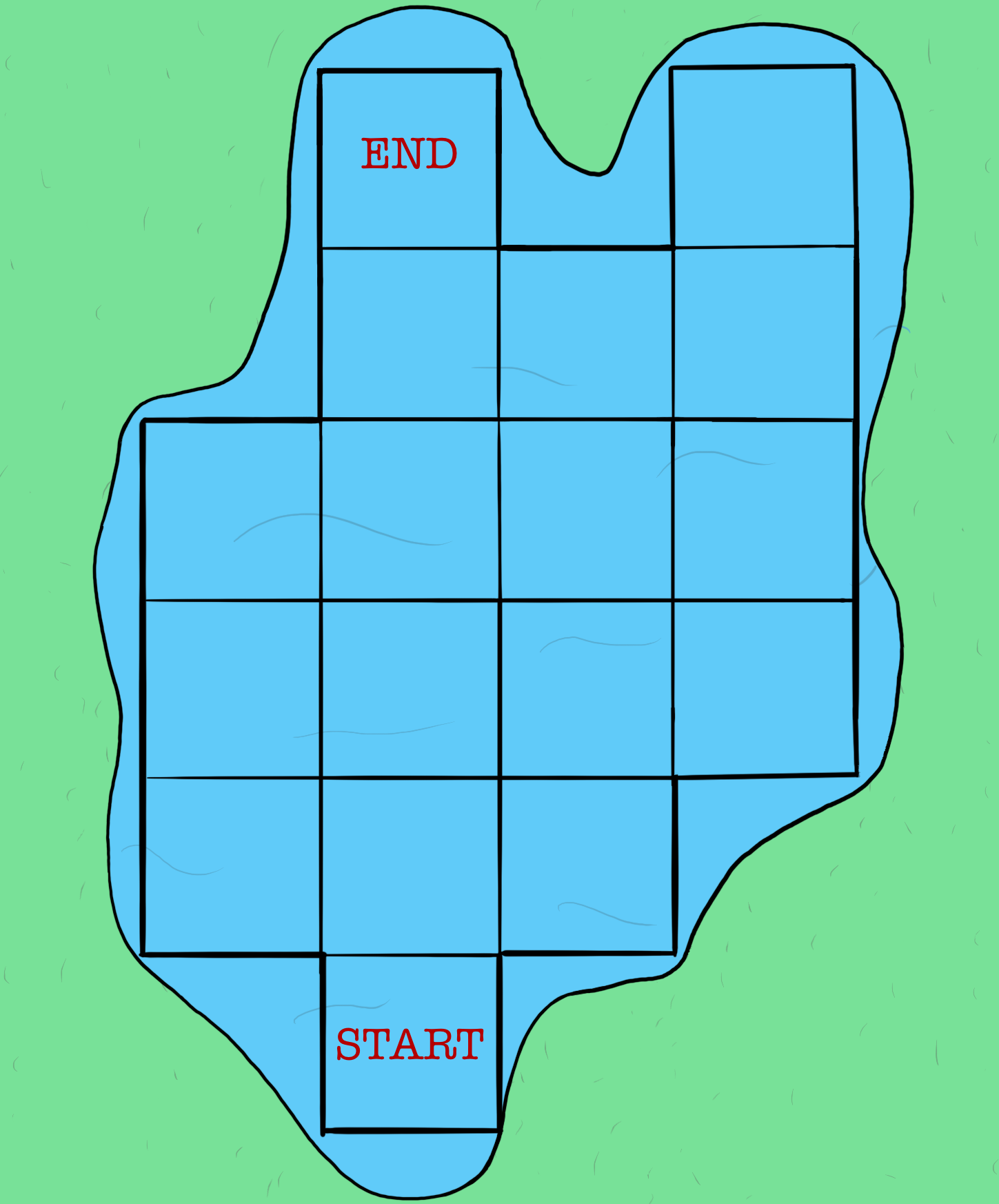
The detective has nearly made it to the town, but first he must cross a small pond (pictured below). But there's a problem! The pond is infested with alligators!
There are 2 alligators, to be exact. And they happent to exhibit a very strange behavior: Whenever the inspector moves, one alligator will move in his same direction, and the other will move in the opposite direcction.
Neither the alligators nor the detective's rowboat can leave the pond. The red alligator symbolizes the one that moves in the same direction as the detective, and the green alligator represents the one that moves opposite the detective. The detective is marked by the rowboat.
The detective is eaten is he is in or directly adjacent to a square containing an alligator (not including diagonals). Use the arrow keys to navigate the detective across the pond.
Can you get the detective from START to FINISH without being eaten?
The chief of police has interviewed several suspects, but unfortunately, their alibis didn't yield any helpful information.
However, Mr. Kane gave each of the suspects a chance to give up information about the other suspects.
Below is a list of the suspects, one of whom are lying, and their statements. Can you determine who the liar is?
A) B is telling the truth.
B) C and E are both telling the truth.
C) B is telling the truth.
D) A is lying.
E) D is lying.
The detective found a secret note hidden within professor Sterling's closet. It tells of a secret laboratory hidden inside his house, and contains clues as to the location of the entrance to the lab.
There are five rooms in the house, all in a single-file line, side-by-side. The are, in no particular order: the bedroom, the living room, the kitchen, the entry, and the study. One of them contains the entrance to the secret lab.
Can you figure out the location of the lab's entrance using the clues provided?
1. The bedroom and entry have one room in between them.
2. The living room is to the far right of the house.
3. The kitchen is directly adjacent to the living room, but not the study.
4. The entry is not to the far left of the house.
5. The room containing the lab's entrance is directly adjacent to the study but not the kitchen.
Finally, a promising lead! The only thing standing between it and the detective is a massive steel door with a combination lock.
Fortunately, professor Sterling left some clues as to the code. Can you guess the combination?
The code is 4 digits long, and each digit ranges from 1 to 5, and no digit is used twice.
Below, the colored marks next to each row of numbers indicates how similar that row is to the correct combination, in no particular order.
Each blue mark indicates a digit somewhere in that row that matches one in the solution, but is not in the correct position.
Each red mark indicates a digit that is in the correct position.
| 1 | 5 | 2 | 3 | |
| 5 | 2 | 1 | 4 | |
| 2 | 5 | 1 | 4 |
So close to finally uncovering the key to this whole case, detective Clay and Mr. Kane have located a chemical formula that will give some insight into professor Sterling's research.
Unfortunately, the professor encoded the recipe into a puzzle, so it wouldn't get into the wrong hands. Can you recreate the chemical?
There are two chemicals created from this reaction: the solution and the byproduct. Below are 7 ingredients, each with a different weight.
The weight of the solution will be a total sum of 29.
The weight of the byproduct will be a total of 30.
Combine the ingredients (labelled A-G) to create the solution and the byproduct. No ingredient will be used twice, and one will not be used at all.
The town has been rigged with a very large amount of explosives, set to detonate in just a few minutes! Luckily, the detective has located the bomb, and might be able to defuse it.
The bomb is made such that after cutting each wire, you are given instructions about which other wires you should or should not cut. To defuse the bomb, you must cut exactly two wires.
You must cut exactly two wires to defuse the bomb.
If you cut the red wire, you must also cut the green wire.
If you cut the blue wire, you must not cut the red wire.
If you cut the green wire, you must cut the yellow wire as well, but must not cut the white wire.
If you cut the yellow wire, you must cut the blue wire, too.
If you cut the white wire, you must cut the yellow wire.
Which wires do you cut?
Alert message.