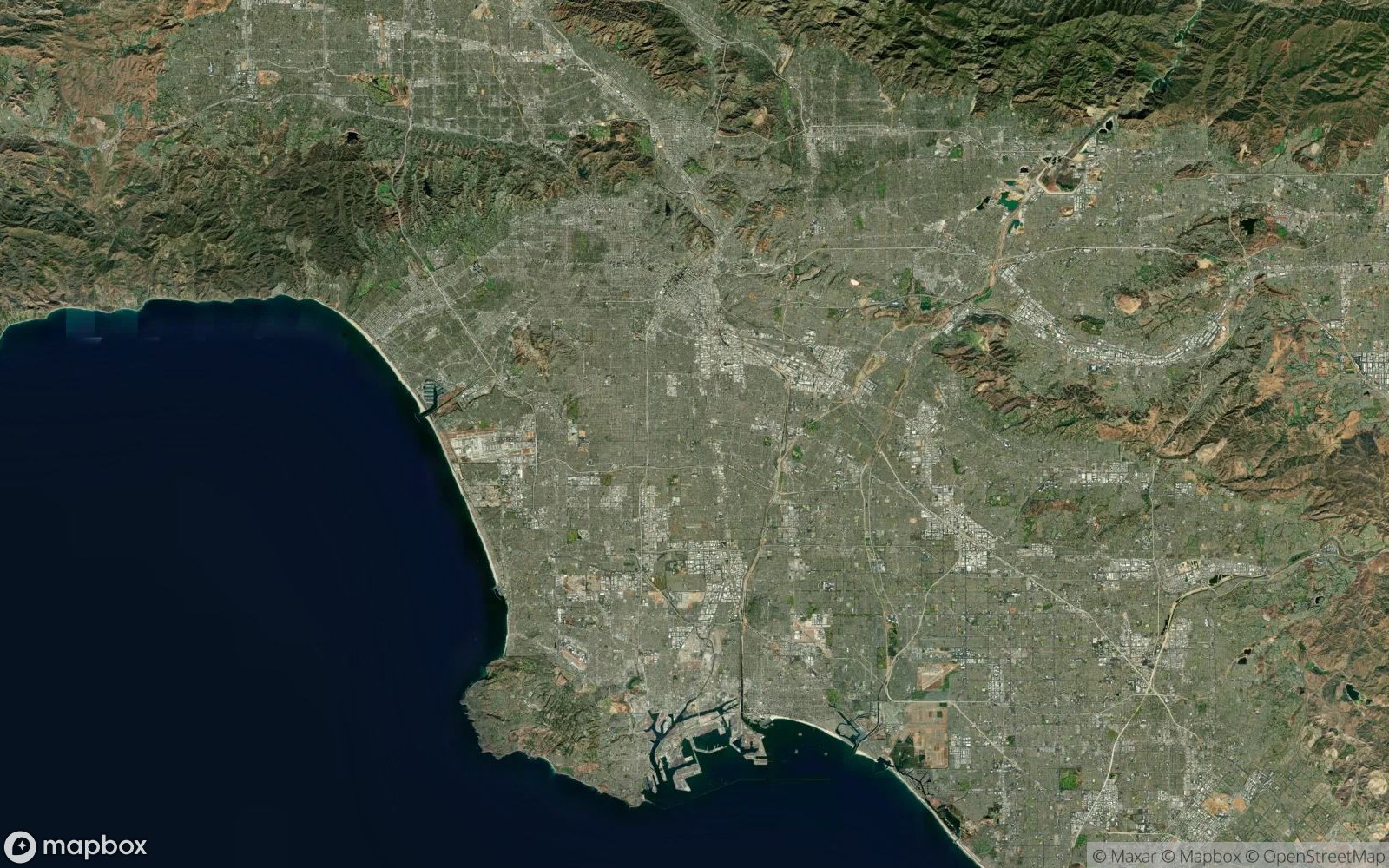
About Los Angeles
Los Angeles (LA) is the most populous city in the U.S. state of California, and the commercial, financial, and cultural center of Southern California. With an estimated 3.88 million residents within the city limits as of 2024, it is the second-most populous city in the United States, behind New York City. Los Angeles has an ethnically and culturally diverse population, and is the principal city of a metropolitan area of 12.9 million people (2024). Greater Los Angeles, a combined statistical area that includes the Los Angeles and Riverside–San Bernardino metropolitan areas, is a sprawling metropolis of over 18.5 million residents. The majority of the city proper lies in the Los Angeles Basin adjacent to the Pacific Ocean in the west and extending partly through the Santa Monica Mountains and north into the San Fernando Valley, with the city bordering the San Gabriel Valley to its east. It covers about 469 square miles (1,210 km2), and is the county seat and most populated city of Los Angeles County, which is the most populous county in the United States with an estimated 9.86 million residents as of 2022. It is the third-most visited city in the U.S. with over 2.7 million visitors as of 2023. The area that became Los Angeles was originally inhabited by the indigenous Tongva people and later claimed by Juan Rodríguez Cabrillo for Spain in 1542. The city was founded on September 4, 1781, under Spanish governor Felipe de Neve, on the village of Yaanga. It became a part of the First Mexican Empire in 1821 following the Mexican War of Independence. In 1848, at the end of the Mexican–American War, Los Angeles and the rest of California were purchased as part of the Treaty of Guadalupe Hidalgo and became part of the United States. Los Angeles was incorporated as a municipality on April 4, 1850, five months before California achieved statehood. The discovery of oil in the 1890s brought rapid growth to the city. The city was further expanded with the completion of the Los Angeles Aqueduct in 1913, which delivers water from Eastern California. Los Angeles has a diverse economy with a broad range of industries. Despite a steep exodus of film and television production since the COVID-19 pandemic, and despite Hollywood’s fading relevance in American culture, the historical nickname “Tinseltown” is still occasionally noted, and the city is also an important site in the history of film. It has one of the busiest container ports in the Americas, and despite a business exodus from downtown Los Angeles, the city's urban core is evolving as a cultural center with the world's largest showcase of architecture designed by Frank Gehry. In 2018, the Los Angeles metropolitan area had a gross metropolitan product of over $1.0 trillion, making it the city with the third-largest GDP in the world, after New York and Tokyo. Los Angeles hosted the Summer Olympics in 1932 and 1984, and will also host in 2028.
On September 4, 1781, a group of 44 settlers known as "Los Pobladores" founded the pueblo (town) they called El Pueblo de Nuestra Señora la Reina de los Ángeles, 'The Town of Our Lady the Queen of the Angels'. The original name of the settlement is disputed; the Guinness Book of World Records rendered it as "El Pueblo de Nuestra Señora la Reina de los Ángeles del Río Porciúncula"; other sources have shortened or alternate versions of the longer name. The local English pronunciation of the name of the city has varied over time. A 1953 article in the journal of the American Name Society asserts that the pronunciation lawss AN-jəl-əs was established following the 1850 incorporation of the city and that since the 1880s the pronunciation lohss ANG-gəl-əs emerged from a trend in California to give places Spanish, or Spanish-sounding, names and pronunciations. In 1908, librarian Charles Fletcher Lummis, who argued for the name's pronunciation with a hard g (), reported that there were at least 12 pronunciation variants. In the early 1900s, the Los Angeles Times advocated for pronouncing it Loce AHNG-hayl-ais (), approximating Spanish [los ˈaŋxeles], by printing the respelling under its masthead for several years. This did not find favor. Since the 1930s, has been most common. In 1934, the United States Board on Geographic Names decreed that this pronunciation be used by the federal government. This was also endorsed in 1952 by a "jury" appointed by Mayor Fletcher Bowron to devise an official pronunciation. Common pronunciations in the United Kingdom include loss AN-jil-eez, -iz, -iss. Phonetician Jack Windsor Lewis described the most common one, , as a spelling pronunciation based on analogy to Greek words ending in -es, "reflecting a time when the classics were familiar if Spanish was not".